
The Real Cost Structure Nobody Shows You at Onboarding
Kill the myth that quick commerce is a simple 10–15% commission play. It is not.
On Blinkit, commission ranges 8–20% by category. Add 18% GST on the commission itself, a $0.09/unit inwarding fee, a $0.12–$0.36/unit fulfilment fee, and the $300/SKU/city-cluster PLA fee. On a $6 product, total platform cost lands at $1.20–$2.10 (20–35%). That is before you spend a dollar on growth.
On Zepto, commission sits at 15–22% with 1.5–2% payment processing. Optional visibility spend runs 5–12% on top. Total cost on a $6 product: $1.08–$1.80 (18–30%). Marginally better for some categories, but Zepto's dark store network is more concentrated — fewer pin codes per SKU than you expect.
On Swiggy Instamart, commission mirrors Blinkit at 15–25%, optional marketing fee 5–15%. Registration runs 7–14 days after application, but commercial terms drag onboarding to 30+ days in contested categories.
| Fee Component | Blinkit | Zepto | Swiggy Instamart |
|---|---|---|---|
| Commission | 8–20% | 15–22% | 15–25% |
| GST on Commission | 18% of commission | 18% of commission | 18% of commission |
| Inwarding Fee | $0.09/unit | Platform-absorbed | Platform-absorbed |
| Fulfilment Fee | $0.12–$0.36/unit | Included | Included |
| Visibility Spend | 5–15% (optional) | 5–12% (optional) | 5–15% (optional) |
| Total Bleed on $6 Product | $1.20–$2.10 (20–35%) | $1.08–$1.80 (18–30%) | $1.20–$2.10 (20–35%) |
If your gross margin is 45%, you are left with 10–25% net after platform fees — before logistics to the dark store, COGS increases, or returns. A brand on a thin gross margin can go cash-flow negative within weeks of going live if it skips this math.
Why "List on All Three Platforms" Is a Trap
Every growth consultant will tell you to list on all three. Frankly, that advice works for $12M+ FMCG companies. It will wreck a D2C brand doing $36,000–$96,000 per month.
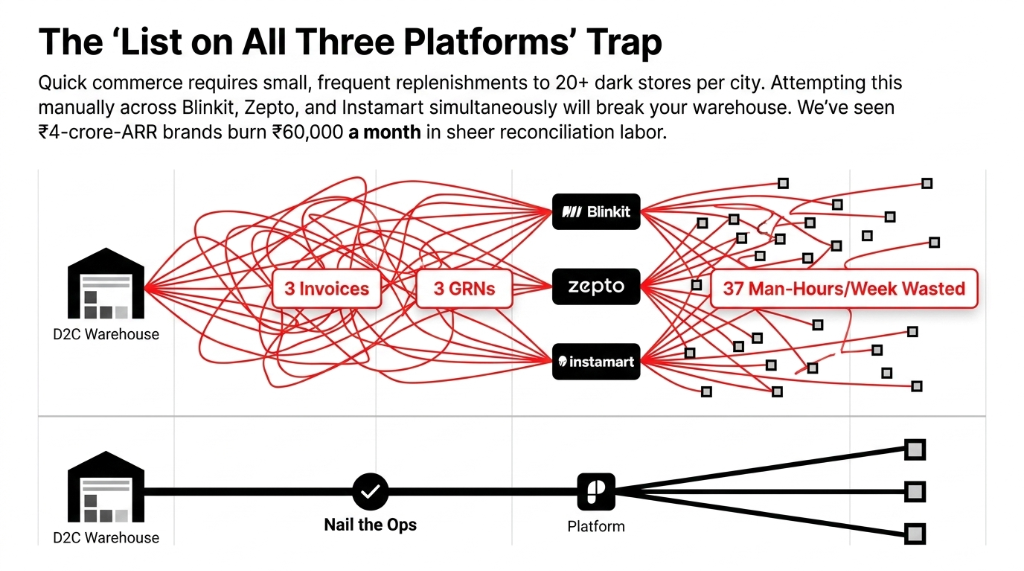
Quick commerce requires small, frequent inventory replenishments to dark stores — not bulk shipments to one central warehouse. In cities like Bengaluru and Delhi, you may need to service 20–30 dark stores per city simultaneously. Each platform has different delivery slot windows, different invoice formats, different documentation requirements, and different rejection criteria.
The 37-Hour Weekly Reconciliation Burn
Without an automated inventory management layer, your warehouse team manually generates 3 sets of invoices, reconciles 3 GRN processes, and manages returns from 3 separate platforms. That reconciliation work grows with every platform and every dark-store cluster you add, and the labour cost rarely shows up as its own line in the P&L.
Start with one platform. Nail the ops. Then expand.
The Dark Store Inventory Problem Every Brand Underestimates
This is the one that kills your ranking before you know it is happening.
Algorithmic Stockout Penalties
Quick commerce platforms algorithmically penalise stockouts. If a dark store runs out of your SKU three times in a week, your product drops in search ranking for that pin code — sometimes permanently until you rebuild velocity. Zepto's AI-driven demand forecasting pre-stocks dark stores based on hyperlocal purchase patterns. Their system already knows what your pin code will order on a Tuesday evening. If your replenishment cadence is weekly, you will miss those demand windows.
The Fix: Automated Velocity-Based Replenishment
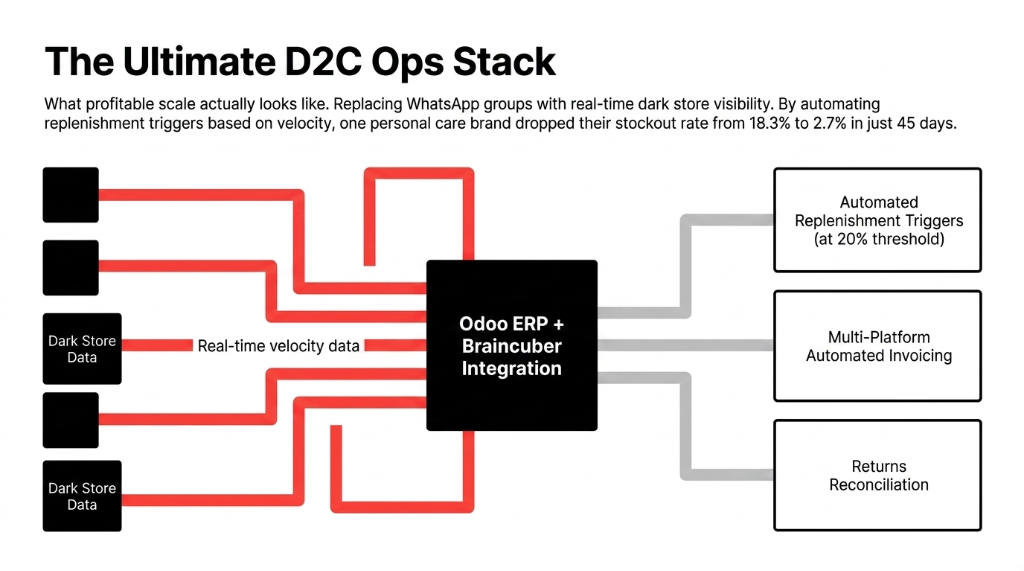
We implemented Odoo ERP with a Blinkit-integrated inventory module for a D2C personal care brand in Pune. Their stockout rate dropped from 18.3% to 2.7% within 45 days — purely by automating reorder triggers based on dark store velocity data. That is not magic. That is replacing a spreadsheet with a system that does not sleep.
The Swiggy Instamart Private Label Problem Nobody Talks About
Here is the uncomfortable truth the Swiggy partnership team will not mention on the onboarding call.
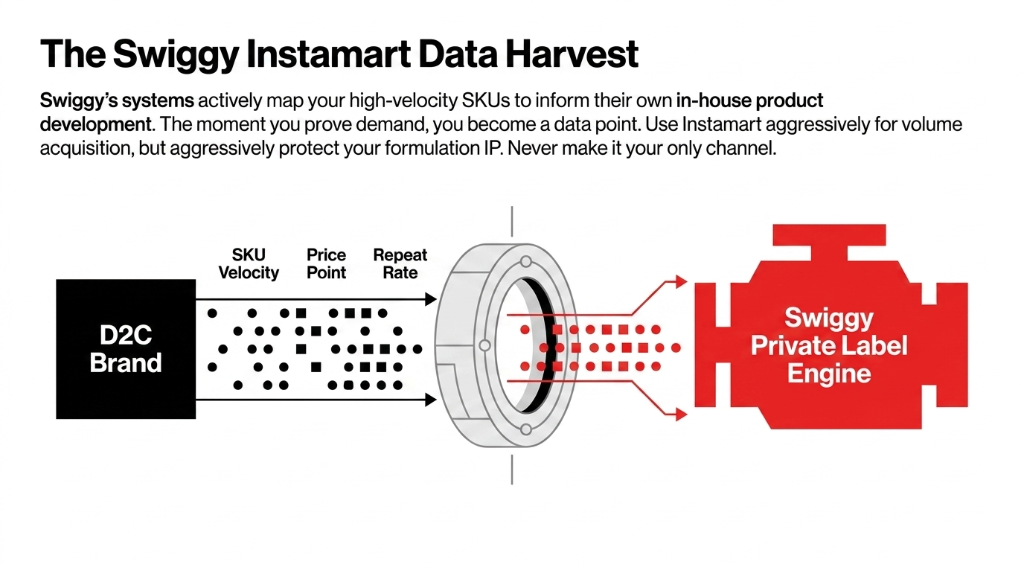
You list on Swiggy Instamart. You pay commission. You pay for sponsored listings. You run promotions. And in the background, Swiggy's system is recording your exact best-selling SKU, your sales velocity, your price point, and your repeat purchase rate.
Swiggy runs its own private label products. The moment your D2C SKU demonstrates strong demand, you become a data point for their own product development. Founders across snacks, beverages, and personal care categories have flagged this publicly.
What This Means for Your Brand
This does not mean avoid Instamart. It means never make Instamart your only quick commerce channel and protect your formulation IP aggressively. Use it as a volume acquisition tool, not your primary revenue channel.
How to Set Up Quick Commerce Ops Without Losing Your Shirt
Here is what the first 90 days should look like:
The 90-Day Quick Commerce Launch Playbook
Weeks 1–2: Unit Economics First
Calculate net margin after: commission + GST on commission + fulfilment + inwarding + at least 8% visibility spend. If the number is below 12% net, do not proceed until you adjust MRP.
Weeks 3–4: Pick ONE Platform
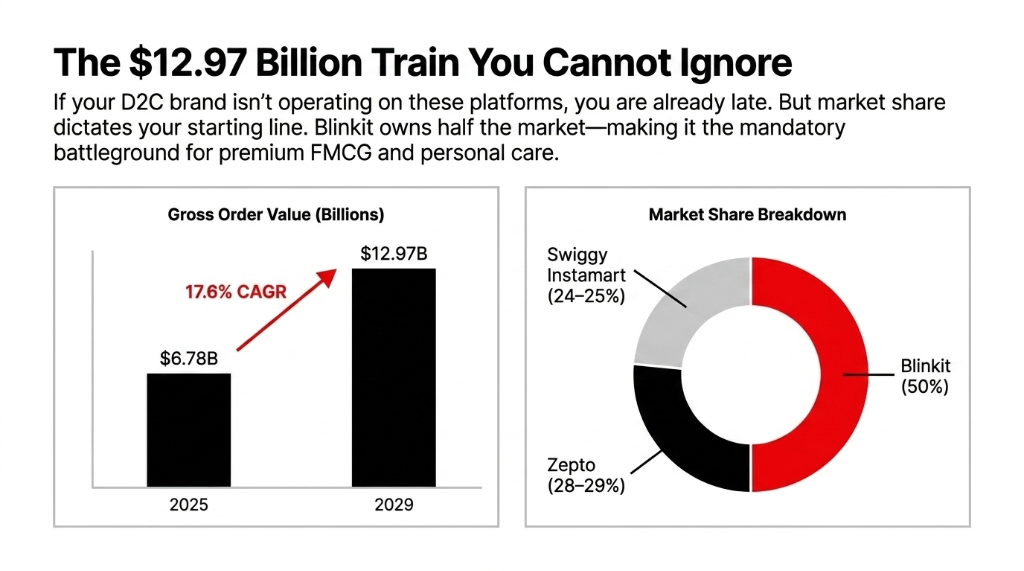
Blinkit for personal care and premium FMCG (50%+ market share). Zepto for snacks and fast-repeat SKUs (AI-driven local demand prediction = faster velocity ramp). Swiggy Instamart for brands already on Swiggy's food ecosystem.
Weeks 5–8: Integrate Before Go-Live
Get your WMS or ERP integrated with the platform's inventory API before go-live — not after. Blinkit's onboarding alone takes 30–60 working days, giving you exactly enough time to fix your back-end ops.
Weeks 9–12: Contained Geography
Start with 2–3 pin codes per city, not the entire metro. Nail fulfilment speed, zero-stockout rate, and return minimisation before scaling to 20+ dark stores.
Blinkit vs Zepto vs Swiggy Instamart: Which Platform Fits Your Brand?
| Criteria | Blinkit | Zepto | Swiggy Instamart |
|---|---|---|---|
| Market Share | 50%+ | 28–29% | 24–25% |
| Best For | Premium FMCG, personal care | Snacks, beverages, fast-repeat | Brands on Swiggy food ecosystem |
| Onboarding Time | 30–60 working days | 14–21 days (approx.) | 7–14 days verification |
| Commission Range | 8–20% + GST | 15–22% | 15–25% |
| Dark Store Coverage | 2,000 dark stores target | Dense urban, hyperlocal AI | Nationwide via Swiggy infra |
| Private Label Risk | Low | Low | Medium–High |
The Ops Stack You Need to Run This Profitably
Running quick commerce at any meaningful scale — say, $18,000–$60,000 GMV per month across 2 platforms — requires four things working in sync:
What Odoo ERP Handles Out of the Box
▸ Real-time inventory visibility at dark store level — no more guessing what stock sits where across 20+ locations
▸ Automated replenishment triggers at 20% stock threshold based on sales velocity — purchase orders fire automatically
▸ Multi-platform invoice generation without manual entry — Blinkit, Zepto, Instamart formats handled natively
▸ Returns reconciliation that matches to the penny across all three platforms simultaneously
(A WhatsApp group and a Google Sheet can carry this at low volume. They stop working once orders, SKUs and dark stores multiply across three platforms.)
If your current ops stack cannot tell you the real-time inventory level at a specific Zepto dark store in Koramangala while you are reading this, you have a gap that is costing you money every hour.
Frequently Asked Questions
Which platform should a new D2C brand launch on first?
Start with the platform where your category has highest search density. For personal care and premium FMCG, Blinkit's 50%+ market share gives better volume. For snacks and fast-repeat products, Zepto's AI-driven local stocking gives faster velocity ramp. Never start on all three simultaneously.
What is the actual total cost of selling on Blinkit?
Commission (8–20%), 18% GST on commission, $0.09/unit inwarding, $0.12–$0.36/unit fulfilment, and $300/SKU/city-cluster PLA fee. On a $6 product, total platform cost typically lands between $1.20–$2.10 (20–35% of MRP) before external logistics.
How do you prevent stockouts across multiple dark stores?
Use a WMS or ERP with real-time inventory sync and automated reorder thresholds calibrated to each dark store's sales velocity. Manual tracking fails above 10 dark stores. Platforms algorithmically penalise stockouts with ranking drops — recovery takes 2–3 weeks.
How long does it take to go live on Blinkit vs Swiggy Instamart?
Blinkit's end-to-end onboarding takes 30–60 working days. Swiggy Instamart verification takes 7–14 days, but commercial terms can drag to 30+ days in contested categories. Having FSSAI, GST, trademark, and product images ready upfront cuts this significantly.
Is Swiggy Instamart safe for brands with proprietary formulations?
Use it for volume acquisition, but protect your IP externally. Instamart collects granular sales data and operates its own private-label lines. Brands in snacks and personal care have reported high-velocity SKUs being replicated. Diversify across platforms and never rely on Instamart as your sole channel.
Your Margins Are Not a Pricing Problem. They Are an Operations Problem.
If you are on Blinkit, Zepto, or Swiggy Instamart right now without real-time dark store visibility, automated replenishment, and per-platform P&L reconciliation — you are leaking money every single day. Book our free 15-Minute Operations Audit. We will pinpoint your biggest quick commerce ops leak on the first call.