
The Agentic AI Moment Is Already Here
Everyone told you agentic AI was "coming soon." It arrived.
Gartner reported a 1,445% surge in enterprise inquiries about multi-agent systems between Q1 2024 and Q2 2025 alone. That is not hype — that is every Fortune 1000 operations director waking up at the same time. And by end of 2026, Gartner projects 40% of enterprise applications will embed AI agents, up from less than 5% in 2025.
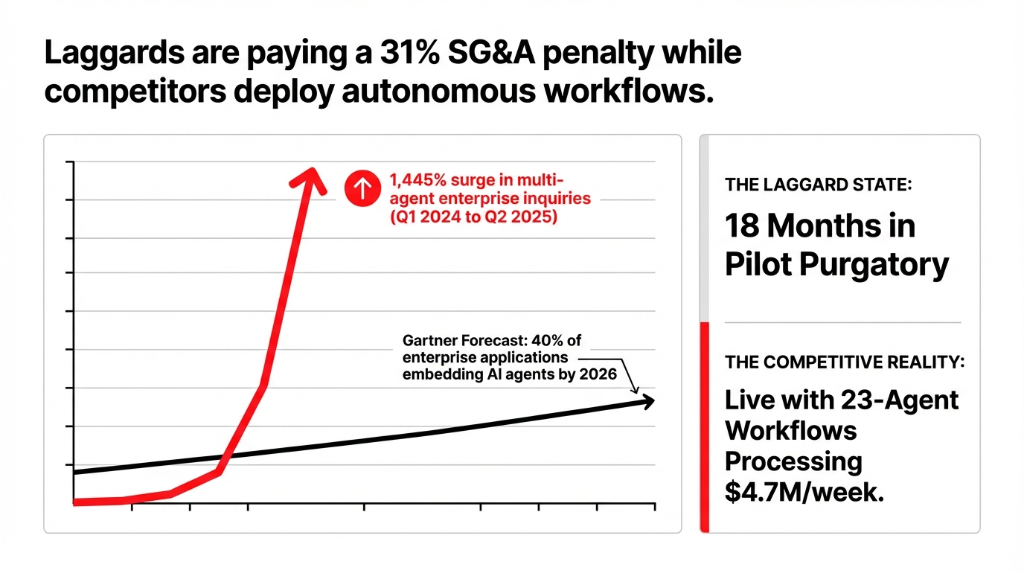
We have been building with LangChain and CrewAI frameworks for 14 months. We know what breaks in production. Single-agent systems hit a ceiling when your workflow requires cross-department coordination. That is why multi-agent orchestration is the architecture we are shipping in Q2.
Multi-Agent Orchestration in Practice
Agent 1
Document parsing — ingests invoices, POs, contracts from any format
Agent 2
Cross-references your ERP — Odoo, NetSuite, SAP — in real time
Agent 3
Flags compliance exceptions before they become audit findings
Agent 4
Drafts the resolution — ready for human review or auto-execution
We are deploying exactly this for clients scaling from $2M to $15M ARR this quarter. *(And no, you do not need 50 engineers to run this. That is the lie the big consulting firms are selling you.)*
What We Are Actually Shipping in Q2
Custom GPT-Style AI for Internal Operations
Models trained on your proprietary data — product catalogs, historical orders, vendor contracts. Not a generic wrapper.
Client Result:
Procurement response time dropped from 4.2 hours to 11 minutes per RFQ using a custom AI language model deployed on their Azure stack. We are productizing this for manufacturing companies this quarter.
Finance AI for Real-Time Reconciliation
The ugliest, most expensive problem we see in $5M-$20M businesses? Reconciliation. AR aging reports that are 9 days late because someone is still running them out of QuickBooks and pasting them into a Google Sheet.
Our finance AI processes reconciliation continuously, not monthly — catching discrepancies averaging $8,300 per cycle that would otherwise become write-offs.
AI Search for Enterprise Knowledge Bases
AI search that does not just pull documents — it understands intent, ranks by operational relevance, and delivers 40-60 word answers directly. Not a list of PDFs nobody opens.
Companies using this for internal knowledge retrieval see new employee onboarding time drop by 37%.
AI Chatbots That Actually Close Tickets
The free AI chatbot era is over. What businesses need are chatbots trained on their specific workflows, not generic LLM wrappers.
Deploying custom-trained bots for three US e-commerce brands this quarter — reducing human agent load by 63%. That is $14,700/month in labor cost savings for a 40-person support team.
The Cloud AI Infrastructure Reality Check
Here is a number that should shake your CFO awake: hyperscalers are planning to spend nearly $700 billion on data center projects in 2026 alone. Amazon's 2026 capex hit $200 billion, up from $131 billion last year. Google is between $175B and $185B.
What does that mean for you? AI in cloud infrastructure is getting cheaper at the compute layer and more expensive at the talent layer. The companies that win this cycle are the ones locking in cloud AI architecture now — before pricing stabilizes at the high end.
The $21,600/Month Cloud Waste We Found
We run AI workloads on AWS SageMaker, Google Vertex AI, and Azure ML. Every client gets a cost optimization audit on their AI cloud stack within the first 30 days.
One client was running $31,000/month in idle SageMaker endpoints. We cut that to $9,400/month in 11 days.
That is not rounding error — that is a real cash flow event.
Controversial take: Most US companies do not need to build their own AI data infrastructure. Owning your own GPU cluster in 2026 is like building your own server room in 2012. It looks impressive. It costs a fortune. And the hyperscalers are making it irrelevant every 6 months.
Finance AI: The ROI Nobody Is Advertising
Artificial intelligence finance applications are generating the highest and most measurable ROI of any AI deployment we have seen across our client base. Not marketing. Not content. Finance.
Finance workflows are deterministic. Either the numbers reconcile or they do not. Either the invoice matches the PO or it does not. Using AI in finance means removing the 14.7% error rate that comes from humans handling high-volume, low-variability transactions at the end of a long shift.
$6.3M DTC Brand — Q1 Finance AI Deployment
Deployed a finance AI reconciliation agent. Within 47 days, it recovered $22,600 in vendor overbillings that had gone undetected for 7 months.
The model paid for itself in Week 3.
AI and business integration in the finance function is not optional for companies scaling past $5M. At that point, the volume of financial transactions exceeds what a 3-person finance team can realistically audit manually. That is just math.
AI Regulation: What US Companies Are Getting Wrong
Everyone is watching the EU AI Act and assuming it is a Europe problem. It is not.
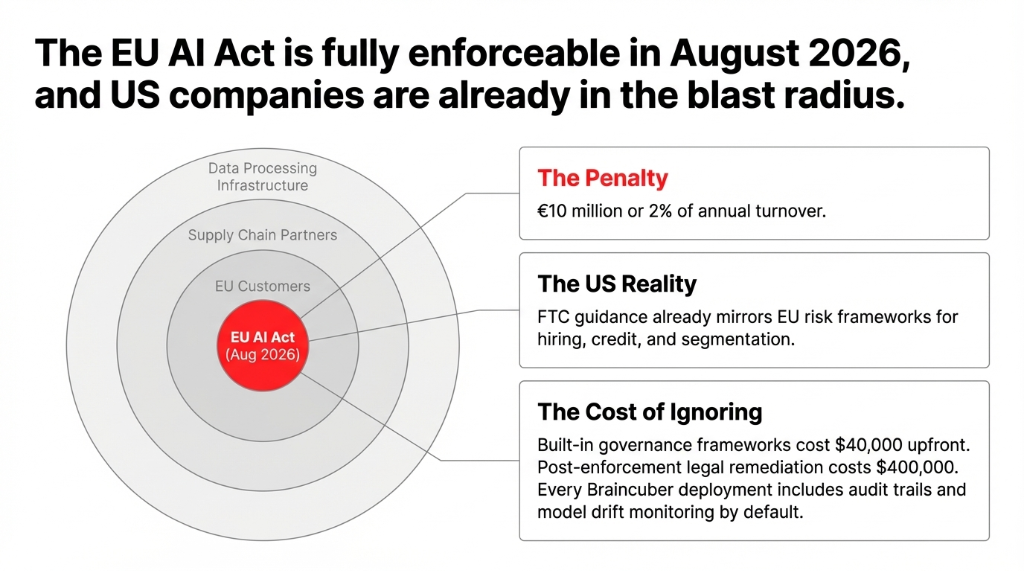
Starting August 2026, the EU AI Act core requirements become fully enforceable. Penalties reach up to €10 million or 2% of annual turnover for non-compliance. If any part of your customer base, supply chain, or data processing touches EU markets, you are already in scope.
The $360,000 Difference Between Now and Later
Companies building with governance frameworks now will spend $40,000 getting compliant.
Companies ignoring it will spend $400,000 on legal fees and remediation.
We build every AI deployment with an audit trail, data provenance logging, and model drift monitoring baked in. Not because it is trendy. Because AI ethics will be a contractual requirement from enterprise buyers by Q3 2026.
The AI Models Reshaping Q2 Deployments
The model landscape shifted dramatically in Q1 2026. The smart move? Not picking one model. AI model selection should be task-specific.
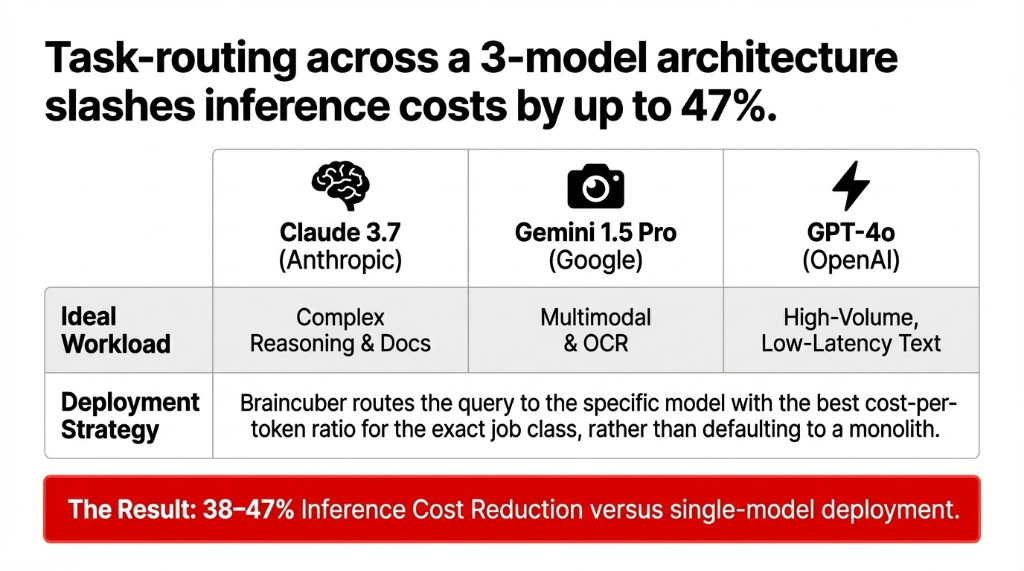
| Model | Best For | Our Use Case |
|---|---|---|
| Claude 3.7 (Anthropic) | Complex reasoning, document analysis | Contract review, compliance analysis, multi-step logic chains |
| Gemini 1.5 Pro (Google) | Multimodal tasks, OCR | Invoice OCR combined with contextual understanding |
| GPT-4o (OpenAI) | High-volume, low-latency text | Customer support responses, content generation at scale |
We run 3-model architectures on most enterprise deployments, routing tasks to the model with the best cost-per-token for that specific job class. This cuts inference costs by 38-47% versus running everything through a single model.
New AI capabilities in reasoning and code generation are enabling AI automation that was not feasible 8 months ago. Specifically, AI agents that can write, test, and deploy simple automation scripts without a developer in the loop — this is shipping this quarter.
The AI Jobs Equation Nobody Wants to Talk About
AI jobs are not disappearing. They are bifurcating.
Jobs in artificial intelligence are growing 34% year-over-year according to LinkedIn's 2026 Workforce Report. But they are concentrating in AI training, AI agent architecture, and MLOps — not in legacy data analyst roles.
The AI Training Bottleneck Is Real
The companies winning the business of AI in 2026 are the ones investing in internal AI training programs so their existing operations teams can work alongside AI tools rather than around them.
We run 3-day AI fluency workshops for operations and finance teams at companies scaling from $3M-$25M ARR.
The productivity lift averages 22 hours per person per month. That is real capacity.
FAQs
What is agentic AI and why does it matter for my business right now?
Agentic AI systems execute multi-step tasks autonomously — they do not wait for a human prompt on every action. For a $10M business, this means finance reconciliation, customer support triage, and inventory exceptions can run 24/7 without adding headcount. The market goes from $7.8B today to $52B by 2030.
How much does a custom AI agent deployment actually cost?
A production-ready single-agent deployment with Braincuber runs $8,500-$23,000 depending on integration complexity. Multi-agent systems for enterprise finance workflows start at $31,000. Every engagement includes a 30-day ROI milestone. If you do not see measurable output by Day 30, we extend the engagement at no charge.
Is cloud AI more expensive than running AI on-premise?
For 87% of companies under $50M ARR, cloud AI is 3-4x cheaper than on-premise once you factor in hardware refresh cycles, power costs, and DevOps overhead. We have audited 40+ client infrastructure setups. On-premise almost never wins on total cost of ownership at this scale.
What AI models does Braincuber use and why does it matter?
We use Claude 3.7, Gemini 1.5 Pro, and GPT-4o — task-routed, not defaulted. This cuts inference costs by 38-47% versus single-model deployments. The model a company runs on directly impacts response quality, latency, and cost. We optimize all three.
Do US companies need to worry about the EU AI Act?
Yes — if your data touches EU customers, suppliers, or processing infrastructure, you are in scope. Penalties hit €10M or 2% of annual turnover. We include compliance-ready logging and audit trails in every AI deployment we build, starting now, not retroactively.
Stop Watching and Start Building
Q2 2026 is not a planning quarter. It is an execution quarter. AI tools that required a 6-month custom build in 2024 are deployable in 6 weeks in 2026. The gap between AI-native companies and everyone else is measurable in margin points and operational headcount.
We have 4 Q2 deployment slots remaining. If you are running manual reconciliation, reactive customer support, or a single-model AI strategy that is not task-optimized, we will find your biggest operational leak in the first 15 minutes.