
Agentic AI Stopped Being a Buzzword
This is the single biggest shift from Q1 to Q2 2026, and if you missed it, pay attention.
Agentic AI stopped living in whitepapers and entered production environments at scale. According to Gartner, 40% of enterprise applications will embed AI agents by the end of 2026 — up from less than 5% in 2025. That is not gradual adoption. That is a wall.
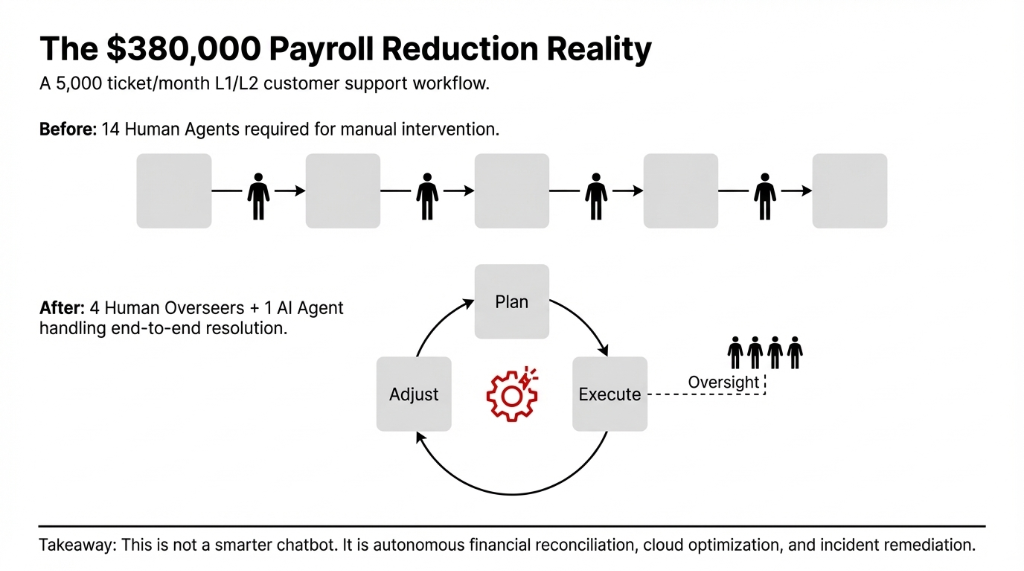
What changed? The architecture matured. AI agents built on frameworks like LangChain and CrewAI can now execute multi-step tasks — planning, executing, reviewing, adjusting — without waiting for a human to click "approve" at every step. We are not talking about a smarter chatbot. We are talking about agents artificial intelligence systems that handle financial reconciliation, autonomous cloud cost optimization, and security incident remediation with zero constant human supervision.
The Ugly Truth Most Vendors Will Not Tell You
The companies deploying agentic AI are not using it to "help employees." They are using it to replace workflows. A customer support team that needed 14 agents to handle 5,000 tickets/month is now running the same volume with 4 humans overseeing an AI agent that handles L1 and L2 resolutions end-to-end.
That is a $380,000/year payroll reduction. The brands still running pilots? They will need 6 more months to catch up.
The $690B AI Data Center Bet — And What It Means for You
Let us talk about the AI infrastructure arms race, because it directly affects the ai tools you will have access to — and their price.
The five largest US cloud and AI infrastructure providers — Microsoft, Alphabet, Amazon, Meta, and Oracle — collectively committed to spending between $660 billion and $690 billion on capital expenditure in 2026, nearly doubling their 2025 levels. Amazon alone is projecting $200 billion in 2026 capex, up from $131 billion last year. Google sits close behind at $175–$185 billion.
The AI Infrastructure Numbers
$4B+ Per Facility
A single 100-megawatt AI data center costs more than $4 billion, including AI chips. About 70% of that goes to servers and graphics processors.
Supply-Constrained
Every hyperscaler is reporting that their markets are supply-constrained, not demand-constrained. They cannot build these data centers fast enough to meet what enterprises are asking for.
New AI Chips Coming
ASIC-based accelerators, chiplet designs, and analog inference hardware are entering production. IBM predicts a new class of chips specifically for agentic workloads could emerge before the end of 2026.
What does this mean for your ai platform decisions? Compute costs are temporarily elevated but will drop as capacity comes online in late 2026 and 2027. If your ai company partnership is locked into a single cloud vendor right now, you are paying a scarcity premium you do not have to.
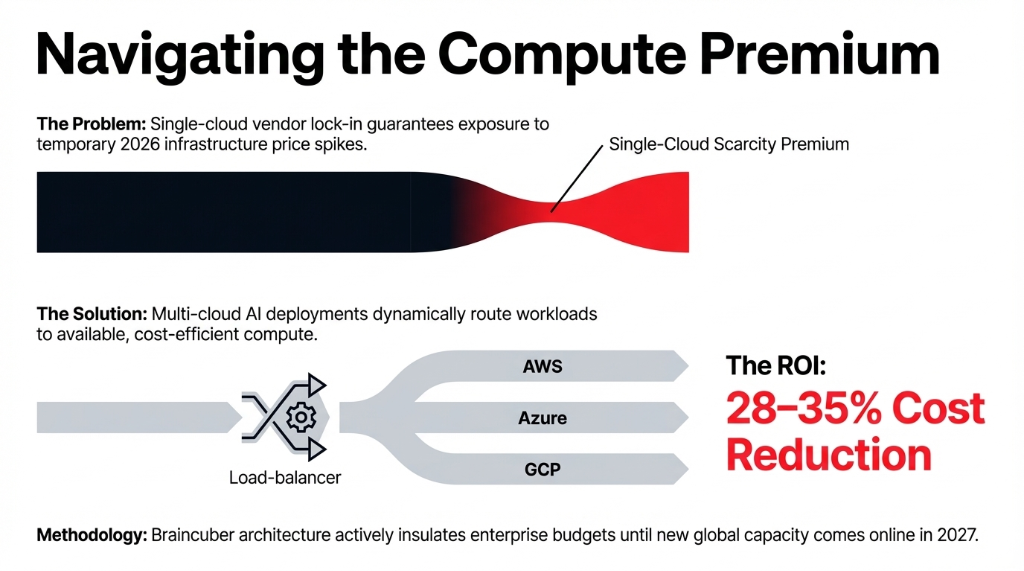
Multi-cloud AI deployments on AWS, Azure, and GCP — the model Braincuber uses for every client — insulate you from that premium by roughly 28–35%.
The LLM Wars: GPT AI, Claude, Gemini, and the New Open-Source Challengers
The large language models race in Q1–Q2 2026 delivered more model releases than most enterprises can track.
OpenAI's GPT-5.2, released in December 2025, features a 400,000-token context window and stronger agentic capabilities than any previous OpenAI GPT version. By Q2 2026, GPT models are embedded in enterprise copilots, developer tools, and customer-facing AI agents across industries. Claude 4, Gemini 2.5/3, Llama 4, and DeepSeek-V3.2 are the other ai models that enterprises are actually running in production — not just demoing.
What the AI Articles Will Not Say Clearly
GPT AI models from OpenAI are not the automatic best choice for every workflow. For specific domain tasks — legal document parsing, manufacturing quality control logs, healthcare triage — fine-tuned open-source models like Llama 4 and Mistral Large 3 outperform GPT-5.2 at 1/7th the inference cost. We have tested this directly across client deployments.
The shift toward ai language models that are domain-specific rather than general-purpose is the real ai trend of Q2 2026. Oracle is explicitly pushing "context-aware AI" — domain-specific artificial intelligence models that handle particular tasks rather than one-size-fits-all intelligence artificial intelligence systems.
| Model | Best For | Watch Out |
|---|---|---|
| GPT-5.2 | General-purpose enterprise copilots, 400K-token context | Highest per-token cost, vendor lock-in risk |
| Claude 4 | Long-form analysis, safety-critical workflows | Limited agentic tool-use maturity |
| Gemini 2.5/3 | Multi-modal tasks, Google ecosystem integration | GCP dependency for best performance |
| Llama 4 | Self-hosted, domain-specific fine-tuning, 1/7th GPT cost | Requires internal ML ops capability |
| DeepSeek-V3.2 | Cost-efficient inference, coding tasks | Data sovereignty concerns for US enterprises |
If your ai strategy still starts with "let us use ChatGPT for everything," that is the wrong starting point. The right question is: which model, at what cost, for which specific business process?
EU AI Act Enforcement: The Clock Is Running
If your business sells into the US market and touches EU customers — which describes most ai for enterprise operations at scale — the EU AI Act is no longer a future problem.
From 2026, the EU AI Act enforces strict transparency and accountability rules for all companies developing or deploying artificial intelligence within the EU. AI-generated images, ai generated content, and deepfakes must now be clearly labeled. Every AI company must disclose training data sources, respect copyright opt-outs, and maintain a full record of data origin.
The Penalties Are Real
Up to €10 million or 2% of annual turnover for failing to meet governance requirements. The deadline for high-risk AI system compliance assessments is August 2, 2026. That is four months away.
US-based ai software companies serving global clients are being forced to build compliance into their ai systems architecture — not bolt it on afterward. Laws on ai in the US remain fragmented, with no single federal framework yet, but the EU is setting the de facto global standard for ai regulation and ethical ai practice.
If you are building ai for businesses and your ai development team has not addressed compliance documentation, training data traceability, and output labeling by August 2026, you are not just risking fines. You are risking customer contracts with any enterprise that has EU exposure. Ethics in ai and ethics for ai are no longer philosophical debates. They are procurement checklist items.
AI in Manufacturing: The 800,000-Job Gap That AI Is Filling
The ai in manufacturing story of Q2 2026 is not about robots replacing workers. It is about a structural workforce crisis that machine learning and artificial intelligence are being used to solve.
The Manufacturing Workforce Crisis
800,000+ unfilled positions in the US manufacturing sector as of Q3 2025. 2.5 million manufacturing workers will retire by 2030.
60% of manufacturers report they cannot find skilled operators. That is not a hiring problem — it is a knowledge transfer crisis. When a 30-year machinist retires, their diagnostic instincts, pattern recognition, and judgment walk out the door with them.
Deloitte found that 80% of manufacturers are now allocating 20%+ of budgets to smart operations. Manufacturing and ai convergence is happening faster than any other sector vertical.
The ai technology running these workflows is not just ai automation for repetitive tasks. It is agentic ai making real-time quality decisions, flagging anomalies in production lines before a human supervisor could notice them, and optimizing shift scheduling based on live demand signals. Hyundai's Georgia facility is a clean example: extensive robotics, but 8,100 human workers whose roles shifted from repetitive assembly to oversight, troubleshooting, and improvement.
The ROI Math Is Direct
An AI-guided workflow tool that costs $180,000/year in implementation and licensing can prevent $1.1M in rework costs, reduce onboarding time from 14 months to 3 months, and fill knowledge gaps without a single new hire. For US manufacturers, this is not "nice to have" — it is how you keep the line running when 2.5 million workers retire by 2030.
What Q3 2026 Will Break Open
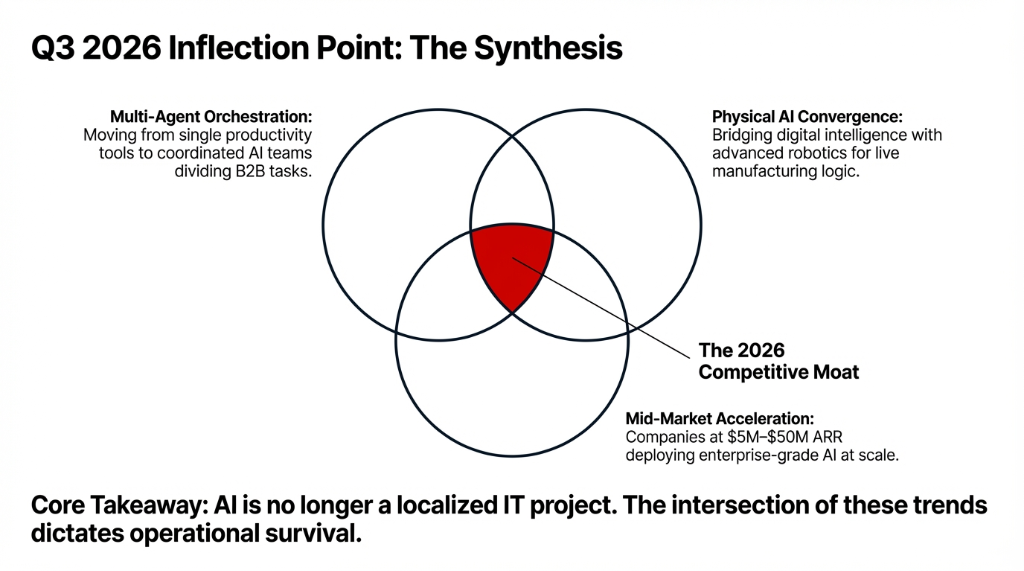
Artificial intelligence and ai are entering the phase where the gap between adopters and non-adopters becomes a competitive moat, not a gap you can close with a six-month project.
What We Are Watching for Q3 2026
Multi-Agent Orchestration
Not one AI agent, but coordinated teams of AI agents sharing context and dividing tasks — exactly the shift Kevin Chung at Writer described as AI moving from individual productivity to full workflow orchestration.
AI Regulation Tightens in the US
With the EU AI Act enforcement live, US legislators will accelerate federal AI governance frameworks — expect clarity on laws for ai by Q4 2026. Artificial intelligence regulation is no longer a hypothetical.
Physical AI Picks Up Momentum
Robotics and ai tech intersect as IBM's research team predicted, moving physical AI from hype into real manufacturing and logistics deployments. AI for industry becomes tangible.
Mid-Market Inflection Point
AI for companies at the mid-market level ($5M–$50M ARR) hits the inflection point — this is where Braincuber is seeing the most acceleration in project pipeline right now. Jobs in ai and careers in ai surge at this tier.
FAQs
What is agentic AI and why does it matter in 2026?
Agentic AI refers to autonomous AI systems that execute multi-step tasks — planning, acting, and adjusting — without constant human input. In 2026, they moved from pilots into production at scale, with Gartner projecting 40% of enterprise apps will include AI agents by year end, up from under 5% in 2025.
How much are companies spending on AI infrastructure in 2026?
The five largest US cloud providers — Microsoft, Amazon, Alphabet, Meta, and Oracle — collectively committed $660–$690 billion in capital expenditure in 2026, nearly double 2025 levels. Amazon alone is spending $200 billion, mostly on AI chips, servers, and data centers.
What does the EU AI Act mean for US businesses?
If you have EU customers or EU data exposure, the EU AI Act 2026 enforcement applies to you. Companies must label AI-generated content, disclose training data sources, and complete compliance documentation for high-risk AI systems by August 2, 2026, or face fines of up to €10 million.
Which AI language model should my company use in 2026?
There is no universal answer. GPT-5.2, Claude 4, Gemini 2.5, and Llama 4 each lead in different tasks. Domain-specific fine-tuned models often outperform GPT at 1/7th the cost for narrow workflows. The right choice depends on your specific process, data privacy requirements, and cost-per-inference budget.
How is AI changing manufacturing jobs in the US?
AI is not eliminating manufacturing jobs — it is filling an 800,000-position gap created by retirements and skills shortages. AI-guided workflows compress apprenticeship timelines from 14 months to 3 months and preserve retiring workers' institutional knowledge, making it possible to scale output without proportionally scaling headcount.
Stop Watching AI From the Sidelines While Your Competitors Deploy It.
Right now, your competitors are past the "evaluating" phase. They deployed agentic AI in Q1, locked in multi-cloud compute rates before the scarcity premium hit, and started EU AI Act compliance documentation while you were scheduling another internal alignment meeting. Book a free 15-minute AI Operations Audit with Braincuber Technologies — we will identify exactly where agentic AI, custom GPT models, or AI-powered Odoo ERP can cut your operational costs by 40–60% in the next 90 days.