
The Finance Team That Was Drowning in QuickBooks
A mid-size B2B distributor in Dallas — $4.3M ARR — came to us in January because their three-person finance team was spending 31 hours every week manually reconciling invoices across QuickBooks, a legacy ERP, and two supplier portals.
The controller was exporting CSV files, running VLOOKUPs in Excel, and cross-referencing PDFs by hand. Every month. Without fail.
The Ugly Truth
They had been leaking $17,800/month in undetected supplier overcharges and duplicate invoice payments for 14 months straight.
Nobody caught it because no one had 31 extra hours to actually audit the audit.
We deployed a finance AI pipeline using our Document AI layer — built on a custom AI language model fine-tuned for invoice parsing — on top of their existing AWS environment. The system ingests invoices, cross-checks against PO data, flags anomalies with 96.3% accuracy, and pushes exceptions directly into Slack with one-click approval.
Result After 11 Weeks
✓ Invoice reconciliation dropped from 31 hrs/week to 4 hrs/week
✓ $17,800/month in leakage recovered, starting in Week 6
✓ Finance team reassigned 27 hours per week to cash flow forecasting
(Yes, we know their accountant was skeptical. She sent us a thank-you note in Week 8.)
This is exactly why finance and AI are not a “nice to have” anymore for US businesses scaling past $2M ARR. It is a cash recovery operation disguised as a software upgrade.
The Manufacturer That Thought More Headcount Was the Answer
A precision parts manufacturer in Ohio — 87 employees, $9.7M annual revenue — told us in February that they needed to hire two more QC inspectors. Their defect rate had climbed to 11.4%, and their rework costs were running at $284,000 per year.
We told them hiring was not scaling. It was bloating.
AI in manufacturing does not require ripping out your existing line. We integrated a computer vision AI agent using our cloud AI infrastructure on GCP — connected directly to their line cameras — and paired it with a machine learning model trained on 14,000 historical defect images from their own production data.
The agent flags defects in real-time, assigns defect type codes, and updates their Odoo ERP automatically. No human in the loop for classification. Humans only handle the physical rework, which now represents 38% less volume.
Result After 9 Weeks
Before: 11.4% defect rate, $284,000/year in rework costs, hiring 2 more QC inspectors
After Braincuber AI Agent Deployment:
Defect rate: 11.4% dropped to 4.1%
Annual rework cost: $284,000 reduced to $102,000
New hires needed: Zero
Total Annual Savings: $182,000
The AI automation here was not magic. It was pattern recognition at a speed and consistency no human team can match at scale. The machine learning model improved its own accuracy by 4.2 percentage points in the first 60 days as it saw more live production data.
Companies that keep throwing headcount at quality problems are choosing a slow, expensive death. Using artificial intelligence to solve a problem that humans fundamentally cannot solve at line speed — that is the entire point.
The D2C Brand That Had Three “AI Tools” and Zero Results
An apparel brand in Los Angeles — $2.1M Shopify store — came to us in March absolutely done with free AI tools that promised everything and delivered nothing.
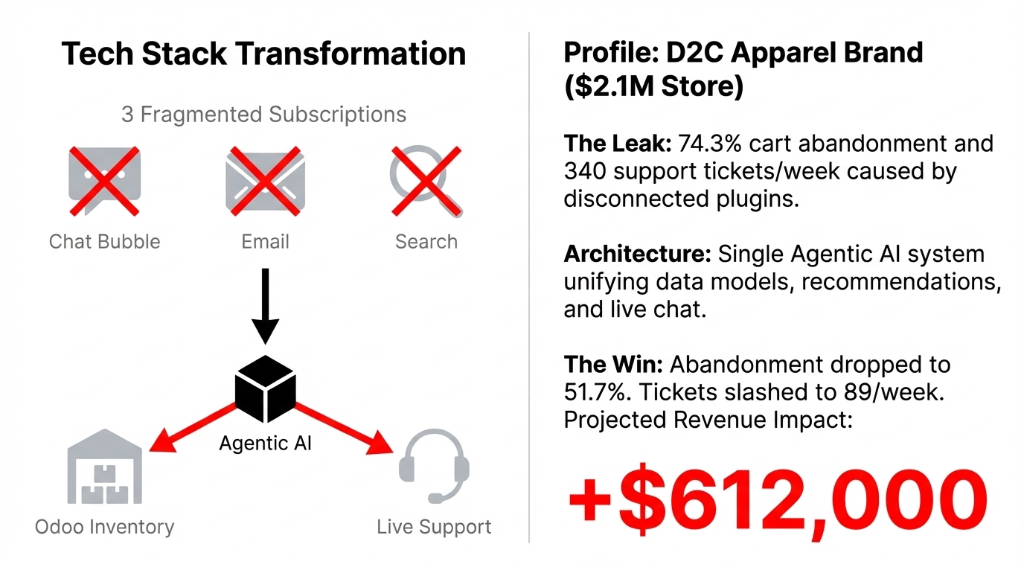
They had tried a free AI chatbot from their Shopify app store, a free artificial intelligence email tool, and a third-party AI search plugin — three separate subscriptions, zero integration, and a customer experience that felt like talking to a broken vending machine.
The Audit Results
Cart abandonment rate: 74.3%
Support tickets: 340 per week, handled manually
Product recommendation accuracy: wrong SKUs 61% of the time
Nobody tells you this about AI tools: throwing disconnected point solutions at an e-commerce stack is not an AI strategy. It is a monthly bill.
We rebuilt their AI layer from scratch — a single agentic AI system built on LangChain that handles product recommendations, live chat, and post-purchase support under one unified data model. The AI agent pulls real-time inventory from Odoo, reads customer purchase history, and personalizes every single touchpoint.
Result After 8 Weeks
✓ Cart abandonment dropped from 74.3% to 51.7%
✓ Support tickets dropped from 340/week to 89/week
✓ Average order value increased by $23.40 per transaction
Annual Revenue Impact: Projected +$612,000
The AI technology powering this is not some exotic new model. It is disciplined architecture — getting your data, your AI models, and your customer experience talking to each other instead of operating in three separate silos.
The Financial Services Firm That Finally Got Serious About AI and Cloud
A wealth management firm in New York with $220M AUM came to us nervous — and rightfully so. They had sensitive client data, strict compliance requirements, and a managing partner who had read every headline about AI regulation and the EU AI Act (even though they operate entirely in the US).
Their ops team was manually generating 180+ client reports per month in Word. Their AI ethics concern was legitimate: they did not want AI generated content going to clients without human review.
We built a cloud AI infrastructure on Azure — fully private, no data leaving their tenant — using a GPT AI workflow that drafts reports from structured data, flags compliance-sensitive language using an AI models classifier, and requires mandatory human sign-off before any output reaches a client.
Result After 12 Weeks
Before: 3.5 hours per report, 180 reports/month = 630 total hours
After Cloud AI Deployment on Azure:
Report generation time: 3.5 hours dropped to 22 minutes
180 reports/month now in: 66 total hours instead of 630
Compliance flags in 11 weeks: Zero
“The hire that cost $0 in salary” — Managing Partner
This is what business of AI looks like when you take AI ethics and AI regulation seriously instead of just pushing a chatbot out and hoping for the best.
The SaaS Company That Used AI Agents to 3x Their Support Capacity
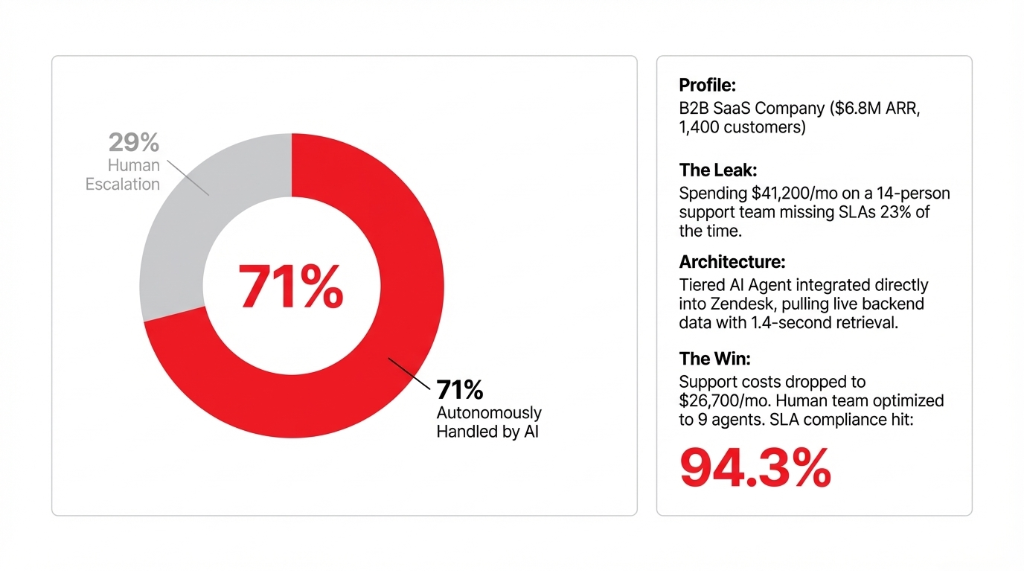
A B2B SaaS company in Austin — 1,400 active customers, $6.8M ARR — was spending $41,200/month on a 14-person support team that was still missing SLA targets 23% of the time.
They asked us: “Can AI help?” We said: “AI can handle 67% of your ticket volume before a human ever reads it.”
We built a tiered AI agent system: Tier 1 handles password resets, billing inquiries, and feature documentation requests autonomously. Tier 2 handles technical troubleshooting with human escalation. The AI chatbots layer integrates directly into their Zendesk and pulls live account data from their SaaS backend.
The AI search capability inside the agent means it surfaces the exact Knowledge Base article in 1.4 seconds — compared to their previous average of 8.3 minutes of agent research time per ticket.
SaaS Support Transformation: The Numbers
71%
Tickets handled without human touch
14 to 9
Support agents via natural attrition, zero layoffs
$14,500/mo
Monthly support cost savings
94.3%
SLA compliance up from 77%
The AI trends we are watching in 2026 all point in the same direction: AI automation is no longer experimental for US SaaS companies. It is the baseline. If you are not deploying AI agent infrastructure at the support layer, you are paying 35–55% more per resolved ticket than your competitors.
According to Google Cloud's 2026 AI Agent Trends Report — across 3,466 enterprise leaders — 88% of early AI adopters are already reporting positive ROI. The ones still “evaluating” are falling behind by one fiscal quarter at a time.
What These 5 Stories Actually Have in Common
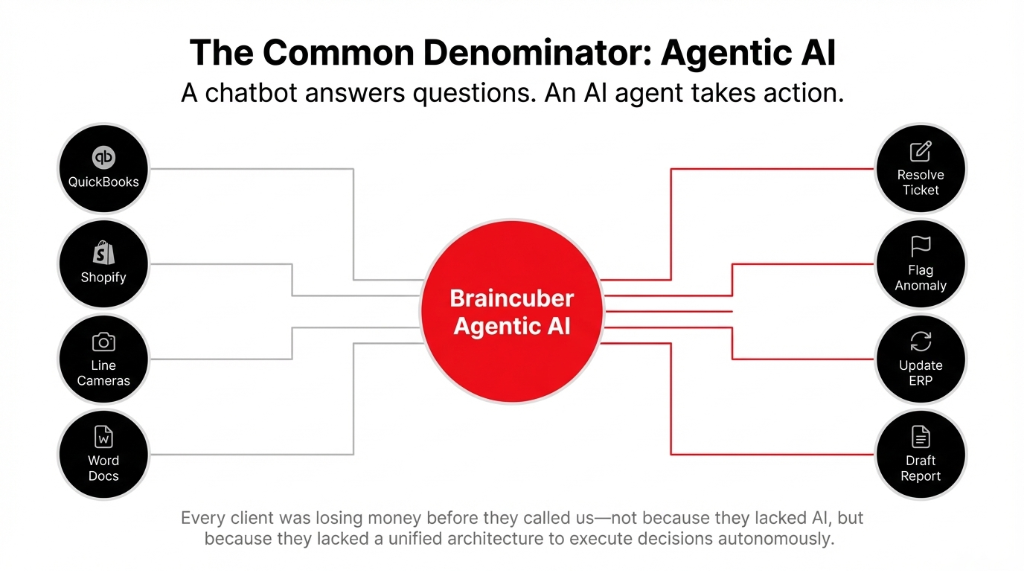
Look at the pattern:
The Pattern Across All 5 Deployments
1. Every client had AI tools that were not connected to each other
2. Every client was losing money before they called us — not because they lacked AI, but because they lacked architecture
3. Every single deployment tied AI and business outcomes to specific dollar figures within 8–12 weeks
The Real Question Has Shifted
The artificial intelligence conversation in America is no longer “should we use AI?” It is “why is our current AI not working?” The answer, in almost every case: disconnected systems, wrong AI models, no AI data strategy, and no one accountable for the outcome.
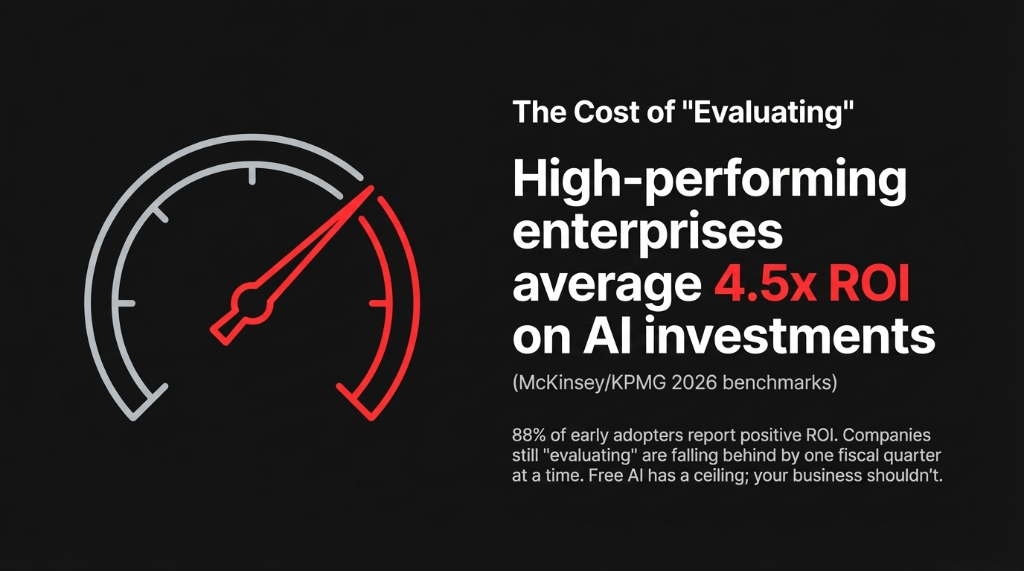
Agentic AI — where agents actually take action instead of just generating text — is the latest AI shift that separates companies generating 4x ROI from those generating content for their blog. McKinsey and KPMG's 2026 benchmarks show high-performing enterprises averaging 4.5x ROI on AI investments, with the biggest gains in operations (44%) and supply chain (22%).
The AI company that wins is not the one with the most subscriptions. It is the one with the most connected, production-grade AI running in their actual business.
What Q2 Looks Like for Our US Clients
We are heading into Q2 with 11 new US deployments in the pipeline. The sectors breaking through right now:
Q2 Pipeline: Where AI Is Hitting Next
Finance AI
Mid-market accounting firms running on legacy NetSuite + manual reconciliation
AI in Manufacturing
Small factories between $5M–$20M revenue that cannot afford full digital transformation but can afford a targeted AI agent
AI Robotics
Warehouse operations where physical + digital automation meet
AI Training Programs
Internal teams who need to manage and audit AI systems they do not fully understand yet
The business of AI is accelerating faster than most AI tech companies are communicating honestly. AI jobs are being created as fast as some are displaced — specifically AI positions that did not exist 18 months ago: prompt engineers, AI workflow architects, AI agency coordinators.
If your business is between $1M and $50M ARR and you have not done a real audit of where using AI could cut your cost-per-output by 30%+, you are already 6–9 months behind the curve.
FAQs
How fast can we see ROI from an AI deployment with Braincuber?
Most of our US clients see measurable cost recovery within 6–11 weeks of go-live. The fastest result we recorded in Q1 was $17,800/month recovered in Week 6. Timeline depends on data readiness and scope, not on the AI technology itself.
Does Braincuber build on free AI or proprietary AI models?
We build on production-grade AI models — GPT-4, Claude, Gemini, and custom fine-tuned models depending on the use case. We never recommend free AI tools for business-critical workflows. Free has a ceiling; your business should not.
How does Braincuber handle AI ethics and data security for US businesses?
Every deployment follows a clear data governance framework. For regulated industries like finance and healthcare, we deploy entirely within private cloud environments on AWS or Azure — no data leaves your tenant. We align with emerging AI regulation standards and build human-in-the-loop checkpoints where compliance requires it.
What is the difference between Braincuber's agentic AI and a standard AI chatbot?
A chatbot answers questions. An AI agent takes action — it reads data, makes decisions, executes tasks, and updates systems without waiting for a human to press a button. Our agentic AI deployments in Q1 reduced manual workloads by an average of 61% across client teams.
Do we need to replace our existing tech stack to work with Braincuber?
No. We integrate with what you already run — QuickBooks, Shopify, Zendesk, Salesforce, NetSuite, or custom ERPs. We build the AI layer on top of your existing infrastructure before recommending any migration or replacement.
Your Competitors Already Did This in Q1. Your Move.
Stop waiting for the “right time.” There is only the quarter where you start and the quarter where your competitors did it first. Book our free 15-Minute Operations Audit — we will find your single biggest cash leak in the first call. No pitch deck. No fluff. Just the number you have been ignoring.