
If you’re running plain Odoo and calling it "fully optimized," you’re probably leaving somewhere between $14,000 and $22,700 a month in recoverable losses on the table. We know this not because of a brochure — we know this because we’ve implemented Odoo ERP for 150+ brands across the US, UK, UAE, and Singapore, and we’ve seen the same pattern repeat itself across industries.
Plain Odoo is a good ERP system. AI-Powered Odoo is a different category of tool entirely. And if you don’t understand the gap between the two, your competitor who does will eat your margins before you figure out what happened.
The Part Nobody Tells You About Plain Odoo
Plain Odoo works. It connects your accounting, inventory management, manufacturing module, and HR system into one ERP. For a business doing $1M–$3M ARR, the standard Odoo setup at $24.90/user/month will get the job done.
But here’s where it quietly fails you.
Plain Odoo is reactive.
It records what happened. It alerts you after something went wrong. Every single decision — reorder point adjustments, invoice approvals, lead prioritization, payroll anomalies — still requires a human to look at the data and decide.
We constantly see US-based clients with 20–50 person operations spending 37+ hours a week across three people just managing tasks that should be automated: manually reviewing low-stock alerts in inventory, hand-keying vendor invoices into accounting, sorting through CRM leads with no scoring logic. That’s $4,810/month in labor doing zero-value work. (Yes, we calculated it — at $43/hour blended rate.)
Module-by-Module: Plain Odoo vs AI-Powered Odoo
Here is exactly what changes when you layer AI onto your Odoo ERP system. Not hypothetically — this is the difference we deploy at Braincuber for clients scaling from $3M to $25M ARR.
| Module | Plain Odoo | AI-Powered Odoo |
|---|---|---|
| CRM / Sales | Manual lead sorting, static pipeline stages | Predictive lead scoring, AI-driven sales forecasting |
| Accounting | Manual invoice entry, basic bank reconciliation | OCR scanning, smart reconciliation: 15 min → under 2 min/invoice |
| Inventory | Low-stock alerts, manual reorder rules | Demand forecasting at 85–95% accuracy, auto POs, 40% fewer stockouts |
| Manufacturing | Manual scheduling, reactive downtime | Predictive maintenance via sensor data, AI quality control |
| HR / Payroll | Manual CV review, basic applicant tracking | Resume parsing, AI candidate matching, payroll anomaly detection |
| Website | Static content, manual chatbot scripts | AI content generation, responsive chatbot, auto layout suggestions |
| Customer Service | Canned responses, human-only ticket handling | Smart ticket triage, AI message translation, auto-suggested resolutions |
That table is not marketing copy. It is the exact breakdown of what Braincuber configures for clients who have already been on plain Odoo for 12–18 months and are hitting operational ceilings.
The Inventory Problem Is Costing You More Than You Think
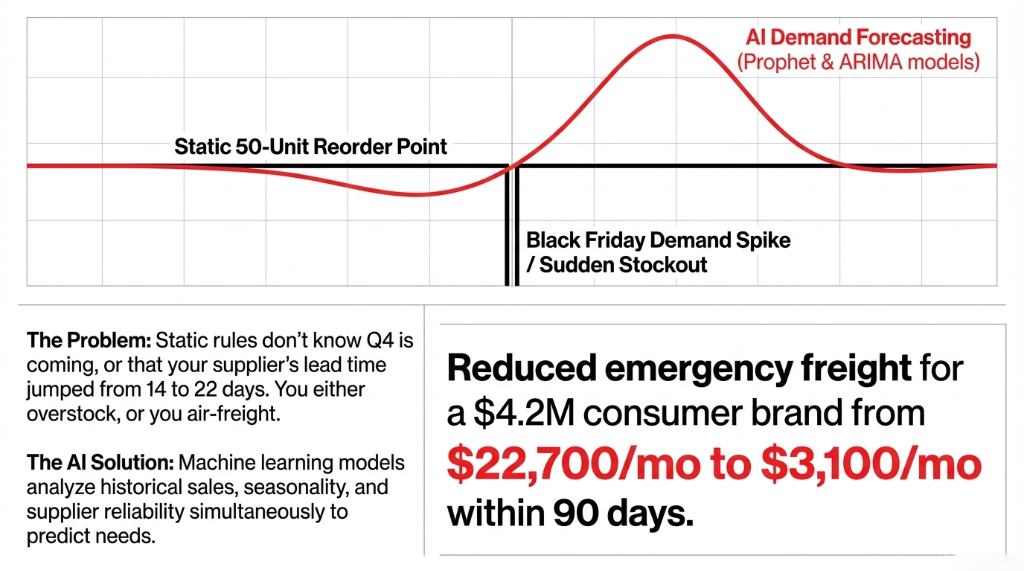
With plain Odoo inventory, you set static reorder rules — say, reorder when stock hits 50 units. That rule doesn’t know that Black Friday is six weeks away. It doesn’t know your supplier out of Houston has a 14-day lead time that jumped to 22 days last quarter. It doesn’t know that your SKU-789 sells 3x faster in Q4. So you either overstock (carrying costs eat your margins) or you stockout (you’re air-freighting from China at $8.70/kg).
One of our clients — a US-based consumer goods brand doing $4.2M/year — was spending $22,700/month in emergency freight because their static reorder logic couldn’t anticipate demand shifts. After we implemented AI demand forecasting on their Odoo inventory module, that number dropped to $3,100/month within 90 days.
AI-powered Odoo inventory uses Prophet, ARIMA, and ensemble machine learning methods to analyze historical sales, seasonal patterns, promotions, and supplier reliability scores simultaneously — and generates reorder recommendations that are 85–95% accurate.
Why Your Accountant Is the Last Person Who Should Touch Invoice Entry
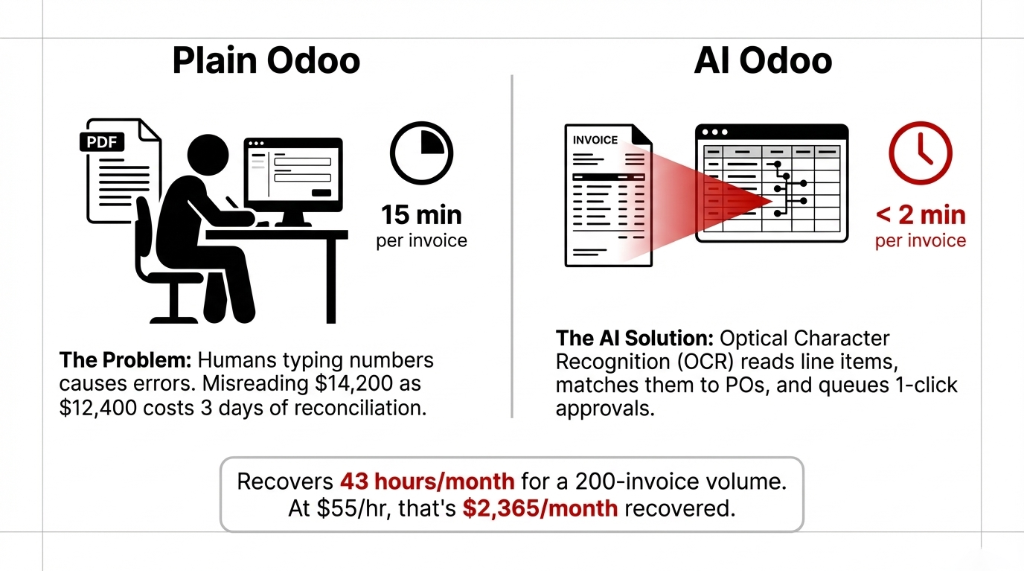
Plain Odoo accounting still relies on humans typing numbers from PDFs into fields. Your AP team member misreads a $14,200 invoice as $12,400 — and you spend 3 days reconciling a discrepancy that should never have existed.
AI-powered Odoo accounting with OCR scanning reads vendor invoices, extracts line items, matches them to purchase orders, and queues them for one-click approval. Processing time drops from 15 minutes per invoice to under 2 minutes. For a business processing 200 invoices a month, that’s 43 hours/month returned to your finance team. At a $55/hour accountant rate, that’s $2,365/month recovered — just from one module.
(Yes, your accountant will protest. They always do. Show them the numbers anyway.)
The CRM Leak Nobody Audits
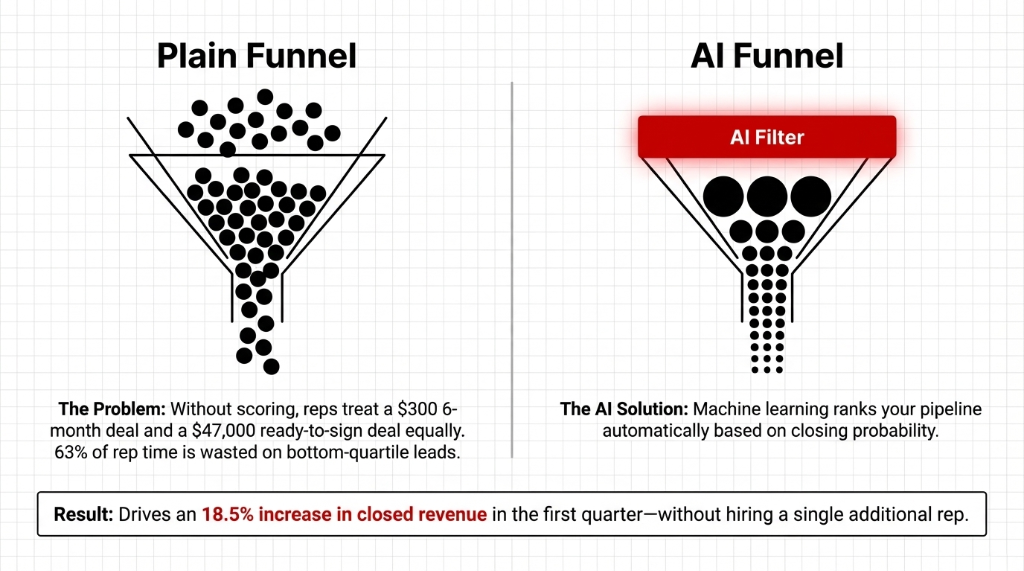
Plain Odoo CRM gives you a pipeline. AI-Powered Odoo CRM gives you a ranked pipeline. That matters more than it sounds.
Without lead scoring, your sales reps spend equal time on a $300 deal that will close in 6 months and a $47,000 deal that is ready to sign this week. We ran an analysis on a 12-person US software reseller’s Odoo CRM data and found that 63% of their rep time was going to leads in the bottom quartile by revenue probability. After enabling AI lead scoring, the same team increased closed revenue by 18.5% in the first quarter — without hiring a single additional rep.
What AI-Powered Odoo Actually Costs
The Real Cost Breakdown
Plain Odoo Enterprise (Standard)
$24.90/user/month
Full module suite baseline
Plain Odoo Enterprise (Custom)
$37.40/user/month
Advanced module customization
AI Layer (Braincuber)
$800–$3,200/month
Depends on number of AI-configured modules and data pipeline complexity
15-user operation, all-in cost:
$2,500–$4,300/month
Compare That Against What You’re Losing
$22,700
Emergency freight/month
$4,810
Manual labor/month
$2,365
Accounting errors/month
40–60% operational cost reduction within the first six months.
The Implementation Reality
Here’s what an honest Odoo implementation timeline looks like when you’re adding AI:
The Honest 8-Week Timeline
Data audit, module mapping, AI training data pipeline setup
OCR accounting and inventory forecasting go live in sandbox
CRM lead scoring and HR parsing configured and tested
Full production deployment, team training, monitoring dashboards active
8 weeks, not 6 months. Anyone quoting you a 6-month AI-Odoo implementation is billing by the hour with no urgency.
Braincuber’s standard AI-Odoo deployment for US mid-market companies runs 8–11 weeks with dedicated support post-launch. You get a functional, live system — not a PowerPoint.
Frequently Asked Questions
Is AI-Powered Odoo only for large enterprises?
Mid-market ($2M–$10M ARR) is exactly where AI-Powered Odoo delivers the fastest ROI. Large enterprises have dedicated ops teams to absorb manual inefficiencies. A $3M–$10M business doesn’t. AI forecasting, OCR accounting, and lead scoring are relevant from your first 500 monthly transactions. No $500,000 NetSuite-style commitment required.
How is AI-Powered Odoo different from just buying Odoo 17 or 18 Enterprise?
Odoo 17 and 18 have native AI features like basic OCR and some ML signals, but they’re unconfigured out of the box. AI-Powered Odoo means custom model training on your specific business data, API integrations with Shopify, QuickBooks, ShipStation, and active monitoring. Buying Odoo 18 without configuration is like buying a race car and never tuning the engine.
What happens to our existing data when we upgrade?
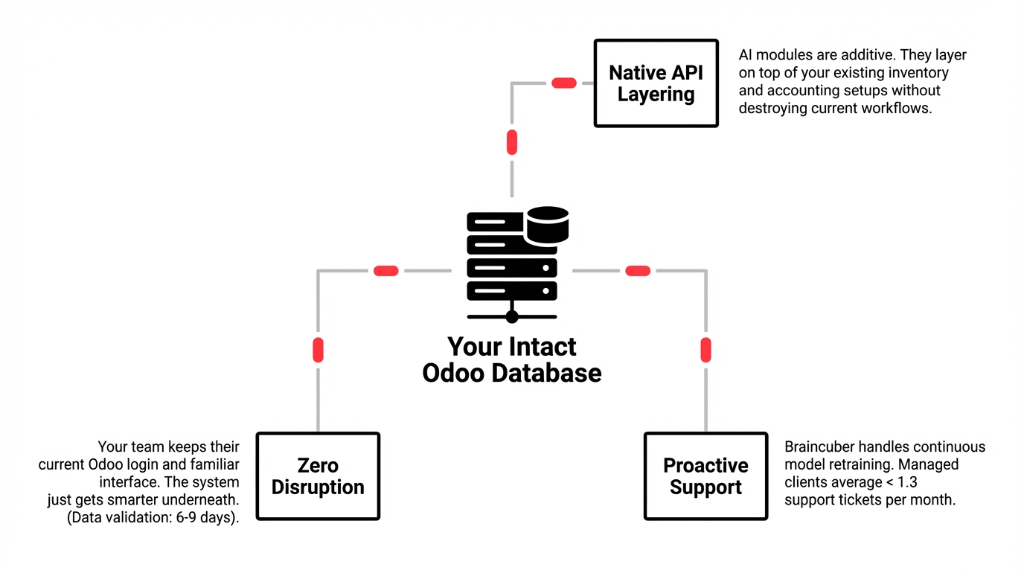
Your Odoo database stays intact. Braincuber runs a full data audit before any AI layer is added, maps your historical sales, inventory, and accounting records as the AI training foundation. Odoo’s modular architecture means AI modules are additive — they don’t replace existing workflows. Data validation takes 6–9 business days.
Does AI-Powered Odoo require replacing current modules?
No. AI is layered on top of your existing Odoo ERP modules — inventory, accounting, manufacturing, HR — not in place of them. Braincuber uses Odoo’s native API integrations and custom AI fields to embed intelligence into the workflows your team already uses. You keep the login, the interface, the workflow — the system just gets smarter underneath.
What ongoing support does Braincuber provide after deployment?
Braincuber provides AI model performance monitoring, retraining cycles when accuracy drops below threshold, module updates for Odoo upgrades, and a direct support line. Most managed AI-Odoo clients average less than 1.3 support tickets per month after the first 60 days — because the system handles edge cases proactively.