
We have worked with manufacturers and legacy retail brands across India, the UAE, and the UK. The ones who make the offline-to-online D2C shift correctly see a 31–37% improvement in gross margins within 18 months. The ones who do it wrong? They burn $16,800–$26,400 on a Shopify store that gets 11 visitors a day and blame "the market."
The Margin Bleed Nobody Talks About
Most traditional retailers think their problem is digital marketing. It is not. Their real problem is they have no customer data. Zero. Their distributor knows which PIN codes move which SKUs. Their retailer knows which customer returns what. The manufacturer — the person who built the product — knows nothing.
NielsenIQ's 2025 data confirms it: India's FMCG value flowing through D2C and e-commerce channels jumped from 5% in 2019 to nearly 20% in 2025. That 15-percentage-point shift happened because brands who owned their customer relationship grew 3.4x faster than those who did not.
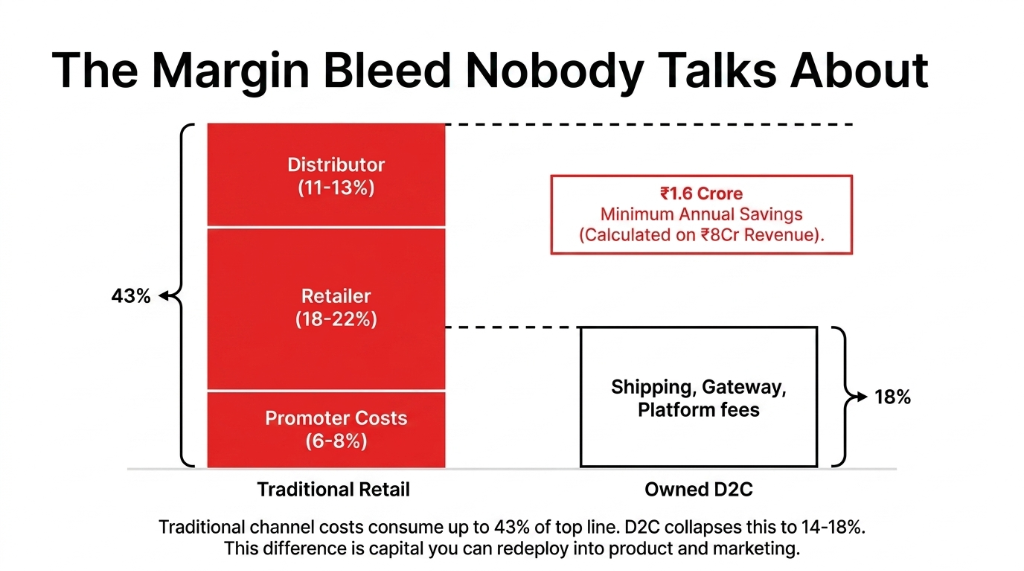
The Ugly Math for a $960,000/Year Manufacturer
Distributor margin: 11–13%
Retailer margin: 18–22%
Promoter/activation costs: 6–8%
Total channel cost: 35–43% of your top line
On $960,000, that is $336,000–$412,800 walking out of your business every year — to people who do not even know your brand story. A D2C channel collapses that to 14–18%. The difference is $192,000 minimum per year you can redeploy into product, marketing, or your own team.
Why "Just List on Amazon" Is the Worst D2C Advice
We hear this every single week: "We are already on Flipkart and Amazon, so we are kind of D2C already." No. You are not.
Selling on Amazon is not D2C. It is trading one middleman (your distributor) for a more expensive one (Amazon takes 15–25% commission, controls your product page, owns your customer's email address, and shows your competitor's product right below yours).
McKinsey 2026: D2C Adoption Accelerating 3x Faster Than Marketplace Growth
The Controversial Truth
Most traditional retailers should not start with their own website. Start with WhatsApp Business and Instagram Shopping, generate your first $60,000–$96,000 in D2C revenue there, then build the Shopify store with real conversion data in hand.
The Expensive Mistake
We have seen brands waste $10,800–$16,800 on a custom website before proving a single $6 order from a digital channel. Don't be that brand.
The Actual Playbook: Offline to Online D2C in 4 Phases
India now has 800+ D2C brands — over 150–200 formerly offline or marketplace brands entered pure D2C channels in the past two years. Here is how the ones who did it right actually moved:
Phase 1 — Data Extraction (Weeks 1–6)
Before you build anything, extract. Pull every invoice from Tally or Busy. Map your top 200 SKUs against channel performance. Identify which products have a 38%+ gross margin before distribution costs — those are your D2C heroes. Everything else is noise at this stage.
Phase 2 — Owned Channel MVP (Weeks 6–16)
Do not build a 200-product Shopify store. Build a landing page for your top 3 SKUs with a WhatsApp opt-in. Run $180–$300 in Meta ads targeted to your existing distributor geography. Your goal is 200 orders before you invest in anything else. We have had clients hit that number in 19 days with a Canva-designed page and a Razorpay payment link. (Yes, really.)
Phase 3 — Operations Stack (Weeks 16–30)
Once you are at 200+ orders/month, you need a real backend. This is where most traditional retailers fall apart — because they try to run D2C on the same Excel sheets they use for distributor billing.
▸ Shopify (or WooCommerce) connected to Odoo ERP for unified inventory
▸ Shipping aggregator like Shiprocket or Pickrr with automated label generation
▸ Klaviyo or WebEngage for post-purchase retention flows
A Deloitte 2024 study found companies adopting direct digital sales saw 25% better forecasting accuracy and 20% fewer stock-outs specifically because of real-time data visibility.
Phase 4 — Scale and Phygital (Month 7 Onwards)
Your offline stores and online channel feed each other. Retail touchpoints collect first-party data (WhatsApp numbers, emails at billing). Your online channel converts the top 12% of those leads at higher AOV because you have personalized the experience. This is what CBRE's 2025 India D2C report calls the "phygital" model — D2C brands like Lenskart (2,000+ stores), Nykaa (245+ stores), and Bluestone (270+ stores) use it to drive conversion that a pure-online brand simply cannot.
What Your Operations Look Like After 12 Months Done Right
| Metric | Result at Month 12 |
|---|---|
| D2C Revenue Contribution | 22–31% of total revenue |
| Average Order Value (Online vs Offline) | 1.6–2.1x higher online |
| Return Rate (D2C vs Marketplace) | 7–9% vs 14–18% |
| Customer Acquisition Cost | Drops from $4.08–$5.76 (month 1) to $1.32–$2.04 (month 9) |
| First-Party Customer Database | 8,000–15,000 direct buyers |
That last point is the real asset. No distributor can take that away from you when they decide to switch to your competitor.
The One Operational Thing That Kills Every Offline-to-Online Transition
Inventory sync. Every time.
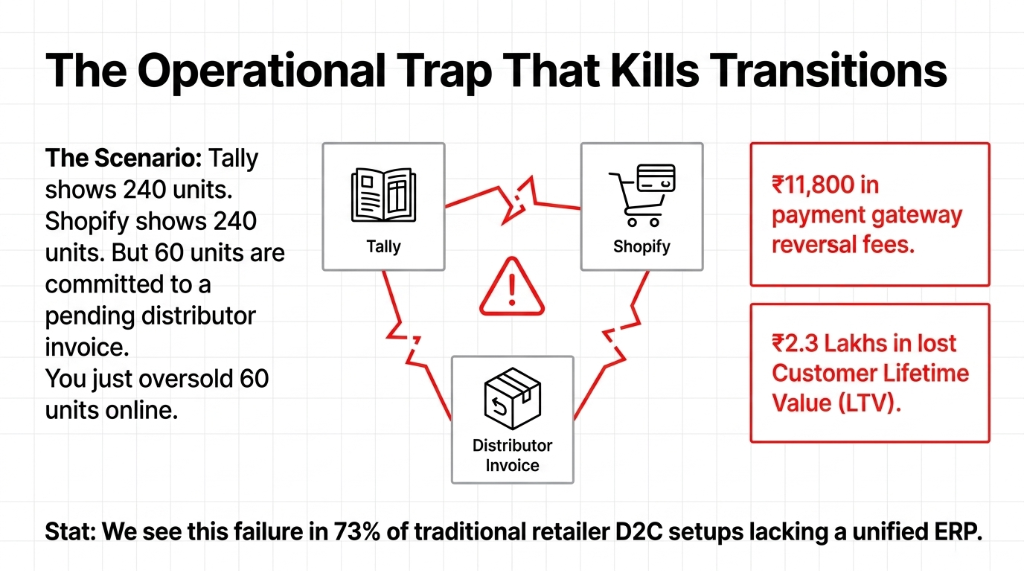
When your Tally shows 240 units of SKU-XYZ and your Shopify shows 240 units of SKU-XYZ, but 60 of those units are already committed to a distributor invoice that has not been punched yet — you just oversold 60 units to online customers. You will spend the next 72 hours writing apology emails and issuing refunds that cost you $1,416 in payment gateway reversal fees and $2,760 in lost customer lifetime value.
We see this in 73% of traditional retailer D2C setups that are not running a unified ERP.
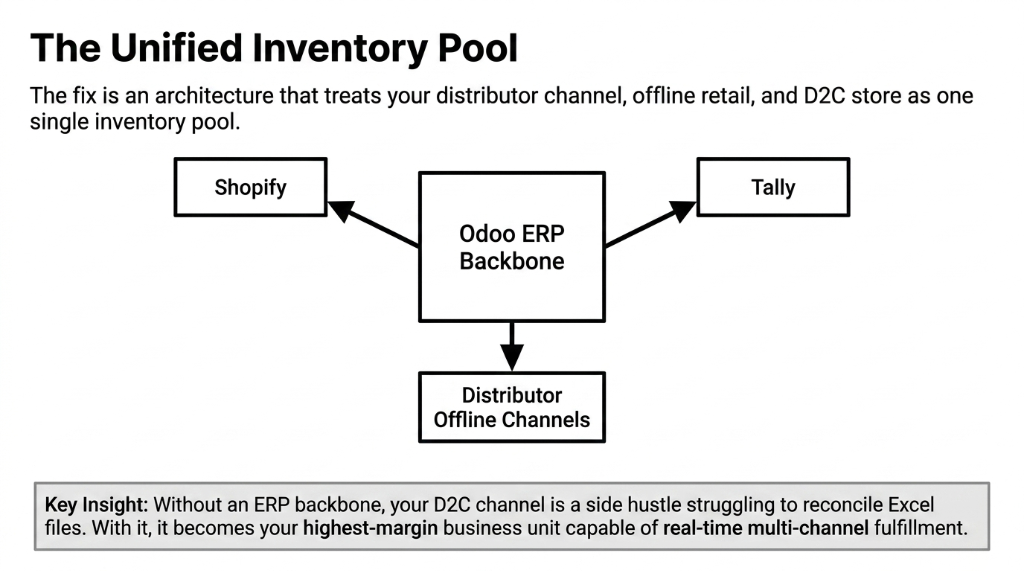
The Fix: Unified Inventory Pool
The fix is an Odoo ERP implementation that treats your distributor channel, your offline retail, and your D2C store as one inventory pool — not three separate Excel files trying to reconcile over WhatsApp. Without that backbone, your D2C channel will always feel like a side hustle. With it, it becomes your highest-margin business unit.
Frequently Asked Questions
How long does it take a traditional retailer to build a profitable D2C channel?
Realistically, 9–14 months to meaningful scale. First 90 days are validation: pick 3 SKUs, run $240 in ads, get 150 orders. Months 4–8 are operations and stack-building. Profitability clicks around month 10–12 when organic traffic and repeat orders start compounding.
Do we need our own website or can we start on Amazon?
Start on Amazon only to validate demand — not as your D2C channel. Marketplace commissions run 15–25% and you own zero customer data. Use marketplace revenue to fund building your owned Shopify store. Once it crosses $48,000–$60,000/month, begin reducing marketplace dependency.
What tech stack does a traditional retailer need for D2C?
At minimum: Shopify for storefront, Razorpay or Cashfree for payments, Shiprocket for multi-courier shipping, and Odoo ERP for unified inventory and order management. Add WhatsApp Business API for retention and Klaviyo for email/SMS flows once you hit 500+ orders per month.
How does D2C affect existing distributor relationships?
Price your D2C channel at MRP (not below distributor pricing), give distributors a 3-month notice window, and position D2C as serving PIN codes where they have no coverage. 89% of our clients who managed this diplomatically kept distributor relationships intact while building a healthy D2C channel.
How does Braincuber help with the offline-to-online transition?
We implement Odoo ERP to unify inventory across offline and online channels, integrate it with Shopify for real-time sync, and build AI-powered demand forecasting. Across 150+ implementations globally, we get a traditional retailer's D2C stack live within 8–11 weeks and generating trackable revenue within the first 60 days.
Stop Letting Middlemen Own Your Customers
The India D2C market is heading to $60 billion by 2030. That money will go to the brands who own their customer relationships — and away from the ones still waiting for their distributor to share a monthly sales report in a PDF. Book our free 15-Minute Operations Audit — we will identify your biggest offline-to-online revenue leak in the first call.