
The Inventory Math That Should Terrify You
Retailers globally lose $634 billion annually to out-of-stock items alone. On Amazon, if your Order Defect Rate crosses 1% — from canceled orders caused by phantom stock — your account gets suspended. One suspension event at a $3M Amazon-selling brand typically costs $47,000–$92,000 in lost revenue before reinstatement.
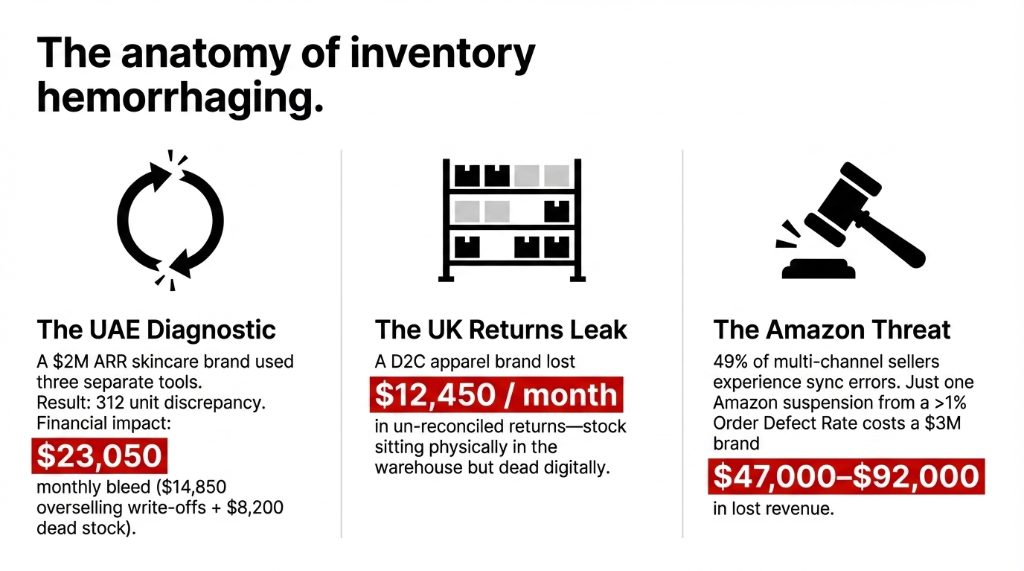
We worked with a UAE-based skincare D2C brand doing $200,000/month across Shopify, Amazon UAE, and Noon. They were using three separate inventory tools — one per channel. Their average inventory discrepancy per month was 312 units, which translated to $14,850 in overselling write-offs and $8,200 in dead stock that sat unsold in the wrong channel.
Total Monthly Bleed: $23,050
Overselling Write-Offs
$14,850/month — phantom stock on one channel triggers orders that cannot be fulfilled. Refunds, apology credits, and customer trust — gone.
Dead Stock
$8,200/month — inventory sitting in the wrong channel. Physically in the warehouse, digitally invisible. Never gets sold.
Industry Average
49% of multi-channel sellers experience order errors due to misaligned inventory data. This is not a technology problem. It is a structural problem.
They thought they had a marketing problem. They had a warehouse problem.
Why Your Current Setup Is Making It Worse
Here is the controversial opinion nobody in the SaaS industry wants you to hear: adding more tools to a broken process makes the process worse, not better.
Most growing D2C brands follow the same path. They add ShipStation for shipping labels. They add a third-party inventory connector for Amazon sync. They bolt Klaviyo onto Shopify for email. They run payouts through QuickBooks, which talks to none of the above.
The 2 AM Black Friday Story
Shopify’s API rate limit hit a wall during a Black Friday flash sale — 800 orders did not sync to the warehouse. The warehouse team was manually keying orders from a Slack channel at 2 AM. They keyed a “0” instead of an “O” in a SKU field and lost track of $5,400 worth of inventory in one night.
We have personally seen this happen. More than once.
The Returns Black Hole
Multichannel returns without a single system of record are a financial black hole. A UK-based D2C apparel brand was leaking $12,450 a month in un-reconciled returns — stock returned via Amazon but never restocked in Shopify’s available inventory. It sat physically in the warehouse while the brand kept reordering the same SKUs from their supplier.
Stock sitting physically in the warehouse but dead digitally. The supplier gets paid twice. You get paid zero times.
The “Buy NetSuite” Trap
The solution most consultants prescribe? “Buy NetSuite.” Do not. Unless you have $400,000+ for implementation and 18 months to burn, NetSuite will destroy your cash flow before it saves it. There is a better path for brands between $1M and $15M ARR.
Hidden cost: $400,000–$600,000+ for a system your warehouse team will still fight against.
What Odoo Warehouse Management Actually Does for D2C
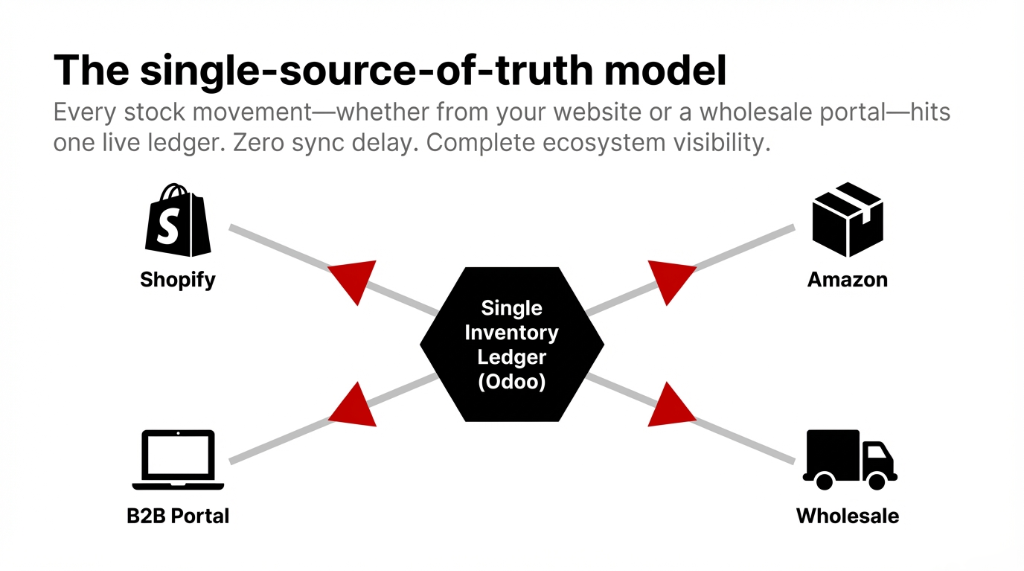
Odoo’s Warehouse Management System operates on a single-source-of-truth model. Every stock movement — whether an order comes in from Shopify, Amazon, your own website, or a wholesale B2B portal — hits one inventory ledger. One number. Live. No sync delay.
Step 1: Multi-Warehouse, Single Dashboard
Odoo lets you configure multiple physical warehouses — your main fulfillment center, a regional 3PL, a pop-up stock location — and view them all from one screen. When Warehouse B in Dubai drops below 50 units of your hero SKU, Odoo auto-triggers a replenishment transfer from your main warehouse in Sharjah. No human decision required.
Step 2: Putaway Rules That Actually Think
In Odoo 17 and 18, you configure putaway rules so incoming stock lands exactly where it belongs — by product category, by size, by temperature zone. A D2C supplement brand we onboarded in Singapore reduced their picking time from 11 minutes per order to 2.4 minutes after configuring intelligent putaway rules. That is 37 hours saved per week in their warehouse.
Step 3: Batch and Wave Picking for Peak Days
Peak days — Prime Day, Diwali, Black Friday — kill poorly configured warehouses. Odoo 18’s batch and wave transfer system groups multiple orders into a single picking run organized by zone. One picker covers an entire warehouse zone in a single pass instead of walking back and forth per order.
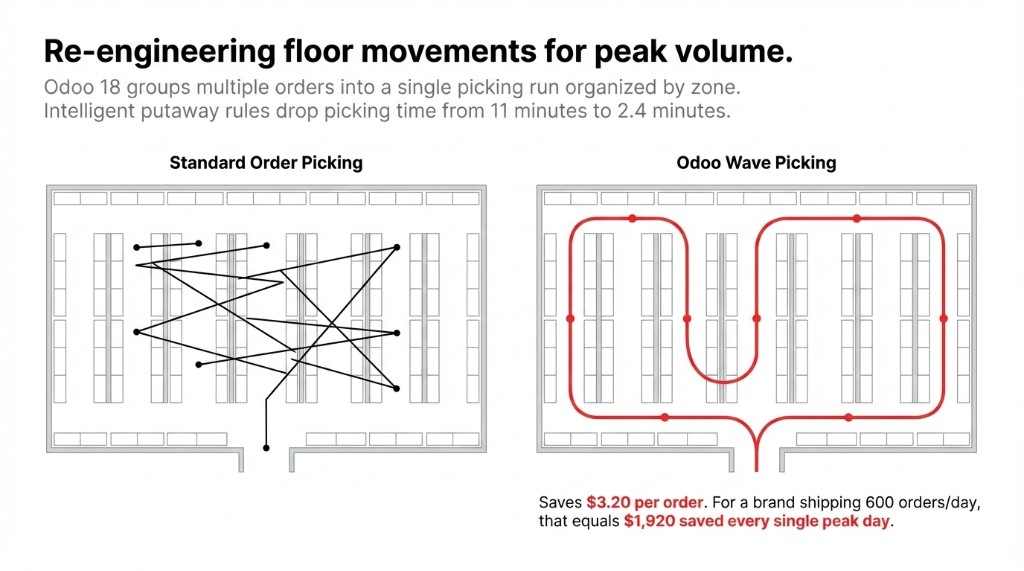
✓ Measured result: This cut pick-pack processing costs by $3.20 per order for a brand shipping 600 orders/day. That is $1,920 saved every single peak day.
Step 4: Lot and Serial Number Tracking Across All Channels
If you sell perishables, cosmetics, supplements, electronics, or anything with a shelf life or warranty, lot tracking is non-negotiable. Odoo tracks lot numbers from the moment goods land in your warehouse to the moment they ship.
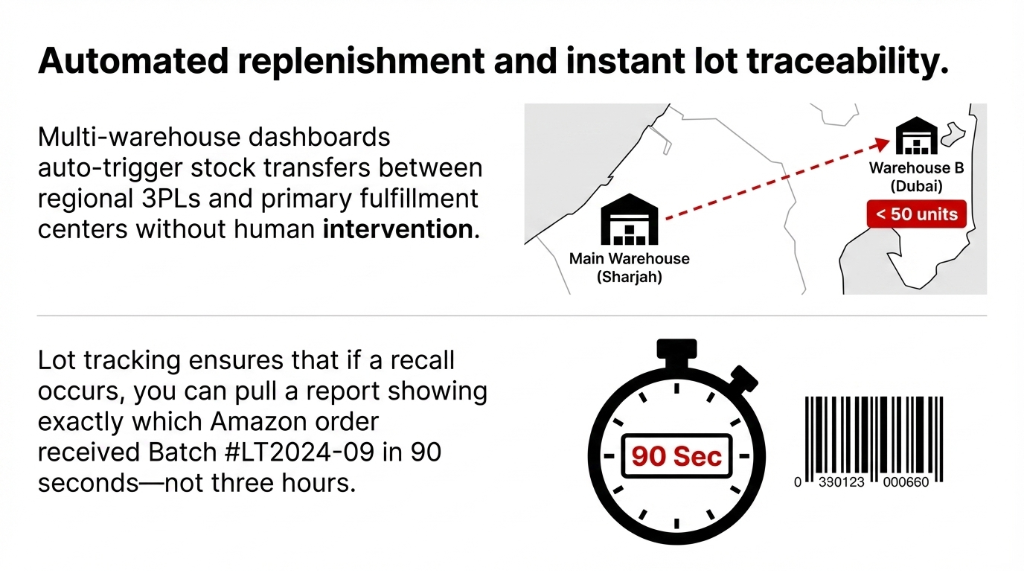
The 90-Second Recall Test
If a recall happens, you pull a report in 90 seconds showing exactly which Amazon order got Batch #LT2024-09. Not three hours of manual SKU hunting. 90 seconds. Try doing that with a Google Sheet.
Step 5: Channel-Specific Inventory Allocation
One of Odoo’s most underused features in D2C: virtual locations. You can ring-fence 200 units of a product for Amazon FBM, 150 for Shopify, and 50 for your B2B portal — all from the same physical shelf — so you never oversell on one channel while under-allocating on another.
✓ Impact: This single feature eliminated $9,700/month in Amazon refund penalties for a US-based D2C electronics brand we implemented in Q3 2024.
The Numbers You Should Demand in 90 Days
We do not promise vague operational improvement. Here is what our clients actually see after a properly configured Odoo WMS goes live:
| Metric | Before Odoo | After Odoo WMS |
|---|---|---|
| Inventory accuracy | ~83% | 98.7% (within 60 days) |
| Order processing time | 14 minutes/order | Under 3 minutes/order |
| Overselling incidents | Weekly occurrences | Zero |
| Stock reconciliation | 6 hours/week | 22 minutes/week |
| Returns processing backlog | 6–9 days (industry avg.) | Under 48 hours |
First-Quarter Recovery: $31,200
The Client
A $3.1M D2C personal care brand selling on Shopify, Amazon India, and Meesho.
The Recovery
$31,200 in the first quarter — purely from eliminating inventory write-offs and return reconciliation failures. No new revenue. Just money that stopped leaking.
What the Actual Implementation Looks Like
No sugarcoating here. Odoo WMS implementation for a multi-channel D2C brand takes 6–10 weeks if you have clean product data and a warehouse team willing to show up for three days of onboarding training.
The 6–10 Week Implementation Sequence
Week 1–2
SKU Audit. Audit your current SKU master, clean duplicates, define warehouse structure. This is where most brands discover they have 400 duplicate SKUs and inconsistent naming conventions.
Week 3–4
Configuration. Configure warehouses, locations, putaway rules, and reorder points. Set up virtual locations for channel-specific allocation.
Week 5–6
Integration. Connect Shopify + Amazon (or whatever your channels are) via Odoo connectors. Live inventory sync begins.
Week 7–10
Go-Live. Barcode scanner setup, picking workflow testing, staff training. Go-live on one warehouse, then roll out. Your warehouse team will complain for two weeks. Then they will refuse to go back.
⚠ Warning: The biggest risk to implementation is bad SKU data going in. If your current product master has 400 duplicate SKUs and inconsistent naming conventions, that needs fixing before any system touches it. We catch this in every pre-implementation audit — and it typically adds $4,000–$7,000 of cleanup work that clients never budgeted for. Now you know.
Your Warehouse Is Not a Cost Center. It Is a Revenue Leak.
Every oversold order, every un-reconciled return, every duplicate SKU sitting dead in the wrong channel — that is money walking out of your business. Not because your product is bad. Because your data architecture is broken.
The brand that fixed this problem recovered $31,200 in one quarter. The brand that ignores it will lose $208,800 this year. Same product. Same market. Different warehouse system.
FAQ
Can Odoo handle inventory across Shopify, Amazon, and a B2B portal at the same time?
Yes. Odoo syncs live inventory across Shopify, Amazon, WooCommerce, and custom B2B portals through native connectors and API integrations. Stock is deducted from one central ledger the moment an order is confirmed on any channel, eliminating overselling within seconds.
How long before we see ROI after going live?
Most D2C clients see measurable ROI within 47–62 days of go-live — primarily through eliminated overselling penalties, faster order fulfillment, and reduced manual labor hours. Brands shipping 300+ orders per day typically recover their full implementation cost within the first quarter based on picking efficiency gains alone.
Do we need to replace Shopify to use Odoo WMS?
No. Shopify stays exactly where it is — handling your storefront, product pages, and checkout. Odoo runs your warehouse, inventory, fulfillment, and back-office. The two systems talk via a connector that pushes orders into Odoo and updates stock back to Shopify in real time. Your customers see nothing change. Your warehouse team sees everything change.
What happens to existing inventory data during migration?
We export your current product master and stock levels from whatever system you use — Cin7, ShipStation, TradeGecko, or even Excel — and import it into Odoo after a de-duplication pass. We run parallel systems for one week before cutover so no orders fall through the gap. The migration itself typically takes 3–5 business days of technical work.
Is Odoo WMS suitable for a brand doing under $1M in revenue?
If you are under $500K ARR and shipping fewer than 50 orders per day on one channel, Odoo WMS is overkill — stick with Shopify’s native inventory for now. But if you are crossing $800K, shipping 80+ orders per day, or already selling on two or more channels, the inventory chaos you are about to hit will cost you far more than the implementation does. Plan now, not after your first major oversell incident.
Open Your Returns Folder. If It Is Full, Call Us.
Book a free 15-Minute Operations Audit with Braincuber. We will identify your single biggest inventory leak in the first call — whether it is phantom stock, un-reconciled returns, or channel allocation gaps. No pitch deck. No sales slide. Just a working session with a consultant who has fixed this exact problem for 150+ brands.