
That's not an opinion. That's what we see across our last 47 e-commerce implementations at Braincuber Technologies across the US, UK, UAE, and Singapore.
The Real Problem Nobody Tells You About Tally
Here is what Tally's sales brochure does not say: Tally Prime has no native API.
That one sentence should end the conversation for any e-commerce brand running more than $500K/year in GMV. No API means no live connection to Shopify. No API means your Shopify orders don't auto-sync to your books. No API means your warehouse team is manually updating stock counts in a desktop application that lives on one specific machine in one specific office.
(Yes — one machine. Tally is primarily desktop-based. Your accountant in Chennai cannot access it while your warehouse manager in Dubai is making entries.)
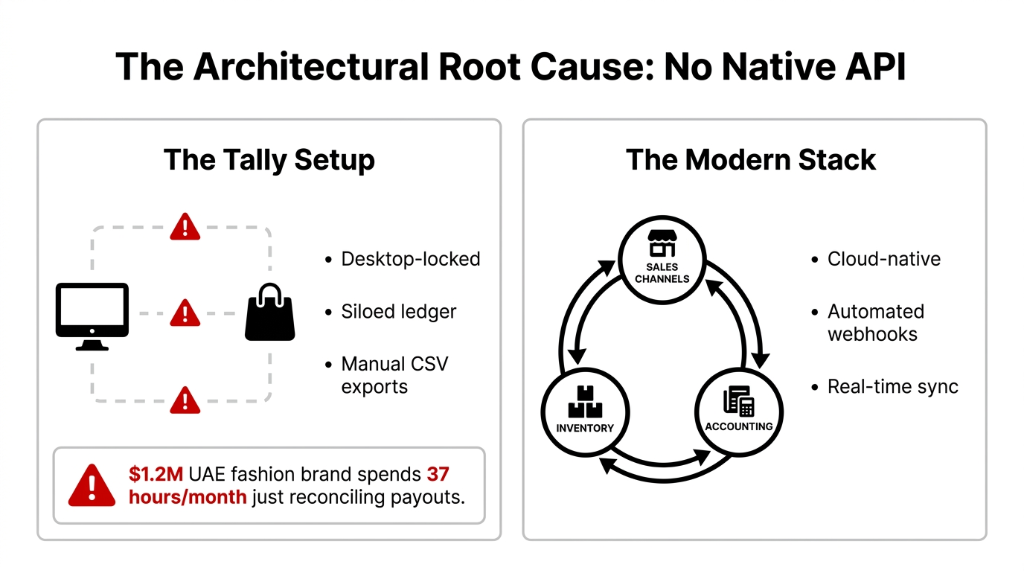
We worked with a D2C fashion brand out of the UAE doing $1.2M/year on Shopify + Noon.com. Their accounting team was spending 37 hours every month just reconciling Tally entries against Shopify payouts, Noon settlements, and their 3PL's Excel reports. That's the equivalent of paying a full-time accountant to do a job that should take 4 hours in a properly configured system.
The Bigger Problem: No Omnichannel Inventory
Tally doesn't support omnichannel inventory management. When your Noon warehouse ships 50 units and your Shopify store sells 30 more, Tally has no mechanism to reserve stock, prevent overselling, or trigger a reorder automatically. You find out you oversold when an angry customer emails you.
Not ideal.
Why "Just Add a Connector" Is Not the Answer
We hear this every single week: "We'll just get a Tally-to-Shopify connector plugin."
Frankly, this is the accounting equivalent of duct-taping a V8 engine to a bicycle. Those connectors cost anywhere from $150 to $400/month, break during peak sale periods *(Black Friday, Diwali, Prime Day)*, and still don't solve the core problem — Tally was built for statutory compliance, not for operational e-commerce.
The SKU Disaster Nobody Talks About
Tally's architecture is ledger-centric. The moment you need to track a specific SKU across 4 sales channels, manage return-triggered debit notes automatically, or see a real-time margin per product per channel — Tally makes you do that in Excel. And when your warehouse guy types a 0 instead of an O in the SKU field, you lose track of $5,000 worth of inventory that's sitting in your warehouse but showing as "zero stock" on your website. Orders get cancelled. Refunds go out. Customer trust dies.
Tally is not broken. It's just doing exactly what it was designed to do — and e-commerce operations are not in that design spec.
What Odoo Actually Does for E-Commerce Accounting
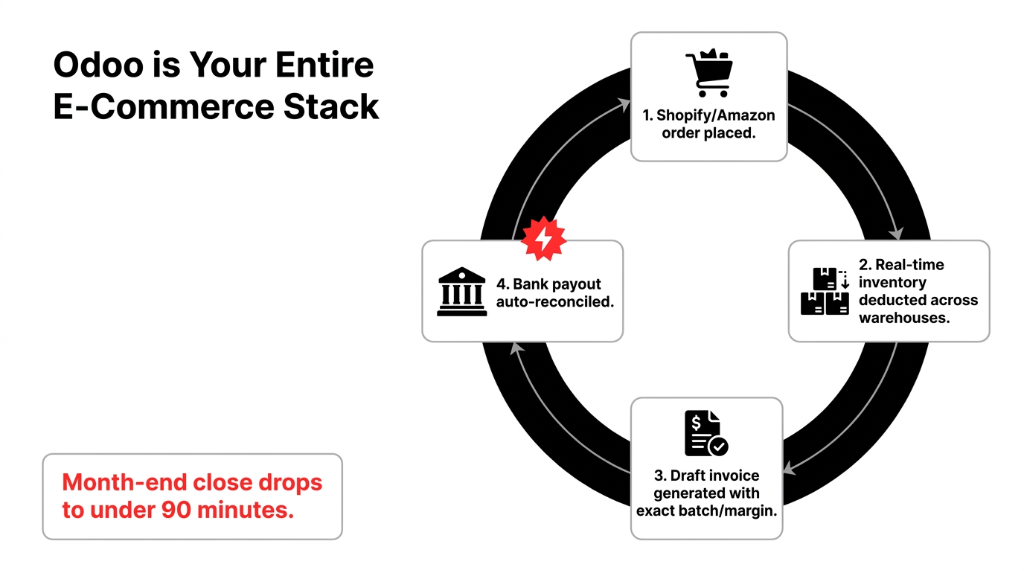
Here is where the story changes. Odoo's accounting module doesn't just sit next to your e-commerce stack — it is your e-commerce stack. When a Shopify order is placed, Odoo:
The Odoo Order-to-Reconciliation Flow
1. Creates a sales order automatically
2. Deducts inventory in real-time across all connected warehouses
3. Generates a draft invoice tied to the exact product, batch, and margin
4. Reconciles the Shopify payout when it hits your bank — automatically
5. Flags any discrepancy between the payout and the invoiced amount before your accountant even logs in
That last point is where brands that migrate from Tally to Odoo recover real money. In our last 23 implementations for e-commerce brands, we found an average of $11,300/year in unreconciled Shopify deductions that clients were simply writing off because they had no system to catch them.
Odoo also has 30,000+ third-party integrations — including native connectors for Shopify, Amazon, WooCommerce, Magento, and every major 3PL including ShipBob and ShipStation. These aren't plugins that break. They're maintained API connections with event-based triggers.
When your Amazon FBA sends a settlement file, Odoo parses it, maps every line item to the correct product, tax category, and warehouse, and posts the journal entry. Your accountant reviews, approves, and closes the month. Total time: under 90 minutes versus the 37 hours Tally demands.
The Numbers E-Commerce Founders Actually Care About
| What You're Comparing | Tally Prime | Odoo (Standard Plan) |
|---|---|---|
| License Cost | ~$600 one-time | $16.90/user/month (annual billing) |
| Shopify / Amazon Integration | Requires plugin ($150–$400/mo) | ✓ Native connector included |
| Real-Time Multi-Warehouse Stock | Manual updates | ✓ Auto-synced all locations |
| Automated Bank Reconciliation | Manual | ✓ AI-driven auto-reconciliation |
| Multi-Currency / Multi-Company | Limited | ✓ Built-in |
| Mobile Access | Desktop-only | ✓ Native mobile apps |
| API for Custom Integrations | None | ✓ Full REST API |
| Returns & Debit Note Automation | Manual entry | ✓ Automated workflow |
| Monthly Hidden Cost (connector + manual labor) | $2,100–$4,800/month | $0 (built-in) |
That last row is the one founders miss. Tally feels cheaper at $600 one-time. But when you add the third-party Shopify connector, the extra accountant hours, and the reconciliation errors you're not catching, you are paying $2,100 to $4,800 more per month than an Odoo Standard plan for a 10-person team at $2,028/year.
How a $2.3M Skincare Brand Cut Month-End Close from 11 Days to 2
The Migration Results (90 Days Post-Go-Live)
▸ Month-end close dropped from 11 days to 2 days
▸ $23,400 in return discrepancies caught and recovered in the first quarter
▸ Inventory accuracy went from 74% to 98.3% (they were shipping wrong products to Shopify orders because stock was out of sync)
▸ Accounting team headcount: stayed the same, but shifted from data entry to actual financial analysis
(We didn't hire anyone new. We just stopped paying people to do a machine's job.)
When Should You Actually Keep Tally?
Controversial take incoming: If your e-commerce revenue is under $150,000/year, stay on Tally.
Seriously. If you're running a small Shopify store, selling on one platform, shipping 20–30 orders a day, and your CA already knows Tally — don't migrate. The Odoo implementation cost ($4,000–$12,000 depending on complexity) and the 3-month learning curve will eat your margins.
Tally is genuinely excellent for Indian GST compliance, basic ledger management, and straightforward P&L reporting. Your CA will love you. Your auditor will have zero complaints.
The Tipping Point
But the moment you cross $400,000–$500,000 GMV, operate on 2+ sales channels, or run a warehouse with 200+ SKUs — Tally is actively costing you money.
Every month you stay on it past that threshold is a month you're paying hidden costs that don't show up in any P&L because Tally can't track them.
How Braincuber Handles the Tally-to-Odoo Migration
We do not do "lift and shift" migrations. That's how you lose 3 months of data integrity and end up with an Odoo that behaves exactly like your old broken Tally — just more expensive.
The 9-Week Migration Sequence
Week 1–2: Data Mapping
Map every Shopify product, variant, and SKU to Odoo's product catalog. Clean the data before it moves.
Week 3–4: Accounting Config
Chart of accounts, tax positions, and multi-currency setup aligned to your markets (US sales tax, UAE VAT, India GST — or all three).
Week 5–6: Integration
Connect Shopify and Amazon via native connector. Test order flow, return flow, and payout reconciliation with live data.
Week 7–8: Parallel Run
Both Tally and Odoo live simultaneously. Your team reconciles both. Any gap gets fixed here, not after go-live.
Week 9: Cutover
Tally becomes the archive. Odoo runs the business. Total timeline: 9–11 weeks for most e-commerce brands under $5M GMV.
5 FAQs: Odoo vs Tally for E-Commerce
Can Odoo handle Indian GST compliance the same way Tally does?
Yes — Odoo's Indian localization supports GST returns, e-invoicing (IRN generation), GSTR-1, GSTR-3B, and TDS. It's not as plug-and-play as Tally for a CA unfamiliar with Odoo, but post-setup it handles Indian compliance end-to-end. Most of our clients get their CA trained in under 2 weeks.
How much does it actually cost to migrate from Tally to Odoo?
For an e-commerce brand under $3M GMV on a single Shopify store with one warehouse, expect $4,500–$8,000 for implementation plus $16.90–$25.50/user/month on Odoo. Brands with multi-warehouse, multi-channel, or multi-company setups typically land between $10,000–$18,000 for implementation.
Will Odoo integrate with my existing Shopify store without rebuilding it?
Yes. Odoo connects to Shopify via a native connector that syncs products, orders, customers, inventory, and payments. You do not rebuild your Shopify store. The integration runs in the background. Order sync typically takes under 60 seconds from Shopify checkout to Odoo sales order.
What happens to 3–5 years of Tally data after migration?
Tally data gets exported, cleaned, and archived — not deleted. Opening balances and historical transactions move into Odoo. You can always reference old Tally files for audit purposes. We have never had a client lose historical accounting data in a Braincuber-managed migration.
Does Tally work for international e-commerce (USD, AED, GBP transactions)?
Tally has multi-currency support, but it's limited in practice — exchange rate management is manual, multi-company setups across geographies are clunky, and there is no automated forex reconciliation. Odoo handles multi-currency natively with real-time exchange rates, automated gain/loss postings, and full multi-company consolidation.
Tally was built for a CA's desktop in 2003. Your e-commerce business in 2026 runs on APIs, real-time inventory, Shopify webhooks, and Amazon settlement files that look nothing like a traditional ledger.
The question isn't "Odoo or Tally?" The question is: "How many more months am I willing to pay $3,000–$5,000 in hidden operational costs to avoid a one-time $8,000 migration?"
We've seen brands wait 18 months making that calculation. By the time they migrate, they've effectively paid for 3 Odoo implementations in wasted accountant hours and unrecovered payout deductions. Check your integration options and do the math yourself.
Stop bleeding cash on a system that wasn't built for you.
Book our free 15-Minute Operations Audit — we'll find your biggest accounting leak in the first call. Already know you need to move? See exactly how we migrated a $2.3M brand from Tally to Odoo in 9 weeks.
Book Your Free Audit