
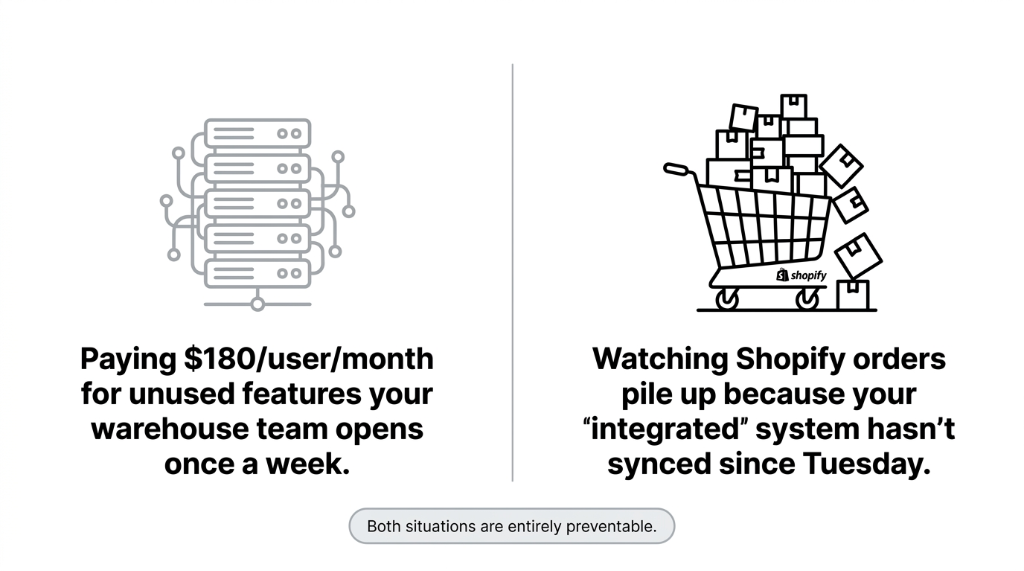
The Real Price Gap Nobody Talks About
Here's where most e-commerce founders get blindsided. They look at Microsoft Dynamics 365 Business Central at $70/user/month and think, "That's fine, we have 12 users — that's $840/month."
Wrong.
That $840 becomes something entirely different once you add implementation costs. For a mid-market e-commerce brand with 50–250 employees, a Dynamics 365 deployment runs $100,000–$400,000 in year one alone — and that's before you've customized a single workflow. Implementation takes 6–14 months. Your Q4 peak season will arrive before your system is live.
Odoo's full enterprise stack, by comparison, starts at $24.90/user/month with a total typical cost of $10,000–$80,000 — and goes live in 1–4 months.
The TCO Nobody Puts in the Proposal
| Cost Factor | Odoo | Microsoft Dynamics 365 |
|---|---|---|
| Licensing | $20–$40/user/month | $100–$200/user/month |
| Implementation | $5,000–$25,000 | $20,000–$100,000+ |
| Customization | Affordable; open-source community | Higher; certified partner-only |
| Annual Support | $1,000–$5,000 | $5,000–$20,000 |
| Typical Total Cost | $10K–$80K | $150K–$1M+ |
| Go-Live Timeline | 1–4 months | 6–14 months |
Frankly, if you're running a D2C brand doing $1M–$10M ARR, the Dynamics 365 sales rep has no business being in your inbox. The licensing alone will consume 3–5% of your annual revenue before you've shipped a single order through it.
Where Odoo Actually Wins for E-Commerce
We constantly see clients come to us after six months of fighting with custom-built WooCommerce connections or trying to force Shopify and Dynamics to talk through a middleware tool that fails every time there's a promotion spike.
Here's the ugly truth about Dynamics 365 Commerce: it's built for Walmart-scale omnichannel retail, not for a brand scaling from $2M to $8M. You'll spend $40,000 on a certified Microsoft partner to get your POS, inventory, and e-commerce storefront talking to each other. With Odoo, those modules ship in the same box.
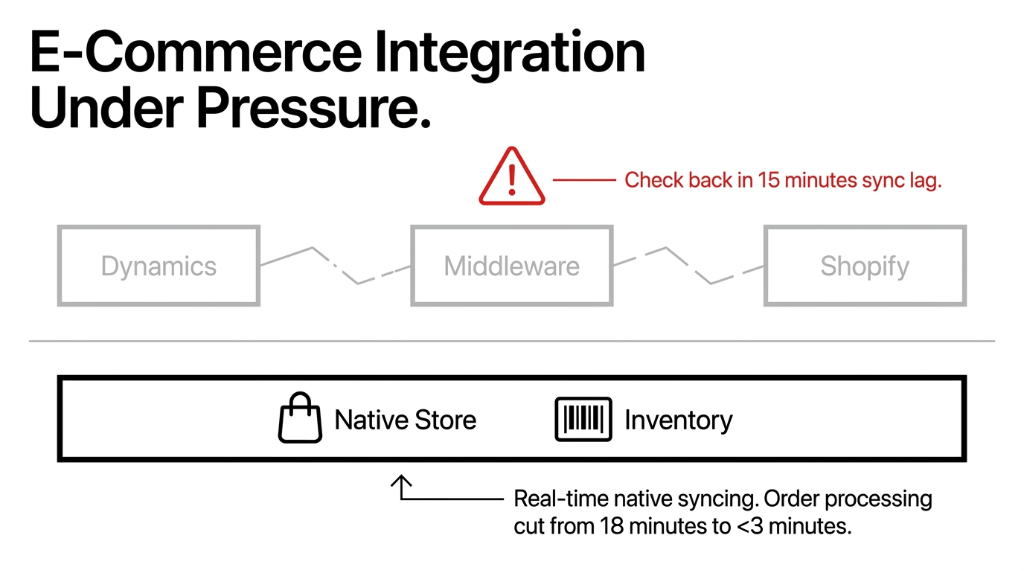
Odoo's integrated e-commerce, inventory, CRM, and POS modules are native to each other. When an order hits your Odoo store, inventory adjusts in real time — no Zapier, no ShipStation API nightmares, no "check back in 15 minutes" sync lag. We've seen clients cut order processing time from 18 minutes per order to under 3 minutes after going live on Odoo's integrated stack.
Odoo rates Strong in e-commerce integration versus Dynamics' Moderate in independent retail ERP research. That gap matters at 11 PM on a flash sale Friday when 500 orders hit simultaneously.
Insider Detail: Shopify API Rate Limits
Shopify's API rate limit has a ceiling during high-traffic events. Odoo's native e-commerce module doesn't have that problem because it's not an external integration — it's the same database. (Yes, this is why your middleware crashes during flash sales.)
Where Microsoft Dynamics 365 Earns Its Price Tag
Don't read this as an Odoo advertisement. We're telling you what the data says.
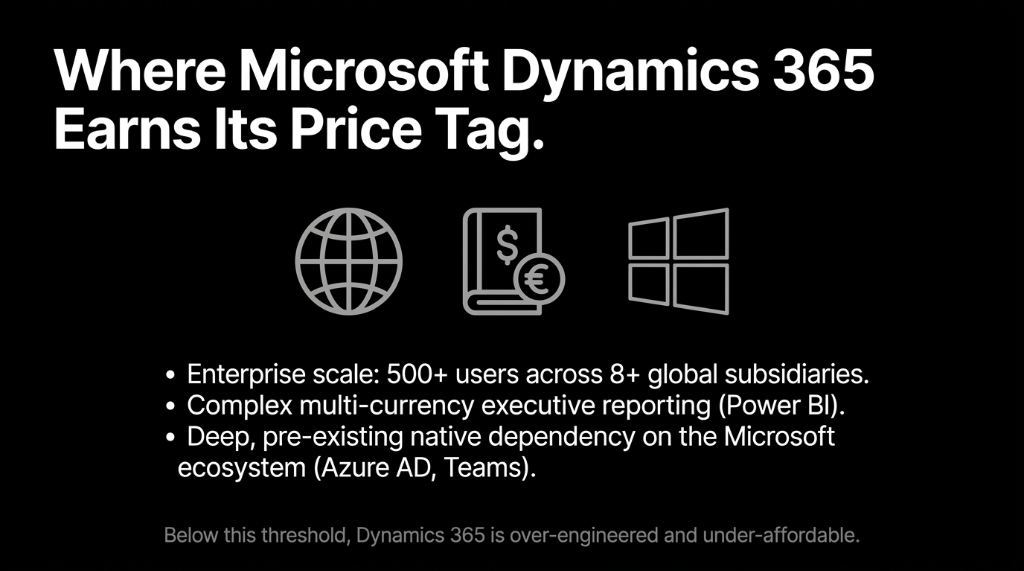
If your e-commerce operation runs across 8+ subsidiaries, multiple currencies, and requires Power BI dashboards for real-time executive reporting, Dynamics 365 is genuinely superior. A Saudi holding company deployed Dynamics 365 Finance & Operations for 500+ users across 8 subsidiaries with a $250,000 investment — and got unified financials and real-time cross-entity analytics that Odoo would struggle to replicate cleanly at that scale.
Dynamics 365's native integration with Microsoft 365, Teams, Azure AD, and Power BI is a legitimate competitive advantage for enterprise teams already living in the Microsoft ecosystem. If your warehouse managers are checking Teams on their phones and your finance team lives in Excel, Dynamics 365 will feel like one continuous workflow instead of five separate logins.
The supply chain module also rates Strong for enterprises — demand forecasting, vendor-managed inventory, and markdown optimization that Odoo's mid-tier MRP simply doesn't match.
The E-Commerce Scenario That Kills Brands
Here's a scenario we've walked three separate UK-based brands through in the last 18 months.
Brand A: Dynamics 365 Path
Timeline: Implementation started January. Still in UAT by April. Spring collection sitting in a warehouse with no live inventory system.
The Hack: Ran Q2 promotions manually in Excel, with VLOOKUPs linking their Shopify export to a handmade SKU sheet.
The Damage: $18,300 in overstock shipped to wrong fulfillment zones. Nobody caught the duplicate SKU entry.
Final Cost: Went live in August — seven months late, $140,000 over original quote.
Brand B: Odoo Path
Timeline: Live in 11 weeks. Shopify integrated via Odoo's native connector.
Inventory: Syncing every 4 minutes. Zero manual spreadsheets.
First-year ERP spend: $31,400 total. That's a $108,600 difference.
The Customization Reality
Everyone tells you Dynamics 365 is "highly customizable." Here's what that actually means: you will need a Microsoft Certified partner billing at $150–$250/hour to make any structural change to the system. Power Platform (Power Apps + Power Automate) is where your customizations live, and it's a separate cost layer on top of your existing license.
Odoo's open-source architecture means your developers — or ours — can modify any module at the code level. We've built custom AI-powered demand forecasting directly into Odoo's inventory module for a UAE home goods brand, cutting their overstock carrying cost by 41% in the first quarter post-deployment. That would have cost $80,000+ in Dynamics customization fees.
Odoo Studio, the low-code builder, lets non-technical users create custom views, fields, and approval flows without touching a line of Python. For a fast-moving e-commerce team that needs to change a returns workflow at 8 AM on a Monday, that matters enormously.
The Verdict: Which Platform for Which Business?
Stop asking "which is better." Start asking "which is right for my revenue band and operational complexity."
| Business Profile | Right Platform | Why |
|---|---|---|
| D2C brand, $500K–$10M ARR, Shopify-based | Odoo | Live in 60–90 days, integrated e-commerce, $10K–$50K total |
| Mid-market retailer, $10M–$50M, complex inventory | Odoo or Dynamics | Evaluate based on Microsoft stack dependency |
| Enterprise, 500+ users, multi-entity, Power BI | Dynamics 365 | Scale, governance, native Microsoft integration |
| On QuickBooks + ShipStation + Klaviyo + 3 Zaps | Odoo immediately | You're running a $5M business on duct tape |
Frankly, if you don't have $150,000 in your IT budget for year one, Dynamics 365 will damage your cash flow. That's not a harsh opinion — it's the math.
What Braincuber's Odoo Implementation Actually Looks Like
We don't hand you a license key and a user manual. In our last 47 Odoo e-commerce implementations across the US, UK, and UAE, here's what Week 1 through Week 12 looks like:
The 12-Week E-Commerce Go-Live
Weeks 1–2: Process Audit
Map every order, return, inventory, and finance flow your team actually uses — not what your old system was supposed to do.
Weeks 3–5: Core Config
Odoo e-commerce, inventory, accounting, and CRM set up against your real SKUs and customer segments.
Weeks 6–8: Integration
Shopify or WooCommerce connector + data migration from QuickBooks/Xero/legacy ERP — zero downtime on your live store.
Weeks 9–11: UAT
Testing with your actual team, not an IT consultant role-playing as a warehouse picker.
Week 12: Go-Live
Launch with 30-day hypercare support included. 94% of our clients are fully operational by Day 90.
Case Study: UAE Home Goods Brand
We built custom AI-powered demand forecasting directly into Odoo's inventory module. Result: Overstock carrying cost dropped 41% in the first quarter post-deployment. That customization would have cost $80,000+ in Dynamics fees. We did it for a fraction because Odoo's source code is open.
FAQs: Odoo vs Microsoft Dynamics for E-Commerce
Is Odoo cheaper than Microsoft Dynamics 365 for e-commerce?
Yes — significantly. Odoo Enterprise starts at $24.90/user/month with a total implementation cost of $10,000–$80,000. Microsoft Dynamics 365 starts at $70/user/month and typically costs $100,000–$400,000 for a mid-market deployment in year one, before advanced customization.
Can Odoo handle a high-volume Shopify store?
Yes. Odoo's native e-commerce and inventory modules sync in real time, and its Shopify connector handles concurrent order volumes without the API rate-limit problems that affect third-party middleware tools. Brands processing 2,000+ orders/day run cleanly on Odoo's stack.
When does Dynamics 365 make sense over Odoo?
When you have 500+ users, operate across multiple legal entities in different countries, need native Microsoft 365 and Power BI integration, and have $150,000+ allocated for year-one ERP spend. Below that threshold, Dynamics 365 is over-engineered and under-affordable.
How long does Odoo e-commerce implementation take?
Between 1 and 4 months for most mid-market brands. Braincuber's standard e-commerce implementation (Shopify + Odoo inventory + accounting) goes live in 10–12 weeks. Microsoft Dynamics 365 typically takes 6–14 months for the same functional scope.
Can we migrate from Dynamics 365 to Odoo without losing data?
Yes. We've handled 11 Dynamics-to-Odoo migrations in the last 24 months. The process involves structured data export from Dynamics, field mapping to Odoo's schema, and a parallel run period of 2–3 weeks before full cutover. No live store downtime required.
Pull up your last ERP integration invoice. Divide the total by the number of orders it actually processed last quarter. If your cost-per-order is above $0.85 — your ERP is eating your margins, not protecting them.
Stop bleeding cash on ERP licensing that costs more than your entire marketing budget.
Book Braincuber's free 15-Minute Operations Audit — we'll identify exactly where your current e-commerce stack is leaking money and whether Odoo or a different approach is the right fix for your specific operation. No pitch. No fluff. Just the honest answer your P&L needs.
Book Your Free 15-Min Audit