
The Real Mess Behind "Outsourced Fulfillment"
Here is what actually happens when you send orders to a 3PL without a proper Odoo integration. Your warehouse team at the 3PL picks, packs, and ships an order. They update their WMS — maybe Manhattan, GEODE, or a proprietary system. That update does not reach your Odoo instance for hours, or in some cases, not at all without a manual export-import cycle.
Meanwhile, your sales team on Shopify or your B2B portal is still showing that stock as available. A second customer orders the same last unit. You oversell. You issue a refund. You pay a re-shipping fee. The customer leaves a 1-star review. The total cost of one oversell incident averages $148 when you add labor, refund processing, and customer acquisition replacement cost. Multiply that by 3–5 incidents a week, and you are leaking $2,300+ a month before lunch on Tuesday.
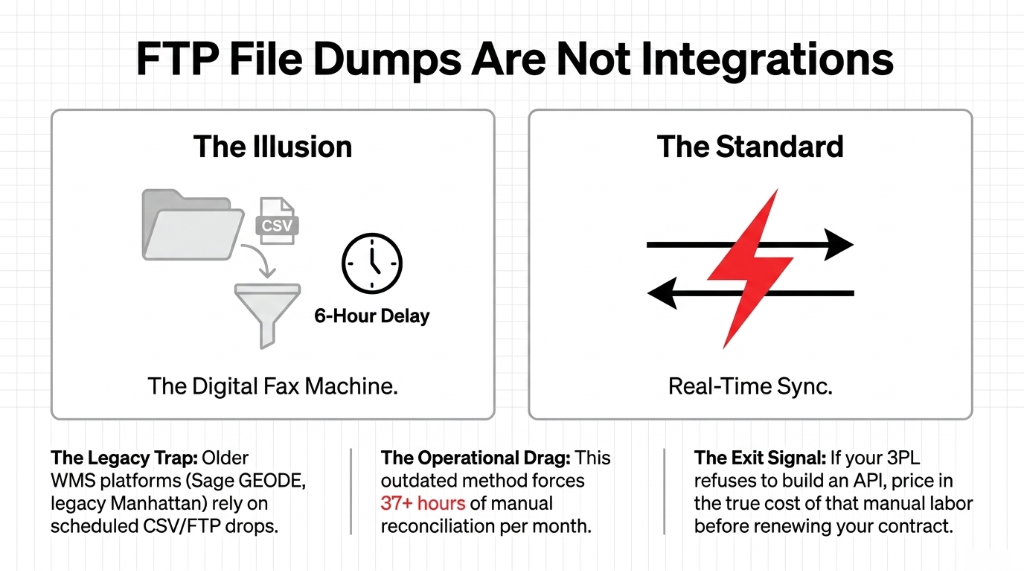
When your 3PL is using an older WMS like Sage GEODE or a legacy EDI-based system, the "integration" many Odoo partners pitch is literally an FTP file dump — a CSV lands in a folder every few hours, a cron job picks it up, and your Odoo inventory updates. That is not an integration. That is a digital fax machine with a 6-hour delay. *(Yes, this is the "solution" being sold to mid-market brands right now.)*
The 3PL Data Gap: By The Numbers
$31,000–$47,000
Annual cost of 4–24 hour data lag on a $2M/year operation — over-selling, mis-ships, and manual reconciliation combined
$148/incident
True cost of one oversell event including labor, refund processing, and customer acquisition replacement — multiply by 3–5x per week
37+ hours/mo
Manual reconciliation time imposed by FTP-only 3PLs — worth more than the 3PL cost itself at typical ops team rates
Why the "Just Use an App" Advice Keeps Failing
Everyone tells you to grab a connector module from the Odoo App Store, flip a switch, and walk away. Don't. We have seen brands spend $1,200–$3,500 on off-the-shelf 3PL connector modules that only push outbound delivery orders to the 3PL — no stock feedback, no tracking number return, no return shipment sync.
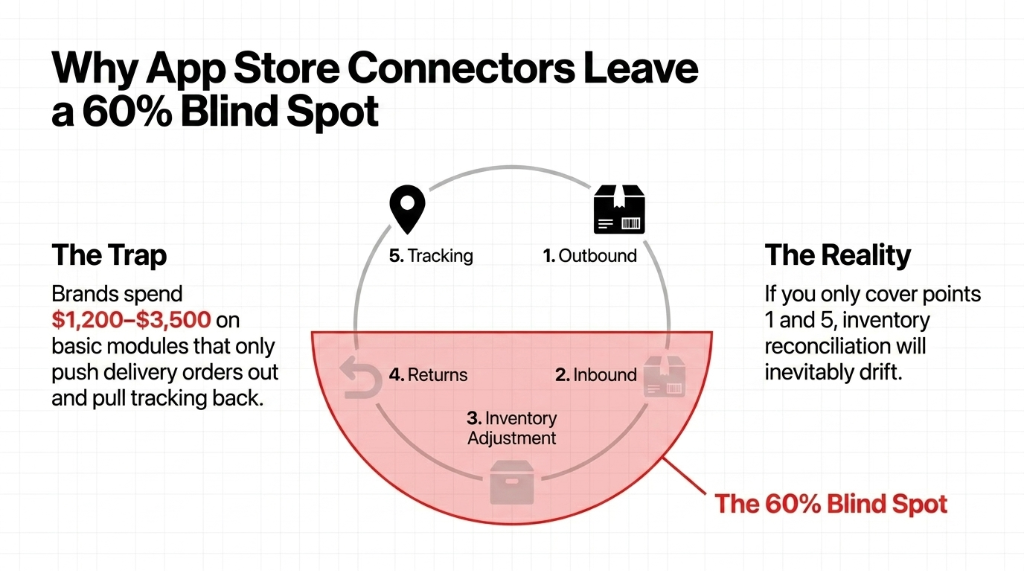
What you actually need is a bidirectional data flow across five events: Outbound (sales order to delivery order to 3PL WMS), Inbound (purchase order to expected receipt to 3PL GRN confirmation back to Odoo), Inventory Adjustment (3PL cycle count to Odoo stock adjustment), Returns (customer return at 3PL to return picking validated in Odoo to refund trigger in accounting), and Tracking (3PL dispatch event to tracking number written to Odoo delivery to Shopify/B2B portal).
If your integration covers only outbound and tracking, you are operating with a 60% blind spot. The inventory reconciliation will drift. It always drifts.
The Controversial Opinion
Most Odoo 3PL connectors on the market are built for the 3PL's convenience, not yours. They push your orders out but don't pull status back with any reliability. The ones that do it right — real-time, API-based, bidirectional — require custom development or a proper integration partner who actually understands both Odoo's stock move model and the 3PL's data schema.
How Odoo's Native Architecture Actually Handles 3PL
Here is the insider knowledge your Odoo reseller probably didn't tell you. Odoo's inventory module was designed for this. The Owner field at the product level — a core feature that became operationally mature in Odoo 17 and was significantly enhanced in Odoo 19 — lets a 3PL tag every stock move, lot, serial number, and package to a specific client. Your inventory is segregated by legal ownership, not just location.
The Full Odoo 3PL Stack (When Configured Correctly)
- Odoo Inventory: Multi-warehouse, multi-client stock segmentation with the Owner field — segregation by legal ownership, not just location
- Odoo Barcode: Scan-to-validate workflows cutting pick errors from roughly 4.2% with paper processes to under 0.8% with guided scanning
- Odoo Quality: QC checkpoints embedded into inbound receipts — damage or short-shipment flagged before stock is put away
- Odoo Manufacturing (BoM-based kitting): 3PL value-added services like bundling, gift wrapping, or assembly kits for subscription boxes and promo bundles
- Odoo Customer Portal: Real-time visibility into stock levels, lot numbers, and packaged pallets — no more emailing the 3PL to ask "how many units do we have left?"
- Odoo Subscriptions + Invoicing: Storage duration, handling moves, and quality check counts converted into automated, itemized invoices — eliminating the monthly spreadsheet battle over billing
Real Result
A B2B eCommerce brand implemented this stack with custom 3PL connectors and saw a 70% reduction in fulfillment delays and 50% fewer shipping errors within the first quarter post-go-live.
This is the same multi-module orchestration we bring to all our Odoo ERP integration services — connect Inventory, Barcode, Quality, and Invoicing into a single pipeline that your 3PL can't break.
The Integration Architecture: API vs. EDI vs. FTP
Not all 3PLs offer the same integration path, and picking the wrong one upfront will cause you to rebuild the integration 18 months later.
| Method | Latency | Best For | Watch Out |
|---|---|---|---|
| REST API (JSON) | Real-time (<2 min) | Modern 3PLs with documented APIs | Rate limits during peak events like Black Friday |
| EDI (850/856/940/945) | 15–60 min batches | Large enterprise 3PLs (UPS Supply Chain, XPO, Ryder) | $8,000–$22,000 setup cost for mapping |
| SFTP/FTP File Exchange | 1–6 hours | Legacy WMS (GEODE, older Manhattan) | Data drift, no error handling, manual reconciliation |
| Odoo Native + 3PL Module | Real-time (within Odoo) | 3PLs running Odoo themselves | Rare; requires compatible Odoo versions |
The Exit Signal
If your 3PL is still running FTP-only and refusing to build an API, that is your exit signal. The operational drag they impose — 37+ hours of manual reconciliation per month at typical ops team rates — is worth more than the 3PL cost itself.
Price in the true total cost of that relationship before you renew the contract.
What the Implementation Actually Looks Like (No Sugarcoating)
We have done this enough times to give you honest timelines. A proper Odoo–3PL integration has four phases.
Phase 1 — Mapping (Week 1–2)
Document every data flow. What does the 3PL's API send for a receipt confirmation? What fields map to Odoo's stock move model? What is the 3PL's SKU format vs. your Odoo internal reference? This mismatch alone is responsible for $5,000–$14,000 in mis-allocated inventory in our first audit of most new clients.
Phase 2 — Development (Week 3–6)
Build the connector. If the 3PL has a documented REST API, a skilled Odoo developer can build the bidirectional sync in 80–120 hours. EDI mappings take longer — plan for 160–220 hours. FTP connectors take the least development time but the most ongoing maintenance time. Ironically.
Phase 3 — UAT + Parallel Run (Week 7–8)
Run both your old process and the new integration simultaneously for two weeks. Compare stock levels daily. You will find edge cases — split shipments, partial receipts, lot number conflicts. Fix them before go-live.
Phase 4 — Go-Live + Monitoring (Week 9+)
The first 30 days post-go-live require active monitoring. Watch for sync failures, webhook timeouts, and the inevitable moment when the 3PL "upgrades their system" without telling you and breaks the API contract. (This happens to every client at least once. We build alerting for it on day one.)
This is the same phased methodology we follow across all our Odoo implementation services — map first, build second, test in parallel, and monitor aggressively post-go-live.
The Cost of Waiting Is Not Zero
Brands scaling from $500K to $5M ARR almost universally hit the 3PL integration wall around $1.2M in annual revenue. That is the point where manual reconciliation starts requiring a dedicated ops headcount — typically $52,000–$68,000/year for a logistics coordinator whose primary job is copying data between systems.
A properly configured Odoo 3PL integration eliminates that role entirely. The integration runs 24/7, catches discrepancies in real time, and feeds your Odoo dashboards with clean, current data. The total implementation cost for a mid-market brand is typically $12,000–$28,000 depending on the 3PL's API maturity. The payback period, based on eliminated labor and error costs, is consistently under 7 months across the projects we have delivered.
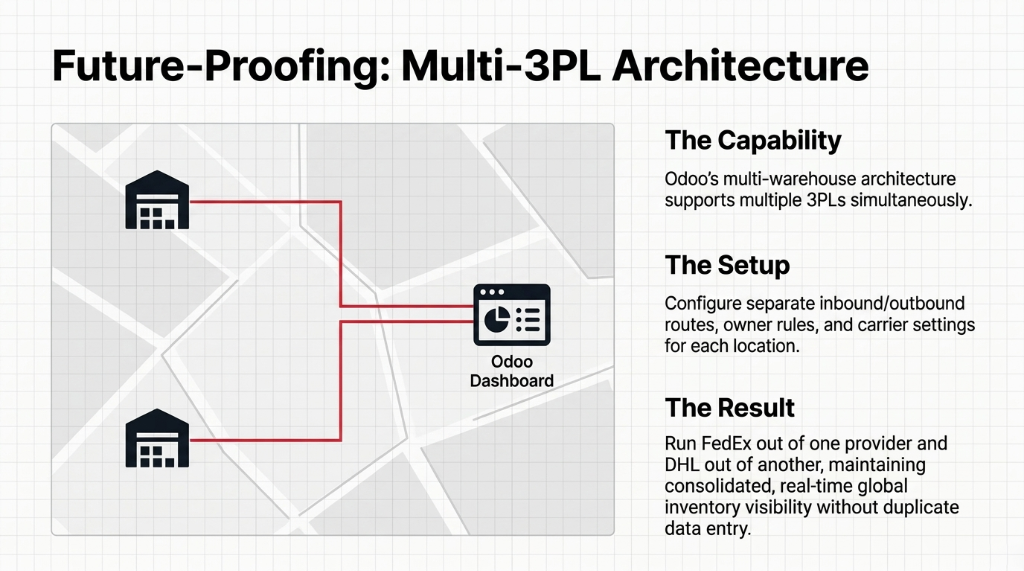
When you are ready to scale past the single-3PL model, our inventory management system setup handles multi-warehouse, multi-3PL architectures natively — FedEx out of one provider, DHL out of another, consolidated visibility in a single dashboard.
The Math Is Not Complicated
$52,000–$68,000/year in dedicated reconciliation headcount vs. $12,000–$28,000 one-time integration cost with under 7 months payback. The decision to delay is what costs you.
Your 3PL Integration Questions, Answered
Does Odoo support multi-3PL setups with different providers?
Yes. Odoo's multi-warehouse architecture lets you configure separate warehouse locations for each 3PL, each with its own inbound/outbound routes, owner rules, and carrier settings. You can run FedEx out of one 3PL and DHL out of another simultaneously, with consolidated inventory visibility in a single dashboard.
What is the minimum Odoo version needed for a production-grade 3PL integration?
Odoo 16 is the baseline for stable 3PL workflows, but Odoo 17+ is strongly recommended. Odoo 19 introduced significant improvements to the Owner field, barcode-guided flows, and the billing dashboard specifically for 3PL use cases. Running Odoo 14 or 15 creates upgrade debt you will pay for in 18 months.
How does Odoo handle 3PL billing — do we need a separate invoicing system?
No. Odoo's Subscriptions and Invoicing modules handle 3PL billing natively. Storage duration, handling move counts, quality check fees, and carrier surcharges all feed into a billing dashboard. An accountant can generate a fully itemized client invoice in under 4 minutes — compared to the industry average of 2.3 hours using spreadsheet-based billing.
Can we integrate Odoo with a 3PL that does not have an API?
Yes, but accept the trade-offs. FTP/SFTP-based integrations using structured CSV or EDI files work for 3PLs with legacy WMS platforms. Data latency is 1–6 hours, manual error handling is required for exceptions, and ongoing maintenance is higher. Any provider processing 500+ orders/day in 2026 should have an API or at minimum an EDI endpoint.
How long does a full Odoo–3PL integration take from kickoff to go-live?
For a 3PL with a documented REST API, plan for 8–10 weeks including a 2-week parallel run. EDI-based integrations run 12–16 weeks due to mapping complexity. The biggest delay is never development — it is getting the 3PL's technical team to provide accurate API documentation and a sandbox environment.
Stop Bleeding Cash on Manual Reconciliation and Fulfillment Errors
Book our free 15-Minute Operations Audit. We will identify your biggest 3PL data gap in the first call — the stale inventory feed, the missing return sync, the oversell pattern you have not quantified yet. No fluff. No pitch. Just a real number.
Get Your Free 3PL Integration Audit