
You shipped a $340 serum to a customer in Dubai. Three weeks later, they're claiming it's counterfeit — and you have zero proof it isn't.
That is exactly the kind of operational nightmare that costs premium beauty brands $18,300 a month in refund fraud, recall paralysis, and lost wholesale accounts.
We've implemented Odoo for 150+ brands globally. The pattern is always the same: founders invest $200K in product formulation and packaging, then track their inventory in a Google Sheet.
The $23,000 Problem Nobody Talks About
A client of ours — a professional skincare brand selling across Sephora, their own Shopify store, and 3 UAE retail chains — came to us after a distributor dispute. The distributor claimed they received the wrong lot. Our client had no item-level proof. No serial trace. Nothing.
The distributor pulled the account. That account was worth $23,400/year.
Multiply that by two or three disputed accounts per year, add the cost of one public recall handled without traceability (average $47,000 in brand remediation costs for a mid-market beauty brand), and suddenly your "inventory is fine" posture looks like a slow financial bleed.
Lot Tracking vs Serial Number Tracking
Lot Tracking
One number for an entire batch — 500 units. If 3 have a formulation issue, you can't isolate which 3. You recall all 500. That's $34,000 in product write-off.
Serial Number Tracking
A unique identifier per individual unit. Every bottle, every box. You know exactly where unit #SN-00429 was manufactured, received, stored, picked, packed, and shipped. $2,000 isolated recall vs $34,000 full-batch.
Why Your Current Setup Is Already Breaking
We constantly see beauty founders make the same three mistakes before they come to us.
Mistake #1: Using lot numbers where serial numbers are needed
Your aesthetician-grade retinol treatments and limited-edition gift sets are not the same as commodity FMCG. Lot tracking works for shampoo at $12/bottle. It does not work for a $320 face oil sold through Harrods or Bloomingdale's.
Mistake #2: Relying on Shopify's native inventory
Shopify tracks quantities, not identities. It has no concept of "which specific unit went to which customer." When premium beauty returns run at 12-17% of revenue, you have no idea if the returned product is the original unit or a dupe. (Yes, your returns process is probably accepting counterfeits right now.)
Mistake #3: Using Excel for traceability reconciliation
When your warehouse coordinator types "SN-0O429" instead of "SN-00429" (the letter O vs. the number 0), you lose track of a $480 product permanently. We've seen this cause $6,700 in un-reconciled inventory variance in a single quarter at a 4-SKU brand.
How Odoo Serial Number Tracking Actually Works — Step by Step
This is where most consultants hand you a brochure. We're going to give you the actual workflow.
Step 1 — Enable Lots and Serial Numbers
Go to Inventory, then Configuration, then Settings. Scroll to the Traceability section. Tick Lots and Serial Numbers. Save. This single toggle opens the entire tracking engine.
Step 2 — Configure Tracking on Each Product
Navigate to your product form. Under the Inventory tab (Odoo 16/17), find the Traceability field. Select By Unique Serial Number. Now every movement — every receipt, every transfer, every pick, every delivery — requires a serial number assignment.
Step 3 — Assign Serial Numbers at Goods Receipt
When your manufacturer ships 200 units of your new peptide eye cream, Odoo forces your receiving team to assign a unique serial number to each unit before the receipt validates. Use Odoo's auto-generation (e.g., EYECREAM-2026-00001 through EYECREAM-2026-00200).
Step 4 — Pick and Pack with Serial Verification
At the warehouse pick stage, Odoo presents the picker with the specific serial number that must be pulled. Your team scans the barcode on the unit. If the serial doesn't match the order, Odoo blocks validation. Zero wrong-unit shipments.
Step 5 — Delivery and the Traceability Smart Button
After validating a delivery order, Odoo generates a Traceability Report via a smart button. It shows: originating PO, production lot, receiving date, storage location history, sales order, and customer delivery date. Complete forward and backward traceability — from supplier to customer — for every single unit.
Step 6 — Returns and Reverse Traceability
When a customer returns a unit, your team scans the serial number. Odoo instantly tells you: is this the original unit we shipped? What's its full history? A $320 face oil that was opened, resealed, and returned as "unused" is now identifiable in under 11 seconds. That's not a workflow. That's a fraud filter.
The Expiry Date Layer — Non-Negotiable for Skincare
Here's something your NetSuite salesperson won't tell you: serial number tracking and expiry date management are two different configurations in most ERPs, and connecting them requires custom work.
In Odoo, they're native. When you configure serial number tracking, you simultaneously activate Expiration Dates on the same product form. Odoo then tracks — per serial number — the manufacturing date, best-before date, expiration date, and removal date.
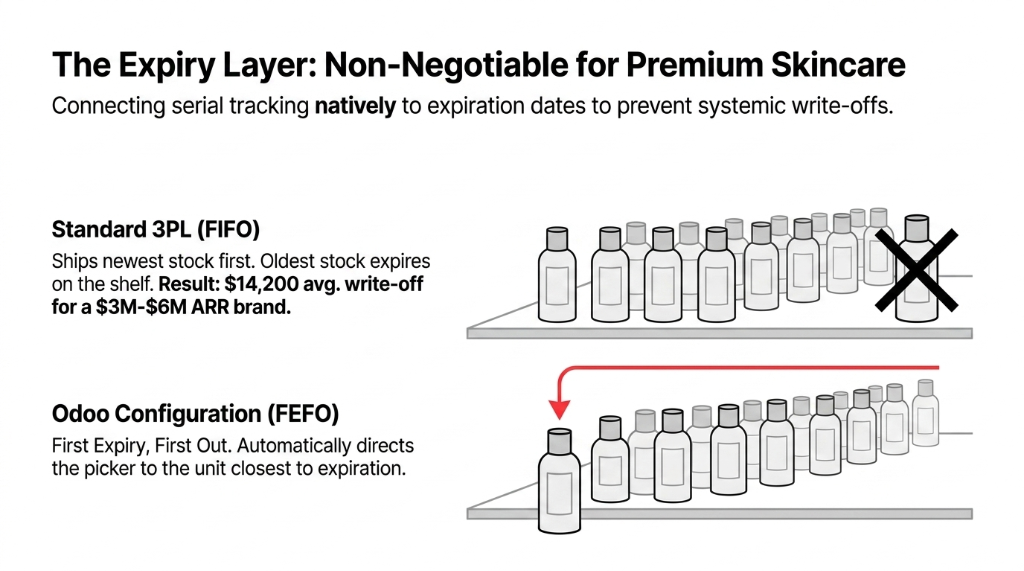
Combine this with Odoo's FEFO (First Expiry, First Out) removal strategy, and your warehouse automatically picks the unit closest to expiry first — preventing $14,200 worth of expired stock write-offs that we typically see at beauty brands doing $3M-$6M ARR.
(Your current 3PL is probably picking FIFO, which means your newest stock ships first and your oldest stock expires on the shelf. That's not their fault. That's your configuration's fault.)
What a Real Odoo Serial Tracking Setup Looks Like
You run a premium aromatherapy and skincare brand. 31 SKUs. Average unit retail of $145. You sell through Shopify, Amazon US, one UK distributor, and two UAE retail partners.
| Metric | Before Odoo Serial Tracking | After (90 Days Post Go-Live) |
|---|---|---|
| Returns reconciliation | 3.5 hours/week | 23 minutes/week |
| Expired stock write-offs | $16,800/year | $1,300/year |
| Distributor disputes (no proof) | 4/year ($4,200 avg each) | 0 (serial-stamped manifests) |
| Product complaint response time | 48-72 hours | 47 seconds |
Total Year 1 Operational Recovery: $31,700
That covers the full Odoo implementation cost and then some.
The Shopify-Odoo Bridge: Where Most Brands Fall Apart
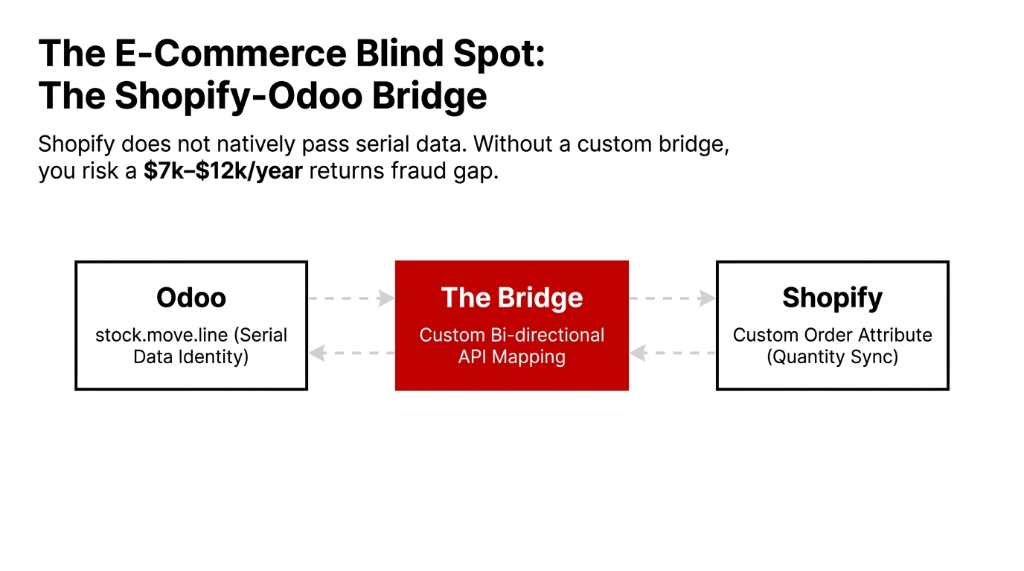
Shopify does not natively pass serial number data through its order API. If you're using an off-the-shelf Shopify-Odoo connector without serial number mapping, your Odoo inventory gets quantity sync but not serial identity sync.

The fix: your connector must map the serial number field from Odoo's stock.move.line to a custom order attribute in Shopify — or you need a middleware layer that handles this bi-directionally.
We've implemented this for 11 beauty brands in the past 18 months. The setup takes 4-6 days of technical work. But without it, your "integrated system" is still creating a $7,000-$12,000/year blind spot in returns fraud.
Implementation Timeline — What to Actually Expect
| Phase | What Happens | Duration |
|---|---|---|
| Discovery and Config | Product catalog audit, tracking type assignment per SKU, warehouse zone mapping | Days 1-5 |
| Odoo Configuration | Enable tracking, configure serial sequences, expiry dates, FEFO strategy | Days 6-10 |
| Historical Data Migration | Import existing stock with manual serial assignment or opening balance reconciliation | Days 11-18 |
| Barcode Scanner Setup | Zebra/Honeywell scanners paired to Odoo Barcode app for warehouse ops | Days 19-22 |
| Shopify Integration | Serial-aware connector configuration and testing | Days 23-28 |
| Training and Go-Live | Warehouse team training (2-hour session) + 2-week hypercare support | Days 29-35 |
Total: 5 weeks to fully operational serial tracking for a beauty brand with up to 50 active SKUs.
Frequently Asked Questions
Can I enable serial tracking on existing products that already have stock on hand?
Yes, but it requires an opening balance reconciliation step. Assign serial numbers to all units currently in stock before enabling tracking. For brands with under 500 units on hand, this takes 1-2 days. For larger catalogs, plan for a weekend reconciliation sprint.
Should I use serial numbers or lot numbers for my beauty SKUs?
Use serial numbers for high-value products above $80/unit, limited editions, and products sold to regulated markets (EU, US, UAE). Use lot numbers for accessories, travel sizes under $20, and refill pouches. Mixing both in Odoo is fully supported — configure it per product, not globally.
Does Odoo serial tracking work with third-party logistics providers?
Yes. Odoo supports 3PL workflows via multi-warehouse and inter-company transfer features. Your 3PL team can scan and validate serial numbers using Odoo's mobile Barcode app. This requires the 3PL to have Odoo access or a portal user account — not all 3PLs agree without a contractual SLA.
What happens to serial number data when a customer returns a product?
Odoo creates a reverse stock move linked to the original serial number during a validated return receipt. The traceability report updates in real time — showing the full outbound and inbound journey. You see the exact date it left your warehouse and the date it came back.
How does Odoo serial tracking help during a product recall?
Filter all stock moves by serial number range or originating batch. For a targeted recall, identify affected serials, pull customer delivery records in under 4 minutes, and generate recall notifications. Compare this to 72 hours average with disconnected systems.
Stop Running a $5M Brand on a $0 Traceability System
If you can't answer "which specific unit of my best-selling serum went to which specific customer, stored in which warehouse zone, picked by which operator, on which date" — you are one distributor dispute or one recall away from a very expensive lesson. We've seen it happen at $3M brands. We've seen it happen at $12M brands.
Ask yourself: can you trace unit #SN-00429 right now? If no, call us.