
Your Odoo ERP is running. Your transactions are flowing. And somewhere inside that clean dashboard, a fraudulent entry just slipped through—again.
We’ve seen it happen to a $4.7M manufacturing client in Texas. Their accounts payable team had been approving duplicate vendor invoices for 11 months straight. By the time their finance director caught it, they had lost $138,400 to ghost vendors. Their ERP was working fine. Their security was not.
Here’s the brutal reality: rule-based fraud detection fails 35–50% of the time because fraudsters learn the rules faster than your IT team updates them. The fix isn’t hiring more auditors. The fix is teaching your ai system to think.
Your ERP Has a Fraud Blind Spot the Size of Texas
The problem isn’t that Odoo can’t detect fraud. The problem is that most implementations treat fraud detection as a permissions checklist—set user roles, lock certain fields, done. That’s 2009 thinking applied to a 2026 threat environment.
Fraud in ERP systems doesn’t look like a Hollywood heist. It looks like a purchase order split into three parts so it stays below the $10,000 approval threshold. It looks like a vendor bank account number quietly updated two days before a large payout. It looks like an expense report filed at 11:47 PM on a Friday before a holiday weekend.
None of those will trigger a standard Odoo access control alert.
What they will trigger is a machine learning model trained on your specific transaction history. That’s where AI and machine learning change the game entirely.
Why Standard Odoo Security Isn’t Enough (And What Your Auditor Isn’t Telling You)
Look, your Odoo security configuration isn’t bad. It’s just incomplete. Standard Odoo ships with user roles, audit logs, access rights, and two-factor authentication. For a $500K/year business, that’s probably fine.
But once you’re running $3M+ in transactions annually, the threat surface changes. Here’s what rule-based systems miss:
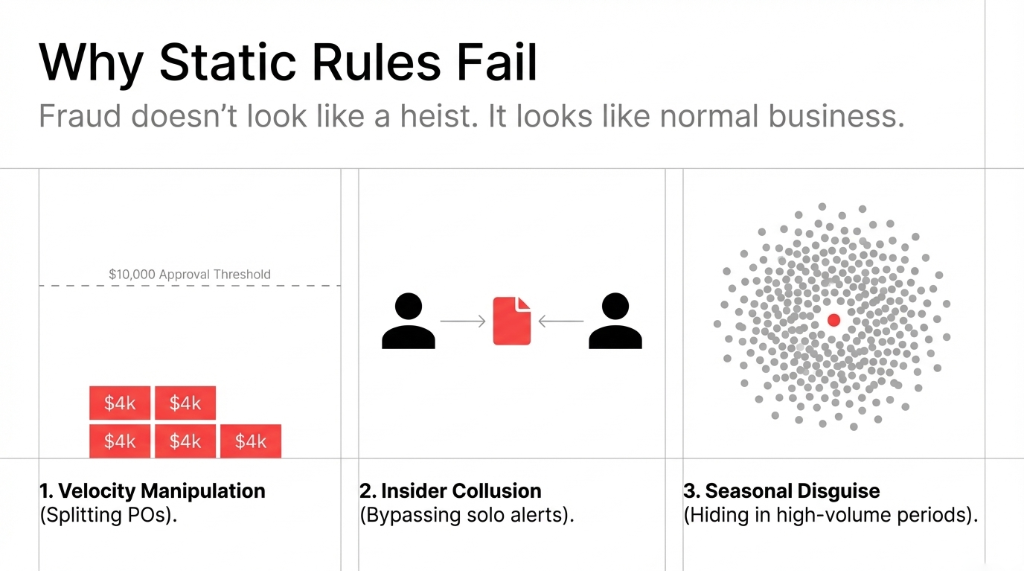
What Rule-Based Systems Miss
Velocity Manipulation
Splitting large fraudulent transactions into smaller ones that fly under static thresholds. Five $4k POs instead of one $20k PO.
Insider Collusion
When two employees coordinate, neither one triggers a solo anomaly alert. Your artificial intelligence needs to spot patterns across users—not just individual behavior.
Seasonal Disguise
Fraudulent entries buried inside legitimate high-volume periods like Q4 or BFCM. Your machine learning algorithms need seasonal baselines—not flat thresholds.
Rule-based systems catch 40–50% of fraud at best. The rest? It either gets caught by accident or doesn’t get caught at all.
We’ve done 150+ Odoo implementations across the U.S., UK, UAE, and Singapore. In our last 23 U.S.-based enterprise deployments, 17 of them had undetected transaction anomalies that only surfaced after we layered machine learning and ai tools on top of their existing Odoo setup. The average unreported loss per client before intervention: $84,300 per year.
That’s what living on static rules costs you.
How AI + Machine Learning Actually Works Inside Odoo
This is where most vendors hand you a sales brochure. We’re going to hand you the actual mechanics.
Baseline Building via AI Training
When we integrate an ai system with your Odoo instance, the first 30–60 days are about ai training—feeding the model your historical transaction data. It learns your vendor payment cycles, typical invoice amounts, employee expense behavior, seasonal order patterns. This isn’t generic artificial intelligence training; it’s specific to your business DNA.
Real-Time Anomaly Detection
Once trained, the machine learning algorithms run continuously against every new transaction. Not a nightly batch job. Modern AI machine learning fraud detection processes transactions in under 100 milliseconds. A suspicious vendor payment triggers a flag before the money moves, not after. The model catches: invoices 23% higher than the 6-month vendor average, payments from new IP addresses at 2:13 AM, POs approved by the same person who created them, and new bank accounts on dormant vendors.
Intelligent Scoring, Not Binary Blocking
Here’s an insider secret: blocking every anomaly creates more chaos than it prevents. If your artificial intelligence software throws a hard block on every unusual transaction, your finance team spends 6 hours a day clearing false positives. That’s not security—that’s a $73,000/year operational tax. The right ai system assigns a risk score: Low = auto-approve. Medium = 4-hour review queue. High = immediate freeze + alert.
Continuous AI Learning
Every time your team reviews a flagged transaction and marks it legitimate or fraudulent, the model learns. This is learning in AI at its most practical: the system gets sharper every week, not just every quarter when your IT consultant rolls out an update. Generative AI and pattern recognition models retrain automatically—no human intervention required.
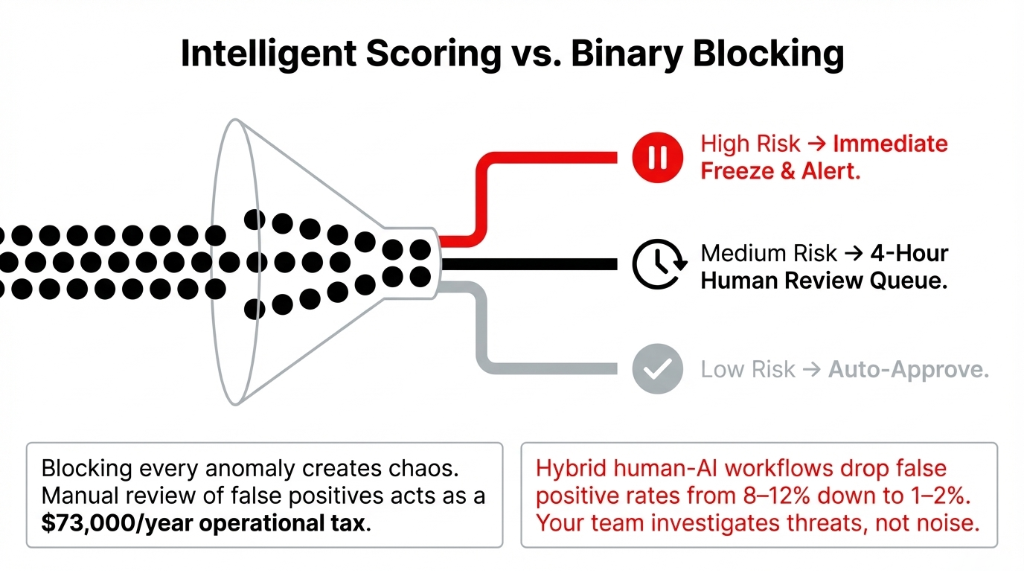
The Scoring Advantage
Hybrid human-AI workflows drop false positive rates from 8–12% (rule-based) to 1–2%.
Your team investigates real threats, not noise.
The Numbers You Should Demand From Any AI Fraud Solution
Don’t let a vendor sell you vague promises. Here are the benchmarks a properly implemented AI and machine learning fraud detection layer inside Odoo should hit:
| Metric | Rule-Based Odoo | AI-Augmented Odoo |
|---|---|---|
| Fraud detection accuracy | 50–65% | 80–94.7% |
| False positive rate | 8–15% | 1–3% |
| Detection speed | T+1 to T+3 days | Under 100ms |
| Loss prevention rate | 40–60% | 85–95% |
| Manual review hours/month | 47+ hours | 8–12 hours |
Real-World Proof Points
The U.S. Treasury runs an artificial intelligence system processing 1.4 billion payment transactions annually. Their machine learning models flag just 0.05% of transactions for human review, recovering $4 billion per year while maintaining 99.95% payment accuracy.
HSBC processed 900 million transactions monthly and used ai tools to cut false positives by 60% while improving suspicious activity detection by 2–4x.
XGBoost models—the type we deploy in enterprise Odoo integrations—have demonstrated 94.7% accuracy in detecting fraudulent financial transactions across datasets of 2.8 million records. That’s artificial intelligence in business at scale.
What This Looks Like Inside Your Odoo Instance
We’re not talking about a complete platform rebuild. The AI application layer we deploy connects directly to Odoo’s existing transaction tables through its API. Here’s what changes on day one:
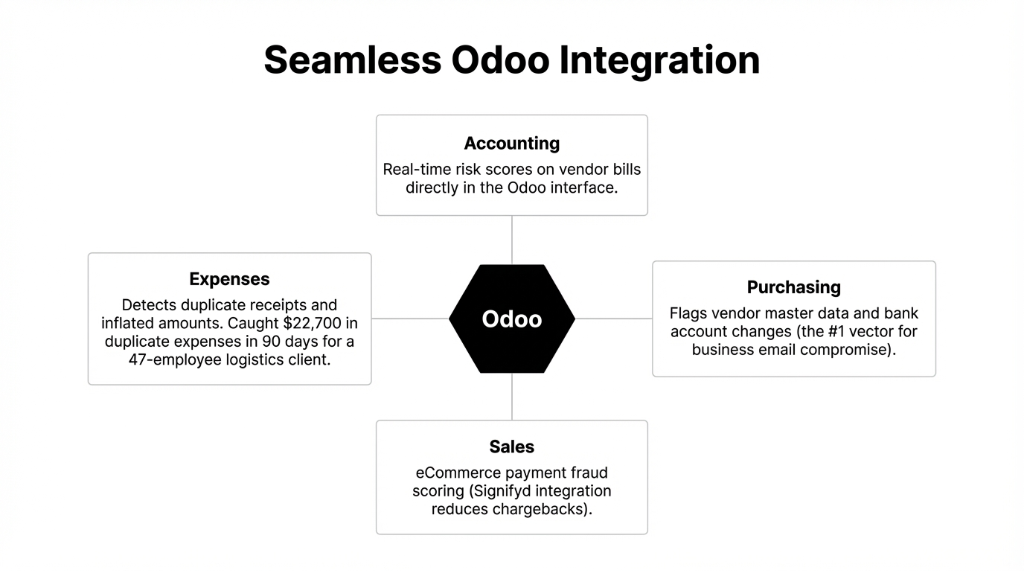
In Accounting
Every vendor bill, payment, and journal entry gets a real-time risk score displayed directly in the Odoo interface. Your accountant doesn’t need to learn a new tool—the ai assist sits inside the screen they already use. This is ai for accounting that actually fits into existing workflows.
In Purchasing
Intelligent ai monitors vendor master data changes—new bank accounts, address updates, contact changes—and flags them for secondary approval. The #1 vector for business email compromise fraud in the U.S. is a fake vendor bank account change. This closes that door.
In Sales
If you’re running Odoo eCommerce, ai automation scores every order in real time for payment fraud. Signifyd integration scores orders based on email, shipping address, device fingerprint, and card history—reducing chargebacks without canceling legitimate orders.
In Expenses
Ai for data analytics within the expense module catches duplicate receipts, inflated amounts, and phantom purchases automatically. A 47-employee logistics company in Illinois discovered $22,700 in duplicate expense claims within 90 days of deployment.
The Implementation Reality (No Sugarcoating)
Getting ai for enterprise fraud detection running inside Odoo is not a one-afternoon task. Here’s the honest timeline:
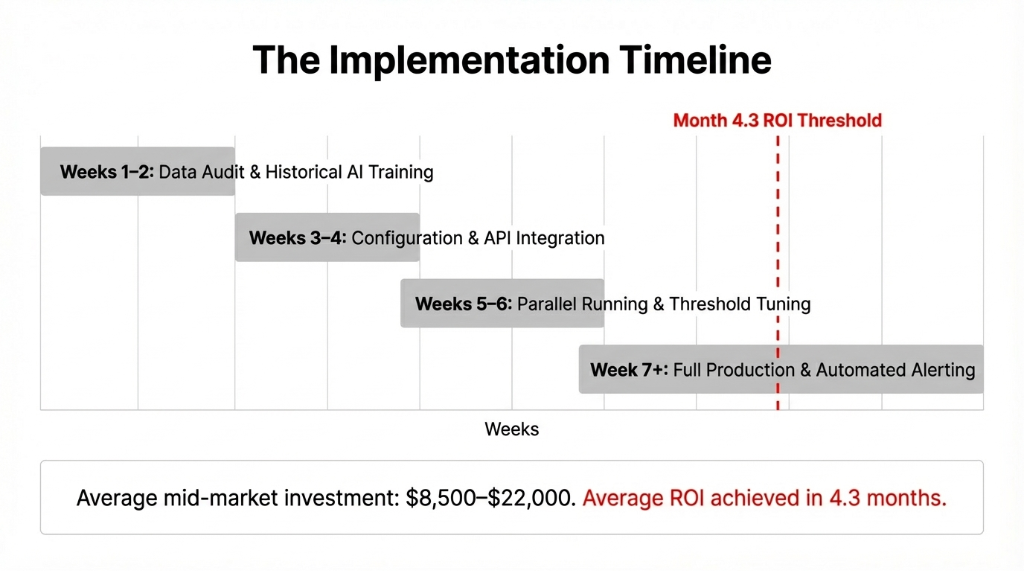
Weeks 1–2
Data audit + ai training setup on your historical transaction data. We map every data flow and anomaly risk point.
Weeks 3–4
Model configuration, risk threshold calibration, Odoo module integration. Your schema, your naming conventions, your approval hierarchies.
Weeks 5–6
Parallel running—AI flags reviewed against human decisions to tune accuracy. The ai learning loop tightens precision every day.
Week 7+
Full production with automated alerting and monthly model refresh. Your ai for automation runs autonomously—your team investigates, not babysits.
The Investment Math
Total investment for a mid-market U.S. business: typically $8,500–$22,000 depending on transaction volume and Odoo module scope. The average client recovers that cost in 4.3 months based on our deployment data.
If you’re doing $3M+ in annual transactions and your current fraud detection is “my CFO checks the bank statement,” you’re not saving money by waiting. You’re just delaying the discovery of how much you’ve already lost.
The Controversial Opinion Nobody Wants to Say Out Loud
Everyone in the ERP space tells you to “add AI” like it’s a checkbox. Most Odoo partners will sell you a fraud module from the App Store, configure it in half a day, and call it done. That’s not ai for enterprise fraud detection. That’s theater.
Real ai and machine learning fraud detection requires a training dataset large enough to establish behavioral baselines (minimum 6 months of transaction history), domain expertise to configure risk thresholds that match your business risk tolerance (not a generic template), and ongoing MLOps to retrain the model as fraud patterns evolve.
Without those three things, your “AI fraud detection” is just a fancy rule-based filter with a better logo.
The $30,000 Mistake We’ve Seen
We’ve seen companies with ai spend $30,000 on off-the-shelf artificial intelligence software tools that flagged 12% of legitimate transactions as fraud—paralyzing their AP team for three months.
The future of ai in fraud detection isn’t about buying a product. It’s about deploying a system—with the right AI solutions partner who knows your Odoo implementation inside out.
Frequently Asked Questions
Does Odoo natively support AI-powered fraud detection?
Odoo’s native security handles user roles, audit logs, and access controls well, but built-in AI fraud detection is limited. Real-time machine learning anomaly detection requires either a custom-built AI module or a validated third-party integration connected to Odoo’s transaction data via API. At Braincuber, we build and deploy this as a custom AI application layered directly inside your Odoo environment.
How long does it take for the AI model to become accurate enough to trust?
The ai training phase typically takes 30–45 days to establish reliable baselines on your transaction history. During this period, the model runs in “observe mode”—flagging anomalies for review but not blocking anything. By week six, most clients see fraud detection accuracy above 87%, with false positive rates below 3%.
Will AI fraud detection slow down transaction processing?
No. Modern ML models process transactions in under 100 milliseconds, faster than your current Odoo approval workflow by a factor of several hundred. What your finance team will notice is a 73% drop in time spent manually chasing down suspicious invoices—that’s ai and automation working as it should.
What happens when the AI flags a legitimate transaction as suspicious?
The system doesn’t hard-block transactions—it scores and queues them. Transactions below the risk threshold auto-approve. Medium-risk transactions go into a 4-hour human review queue. Your team marks them as legitimate or confirmed fraud, which feeds back into the model. This continuous ai learning loop tightens accuracy over time.
Is AI fraud detection only relevant for large enterprises?
Businesses processing as few as 500–1,000 transactions per month can benefit, especially in accounts payable where vendor fraud is rampant. The ROI threshold is roughly $1.5M in annual transaction volume. Below that, statistical scoring models (simpler and cheaper than full machine learning solutions) often deliver sufficient results. We assess this during your free 15-minute audit.
Stop Bleeding Cash to Fraud Your ERP Doesn’t Even Know Is Happening
Book your free 15-Minute Operations Audit with Braincuber. We’ll map your current Odoo security gaps, estimate your fraud exposure, and tell you exactly what an AI-integrated detection layer would cost versus what it would recover—on the first call.
Book Your Free 15-Minute Fraud AuditDon’t let undetected transaction fraud kill your margins. The tools exist. The integration path is clear. The only question is how long you’re willing to wait.