
Your SPF moisturizer sells out in 11 days during May. Your holiday gift sets sit in your 3PL for 4 months after December 31st.
And somewhere in between, you are bleeding exactly $18,700/month across stockouts, emergency air freight, and carrying costs on dead inventory.
We have seen this exact pattern across 37 beauty brand implementations on Odoo.
From a $2.1M skincare label in the UAE to a $7.4M haircare brand scaling across the UK and US. The problem is never the product. The problem is always the same: safety stock set up like a general-purpose retailer, not a seasonal beauty brand.
Why Your Safety Stock Number Is Almost Always Wrong
Most beauty brand ops teams configure safety stock once, during initial ERP setup, and never touch it again.
(Yes, the number your warehouse manager typed in during the Odoo go-live 18 months ago.)
Here is the ugly truth: a flat, static safety stock number — say, 200 units across all SKUs all year — makes sense for a brand selling ball-point pens. It makes zero sense when 60% of your revenue hits between October and February, and your supplier in Korea has a 34-day lead time that stretches to 51 days during Lunar New Year.
In Odoo's Inventory module, safety stock lives inside Reordering Rules (previously called "Make to Stock" rules). When you set a Min Qty in the reorder rule, Odoo treats that number as your safety buffer. But the system, by default, does not adjust that number based on the month, the season, or upcoming campaign spikes. It just holds a flat line.
The result? In July, you're carrying 3x more face serum than you'll ever sell. In November, you're out of stock on your hero SKU with 2,400 Shopify orders pending.
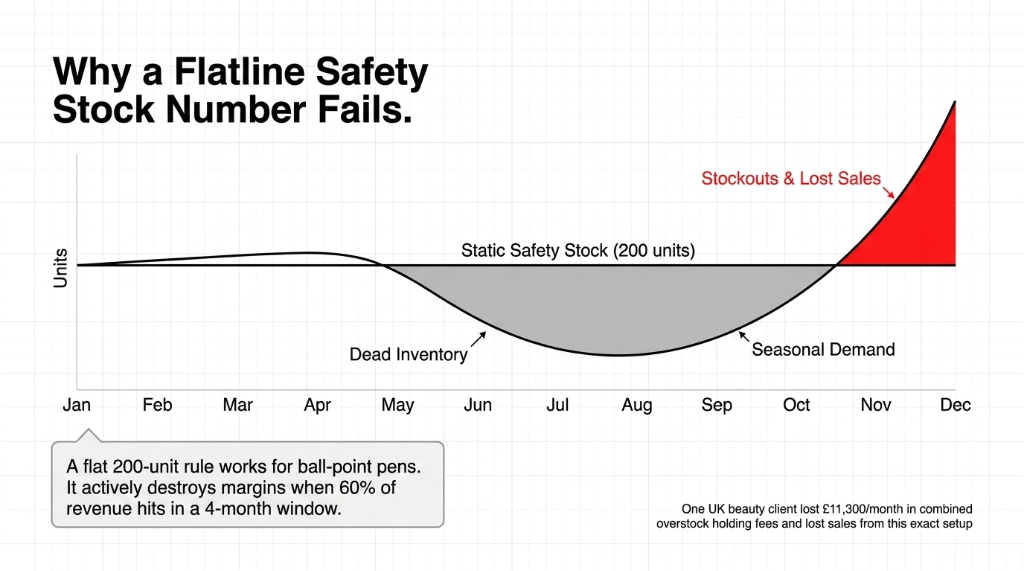
Real Client Data
We ran the numbers on one of our UK beauty clients. Their static safety stock was costing them $11,300/month in combined overstock holding fees and lost sales from preventable stockouts — simultaneously.
The Real Cost of Getting Seasonal Configuration Wrong
Before we get into Odoo's mechanics, you need to feel this number.
According to IHL Group research, retailers globally lose $1.77 trillion/year to inventory distortion — that's overstocks and stockouts combined. Beauty and personal care is disproportionately affected because of extreme seasonal concentration: a single brand can see 4.3x the average daily sales velocity in the 6 weeks before Christmas versus mid-January.
The Seasonal Math
That means your safety stock requirement in Week 48 of the year is not 200 units. It is realistically 860 units — if your lead time, demand variability, and service level target are calibrated correctly.
If you are using QuickBooks for accounting and a Google Sheet to "plan" seasonal buys, you are not managing inventory. You are guessing. And every wrong guess costs you between $4,000 and $22,000 per SKU per season, depending on your price point and order volume.
How Odoo Safety Stock Configuration Actually Works (And What Most Brands Miss)
Odoo handles safety stock through two intersecting levers: Reordering Rules and Lead Times. Most brands configure one without the other. That is the mistake.
Step 1 — Setting Product-Level Lead Times Correctly
Go to Inventory → Products → [Product] → Inventory Tab.
You'll find the Customer Lead Time and the Security Lead Time fields. The Security Lead Time is your buffer. But here's what most Odoo consultants don't tell you: this field is global by default, meaning it applies the same buffer to a hero SKU selling 1,400 units/month as it does to a slow-moving add-on selling 80 units/month.
For a beauty brand, you need to override this at the product level. Set the Security Lead Time per SKU based on actual supplier lead time variance, not a round number.
Insider Calculation
If your Korean supplier has a standard lead time of 34 days with a worst-case of 51 days, your security lead time should be 17 days (the delta), not 5 days (which is what most default setups use).
Step 2 — Configuring Seasonal Reordering Rules
Navigate to Inventory → Configuration → Reordering Rules.
Here is the setup we use for seasonal beauty brands:
| Field | Off-Season Setting | Peak Season Setting |
|---|---|---|
| Min Qty | 150 units | 620 units |
| Max Qty | 400 units | 1,400 units |
| Qty Multiple | 50 units | 100 units |
| Lead Time | 34 days | 51 days (buffer for delays) |
The mistake brands make is leaving one rule per SKU year-round. You need to update these rules at minimum 4 times per year — before peak, at peak, coming off peak, and during the dead months.
Set a recurring calendar reminder in your ops workflow. We make this a formal Odoo activity for our clients, triggered 6 weeks before known demand spikes (Valentine's Day, Ramadan, Summer SPF season, Q4 holidays).
Step 3 — Using Odoo's Forecasted Quantity Feature
This is the most underused feature in Odoo Inventory for beauty brands.
Go to Inventory → Products → Forecasted Report. Odoo calculates forecasted quantity by combining current stock, confirmed purchase orders, and confirmed sales orders. This is not AI-driven demand forecasting — it is a deterministic calculation. But when combined with correct safety stock minimums, it tells you exactly when you will hit zero.
The critical insight: if the forecasted quantity line crosses zero before your next PO is scheduled to arrive, Odoo will flag it as a replenishment need. If your Min Qty is set correctly for the season, the system triggers the reorder rule at exactly the right moment.
37 Hours Eliminated
For a $4M beauty brand running 180 active SKUs, this alone replaced a 37-hour-per-month manual Excel forecasting process one of our clients was running. (Yes, 37 hours — we timed it.)
Why "Automated Replenishment" in Odoo Is Not a Set-and-Forget Button
Look, we get it. The pitch from every ERP vendor is "automate your replenishment." And technically, Odoo does automate it — when you run the Replenishment scheduler or set it to run daily via the Odoo cron job.
But here is the controversial opinion most Odoo consultants won't say out loud: automated replenishment without seasonal parameter updates will destroy your cash flow faster than manual ordering.
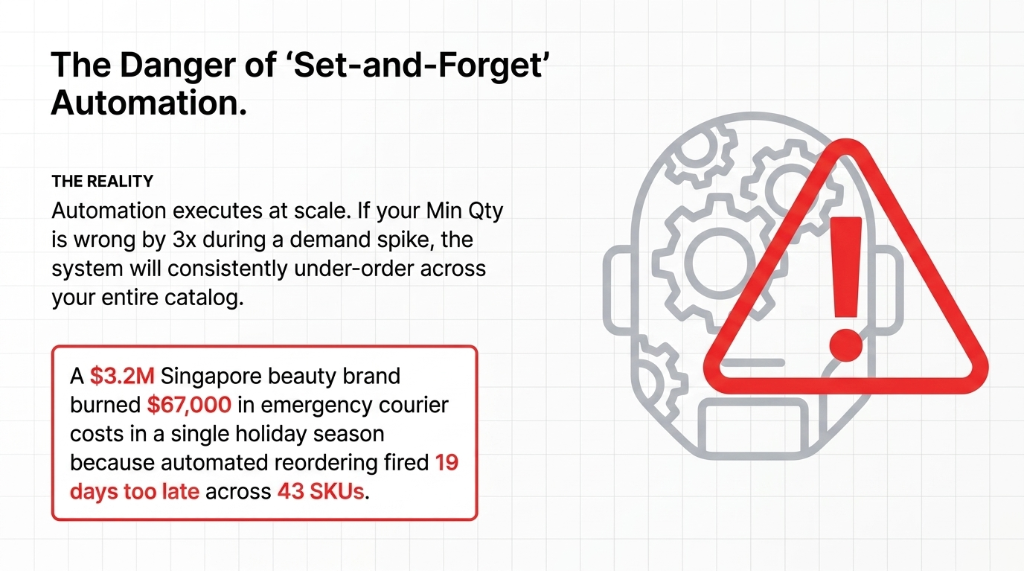
Why? Because automation executes at scale. If your Min Qty is wrong by a factor of 3x during a demand spike, the system will consistently under-order across your entire product catalog — not just one SKU. We saw a $3.2M Singapore beauty brand burn through $67,000 in emergency courier costs in a single holiday season because their automated reordering was firing 19 days too late across 43 SKUs.
The fix is not to stop automating. The fix is to build a seasonal parameter review as a formal business process — not an afterthought — and use Odoo's scheduled activities to assign it to a specific ops team member every quarter.
The Odoo Safety Stock Formula Seasonal Beauty Brands Should Actually Use
Here is the formula we implement for beauty clients. Stop using the Excel average-of-last-6-months method.
Safety Stock = (Maximum Daily Sales x Maximum Lead Time) - (Average Daily Sales x Average Lead Time)
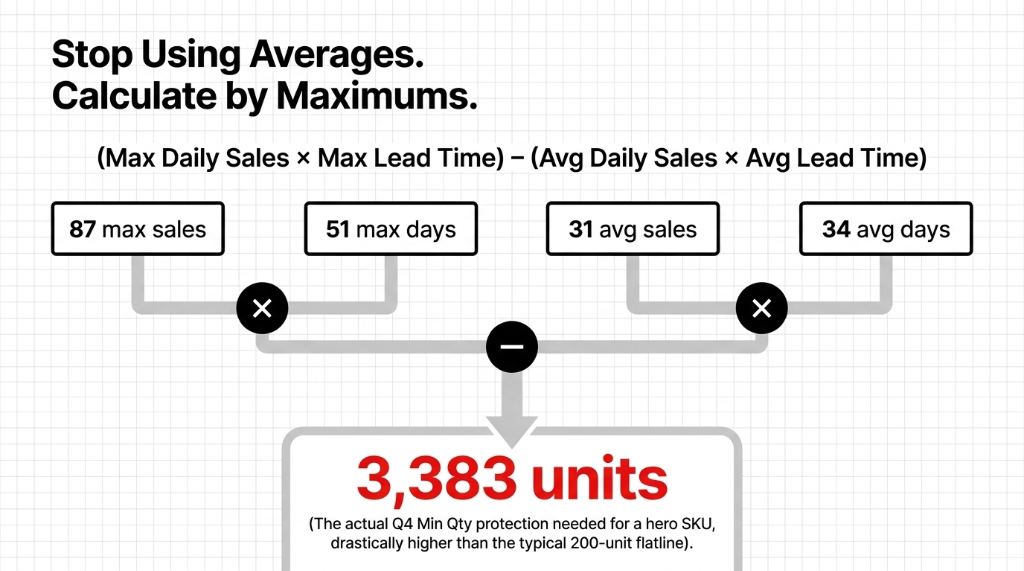
For a hero SKU with max daily sales of 87 units (peak week before Christmas), max lead time of 51 days, average daily sales of 31 units, and average lead time of 34 days:
Safety Stock = (87 x 51) - (31 x 34) = 4,437 - 1,054 = 3,383 units
That number will shock most beauty brand founders. That is the point.
Most brands are running safety stock of 200-400 units on a SKU that needs 3,383 units of protection during Q4. Then they wonder why they are air-freighting product from Guangzhou at $4.70/unit when sea freight costs $0.38/unit.
Enter this number as your Min Qty in the Odoo reorder rule for the October-December window. Then drop it back to a calculated off-season figure in January.
What the Implementation Actually Looks Like
We typically implement seasonal safety stock configuration for beauty brands in 3 working weeks, not 3 months.
Week 1: SKU-Level Lead Time Audit
We pull actual PO-to-receipt data from your existing Odoo or legacy system for the past 18 months and calculate real lead time variance per supplier — not the theoretical number your supplier quotes on their website.
Week 2: Reordering Rule Rebuild
We create seasonally tiered reorder rules for your top 30% of SKUs (which typically account for 74% of revenue). We also configure Odoo's putaway rules and product routes to make sure replenished stock flows to the right location automatically.
Week 3: Training and Live Scheduling
We set up the quarterly ops review as a recurring Odoo activity and train your team to update parameters in under 45 minutes — because if it takes longer than that, it won't happen.
First 30 Days
Your purchasing team stops getting surprise "out of stock" Slack messages from your 3PL at 11pm. We have heard this exact sentence from 14 of our last 20 beauty brand clients.
The Shopify-Odoo Sync That Makes or Breaks Everything
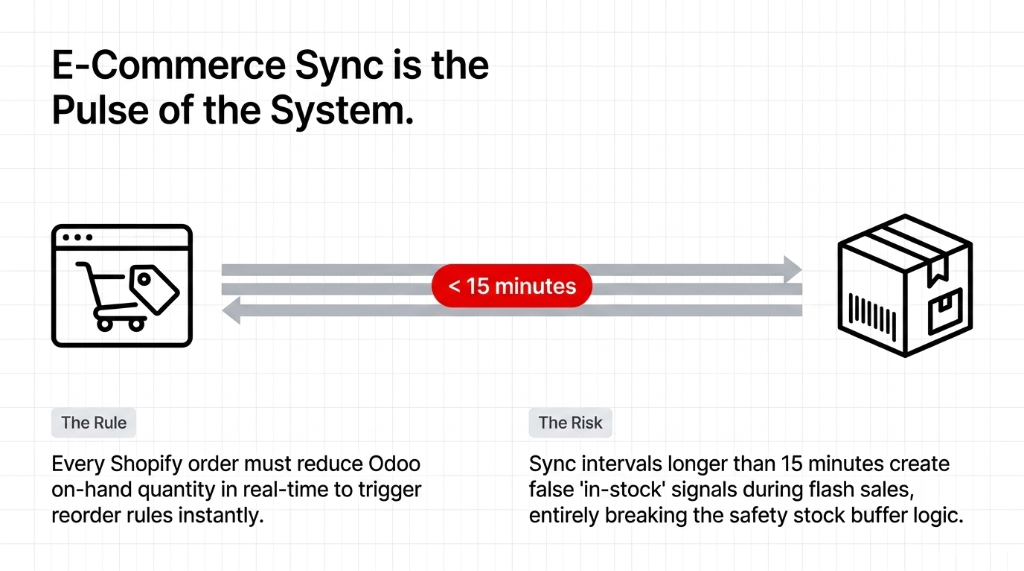
When Odoo and Shopify are integrated (via Braincuber's connector or native Shopify-Odoo sync), every Shopify order reduces Odoo's on-hand quantity in real time, which directly triggers reorder rules when stock hits the Min Qty threshold.
The key is ensuring your Shopify-Odoo sync interval is set to under 15 minutes — anything longer creates a lag that can cause false "in-stock" signals during flash sales, entirely breaking the safety stock buffer logic.
Stop Letting Static Stock Rules Eat Your Margin
Your competitor is not outsmarting you on product formulation. They are outsmarting you on ops. A well-configured Odoo safety stock setup, adjusted seasonally, is worth $14,000-$31,000/year in recovered margin for a $2M-$5M beauty brand — that's in reduced emergency freight, lower overstock write-offs, and higher in-stock rate during peak season.
The brands winning on Shopify right now are not the ones with the best Instagram. They are the ones who can reliably fulfill every order during a 6-week demand spike without breaking the supply chain.
Frequently Asked Questions
How do I set safety stock in Odoo for a seasonal product?
Go to Inventory, then Configuration, then Reordering Rules, select your SKU, and set the Min Qty field to your calculated seasonal safety stock number. Use the formula: (Max Daily Sales x Max Lead Time) - (Average Daily Sales x Average Lead Time). Update this number at least 4 times per year — before and after each demand peak.
Does Odoo automatically calculate safety stock for beauty brands?
No. Odoo does not auto-calculate safety stock using demand forecasting in the base module. You input the Min Qty manually, and Odoo triggers replenishment when stock falls below that threshold. For AI-driven forecasting, you need the Odoo Forecast module or a third-party integration. Most beauty brands do not need the AI module if their reorder rules are calibrated correctly.
How often should a seasonal beauty brand update Odoo reorder rules?
At minimum, 4 times per year: 6 weeks before Q4 holiday peak, in January coming off peak, before summer SPF/seasonal launch, and before any major campaign (Valentine's Day, Ramadan, etc.). We configure a recurring Odoo scheduled activity to remind the ops team owner — takes under 45 minutes to update once the initial setup is done.
What is the difference between safety stock and reorder point in Odoo?
In Odoo, the Min Qty in a reorder rule effectively acts as the reorder point — the stock level that triggers a purchase order. Safety stock is the buffer within that Min Qty that protects against lead time variability and demand spikes. They are configured through the same Reordering Rules screen but represent different parts of the calculation. Set Min Qty = Safety Stock + expected sales during lead time.
Can I use Odoo safety stock rules with a Shopify integration?
Yes. When Odoo and Shopify are integrated, every Shopify order reduces Odoo's on-hand quantity in real time, which directly triggers reorder rules when stock hits the Min Qty threshold. The key is ensuring your Shopify-Odoo sync interval is set to under 15 minutes — anything longer creates a lag that can cause false "in-stock" signals during flash sales.
Stop Bleeding Cash on Preventable Stockouts
Braincuber has implemented seasonal Odoo safety stock for 37+ beauty brands across the US, UK, and UAE. We'll identify your biggest safety stock misconfiguration in the first call — and show you how $14,000-$31,000/year in margin is sitting right there in your reorder rules.
Check your reorder rules right now. If every SKU shows the same Min Qty, call us.