
A UK-based skincare brand doing £2.3M/year was losing £11,700 every quarter from duplicate purchase orders and untracked vendor invoices.
The sourcing team identified niacinamide stock running low. Someone pinged a supplier on WhatsApp. A "confirmed" order got placed verbally. Two days later, finance had no record of it. A week later, a second team member ordered the same ingredient from a different supplier because the first order "was not in the system."
They paid twice for the same raw material. And did not catch it until the accountant reconciled invoices at month-end.
If your beauty brand is still managing raw material purchases across WhatsApp messages, supplier emails, and a Google Sheet your procurement manager built in 2021 — you are leaking money. Not a little. Raw materials and packaging account for 40-50% of total production budgets for beauty brands. With margins already squeezed between ingredient inflation and rising freight costs, you cannot afford a procurement process that runs on gut feel and group chats.
This is the story of how the Odoo purchase order workflow ends that chaos — from the first Request for Quotation to the final stock receipt — and why beauty brands that skip this setup are the ones calling us at 11 PM before a product launch.
Your Procurement Is Broken Before the PO Is Even Created
Here is what we see in 8 out of 10 beauty brand audits:
What We Actually Find During Procurement Audits
Hidden cost: $11,700/quarter in duplicated orders, price inflation, and over-invoicing — minimum.
How the Odoo Purchase Order Workflow Actually Works for Beauty Brands
The Odoo purchase order workflow is not magic. It is a structured 6-step process that creates a paper trail, enforces spending limits, and syncs directly to your inventory — so you never order 200kg of hyaluronic acid when you already have 150kg sitting in a warehouse you forgot about.
The 6-Step Purchase Order Workflow
Step 1: Request for Quotation (RFQ)
Procurement creates an RFQ inside Odoo's Purchase module. Select raw material (glycerin, synthetic mica), quantity, preferred vendor. Odoo auto-pulls historical pricing, lead time, and last negotiated contract terms. No Excel lookups. No old emails.
Step 2: Vendor Comparison & Pricelist
Send the same RFQ to 3-4 suppliers simultaneously. System compares pricing side by side and flags any supplier whose quote deviates more than a set % from historical average. We caught one supplier inflating fragrance oil pricing by 18.5% over 6 months.
Step 3: PO Confirmation & Approval
Procurement manager selects winning vendor. PO shifts to "To Approve" status — does NOT go to the supplier yet. Sits in tiered approval queue based on PO value.
Step 4: Vendor Notification
Approved PO automatically emails vendor the purchase order PDF. No manual sending. Vendor confirmation and expected delivery date logged. Lead times auto-calculate receipt dates.
Step 5: Receipt & Quality Check
Warehouse validates receipt against original PO. Quantity, lot number, and expiry date (critical for cosmetic ingredients) recorded in one screen. Discrepancies trigger automatic backorder or vendor alert.
Step 6: Three-Way Match
Automatic three-way match: PO quantity → received quantity → vendor invoice amount. Vendor invoices you for 200 units but warehouse received 180? Odoo flags it before finance opens their inbox.
Real result: We have seen brands recover $8,300 in a single quarter just from catching over-invoiced raw material deliveries they had been paying without question for over 18 months.
Why Single-Level Approval Is Costing You Money
Most brands that come to us have one of two setups: either everyone can approve any PO regardless of value, or no one has clear authority and orders sit in limbo for 4-6 days waiting for a manager who is traveling.
Both are wrong.
| PO Value | Approval Level Required | Why This Matters |
|---|---|---|
| Below $1,000 | Auto-approved (procurement officer) | Routine orders do not need a bottleneck |
| $1,001 – $5,000 | Procurement Manager approval | Mid-range orders get a second set of eyes |
| Above $5,000 | CFO or Operations Director approval | Big spends need financial sign-off |
Odoo 18 supports this natively through threshold-based multi-level approval workflows — no custom code, no paid third-party apps needed. A PO for 50kg of titanium dioxide worth $3,500 routes to the procurement manager. A bulk order of 500kg of cetearyl alcohol worth $14,200 goes straight to the CFO's queue with a one-click approval button.
Real result: One of our UAE-based beauty clients reduced PO approval time from 4.3 days average to 6 hours after we implemented this tiered workflow. That is the difference between catching the last batch slot at your contract manufacturer and waiting another 2 weeks.
The Part Nobody Talks About: What Happens After Approval
Everyone focuses on the approval step. Almost no one talks about what Odoo does after the PO is approved — and this is where beauty brands either win or bleed.
Vendor Notification & Delivery Scheduling
The moment a PO moves from "To Approve" to confirmed, Odoo automatically emails the vendor the purchase order PDF. No manual sending. No "did you forward that to the supplier?" The vendor confirmation and expected delivery date get logged in the system. If the vendor has a lead time of 14 days stored in their profile, Odoo calculates the expected receipt date immediately.
Receipt & Quality Check
When the raw material arrives — whether shea butter from a West African supplier or synthetic mica from a domestic source — your warehouse team validates the receipt in Odoo against the original PO. Quantity received, lot number, and expiry date (critical for cosmetic ingredients) all get recorded in one screen. Any discrepancy triggers an automatic backorder or vendor alert.
(Yes, this is also how you prove to regulators that you have full ingredient traceability — something every beauty brand selling in the EU or US needs documented.)
Three-Way Match & Vendor Invoice Processing
This is where finance teams usually want to kiss us. Odoo performs an automatic three-way match: PO quantity → received quantity → vendor invoice amount. If a vendor invoices you for 200 units but your warehouse only received 180, Odoo flags the discrepancy before your finance team even opens their inbox.
We have seen brands recover $8,300 in a single quarter just from catching over-invoiced raw material deliveries they had been paying without question for over 18 months.
The Inventory Sync Nobody Tells You About
Here is an insider truth that most Odoo resellers gloss over: the purchase order module is useless in isolation.
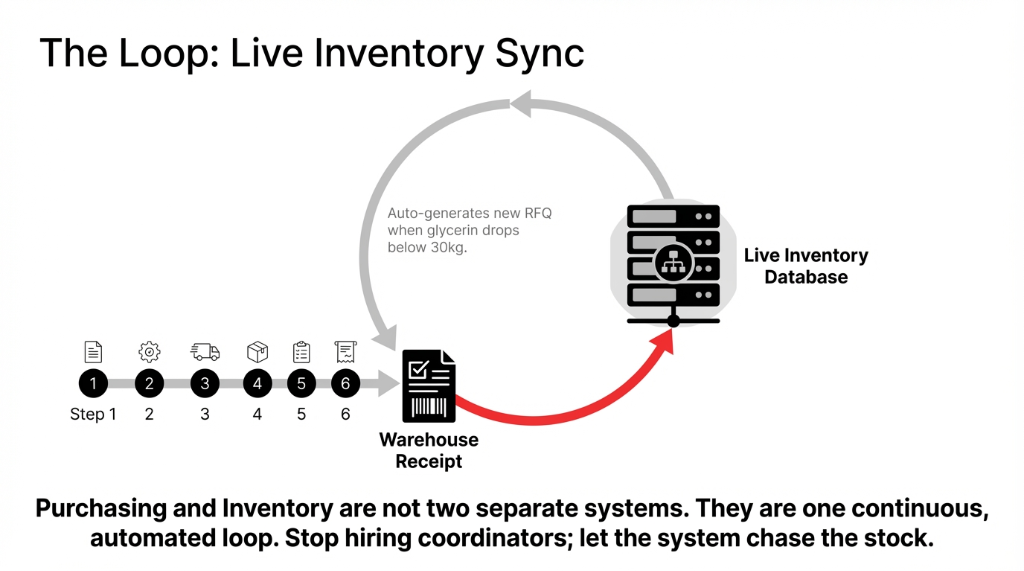
The reason the Odoo PO workflow actually moves the needle for beauty brands is the live inventory sync. The moment your warehouse validates a raw material receipt, Odoo updates stock levels in real time — no separate inventory update, no spreadsheet reconciliation, no delay.
Your production team can see available niacinamide stock in real time. Your procurement team can set automatic reorder rules so that when glycerin stock drops below 30kg, Odoo auto-generates a new RFQ to your preferred supplier — without a single human triggering it.
That is how brands scaling from $1M to $10M ARR stop hiring extra procurement coordinators and instead let the system do the chasing. Purchasing and inventory are one continuous loop — not two separate systems stapled together with Excel.
What Happens When You Do Not Fix This Before a Product Launch
Frankly, the ugliest procurement failures we see happen 3 weeks before a major launch.
The Launch Delay Cascade
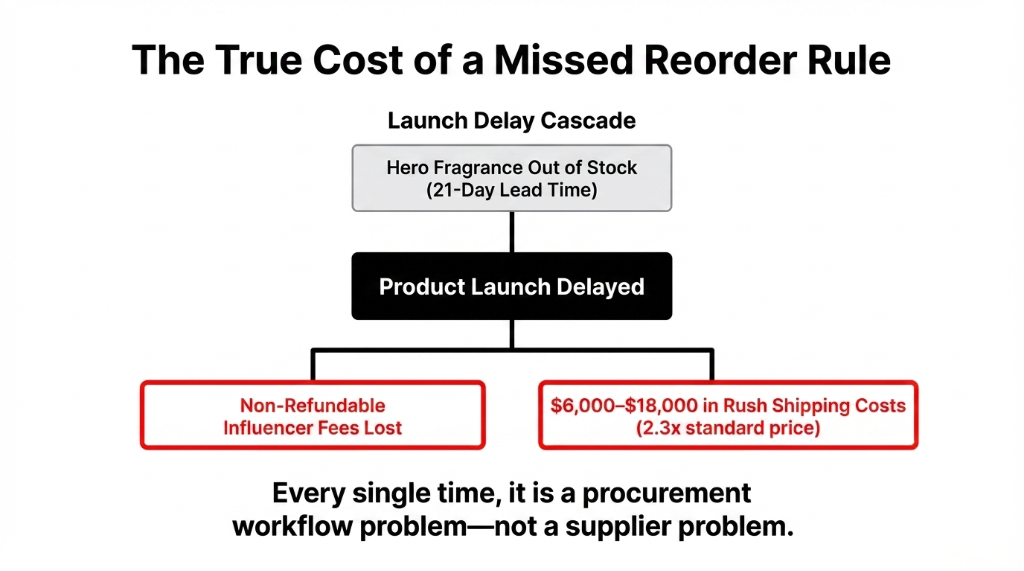
A beauty brand confirms a new SKU. Marketing books influencers. The campaign is set. Then the production team realizes the fragrance compound needed for the hero product is out of stock — because no reorder rule existed, no PO was triggered, and the supplier's lead time is 21 days.
The launch gets delayed. The influencer fees are non-refundable.
The brand pays $6,000-$18,000 in rush shipping to get materials from an alternate supplier at 2.3x the standard price.
This happens more than you think. And every single time, it is a procurement workflow problem — not a supplier problem.
The Implementation Reality — What It Actually Takes
We will not pretend this is a 2-day job. Here is the honest timeline for a beauty brand going live with Odoo purchase order workflows for raw materials:
| Week | What Happens | Who Is Involved |
|---|---|---|
| Week 1-2 | Vendor data migration (contacts, pricelists, payment terms), raw material SKU setup with UoM and lot tracking configured | Procurement + Braincuber |
| Week 3 | Approval rule configuration, reorder point setup for top 20 raw materials by purchase frequency | Procurement + Finance |
| Week 4 | User training for procurement team, warehouse team, and finance (typically 3-4 people) | All teams |
| Week 5 | Parallel run — Odoo and old system running simultaneously to catch gaps | Procurement + Braincuber |
| Week 6 | Full go-live, old system retired | Everyone |
Total: 6 weeks from kickoff to live. Most of our beauty brand clients see the first measurable result — usually an over-invoicing catch or a duplicate order prevention — within the first 30 days of go-live.
ROI Break-Even
Based on our last 23 beauty and cosmetics brand implementations, the average ROI break-even point is 4.1 months post go-live. Primary savings: eliminating duplicate orders, catching vendor over-invoicing, and reducing procurement coordinator hours by 37% on average — since routine reorder tasks become fully automated.
Everyone says buy NetSuite for this. Do not. It burns $500k before you even configure your first approval tier. Odoo does it at a fraction, and your procurement team is live in 6 weeks — not 6 months.
Frequently Asked Questions
Can Odoo handle raw material lot tracking and expiry dates for cosmetic ingredients?
Yes. Odoo's inventory module supports lot/serial number tracking and expiry date management natively. When a raw material is received on a PO, your warehouse team records the lot number and expiry date. This creates full traceability from supplier batch to finished product batch — which is non-negotiable for FDA or EU Cosmetics Regulation compliance.
How does Odoo prevent duplicate purchase orders for the same raw material?
Odoo links every PO to a specific vendor and product with quantity visibility. Before confirming an RFQ, the system shows current stock on hand and any open POs for that material. Your procurement officer can see in real time that 80kg of glycerin is already on order before accidentally placing a second order from a different supplier.
What if our raw material suppliers do not use formal invoicing systems?
Odoo supports manual vendor bill creation against a PO. Your finance team can enter the invoice manually, and the three-way match still validates received quantity vs. billed quantity. You can also set up vendor bill automation via email-to-bill if your supplier sends PDF invoices — Odoo's Document AI can extract and pre-fill invoice fields automatically.
Can we set different reorder rules for seasonal raw materials in beauty manufacturing?
Yes. Odoo allows you to configure reorder rules with min/max quantities per product, per warehouse, per season. You can temporarily increase minimum stock levels for high-demand ingredients before a product launch or peak sales season — and the system adjusts automated RFQ generation accordingly, without manual override every time.
How long before we see ROI from implementing Odoo purchase order workflows?
Based on our last 23 beauty and cosmetics brand implementations, the average ROI break-even point is 4.1 months post go-live. The primary savings come from eliminating duplicate orders, catching vendor over-invoicing, and reducing procurement coordinator hours by 37% on average — since routine reorder tasks become fully automated.
Check Your Last 3 Months of Vendor Invoices. If a Single One Does Not Match the PO, Call Us.
We bet you will find at least one over-invoiced delivery you paid without question. Book our free 15-Minute Operations Audit — we will identify your single biggest procurement leak and tell you exactly what it is costing you per quarter. No pitch deck. No fluff.
Do not let a broken purchase workflow cost you another $11,000 quarter.