
If you are an Odoo partner in the USA and AI services are not yet a line item on your proposals, you are actively giving your clients a reason to call someone else. According to PwC’s 2026 AI Business Predictions, companies executing a disciplined, top-down AI strategy are pulling away from peers who are still "exploring" — and your clients have noticed.
That is not a forecast. That is your churn rate, building up quietly.
Your Clients Are Spending on AI — Just Not With You
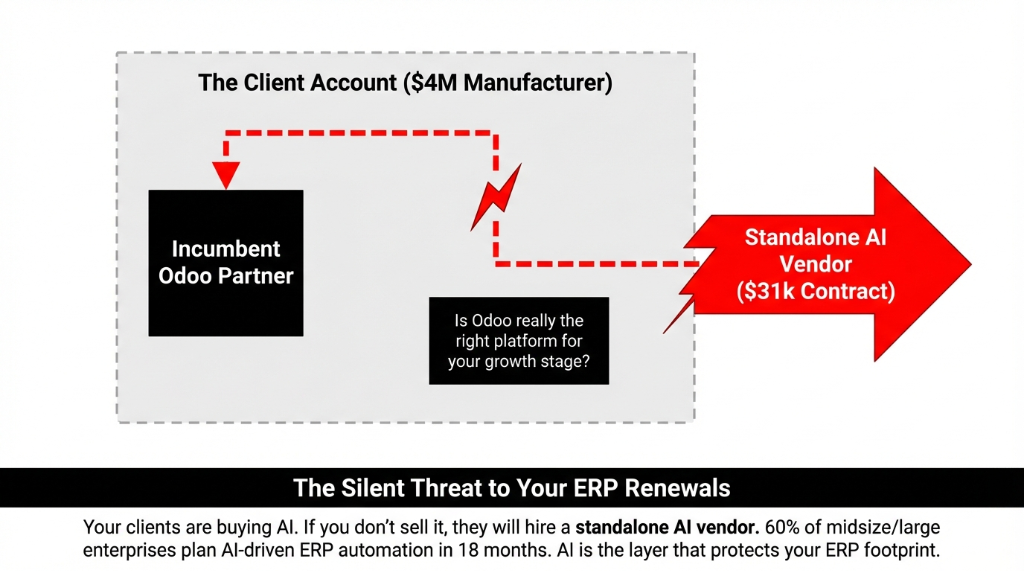
We have had this exact conversation with dozens of Odoo partners across the US over the past year. The story is almost always the same: a $4M manufacturer on Odoo just signed a $31,000 contract with a standalone AI consulting company to build a demand forecasting model. The Odoo partner managing their ERP had no AI offer on the table. So the client went elsewhere.
Now there are two vendors in the account. And the AI vendor is already asking: "Have you considered whether Odoo is really the right platform for your growth stage?"
You already have the ERP footprint.
The AI services layer is what protects and multiplies that relationship. 60% of midsize and large enterprises are planning AI-driven ERP automation within the next 18 months. If you are not the one delivering it, a competitor will — and they will use that engagement to undercut your renewal.
Why "Wait for Odoo to Ship It" Is Costing You Right Now
Odoo’s native AI is genuinely impressive and getting better fast. Odoo 18.3 shipped the dedicated AI App with AI Agents, AI Fields, and natural language server actions. Odoo 19 deepened those capabilities. Odoo 20 — expected September 2026 — is projected to introduce Agentic AI that proactively executes complex workflows without user prompts.
But here is the part nobody in the partner community wants to say out loud:
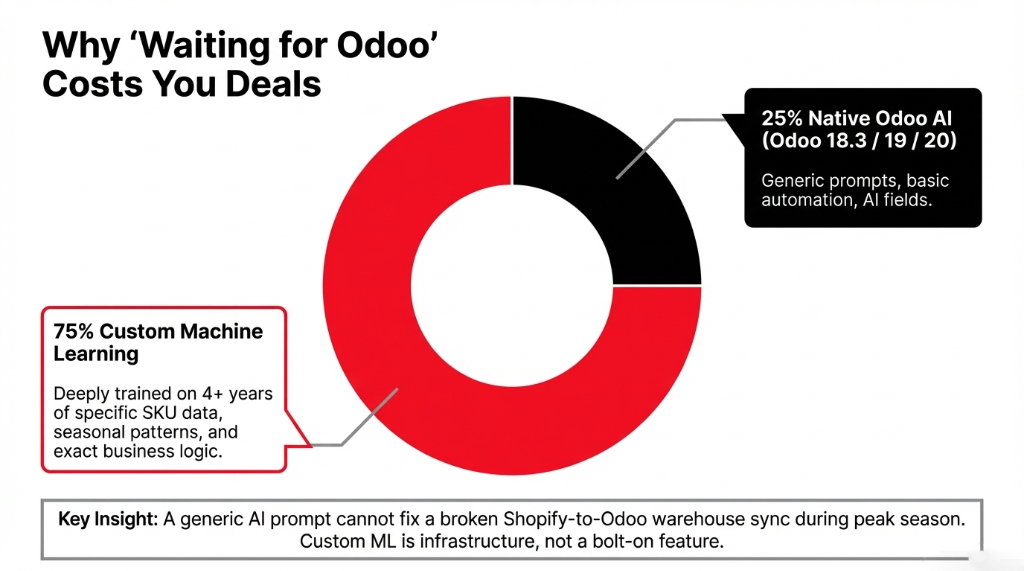
Odoo’s built-in AI covers roughly 25% of what your clients actually need.
The other 75% is custom machine learning territory.
Your distribution client does not need a generic AI prompt — they need a demand forecasting model trained on 4 years of their specific SKU movement data, seasonal patterns, and supplier lead times. Their Shopify store and their Odoo warehouse are already struggling to sync properly during peak season. Adding a generic AI layer on top of broken data is not a solution.
A machine learning model trained on their actual data, deployed on AWS SageMaker or Azure ML, and piped directly into Odoo’s replenishment module is not a bolt-on. It is infrastructure. And that is a $2,500/month retainer, not a one-time module fee.
The Four AI Services Every Odoo Partner Can Sell Right Now
1. Predictive Analytics for Inventory & Supply Chain
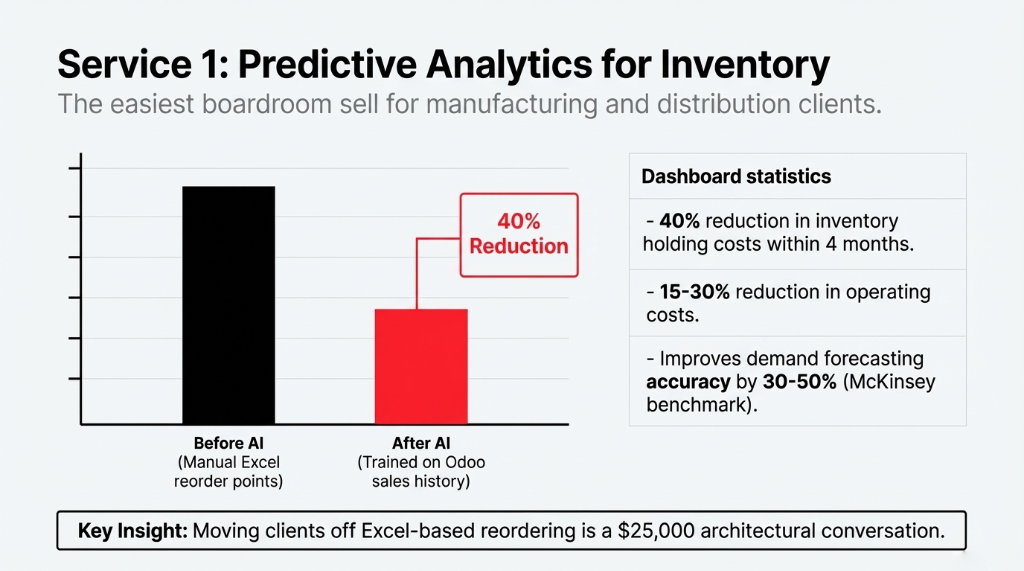
The easiest boardroom sell. Every Odoo client with a warehouse has the same problem: too much of what is not selling, and stockouts on what is. A machine learning model trained on their Odoo sales history cuts inventory holding costs by 40% for a typical mid-market manufacturer — within 4 months of go-live. McKinsey research confirms predictive analytics improves demand forecasting accuracy by 30–50%.
(Yes, we know some of your clients are still managing reorder points with Excel formulas and a gut check on Fridays. That is exactly why this is a $25,000 conversation.)
2. Document AI & Intelligent Automation
If your client is manually keying vendor invoices into Odoo, they are losing approximately $11.70 per invoice in labor cost (AIIM industry benchmark). A Document AI pipeline built on AWS Textract or Azure Form Recognizer, connected to Odoo’s vendor bill workflow, brings that cost to $0.09 per invoice with 91.3% accuracy — improving to 98.7% after 30 days of learning.
75%
Reduction in processing time within 3 months
90%
Improvement in data entry accuracy within 6 months
$9,288
Monthly labor savings at 800 invoices/month
Project pays for itself in under 60 days.
3. Agentic AI Customer Support
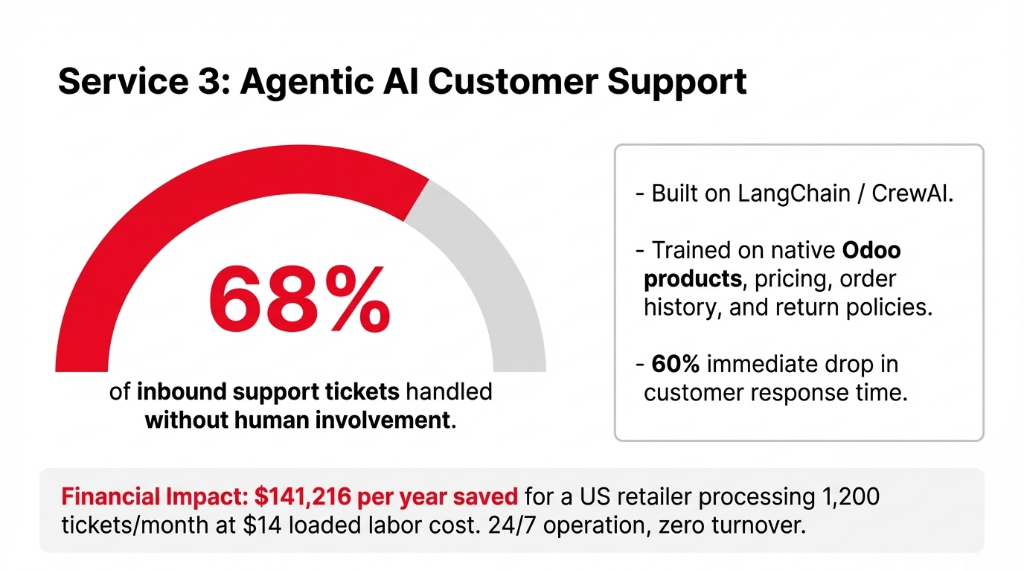
A custom AI agent built on LangChain or CrewAI, trained on your client’s Odoo data — their products, pricing, order history, and return policies — handles 68% of inbound support tickets without human involvement. For a US retailer processing 1,200 support tickets per month at $14 per ticket in fully loaded labor cost, that is $141,216 per year saved. 24/7, no payroll, no turnover, no training ramp.
4. Finance AI & Cash Flow Prediction
The CFO sell. Your client’s finance team is currently producing 13-week cash flow forecasts in Excel with VLOOKUPs and historical gut feel. (We have seen $40M companies running on exactly this.) An AI model connected to Odoo’s accounting module predicts cash flow with 87.2% accuracy, flags receivables at risk 19 days before they go overdue, and compresses month-end close from 8 days to 2.5 days.
AI anomaly detection in ERP financial workflows flags potential fraud with a 95% accuracy rate. That is not a feature — that is a risk management argument your client’s CFO cannot ignore.
The Pricing Mistake Killing Your AI Revenue
We see this constantly: someone builds a genuinely strong AI application, then prices it at $3,500 as a one-time fee because they are afraid of losing the deal.
Stop doing this.
AI consulting companies with zero Odoo experience charge $15,000–$50,000 for the architecture phase alone. You can build and deliver the same capability inside Odoo for a fraction of the cost, because you already understand the data model, the workflows, and the client’s operations. Price accordingly.
Productized AI Pricing for Odoo Partners
AI Readiness Assessment
$2,500–$5,000
3–5 day engagement; identifies 3 highest-ROI AI use cases with real numbers from the client’s own data
AI Implementation Project
$18,000–$75,000
Depends on model complexity and integration depth
AI Operations & MLOps Retainer
$1,500–$4,500/mo
Model monitoring, automated retraining, performance reporting
A mid-sized Odoo partner with 12 active clients converting just 4 to AI retainers at $2,800/mo:
$134,400 annual recurring revenue
No new ERP clients required.
What You Actually Need to Deliver This
The insider truth: you do not need a full data science team to sell and deliver AI development services as an Odoo partner.
The Three Things You Actually Need
A Data Pipeline Baseline
Your client’s Odoo PostgreSQL database holds 3–7 years of operational data. A well-designed ETL process pulling inventory moves, sales orders, vendor bills, and CRM records into AWS S3, Azure Data Lake, or GCP BigQuery. Your team can likely already do this.
Pre-Validated ML Model Frameworks
Facebook Prophet or LSTM for demand forecasting. Fine-tuned BERT for invoice classification. XGBoost for churn prediction. These are 4–8 week deployment projects using battle-tested models.
An MLOps Layer
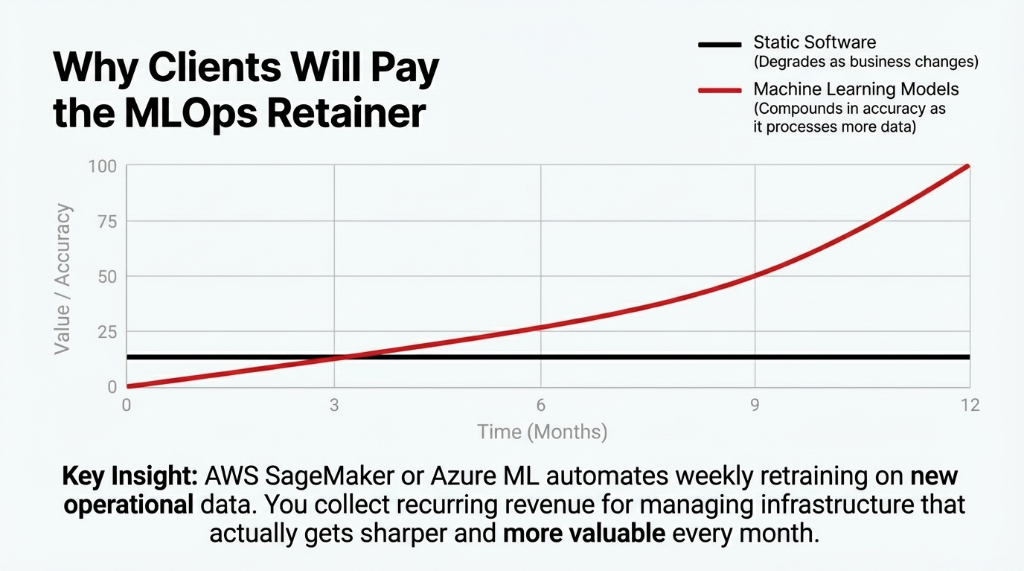
This is what transforms a $20,000 project into a $2,800/month retainer. AWS SageMaker Pipelines or Azure ML automate weekly model retraining on new operational data.
The 90-Day Launch Plan for Your First AI Service
90-Day Launch Timeline
Days 1–14 — AI Readiness Assessment
Run assessment on one existing Odoo client. Map data quality first — if inventory move history has more than 12–18% missing or inconsistent records, build data remediation into scope before any model training.
Days 15–50 — Build & Deploy First Model
Narrow scope. A demand forecast for your client’s top 250 SKUs is better than a mediocre forecast across all 4,700. Integrate output directly into Odoo’s replenishment module as actionable reorder suggestions.
Days 51–90 — Measure, Document, Expand
If the model cut overstock by 22.7% in the first 6 weeks, that is your US case study. That is your next sales call to the three other Odoo clients sitting on the same exact data problem.
Organizations using AI-enabled ERP platforms in 2026 are achieving 15–30% reduction in operating costs and up to 40% improvement in forecast accuracy compared to peers still running static ERP workflows. You already have the ERP. The AI services layer is the multiplier.
Frequently Asked Questions
How much does it cost to add AI services to an existing Odoo client?
Start with an AI Readiness Assessment at $2,500–$5,000. Initial AI implementation projects run $18,000–$75,000 depending on model complexity. Ongoing MLOps retainers typically run $1,500–$4,500 per month. These reflect standard US market pricing for Q1 2026.
Does my client need clean data before starting an AI project in Odoo?
Yes — and most clients don’t have it. If their Odoo data has more than 12–18% missing or inconsistent records in the target module, budget 2–4 weeks for data remediation before model training. Skipping this produces AI that is confidently wrong, which is worse than no AI at all.
What is the difference between Odoo’s native AI and custom AI development?
Odoo’s built-in AI handles general tasks: drafting emails, summarizing records, basic automation. Custom AI models are trained on your client’s specific historical data. The accuracy gap between generic AI and a domain-trained model on real business forecasting is typically 30–45 percentage points.
How long does it take to see ROI from Odoo AI integration?
Document AI and intelligent automation show measurable ROI within 60–90 days. Demand forecasting and predictive analytics show meaningful accuracy improvements in 90–120 days. Cash flow prediction delivers CFO-level impact within 4 months.
Can a small Odoo partner (3–7 person team) actually deliver AI services?
Yes — with the right delivery model. Pre-built ML frameworks, cloud AI platforms like AWS SageMaker and Azure ML, and white-label AI development partnerships let a team of 3–7 scope, sell, and deliver $40,000–$80,000 AI projects without adding headcount.