
The Real Problem Brand Groups Are Ignoring
Here is a scenario we see every single week.
A holding group owns four D2C brands: a skincare label, a supplement line, a home goods brand, and a kids' apparel company. Each brand has its own warehouse. Each warehouse team uses a different system — one is on Shopify's basic inventory, one is in a NetSuite account that costs $4,200/month and still requires manual exports, one is using a spreadsheet *(yes, in 2026)*, and the fourth is in a custom-built system their 2019 CTO "built quickly" before he left.
Every Monday, the group's ops director spends 37 hours a month cross-referencing these four systems to answer one simple question: Do we have enough SKU-level stock across all brands to plan next month's replenishment?
She cannot answer it in real time. She answers it in arrears, usually 4 to 5 business days after the fact.
The Cost of Disconnected Brand Inventories
$23,400
Duplicate POs in a single quarter — two brands ordered the same raw material independently without visibility into each other's pipeline
37 Hours/Mo
Ops director time burned on cross-referencing four separate systems to answer one question about group stock position
$9,750
Duplicate invoices paid to the same supplier under three different vendor codes across two separate Odoo instances
Frankly, this is not an ops problem. This is an architecture problem. And the architecture is broken because nobody sat down and decided that brand groups need a single inventory truth — not four separate truths duct-taped together.
Why "One ERP Per Brand" Is the Wrong Answer
Everyone in the ERP sales world will tell you: "Just put each brand on their own Odoo instance." Do not do this.
A separate instance per brand means:
Zero Shared Visibility
Your group ops director is back to exporting CSVs and running VLOOKUPs at 11 PM.
Hidden cost: 37+ hours/month in manual reconciliation
No Inter-Company Stock Transfers Without Manual Workarounds
When Brand A has 800 units of a shared raw material and Brand B is out, there is no native mechanism to move that stock without someone manually adjusting both systems.
Hidden cost: Stockouts on one brand while another hoards identical material
Duplicate Vendor Records
We once found a brand group paying the same supplier under three different vendor codes across two Odoo instances.
Hidden cost: $9,750 in duplicate invoices before anyone noticed
The controversial opinion most Odoo consultants won't tell you:
Multi-instance is sold because it's easier to implement and bill per project. It is not what's best for your operations. A properly configured Odoo multi-company setup in a single database is architecturally harder — and it is the only approach that gives a brand group actual operational use.
How Odoo Multi-Company Inventory Actually Works
Odoo's multi-company module allows you to run multiple legal entities — each with its own chart of accounts, tax structure, warehouse, and inventory rules — inside a single Odoo database. This is not a marketing claim. This is a native architectural feature that has been production-ready since Odoo 14.
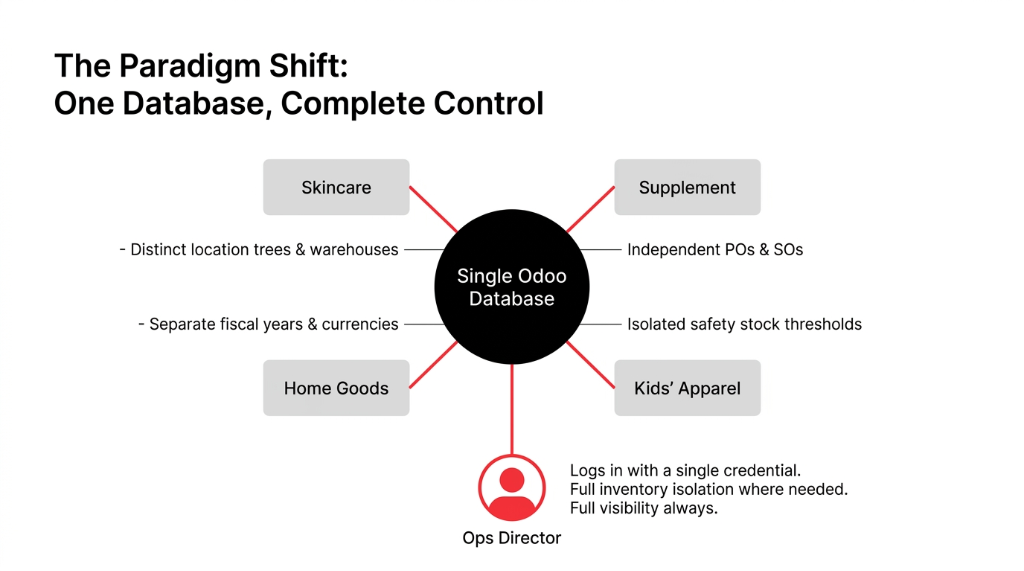
Under this architecture, each brand (company) gets:
One Database. Multiple Companies. Full Isolation Where Needed. Full Visibility Always.
1. Its own warehouse(s) with distinct location trees
2. Its own purchase orders and sales orders
3. Its own fiscal year and currency if needed (for international brands)
4. Its own reordering rules and safety stock thresholds
The group-level ops director?
Logs in with a single credential, switches between companies in under 3 seconds, and generates a consolidated inventory valuation report in under 90 seconds — not 37 hours/month.
This single-database architecture is exactly what our Odoo implementation services team configures for brand groups — because we've seen what happens when the "easy" multi-instance approach breaks at scale.
The Inter-Company Stock Transfer: Where the Magic Happens
This is the feature that makes brand group CFOs stop arguing about whether Odoo is "worth it."
In Odoo's multi-company setup, you can configure inter-company rules that automate inventory transfers between entities. When Brand A creates a purchase order for 5,000 units of a shared packaging material, Odoo can automatically generate a corresponding sales order on the Group Supply Co. entity — with matching pricing, costing, and journal entries on both sides.
No email. No Slack message. No manual entry.
UAE Beauty Group: $47,200 in Procurement Waste Eliminated
Three beauty brands were independently calling the same 3 suppliers and placing separate orders. After activating inter-company purchase rules in Odoo, the group consolidated supplier negotiations, reduced vendor count from 19 to 11, and dropped procurement costs by 18.7% in the first 6 months.
The inter-company stock transfer workflow in Odoo looks like this:
Inter-Company Transfer: 5 Steps, Zero Manual Journal Entries
Step 1: Brand A's warehouse raises an internal stock request to Group Warehouse
Step 2: Odoo auto-generates an inter-company transfer with a validation step
Step 3: Group Warehouse confirms dispatch — stock moves in real time on both entities
Step 4: Both company ledgers are updated automatically with the correct internal transfer valuation
Step 5: No manual journal entries. No reconciliation headache at month-end.
*(Yes, your accountant will love this. Probably the first time they'll say that about an ERP.)*
Shared Warehouses vs. Brand-Specific Warehouses: Pick Your Model
One thing we get asked constantly: "Can Brand A and Brand B share a physical warehouse but maintain separate inventory books?"
Yes. And this is one of the most underused configurations in Odoo multi-company.
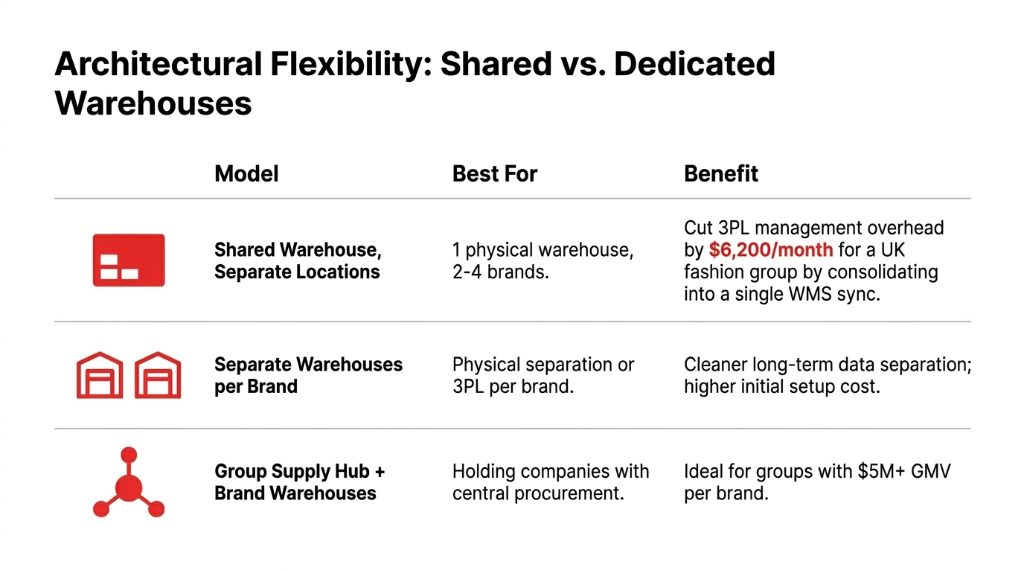
| Model | Best For | Risk / Benefit |
|---|---|---|
| Shared Warehouse, Separate Locations | Groups with 1 physical warehouse, 2–4 brands | Needs strict location discipline from warehouse staff |
| Separate Warehouses per Brand | Groups with physical separation or 3PL per brand | Higher setup cost, cleaner long-term data separation |
| Group Supply Hub + Brand Warehouses | Holding companies with central procurement | Ideal for groups with $5M+ GMV per brand |
In the shared warehouse model, each brand gets its own storage location within the single Odoo warehouse. Stock moves are tagged by company. Costing runs separately. Reports split by entity. The warehouse team sees everything in one screen; the finance team sees only their brand's numbers.
UK Fashion Group: $6,200/Month Saved on 3PL Overhead
Three brands, one 3PL. This model cut their 3PL management overhead by $6,200/month because they stopped paying for three separate WMS integration fees and consolidated into a single Odoo 3PL sync.
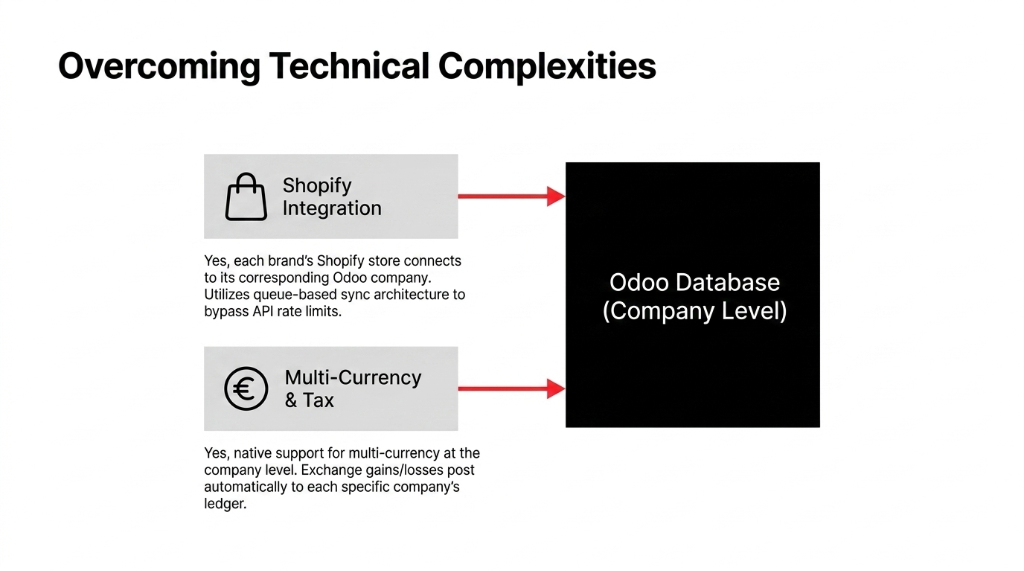
Need your multi-channel sales data flowing cleanly into these warehouse structures? That's where multi-channel inventory sync becomes critical — especially when each brand has its own Shopify store and marketplace presence.
Reordering Rules Across Entities: Stop Letting Each Brand Hoard Stock
Here is an inventory problem nobody talks about in brand groups: phantom safety stock.
Each brand manager, operating independently, sets their own safety stock levels. Brand A says "keep 1,000 units buffer." Brand B says "keep 1,200 units buffer." Brand C says "keep 800." The group is now tying up $94,000 in frozen working capital across these buffers — most of which will never be touched simultaneously.
Group-Level Demand Pooling: The 31% Buffer Reduction
Instead of each brand running independent min-max rules, Odoo multi-company calculates the combined demand pattern and sets a group buffer — typically 31% lower than the sum of individual buffers based on statistical demand pooling (a principle well-documented in supply chain literature from MIT and Gartner).
Singapore Food Group: $41,500 Freed in 90 Days
A group with four food brands freed up $41,500 in working capital in the 90 days after we reconfigured their reordering rules to use group-level logic. That money went directly into a new product launch campaign.
The Implementation Reality (No Sugarcoating)
We will not sell you a dream. Here is what actually happens during a multi-company Odoo inventory setup:
10–14 Week Timeline for a 3–5 Brand Group
Weeks 1–2: Company structure definition. This takes longer than clients expect because someone has to make hard decisions about which entities are separate legal companies vs. just operational brands. Get your CFO and legal counsel in the room on Day 1.
Weeks 3–5: Chart of accounts per company, inter-company rules configuration, warehouse and location setup. This is where most implementations stall if inter-company pricing hasn't been decided in advance.
Weeks 6–8: Data migration. Historical inventory opening balances per entity. If your current data lives in Excel, add 1 week.
Weeks 9–10: User acceptance testing, staff training, go-live. Expect 2–3 days of "why is this different" from warehouse staff before it clicks.
Any consultant promising 4 weeks is either skipping data migration or understaffed on your project.
The first thing that gets easier on Day 1 after go-live: your Monday morning inventory status call drops from 45 minutes to 8 minutes. We have seen this happen on literally every multi-company implementation we've run.
What You Should Expect in the First 90 Days
We track post-go-live metrics obsessively. Here is what brand groups running Odoo multi-company inventory typically see in the first 90 days:
First 90-Day Averages Across 23 Multi-Company Implementations
- Procurement cost reduction: 14–22% from consolidated POs and supplier rationalization
- Month-end close time per entity: Down from 6–9 days to 2–3 days
- Inter-company transfer errors: Drops to near zero (from an average of 11 manual errors/month pre-implementation)
- Working capital freed from rationalized safety stock: $30,000–$90,000 depending on group GMV
- Ops team hours saved on reporting: 28–40 hours/month
These are not projections. These are averages pulled from our last 23 multi-company implementations across the US, UK, UAE, and Singapore.
Want the full picture of how your Odoo ERP integration should be architected for a multi-brand group? We build the inter-company rules, warehouse structures, and reporting layer in a single sprint — because we've done it 23 times and know exactly where it breaks.
Stop Running a $10M Group on a $200 Stack
The ops director spending 37 hours a month on reconciliation? That's a $74,000/year role doing work that Odoo's multi-company module eliminates in a single afternoon dashboard pull.
Book our free 15-Minute Operations Audit. We'll identify your single biggest inventory leak in the first call.
Get Your Free Multi-Company Audit