
The Real Cost of "Winging" Gifting
Here is what a $3M US beauty brand told us before we implemented their Odoo gifting tracking: "We think we gift about 200 units a month. Maybe more."
Maybe more. That is $6,200 to $9,400 in product cost walking out the door with a "maybe" attached to it.
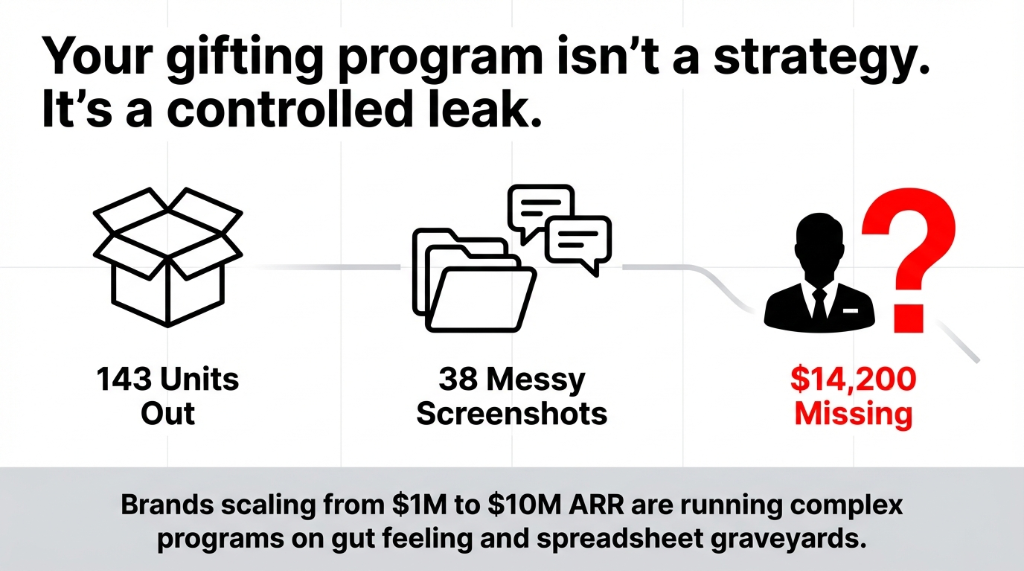
The problem is the zero-traceability model most brands operate on. When your operations manager ships a product to a TikTok creator, that transaction exits your ERP and enters a spreadsheet graveyard. No PO. No linked inventory deduction. No campaign attribution. No follow-up trigger.
The Accounting Panic Nobody Budgets For
When your accountant asks how to categorize gifted units — and they will — someone panics and books it to "miscellaneous expense."
That is how a gifting program that should cost $0.37 per engagement ends up costing $4.12 per engagement with zero way to prove it.
Why Spreadsheets and Stand-Alone Tools Don't Cut It
Everyone in the influencer marketing space will try to sell you a standalone gifting platform — Aspire, Klear, Influencer Hero, all of them. They connect to Shopify via API, auto-pull tracking numbers, and give you a clean dashboard. We are not here to trash them.
But here is the thing nobody tells you: those tools live outside your ERP. The moment a unit ships through one of those platforms, your Odoo inventory does not know about it. Your COGS do not update. Your fulfillment team does not get a deduction alert. Your finance team reconciles it manually at month-end — if they reconcile it at all.
Real Story: 312 Ghost Units in Dallas
We had a client in Dallas running $200K/month in e-commerce volume. They were using a popular gifting platform + Shopify + QuickBooks. Their gifting shipments were invisible to QuickBooks until someone manually entered them.
3 months into the program: 312 unreconciled gifted units sitting in limbo between their Shopify inventory count and their warehouse's physical count. The discrepancy caused their demand forecasting model to over-order by 18.5% on their best-selling SKU.
That one oversight cost them $11,340 in excess inventory carrying costs over 90 days. The fix was not a new tool. It was connecting gifting to the ERP they already owned.
How Odoo Influencer Gifting Tracking Actually Works
The Braincuber-implemented Odoo Influencer Gifting Module is not a bolt-on. It lives inside Odoo CRM and Odoo Inventory simultaneously — which is exactly why it closes the gaps those standalone tools create.
Here is the workflow we configure for US D2C brands:
Step 1 — Gifting Request Raised in CRM
Your marketing team creates an influencer record in Odoo CRM. Name, platform (Instagram, TikTok, YouTube), follower tier, campaign association. When they want to send product, they raise a gifting request directly from the CRM lead. No email. No Slack message. A formal, tracked request.
Step 2 — Inventory Deduction Triggered Automatically
The moment the gifting request is approved, Odoo Inventory fires a stock deduction against that specific SKU. The product is no longer available for sale. No warehouse manager manually subtracting. No reconciliation gap. The unit is tagged as "gifted — pending shipment" with a linked influencer record.
Step 3 — Shipment Dispatched and Tracked
The fulfillment team picks the order from Odoo's internal shipping queue — the same queue your regular orders run through. Tracking numbers are auto-generated and pushed back to the influencer's CRM record. Your marketing coordinator can see delivery status without calling the warehouse or checking ShipStation in a separate browser tab.
Step 4 — Campaign Deliverable Linked
Once the product is delivered, Odoo triggers a follow-up task: log the influencer's post URL, views, engagement rate, and promo code redemptions. This is where the attribution loop closes. The gifted unit cost ($COGS) sits next to the campaign result in a single record.
Step 5 — Finance Gets a Clean Audit Trail
Every gifted unit is booked as a marketing expense — not "miscellaneous," not a manual journal entry. When your CFO pulls a monthly P&L, gifted inventory is categorized, SKU-level, with influencer attribution. Your QuickBooks sync (or native Odoo Accounting) pulls this automatically.
The Numbers You Should Expect After Implementation
We are not going to promise "better ROI." Here are the actual outcomes from our last 4 US-based D2C implementations using this module:
Verified Implementation Results (4 US D2C Brands)
Inventory Reconciliation
Down from 6.5 hours/month to 41 minutes/month
Unaccounted Gifted Units
Dropped from an average of 23 units to 0 at month-end
CFO Approval Time
Cut from 4 days to same-day approval (clean request-to-ship paper trail)
Nano vs Macro Insight
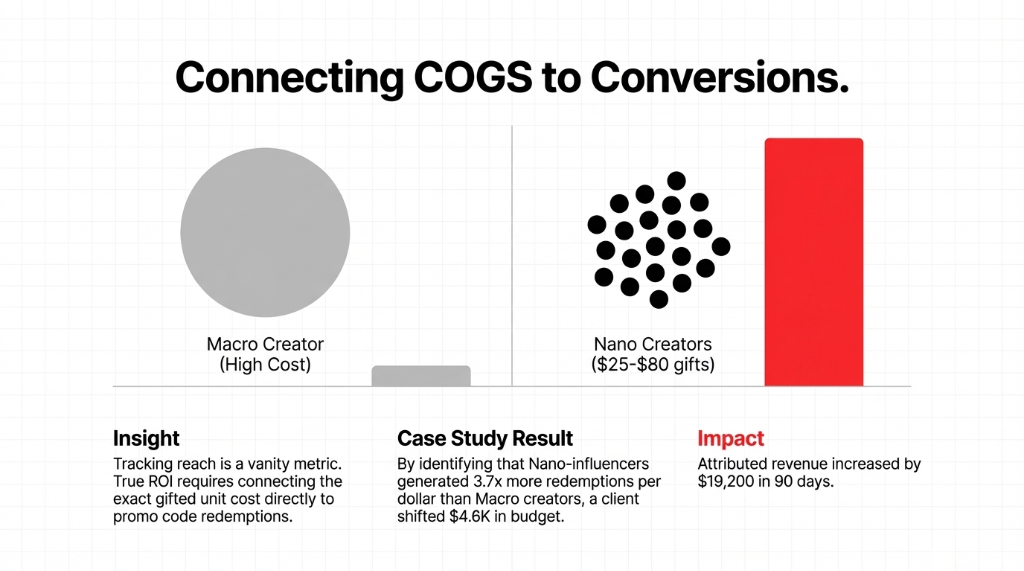
Nano-influencer tier generated 3.7x more redemptions per dollar than macro campaigns
The Budget Shift That Paid for Itself
That last data point alone shifted $4,600/month in gifting budget from macro to nano creators.
Revenue from gifting attribution went up $19,200 in the next 90 days. You cannot make that shift if you cannot see the data.
The Implementation Reality (No Sugarcoating)
We will not pretend this takes 48 hours to go live. Here is an honest timeline:
Week 1: CRM Influencer Records
Odoo CRM influencer record structure configured; existing influencer database imported (yes, even from your Excel nightmare).
Week 2: Inventory Deduction Workflow
Inventory deduction workflow mapped to your specific warehouse and fulfillment process. Gifting stock move type configured.
Week 3: Request-to-Shipment Automation
Gifting request-to-shipment automation tested in staging. Delivery triggers and follow-up task automation validated.
Week 4: Finance Mapping
Marketing expense category set up in Odoo Accounting or synced to QuickBooks/Xero. P&L categorization finalized.
Week 5: Team Training
Marketing, ops, and finance. This is where most implementations fail. We stay until everyone knows how to use it.
Total go-live: 37 to 45 working days depending on your current Odoo setup. If you are starting Odoo fresh, add 2–3 weeks for base configuration.
What gets easier immediately — even during setup? The gifting request form. From day one, your marketing team stops Slacking the warehouse and starts using a formal approval flow. That alone eliminates 4–6 back-and-forth messages per gifting request.
What Most Brands Get Wrong About Gifting Attribution
Here is the controversial take: most brands are measuring influencer gifting ROI wrong, and their agencies are letting them.
They track reach and impressions. They celebrate 200,000 views on a TikTok. But they cannot tell you how many of those 200,000 views converted to a product page visit, added to cart, or redeemed a discount code — because the gifting workflow was never connected to their conversion tracking infrastructure.
The Attribution Loop That Changes Everything
When promo codes are generated per influencer inside Odoo, redemption data flows directly back to the CRM record. You see the full chain:
Unit gifted ($47 COGS) → Post went live 9 days after delivery → 312 promo code redemptions → $7,488 in revenue attributed
That is a 159x return on the gifted unit cost. If your gifting program cannot produce that number per influencer, per campaign, you are flying blind in a $9.29 billion market.
Stop Letting Free Units Be Invisible Costs
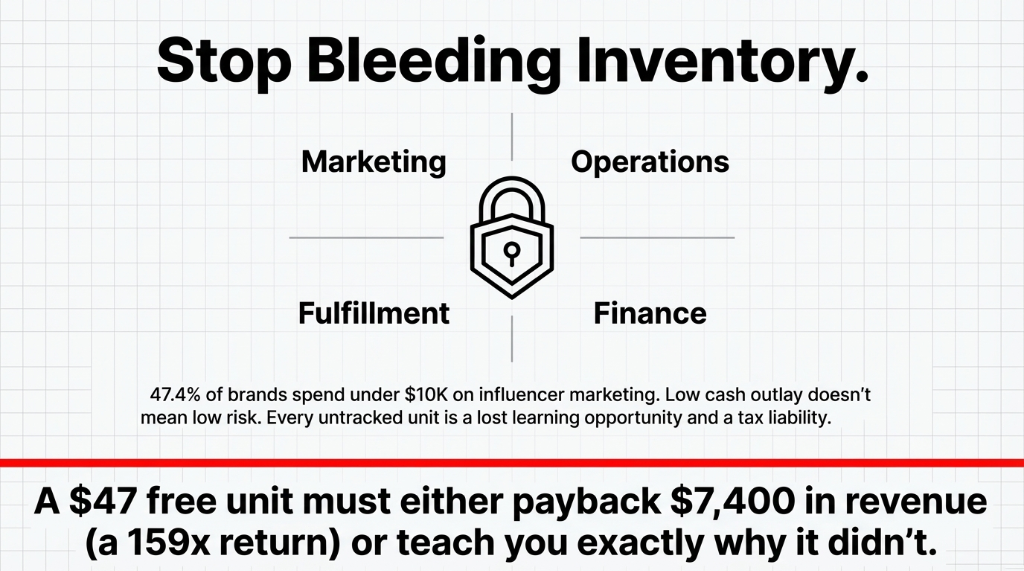
47.4% of brands spend under $10,000 on influencer marketing — and the gifting-only model is the entry point for most of them because it is lower cash outlay. But low cash outlay does not mean low risk. Every untracked unit is a COGS write-off with no attribution, no tax categorization, and no learning.
If your team is managing gifting through Airtable, a shared inbox, or — worst of all — a Notes app on someone's iPhone, you are one quarter away from a reconciliation crisis.
The Braincuber Odoo Influencer Gifting Module is not about making your marketing team's lives easier. It is about making your operations airtight so that a $47 free unit either pays back $7,400 in revenue or it teaches you something specific about why it didn't. That is the only acceptable outcome.
FAQ
Does Odoo have a built-in influencer gifting module?
Odoo does not ship a native influencer gifting module out of the box. Braincuber builds and configures a custom module that extends Odoo CRM and Inventory to handle gifting requests, shipment tracking, and campaign attribution — all connected to your existing Odoo instance without third-party platforms.
How does Odoo track gifted inventory without creating a sales order?
We configure a dedicated "gifting" stock move type in Odoo Inventory. When a gifting request is approved in CRM, it triggers a warehouse transfer that deducts the unit from available stock, books it as a marketing expense in Odoo Accounting, and logs the linked influencer record — no sales order, no revenue entry, clean COGS write-off.
Can Odoo send automated follow-up tasks after gifted products are delivered?
Yes. We configure delivery confirmation triggers in Odoo that auto-create a follow-up task assigned to your marketing coordinator — prompting them to log the influencer's post URL, engagement data, and promo code performance within a set window, typically 14 days post-delivery.
Will this work if we already use Shopify for fulfillment?
Yes. Braincuber's Shopify–Odoo integration means gifting orders can be routed through your existing Shopify fulfillment workflow while inventory deductions and influencer records stay inside Odoo. Tracking numbers sync back automatically so CRM records update without manual entry.
How long does it take to implement the Odoo influencer gifting tracking module?
For brands already running Odoo, go-live takes 37 to 45 working days. This covers CRM configuration, inventory workflow setup, finance mapping, and team training. If you are implementing Odoo fresh alongside this module, add 2 to 3 weeks for base configuration.
Stop Bleeding Inventory on Influencer Gifting
Book a free 15-Minute Operations Audit — we will map your gifting workflow gaps and show you exactly where Odoo closes them. No prep needed. Just bring your current mess.