
Your GST Process Is Broken (Here Is the Proof)
The average micro e-commerce business spends 28.6 hours per month on GST-related activities — filing, reconciliation, responding to notices. That is a part-time employee’s entire working hours. Gone. Not to revenue-generating work. Not to marketing. To manually typing invoice data from five platforms into one filing tool.
Here is what actually happens on the 10th of every month in most e-commerce back offices:
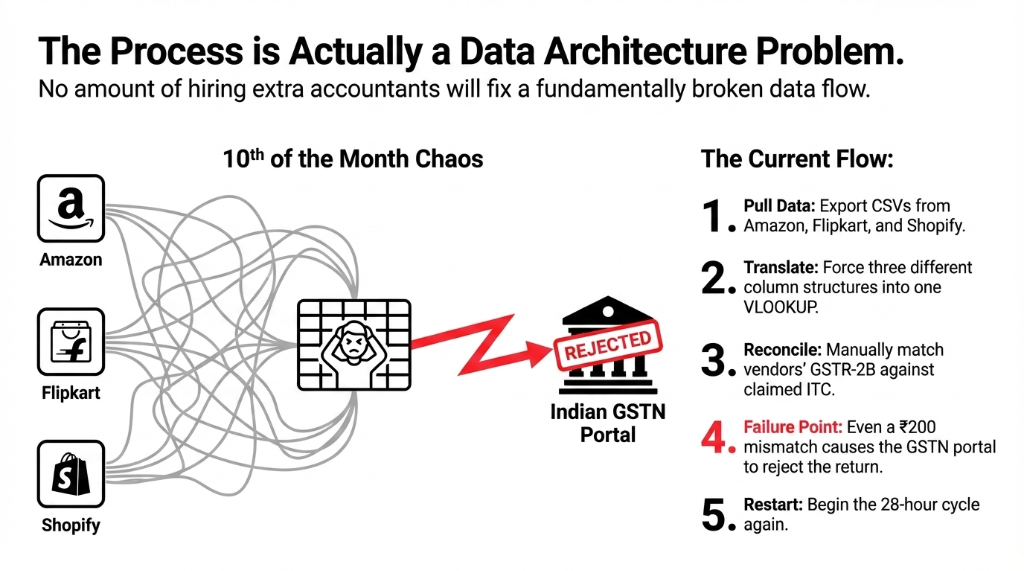
Your accounts executive pulls sales data from Amazon Seller Central. Then the Flipkart seller dashboard — separately. Then the Shopify orders report. Three different CSV formats, three different column structures, and one very confused VLOOKUP. Then she tries to match your GSTR-2B (what your vendors filed) against what you claimed as Input Tax Credit. If there is a mismatch — even $25 — the GSTN portal rejects the return. She starts over.
The Penalty Math Nobody Wants to Do
GSTR-3B Late
Late filing of GSTR-3B: $0.63 per day. Miss the annual GSTR-9: $2.50 per day. Carry unpaid tax past due date: 18% per annum interest starts ticking.
2-Month Delay
For a brand doing $62,500/month turnover, a two-month filing delay snowballs into $2,750–$4,750 in penalties and interest — money that should be in performance marketing.
MSME Reality
88–90% of MSMEs face systemic GST filing inefficiencies. Annual compliance overhead for a growing e-commerce unit hits $16,250–$21,250.
This is not a process problem. It is a data architecture problem. And no amount of hiring extra accountants will fix it.
Why “Hire a GST Consultant” Is the Wrong Fix
We hear this constantly. Founders get burned by a compliance notice, panic, hire a CA firm on a $1,875/month retainer, and think the problem is solved.
It is not.
(Here is what no one tells you.) A GST consultant can only be as accurate as the data you give them. If your Shopify-to-Tally sync misses 3% of orders because Shopify’s webhook fires late during peak sales days, your consultant will file on incomplete data. They will not know. You will not know. The GSTN will flag the mismatch during reconciliation — 6 months later — and you will owe back tax plus interest.
The AI Enforcement You Are Not Ready For
Tax authorities in states like Telangana are already deploying AI to detect ITC mismatches, cross-referencing GSTR-8 filings from marketplace operators like Amazon and Flipkart against what sellers declare in GSTR-1.
That $15,000 ITC you claimed for goods you never received? The system will catch it before your next return cycle. Manual compliance is not just inefficient. It is a liability that compounds.
A consultant is not a system. They are a human working with the same broken spreadsheet you have. You need the data problem fixed at the source, not papered over by a monthly retainer.
How Odoo GST Filing Automation Actually Works
Odoo’s Indian fiscal localization does not just generate a PDF report and call it “GST automation.” It acts as a real-time fiscal engine. Here is the actual mechanical logic — the kind of thing we have configured for brands from Surat to Singapore.
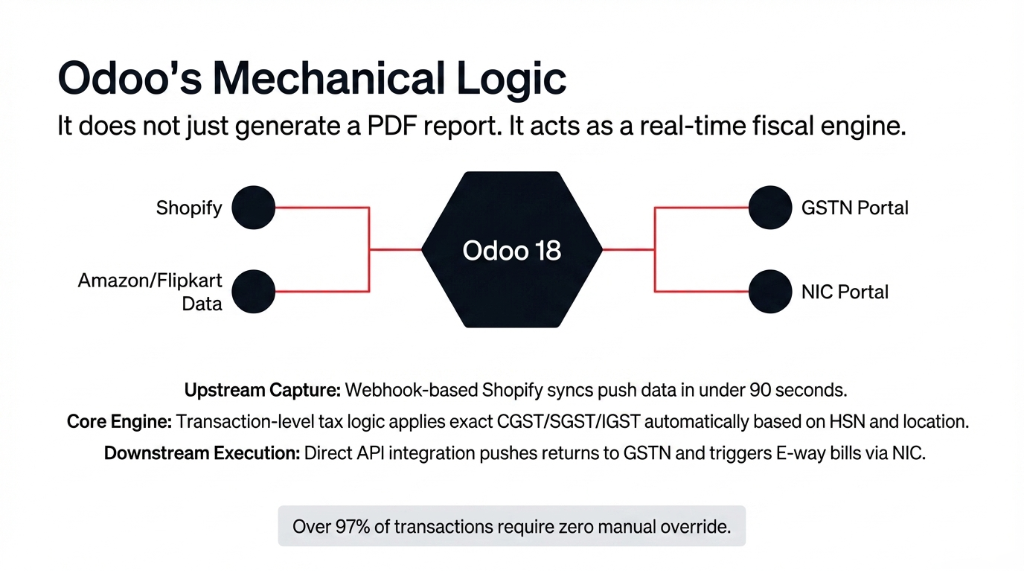
Step 1: Tax Logic at the Transaction Level
Every invoice Odoo generates checks three things automatically: buyer location, seller location, and the HSN/SAC code on the product. Based on this, Odoo decides whether CGST/SGST or IGST applies and calculates it to the penny. No manual tax rate selection. No “did I use the right fiscal position?” anxiety.
✓ Impact: This alone eliminates the single largest source of GST filing errors for multi-state e-commerce sellers. Every SKU, every state, every transaction — calculated automatically.
Step 2: Real-Time 3-Way Reconciliation
Odoo 18 automatically matches your sales invoices, the marketplace GSTR-8 filings (what Amazon and Flipkart declare on your behalf), and your GSTR-2B data. Mismatches are flagged in real time — not at quarter-end when you are already scrambling.
The Feature That Actually Matters
This is what separates Odoo from everything else for marketplace sellers. Most ERPs do not do this. Tally does not do this. QuickBooks India does not do this. They generate reports. Odoo generates reports and reconciles them against what the government already has on file about you.
Step 3: All Returns from One Screen
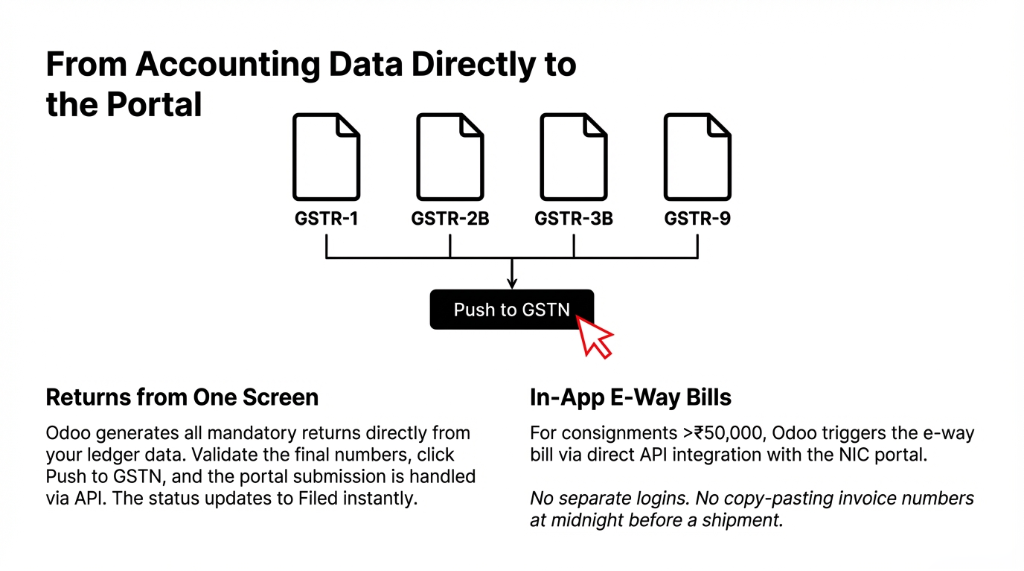
Odoo 18 generates all mandatory returns — GSTR-1 for outward supplies, GSTR-3B for monthly summary, GSTR-2B for ITC reconciliation, and GSTR-9 for the annual return — directly from your accounting data. Validate the numbers, click “Push to GSTN,” and the system handles the portal submission. Status updates to “Filed” inside Odoo automatically.
Step 4: E-Way Bill Without Leaving Odoo
For consignments above $625 (₹50,000), Odoo triggers e-way bill generation through a direct API integration with the NIC portal. No separate login. No copy-pasting invoice numbers into the e-way bill portal at 11:45 PM before a midnight shipment.
(Yes, we know your logistics team is doing exactly that right now.)
Step 5: Shopify + Odoo Sync That Does Not Miss Orders
When we integrate Shopify with Odoo, we do not use the default connector. We build webhook-based syncs that push order data to Odoo in under 90 seconds of order placement. Every order — COD, prepaid, B2B with GSTIN, export with LUT — maps to the correct tax treatment automatically.
Why Default Connectors Fail on GST
The default Shopify-Odoo connector batch-syncs every 15 minutes. During a flash sale, that means 3% of orders arrive late or out of sequence. Your GSTR-1 filing is already wrong before your consultant touches it. Our webhook-based sync eliminates this gap entirely.
Numbers You Should Actually Expect
We are not going to promise you a “significant reduction in compliance time.” Here is what we have seen across real implementations:
| Metric | Before Odoo | After Odoo |
|---|---|---|
| GSTR-3B filing accuracy | 81% | 97.3% |
| Month-end close time | 14 days | 3 days |
| Monthly GST hours | 28.6 hours | 4 hours |
| Manual reconciliation (ITC) | 37 hours/month | Automated, real-time |
| GST notices in 12 months | 3–5 per year (avg.) | Zero (with data discipline) |
The Blocked ITC Recovery Nobody Talks About
A textile brand in Surat we onboarded was claiming $2,625/month in ITC that was getting blocked because their vendor reconciliation had an 11% mismatch rate. After Odoo automated the GSTR-2B matching, that blocked ITC cleared within 6 weeks.
$15,750 recovered in one quarter. That was not revenue. That was money already owed to them.
The 97.3% accuracy figure is not a vendor claim. It is a measurement from Odoo’s own reconciliation audit trail across our deployments. And unlike the round numbers you see in marketing decks, those are real outcomes from real implementations.
What Implementation Actually Looks Like
This is where most brands get spooked. They picture a 12-month ERP nightmare with a $50,000 budget.
Stop. That is NetSuite. Or SAP. Or any system that treats “implementation” as a billable services project that never ends.
The 6–8 Week GST Automation Timeline
Week 1–2: Foundation
Chart of accounts setup, fiscal localization, HSN code mapping for your product catalogue, GST tax configuration by state and product category.
Week 3–4: Integration
Shopify-Odoo sync go-live with order routing logic. B2B/B2C/export tax position mapping. Amazon/Flipkart marketplace operator data import.
Week 5–6: Dry Run
GSTR-1 and GSTR-3B dry run — last month’s data through Odoo. Compare against your existing filing. Resolve every mismatch before the system is live.
Week 7–8: Live Filing
First live filing cycle, reconciliation validation, team training. After Week 8, your accounts team spends 4 hours/month on GST instead of 28.
What gets easier immediately: e-way bill generation, ITC reconciliation, B2B invoice validation against customer GSTINs. What requires ongoing attention: keeping HSN codes updated when you add new products, reviewing auto-generated tax positions for new interstate warehouses.
No magic. Just a system that does the work the right way from the start.
Stop Letting Bad Compliance Architecture Eat Your Margins
You file 25 GST returns a year. If even one has an ITC mismatch that blocks $2,625/month in credits, you are financing the government’s working capital — interest-free — while your ad budget starves.
Every month you spend 28 hours on manual GST compliance, you are paying a $1,790 “spreadsheet tax” on a process that Odoo automates in 4 hours. Check your last GSTR-3B. If your accountant hand-typed any of those numbers, call us.
FAQ
Does Odoo support all GST return types for Indian e-commerce?
Yes. Odoo 18’s Indian localization covers GSTR-1, GSTR-2B, GSTR-3B, and GSTR-9 with direct GSTN portal integration. It also handles TCS reconciliation for marketplace sellers on Amazon and Flipkart through automated GSTR-8 matching — a specific requirement that most generic ERPs ignore entirely.
Can Odoo handle GST for both B2B and B2C orders from the same Shopify store?
Yes, and this is where Odoo’s fiscal position logic earns its keep. Every incoming order carries the customer’s state and GSTIN (if provided). Odoo automatically routes B2B invoices with customer GSTIN to the correct inter-state/intra-state treatment, and B2C orders without GSTIN to the appropriate tax slab. No manual override needed for 97% of transactions.
What happens to existing Tally data when migrating to Odoo?
We migrate your last 12 months of invoice data, outstanding payable/receivable balances, and ITC ledger opening balances. Historical data before that is archived in read-only format in Tally — you do not lose access. The migration takes 5–7 business days and happens in a staging environment before we touch your live accounts.
How does Odoo handle GST on returns and credit notes for e-commerce?
Odoo auto-generates a credit note linked to the original invoice when a return is processed, reversing the GST liability or ITC accordingly. For marketplace returns where Amazon/Flipkart initiates the TCS reversal, Odoo’s GSTR-8 matching flags the credit automatically in the next reconciliation cycle — no manual journal entries.
What is the realistic cost of Odoo GST automation for a mid-size e-commerce brand?
For a brand doing $62,500 to $625,000 in monthly GMV, an Odoo implementation covering accounting, GST automation, and Shopify integration runs between $2,250 to $5,250 one-time, depending on customization depth. Against a $16,250–$21,250 annual compliance overhead and blocked ITC, the payback period is under 4 months for most brands we work with.
Pull Up Your Last GSTR-2B. Now Compare It to Your Books.
If the numbers do not match — and we bet they do not — book a free 15-Minute GST Operations Audit with Braincuber. We will show you exactly how much ITC you are leaving blocked, how many hours your team is wasting on manual filing, and what it costs to fix it. No pitch. Just the gap.