
We've seen this exact setup at 23 skincare brands across the US in the last 18 months. Every single one was leaking money. The average? $17,400 per month in waste, stockouts, and unreconciled inventory write-offs.
If you are running a skincare operation between $1M and $15M in annual revenue without a purpose-built ERP, this guide is the wake-up call you didn't ask for but desperately need. Odoo ERP for skincare brands is not just a technology decision. It's a survival strategy in a post-MoCRA world where the FDA can walk into your facility and demand a complete audit trail — and you have 72 hours to produce it, not 3 weeks.
Your Operations Are More Broken Than You Think
Here is the story we hear almost every time a skincare founder calls us.
They started with 12 SKUs, a Shopify store, and a 3PL in New Jersey. Orders came in. They hired a warehouse coordinator. They added a QuickBooks subscription. They hired a contract manufacturer in Texas. Now they have 47 SKUs, three raw material suppliers, a retail partnership with Ulta, and an operations team of 6 people — all working from different spreadsheets that nobody updates at the same time.
The moment one supplier sends a batch of niacinamide with a slightly different concentration, nobody catches it until a production run is already contaminated.
That recall costs $140,000 minimum — plus the brand damage that never fully recovers.
We worked with a natural serum brand in California that had exactly this problem. Their QC manager was maintaining batch records in Excel with 14 tabs and cross-referencing supplier CoAs via email. When their contract manufacturer flagged a potential contamination issue with a fragrance compound, tracing which finished goods were affected took 11 days. By that point, 3,400 units had already shipped to retail partners.
The fix was not "better spreadsheets." The fix was Odoo ERP with end-to-end batch traceability — tracking every raw ingredient from the supplier invoice all the way to the customer delivery address.
Why QuickBooks and NetSuite Are Both Wrong Answers
Frankly, this is where most skincare founders make a catastrophic mistake.
They outgrow QuickBooks (usually around $1.5M ARR when multi-location inventory breaks the system) and immediately jump to the next "enterprise" option they find on a Google search. Nine times out of ten, that means either NetSuite or SAP.
The NetSuite Money Pit
Base implementation for a mid-market skincare brand: $85,000-$220,000. That doesn't include cosmetics-specific customization for formula versioning, batch tracking, and FDA-compliant reporting.
We've watched three US skincare brands burn through 18 months and $190,000+ on NetSuite implementations that never properly handled lot traceability.
They eventually called us to fix it.
QuickBooks, on the other hand, will never be able to tell you which specific lot of shea butter is in which finished goods batch currently sitting in a Chicago 3PL. (Yes, your FDA compliance officer knows this too — they just haven't told you yet.)
The skincare industry doesn't need pharma-grade ERP at pharma-grade prices. It needs an ERP that handles formulation management, GMP compliance, batch tracking, and multi-channel sales — without a $500,000 implementation bill that kills your cash flow for two years. That's exactly the gap that Odoo ERP for skincare brands fills.
How Odoo Actually Handles Skincare Operations
Stop thinking of Odoo as "just another ERP." For skincare brands specifically, Odoo 17/18 handles seven operational layers that most skincare brands currently manage across four disconnected tools.
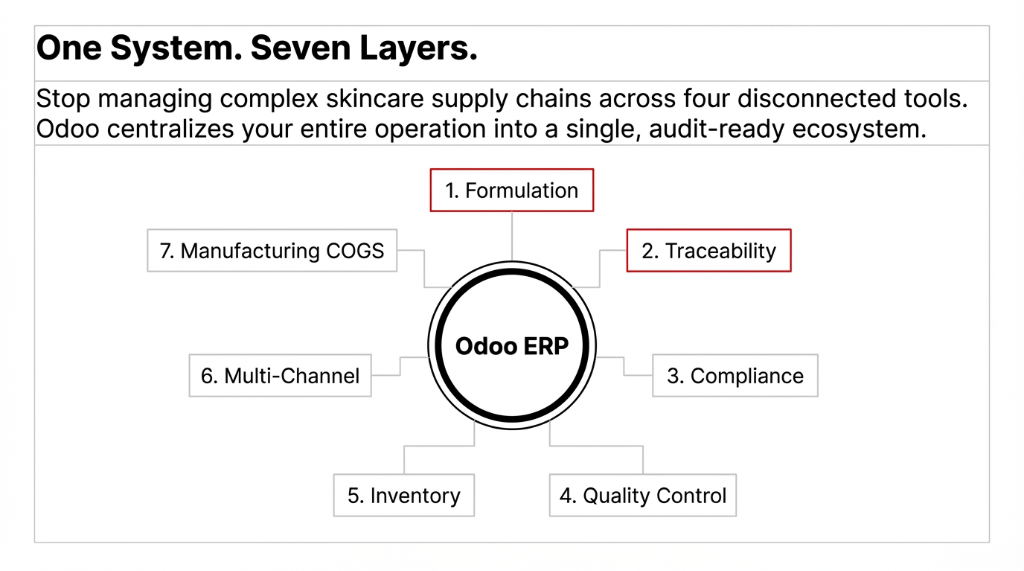
Layer 1 — Formulation Management
Every product formula lives in Odoo with version control. If your R&D team tweaks the vitamin C concentration from 15% to 17% in your serum, that change is logged, time-stamped, and linked to every production run that uses the new formula.
No more "which version are we using?" Slack messages at 9 PM.
Layer 2 — Batch and Lot Traceability
Every raw material gets a lot number the moment it enters your system — tied to the supplier, the CoA, the date received, and the expiration date. Odoo tracks FEFO (First Expired, First Out) automatically, so your warehouse doesn't accidentally use a batch of hyaluronic acid that expires in 6 weeks when there's a newer lot sitting behind it.
Layer 3 — FDA/MoCRA Compliance Reporting
Under the Modernization of Cosmetics Regulation Act of 2022, US skincare brands must now maintain facility registrations, safety substantiation records, and adverse event reporting systems.
Odoo's compliance module automates documentation so your compliance officer pulls a complete FDA audit package in 2 hours, not 3 weeks.
Layer 4 — Quality Control Workflows
Incoming raw material inspections, in-process quality checks, and finished goods release approvals all live in Odoo. Your QC team sets up inspection checkpoints — and nothing moves forward in the production queue without a passing result.
No bypassing. No "we'll check it later."
Layer 5 — Inventory and Supply Chain
Real-time raw material levels, automated reorder points based on your production schedule, and supplier lead time tracking.
We consistently see skincare brands cut raw material waste by 15-25% in the first quarter after go-live, simply because they stop panic-buying ingredients they already have in the warehouse.
Layer 6 — Multi-Channel Order Management
Shopify, Amazon, Ulta wholesale EDI, and your direct DTC site all flow into a single order management dashboard. Returns get reconciled automatically.
No more month-end spreadsheet reconciliation where your accountant finds $11,700 in unmatched credits.
Layer 7 — Manufacturing COGS
If you do any in-house blending, filling, or packaging, Odoo's manufacturing module manages work orders, tracks labor time per batch, and calculates real cost-of-goods at the batch level. Not estimated COGS. Actual COGS.
That data alone changes every pricing conversation you have with a retail buyer.
The MoCRA Compliance Bomb Most Skincare Brands Are Ignoring
If you registered your facility with the FDA under MoCRA and thought that was the end of it — you are about to get a very expensive education.
MoCRA requires ongoing safety substantiation documentation, serious adverse event reporting within 15 business days, and facility inspection readiness. The problem is that most skincare brands running on QuickBooks + Shopify + Excel have absolutely no way to produce this documentation on demand.
Real Story: $34,000 Just to Compile Paperwork
A Texas-based clean beauty brand with $4.2M in annual revenue got an FDA inspection request in September 2024. Their regulatory consultant told them it would take 23 days and $34,000 in consulting fees just to compile the required documentation from their existing systems.
That was the moment they called us.
With Odoo implemented, that same document package takes 2 hours. The ERP maintains every batch record, every supplier CoA, every quality inspection result, and every lot disposition decision in a single, audit-ready system.
The brands that treat compliance as an "operations problem" and not a "QC problem" are the ones that survive FDA scrutiny. And Odoo ERP for skincare brands is the engine that makes that shift possible.
Real Numbers From Real Skincare Implementations
We don't do "up to X%" claims. Here is what we actually see across skincare brand implementations:
Verified Implementation Results
Audit Prep Time
Down from 14-21 days to under 2 hours
Raw Material Waste
15-25% reduction in first 90 days after go-live
Compliance Risk
40% drop in audit findings & documentation gaps
Recall Response
From 11+ days to under 4 hours with full lot traceability
Inventory Write-Offs
$110,000-$180,000 recovered in first year via FEFO + demand-driven reordering
Profit Growth
113% profit growth on just 7% revenue growth via just-in-time inventory
That last number is not a typo. Margins in skincare are largely an operations problem, not a marketing problem.
What Odoo ERP Implementation Actually Looks Like for Skincare Brands
Stop assuming ERP means 12 months of pain and a $300,000 consulting bill. Here's the real timeline we run for skincare brands at Braincuber:
Weeks 1-2: Discovery
We map your formulation workflows, production process, QC checkpoints, and compliance requirements. We audit your current raw material suppliers, batch record formats, and Shopify order data.
Weeks 3-6: Configuration
We configure Odoo with skincare-specific modules — formula versioning, FEFO batch tracking, MoCRA-ready compliance documentation, and your specific quality inspection checkpoints.
Weeks 7-9: Data Migration
We migrate your product formulas, supplier master data, historical batch records, and open purchase orders. Zero data loss. Your team doesn't walk in on go-live day to an empty system.
Weeks 10-12: Training & Go-Live
Your production team, QC team, and ops managers get role-specific training. We stay on live support for the first 30 days after go-live.
Total timeline: 8-12 weeks. Not 6 months. Not a year.
The brands that delay because they're "not ready for ERP" are the ones still losing $17,000 a month to operational drag while their competitors pass FDA audits in an afternoon.
Odoo vs NetSuite vs QuickBooks: The Skincare Brand Comparison
| Capability | QuickBooks | NetSuite | Odoo (Braincuber) |
|---|---|---|---|
| Formula Versioning | No | $40K+ add-on | Built-in |
| Lot/Batch Traceability | No | Partial | Full FEFO |
| MoCRA Compliance | No | Custom build | Audit-ready |
| Multi-Channel Sync | Basic | Yes | Yes + EDI |
| Implementation Cost | $0-$5K | $85K-$220K | Fraction of NetSuite |
| Go-Live Timeline | 1 week | 12-18 months | 8-12 weeks |
| Skincare-Ready? | Outgrown by $1.5M | Overkill + $$$$ | Purpose-built |
Why Generic Odoo Implementers Fail Skincare Brands
Here's the part nobody talks about. Odoo is the right platform. But picking the wrong implementation partner is almost as expensive as picking the wrong ERP.
Generic Implementer:
▸ Configures inventory module for "products" — no concept of FEFO vs FIFO distinction for perishable goods
▸ Sets up manufacturing with no formula version linkage
▸ Ignores MoCRA entirely — "that's a compliance team problem"
▸ QC module set up for pass/fail, missing incoming raw material inspections
Skincare-Specialized Partner:
▸ Knows the difference between a serum formulation and an emulsion
▸ Configures FEFO for lot tracking with supplier CoA linkage
▸ Builds MoCRA-ready compliance documentation into daily workflows
▸ Maps QC checkpoints to FDA GMP requirements at each production stage
We've had to rescue three NetSuite-to-Odoo migrations where the previous implementer didn't understand cosmetics-specific ERP integration requirements. Every single time, the problem was the same: the partner configured Odoo like it was a generic distribution company, not a formulation-driven manufacturing operation with regulatory obligations.
Stop Treating This Like a Technology Problem
Here is what we tell every skincare founder in the first 15 minutes of our audit call:
Your operations are not broken because you don't have software. They're broken because your current software stack was never designed for what you're actually doing — managing complex formulations, multi-supplier raw materials, batch-level traceability, and FDA compliance simultaneously.
Odoo ERP for skincare brands, implemented correctly by people who actually understand GMP, MoCRA, and the difference between a serum and an emulsion, solves all of it. In 8-12 weeks. At a price point that won't destroy your cash flow.
FAQ
How long does Odoo implementation take for skincare brands?
8-12 weeks. Discovery, skincare-specific configuration (formulation, batch tracking, MoCRA compliance), data migration, and team training. Live in under three months.
Does Odoo handle FDA and MoCRA compliance?
Yes. Automated audit trails, batch records, adverse event documentation, and regulatory reporting. Complete FDA audit package in under 2 hours vs 2-3 weeks with manual systems.
How much does Odoo cost vs NetSuite for skincare?
NetSuite runs $85,000-$220,000 before cosmetics customization. Odoo delivers deeper skincare functionality at a fraction of that cost, with faster go-live and a partner who knows formulations.
Can Odoo integrate with Shopify and 3PLs?
Yes. Real-time order and inventory sync with Shopify, API connections to major 3PLs. Returns auto-reconcile — eliminating the $8,000-$15,000/month reconciliation gap most brands don't know they have.
What happens to existing data during migration?
Every formula, supplier CoA, historical batch record, and quality inspection result gets migrated before go-live. Full data audit and validation. Historical compliance data stays intact — which matters when FDA asks about a batch from 18 months ago.
Stop Bleeding $17,400/Month on Operational Drag
Book a free 15-Minute Operations Audit with Braincuber. We'll find your biggest operational leak in the first call. No pitch. No fluff. Just the truth about where your money is going.