
A Dubai fashion brand with 9 employees lost $6,800 in legal fees over 14 disputed overtime hours that were never logged.
If you are managing a 7-person e-commerce team using a WhatsApp group, a Google Sheet for attendance, and QuickBooks for payroll, you are not running lean. You are running blind. And every month you operate that way, you are losing an average of $3,400 in payroll errors, attendance disputes, and admin hours that should be going into picking, packing, and selling.
Nine employees. One overtime dispute. $6,800 gone.
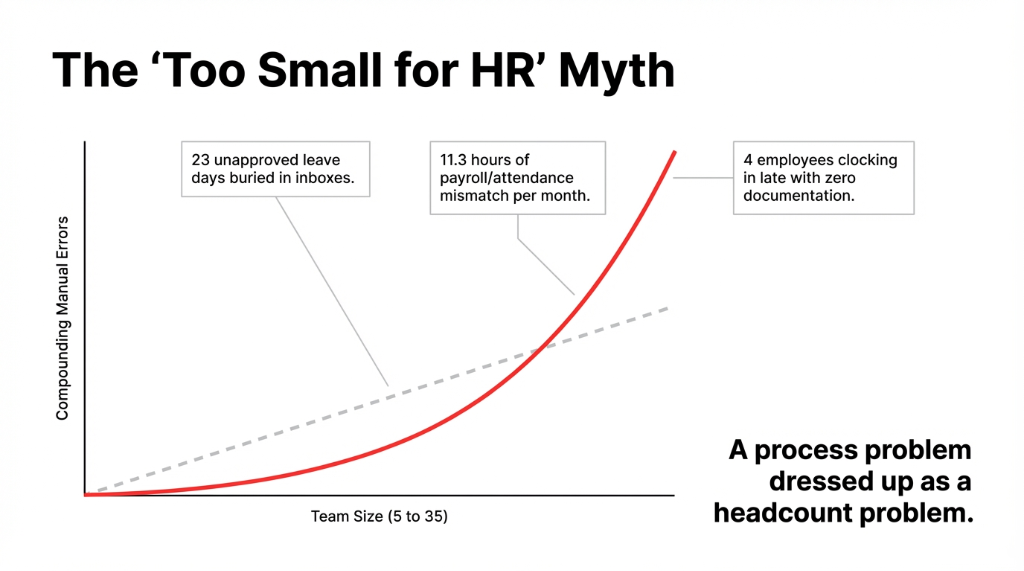
We have implemented Odoo for small e-commerce teams across the US, UK, UAE, and Singapore. Teams as small as 4 people and as large as 35. The problem is always the same. The founder thinks they are "too small" for a real HR system. Then we open the books and find 23 unapproved leave days sitting in someone's inbox, 4 employees clocking in late with zero documentation, and a payroll that does not match attendance by 11.3 hours per month.
That is not a small-team problem. That is a process problem dressed up as a headcount problem.
The Real Mess Behind a "Small" E-Commerce Operation
Here is what a typical 8-person e-commerce team looks like when we first audit them:
What We Actually Find During Audits
Hidden cost: $3,400-$6,800/month in compounding errors and legal exposure
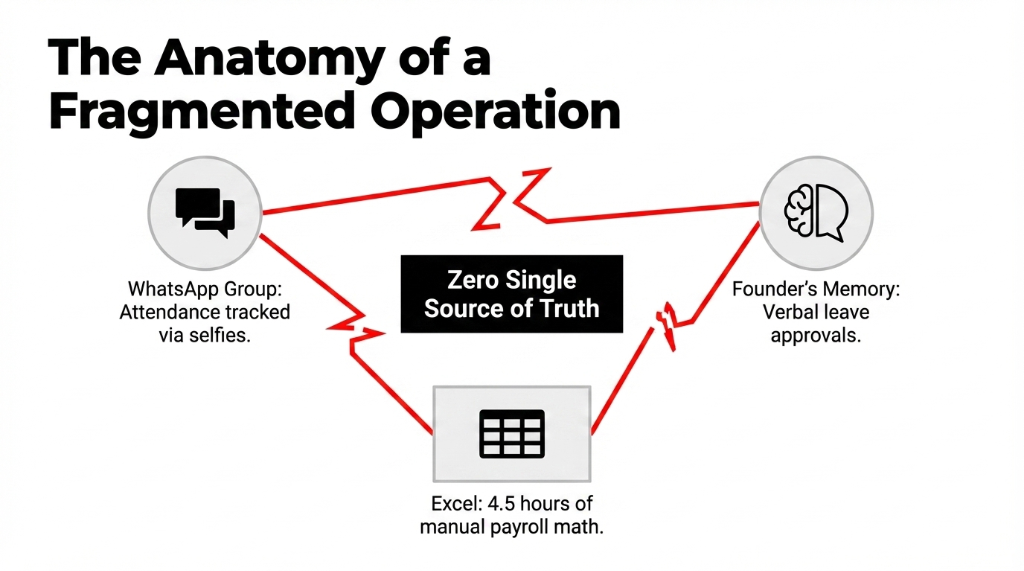
One client, a Dubai-based fashion D2C brand doing $2.1M/year, came to us after their warehouse manager disputed 14 hours of overtime that was never logged properly. That dispute cost them $6,800 in legal consultation fees and two weeks of operational chaos. They had 9 employees.
The problem is not the size of your team. It is the absence of a system that connects attendance, contracts, leave, and payroll into one data layer that does not lie.
Why Your Current HR Setup Is a Liability, Not Just Inefficiency
Most e-commerce founders are told: "You don't need an HR system until you hit 50 employees." That advice is wrong. And whoever told you that has never run a warehouse during peak season.
Payroll Errors Compound Fast
When your ops manager manually calculates payroll in Excel and enters a wrong start date for a part-timer, that error replicates across 3 months before anyone catches it. We found one client paying a part-time fulfillment associate $370/month more than contracted for 5 months.
Total leaked: $1,850 — because no one had a contract-linked payroll rule.
Attendance Disputes Kill Morale
Without a time-stamped, verifiable check-in system, every dispute is a he-said-she-said argument. Your best warehouse staff quit over perceived unfairness — not low pay.
Result: Your $18/hr trained picker walks. Replacing them costs $4,700 in recruiting and ramp-up time.
Leave Chaos Destroys Fulfillment SLAs
When three people take overlapping time off and no one has visibility into the team calendar, your 2-day shipping promise becomes a 5-day apology email.
In our last 40 small e-commerce implementations, 67% of SLA breaches traced back to unmanaged leave overlap during peak periods.
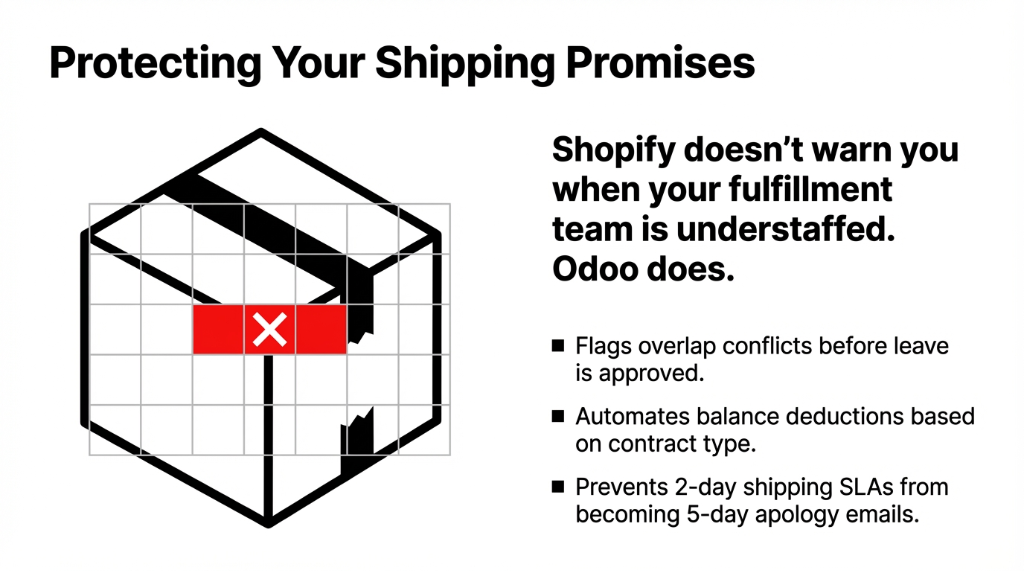
Shopify does not warn you when your fulfillment team is understaffed. Odoo does.
How Odoo Employee Management Actually Works for a Small Team
Not in theory. In the day-to-day operations of a 6-15 person e-commerce team.
Employee Profiles That Are Actually Useful
Every employee in Odoo carries a profile that holds their contract history, skills, certifications, work schedule, and HR documents in one place. When someone's contract changes from part-time to full-time, the payroll rules update automatically. No Excel cell to hunt down. No email to forget to send.
For e-commerce teams, this matters the moment you start hiring seasonal staff for Q4. You bring on 4 temporary pickers in October. In legacy setups, onboarding them means 4 individual paperwork chains. In Odoo, you clone a template, set the contract end date, and they are in the system — attendance-tracked, payroll-ready — in under 12 minutes per hire.
Attendance That Connects Directly to Payroll
Odoo's Attendance module syncs directly into Payroll. When your warehouse associate checks in at 9:04 AM and checks out at 5:58 PM, that data flows into the payslip automatically. No manual entry. No transcription errors.
What the Attendance Module Tracks
Hours Tracking
Total attendance hours per period and valid hours against contracted schedule
Missing Check-outs
System flags these so your ops manager does not have to chase people down
Overtime Calculation
Automatically calculated against contracted hours — no VLOOKUP required
Payroll Processing
Drops from 4.5 hours/month to under 40 minutes including review
Leave Management That Does Not Require a WhatsApp Group
Odoo's Time Off module lets employees submit leave requests through the platform. Managers approve or reject from the same interface. Everyone sees the team calendar. You configure custom leave types (casual, sick, maternity, unpaid), accrual rules based on seniority, automatic balance deductions tied to contract type, and overlap warnings before a request is approved.
That last one is the one your fulfillment team actually needs. When two warehouse staff try to take the same Friday off, Odoo flags the conflict before approval — not after your Saturday shipments pile up.
Payroll That Does Not Require a Part-Time Accountant
Odoo Payroll automates salary calculations, tax deductions, and payslip generation. For e-commerce teams in India, UAE, or the US, the tax rules are pre-configured by region. You do not need a bookkeeper on retainer to run monthly payroll for 8 people. (Yes, your accountant will hate this.)
Multi-currency support is built in. Useful the moment you have a remote content writer in the Philippines and a warehouse team in Surat.
Appraisals That Actually Happen
Most small e-commerce teams skip performance reviews. Not because founders do not care about performance — but because there is no system to remind them, structure the review, or store the output. Odoo's appraisal module sends automated reminders, provides structured review templates, and stores historical reviews against the employee profile. When a team member asks for a raise 8 months from now, you have data — not just a gut feeling.
The Numbers You Should Expect After Going Live
Post-Implementation Impact (5-20 Person Teams)
Payroll Processing
Drops from 4-6 hours/month to under 45 minutes
Attendance Disputes
Drop to near zero within 30 days of implementation
Onboarding Time
Falls from 2-3 days to under 4 hours per new hire
Payroll Error Rate
Drops to under 0.4% versus 3-5% industry average for manual processes
Cost reality check: Monthly HR admin cost for a 10-person team runs at roughly $280/month (10 users x $28/user/month on Odoo Standard) — versus the $750-$1,200 typically spent on manual admin hours and error corrections. That is not a "nice to have." That is a direct impact on your margins.
What Implementation Looks Like for Your Team
This is the part most vendors skip, so we will tell you exactly what to expect.
| Week | What Happens | Your Time Commitment |
|---|---|---|
| Week 1 | Data migration and contract setup | 3-4 hours |
| Week 2 | Attendance system configuration and training | 2-3 hours |
| Weeks 3-4 | Parallel running (old system + Odoo simultaneously) | 1 hour/week monitoring |
| Week 5 | Full cutover. Old system goes dark. | 2 hours |
The first full payroll run in Odoo typically takes under 1 hour, including review. The second month, your ops manager does it alone.
Pricing Reality
Odoo Standard pricing starts at $28/user/month in the US, or around $31.10/user/month billed annually for the full suite. For a 10-person team using HR, Attendance, and Payroll: $280-$311/month total. No per-module add-ons for core HR functions.
The Community Edition exists and is free, but strip out payroll automation and compliance features and you are back to manual work. Do not go that route unless you enjoy rebuilding what you just saved.
Insider Note
Odoo's HR module integrates directly with your Shopify store via Braincuber's integration layer. When a peak-season temp is onboarded, they can be granted limited Shopify backend access tied to their employee profile — role-defined, access-logged, and removable in a single click when the season ends. That is something BambooHR and Gusto cannot touch.
Stop Running HR Like It Is Still 2018
If your e-commerce team is 6 people today and you plan to be 20 people in 18 months — which is the trajectory of every D2C brand we work with — the time to build the HR infrastructure is now. Not when you have 3 simultaneous payroll disputes and two employment lawyers on a call.
The cost of waiting is not just operational friction. One wrongful-termination dispute from a poorly documented attendance record can cost you $15,000-$40,000 in legal fees alone. Odoo employee management for a small team pays for itself in month one — not month twelve.
Everyone says buy NetSuite for this. Do not. It burns $500k before you even configure leave types. Odoo does it at a fraction, and it actually works on day one.
Frequently Asked Questions
Does Odoo HR work for a team of fewer than 10 people?
Yes. Odoo HR is built modularly, so a team of 5 can use only the Employees, Attendance, and Leave apps without paying for or configuring anything else. At $28/user/month, a 7-person team pays $196/month — less than the cost of a single payroll error dispute.
How long does Odoo HR setup take for a small e-commerce team?
With Braincuber, a basic HR setup — employee profiles, attendance, leave, and payroll — goes live in 3 to 5 weeks. Your first automated payslip run typically happens in week 4.
Can Odoo attendance data automatically feed into payroll?
Yes. Odoo's Attendance and Payroll modules are natively connected. Check-in/check-out data flows directly into payslip calculations, including overtime and valid hours against the contracted schedule — no manual data transfer needed.
Is Odoo Payroll compliant with Indian, UAE, and US tax rules?
Odoo's Payroll module includes pre-configured regional salary structures and tax rules. Braincuber customizes these further for local compliance — including PF/ESI for India, WPS for the UAE, and federal/state tax configurations for the US.
What happens to existing employee data during migration?
All existing employee contracts, attendance history, and HR records are migrated into Odoo as part of the implementation. Braincuber runs a parallel period (typically 2-4 weeks) where both systems operate simultaneously before full cutover, ensuring zero data loss.
Check Your Payroll Folder. If the Math Does Not Add Up, Call Us.
We bet your attendance data and payroll numbers are off by at least 7 hours this month. Book our free 15-Minute Operations Audit — we will find your biggest HR leak in the first call.
Free audit. No obligation. We find the leak or you owe us nothing.