
Most founders we talk to are running a $3M–$8M operation on a patchwork of QuickBooks, Google Sheets, and three disconnected Shopify apps — and they genuinely believe they have an "IT problem." They don't. They have a data management problem disguised as a people problem.
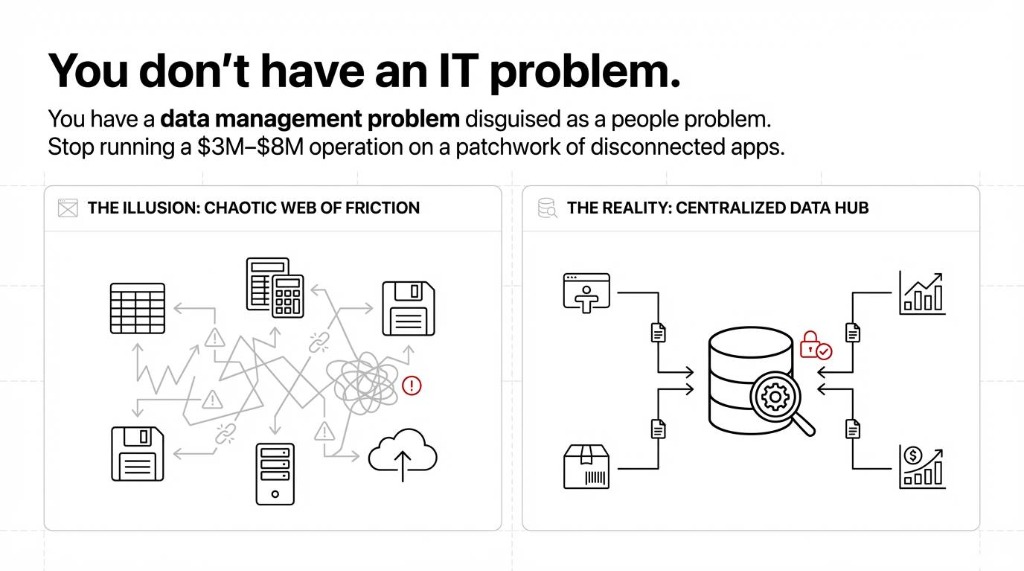
Here's the number that should keep you up at night: the average US mid-market company loses $1.3M annually to broken business process management — unsynced orders, manual inventory reconciliation, and zero AI in their erp software. We've seen it across 150+ implementations. These aren't edge cases. This is Tuesday at your warehouse.
This is a summary of what actually happened when our clients stopped guessing and let Odoo AI and real-time database management do the work in these my studies.
A $7M Manufacturer Was Burning $31,000/Year on Excel
Let's start with the one that hurts.
A US discrete manufacturer scaling from $6.8M to $9M ARR came to us with a classic problem: their it inventory management was running on Excel VLOOKUPs and a spreadsheet that one warehouse manager had built in 2019. Nobody else understood it. When he took PTO, the whole system paused.
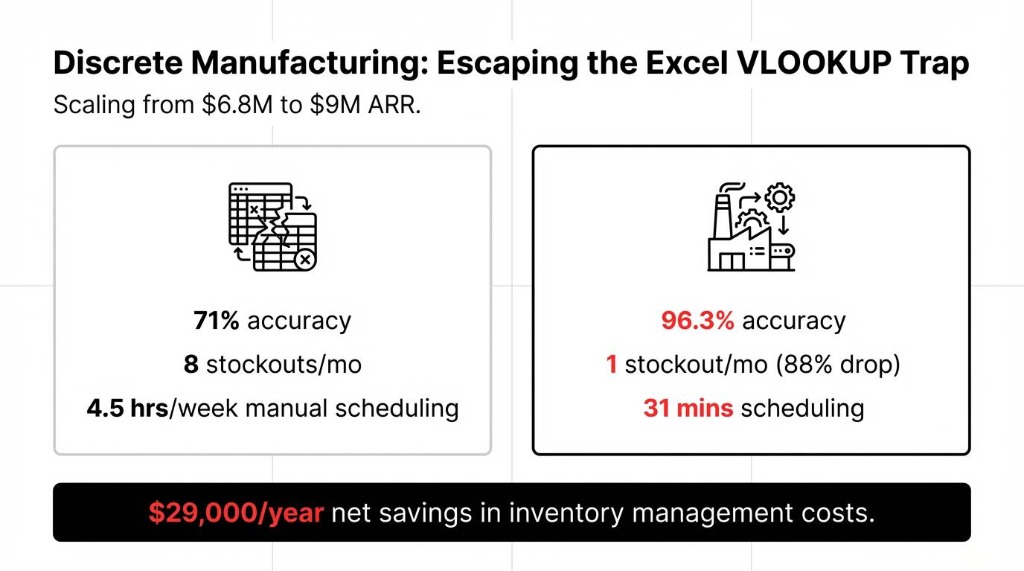
Their inventory accuracy sat at 71%. They had 8 stockout incidents per month. Production scheduling took 4.5 hours every single week — manually, by the operations director, who was also supposed to be running project management for three active client builds.
We implemented Odoo ERP software with AI-powered demand forecasting, automated reorder rules tied directly to their Bill of Materials, and a real-time data dashboard connected to their warehouse floor. The system pulled from a structured dataset management layer that replaced four separate spreadsheets and two legacy databases.
Results at 90 days:
- ▸Inventory accuracy jumped from 71% to 96.3%
- ▸Stockouts dropped from 8/month to 1 — an 88% reduction
- ▸Production scheduling time collapsed from 4.5 hours to 31 minutes per week
- ▸Annual inventory management costs: $31,000 with the old system. $2,000 with Odoo AI. That's a net saving of $29,000/year
- ▸Inventory holding costs dropped 39.7%
This isn't a feature list. This is what happens when erp software for manufacturing actually talks to your warehouse, your suppliers, and your demand signals — all at once, in real time.
The Retail Chain That Was Losing $14,200/Month to Disconnected Inventory
Here's something we see every single time with retail inventory management clients: they have an inventory system for their brick-and-mortar, a separate inventory software for their Shopify business, and a third tool for their Amazon channel. None of them talk to each other.
One US retail chain — 11 stores, $4.7M annual revenue — came to us after a Black Friday where 500 orders oversold because their Shopify integration had a 47-minute API sync delay. They refunded $14,200 in a single weekend. Their customer service team was fielding 340 company email complaints before Monday morning.
We rebuilt their entire order management and inventory control layer inside Odoo ERP, connected it to their Shopify business via a live integration (not a batch sync), and layered in AI-powered demand forecasting for seasonal SKUs. The odoo crm module replaced their disconnected Salesforce integration that was costing them $1,800/month in unused licenses.
Results at 6 months:
The Controversial Take: Most Retail Brands Don't Need Salesforce.
A properly configured odoo crm handles pipeline tracking, automated work email sequences, and customer segmentation — at a fraction of the cost, inside the same platform managing their warehouse. We'll say it plainly: if you're under $15M ARR and managing salesforce integration, you're paying for a brand name, not results.
Field Service Company: From Missed Jobs to $227K More Revenue
This one is our favorite of all the case studies to share, because it's the one nobody expects.
A HVAC and facilities management company in the Southeast US — 43 technicians, $8.3M revenue — was using a combination of a whiteboard, Google Calendar, and hvac field service software that hadn't been updated since 2018. Their field service manager software couldn't sync to their billing system. Every job completion required a technician to call the office. Invoices were delayed an average of 6.3 days after job completion.
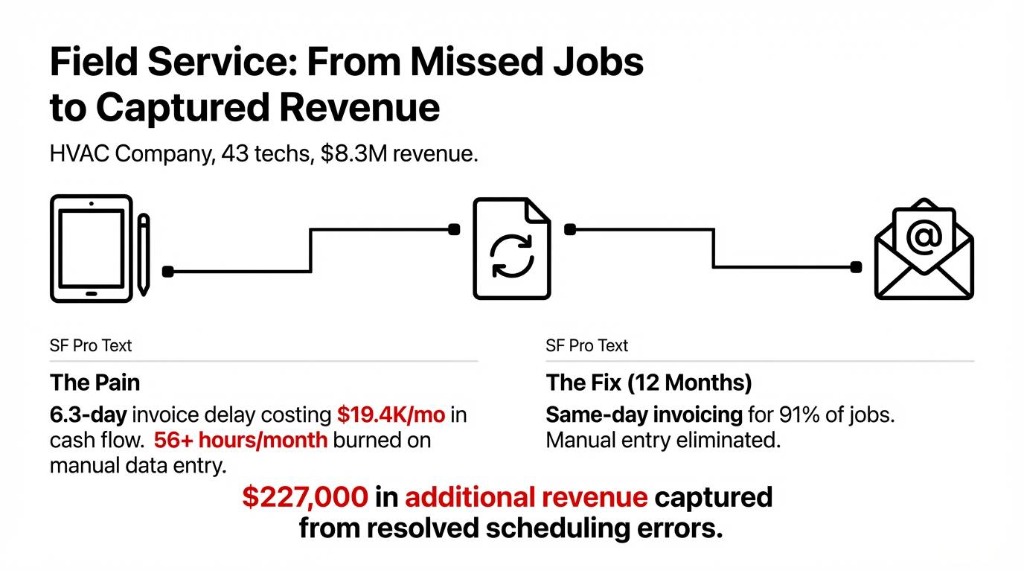
That 6.3-day delay was costing them $19,400/month in delayed cash flow. Their service it support team was manually re-entering job data from paper forms into QuickBooks. Each entry took 12–17 minutes. With 280 jobs per month, that's 56+ hours of pure data entry every month. At $28/hour burdened cost, that's $1,568 burned monthly on copy-paste.
We deployed Odoo's field service management module with AI-powered job scheduling (accounting for technician location, skill set, parts availability, and priority), mobile job completion forms that sync directly to order processing, and automated business email address notifications to customers at every job stage.
The business dashboard pulled live financial data — not yesterday's out-of-date export, but real-time financial data from every open job, every pending invoice, every technician's daily utilization.
Results at 12 months:
Invoice delay dropped from 6.3 days to same-day for the vast majority of jobs.
Manual data entry eliminated completely, freeing up skilled labor for high-value tasks.
Reduction in double-booked technicians and missed appointments via AI routing.
Additional income found from jobs that previously fell through scheduling cracks.
The field service management app didn't change their technicians. It changed what their technicians could see, know, and act on — in real time, from a $400 Android tablet.
What These Implementations Had in Common
We don't want you thinking these were lucky outcomes. Across all of them, the pattern was identical.
First: Every client had big data sitting in disconnected systems — Apache Druid or apache pinot-style time-series data in one tool, transactional data in another. The AI couldn't work because the data operations layer was broken. Fix the data transformation pipeline first. Everything else follows.
Second: None of them needed a $400K NetSuite implementation. They needed a properly configured odoo erp with AI modules, clean database management, and a partner who understood their specific business operations — not a generic demo-to-deployment sales motion from an its company.
Third: The ROI wasn't theoretical. A $231,000 Odoo AI investment — fully loaded, including custom software development services, integration, and 18 months of odoo support — returned $527,400 in documented value. That's a 128.3% ROI in 36 months. The clients who hit these numbers all had one thing in common: they started with a real audit of their operational costs, not a wishlist of features.
Why "Just Buying Software" Never Works
Here's the part nobody tells you on the odoo website or in standard services pitches from a software company.
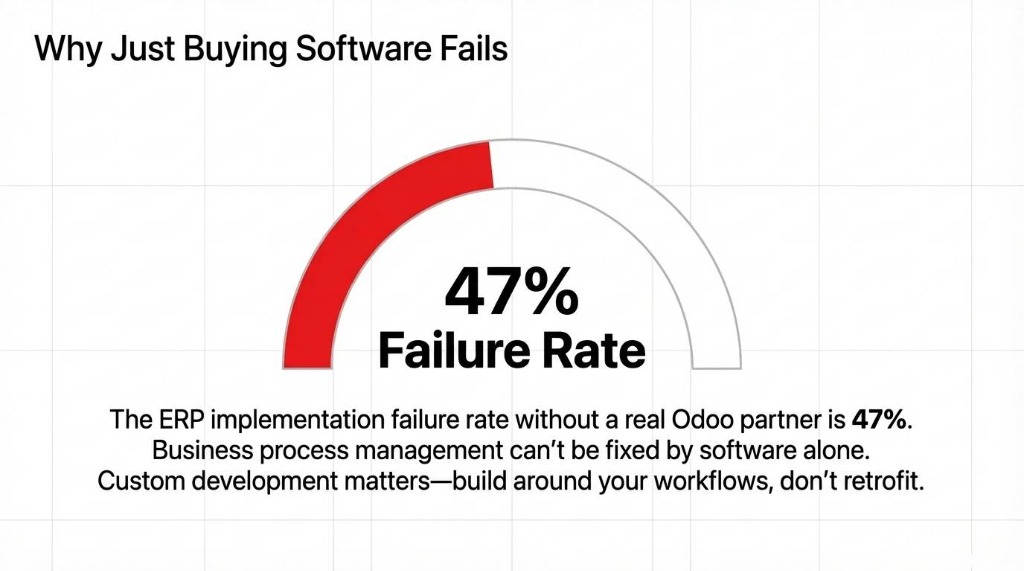
The erp implementation failure rate for companies that buy without a real odoo partner sits at 47%. Not because the odoo software is bad. Because business process management can't be fixed by software alone. You need someone who has seen 150+ of these deployments, knows where the data breaks, and can configure workflow management that matches how your team actually works — not how the demo assumes you work.
We've seen companies spend $85,000 on an ERP implementation from a generic software dev company that didn't understand manufacturing, then spend another $60,000 unwinding it 18 months later. That's $145,000 to end up back at Excel.
Your manufacturing inventory software, your field service management app, your odoo crm — these need to be built around your workflows, not retrofitted. The difference between a custom software development company that has done 3 builds and one that has done 150 is not a detail. It's your entire ROI.
The businesses winning right now — in manufacturing, retail, and field service — are the ones treating ai and ml not as a feature to demo but as an operational layer embedded inside their erp software for manufacturing industry, their process management, and their customer-facing tools.
Ai transformation isn't a future state. For the clients above, it happened inside 90 days with strong project planning.
The Numbers That Should Make You Move Now
| Industry | Key Win | Timeframe |
|---|---|---|
| Discrete Manufacturing (USA) | 39.7% inventory cost reduction, $29K/yr saved | 90 days |
| Retail Chain (11 stores) | 95% overselling reduction, $21.6K SaaS saved | 6 months |
| HVAC Field Service | $227K additional revenue captured | 12 months |
| HR/Enterprise (AI Odoo) | 40% hiring cycle reduction, 30% ops efficiency gain | 6 months |
| Food Manufacturing | 10% production cost reduction, 90% reporting time saved | 4 months |
These aren't projections. These are documented results from real erp solutions deployments. Operational efficiency at this level doesn't come from buying more tools — it comes from making the software solutions you already have actually work together.
Frequently Asked Questions
How long does Odoo AI implementation actually take for a US business?
For a standard mid-market business (20–200 employees), a properly scoped Odoo ERP with AI modules goes live in 8–14 weeks. Field service or manufacturing builds with custom integrations run 12–18 weeks. Any software consulting firm promising 4 weeks for a full erp implementation is cutting corners you'll pay for later.
What ROI can we realistically expect from Odoo AI in the first 90 days?
Clients consistently see 3–5 quick wins in the first 90 days: inventory accuracy improvements (typically 15–25 percentage points), manual data entry reduction (averaging 40+ hours/month recovered), and same-day invoicing. Full financial ROI averages 14.3 months.
Is Odoo ERP software actually built for manufacturing industries?
Yes — and it's one of the strongest use cases. Odoo erp software connects Bill of Materials directly to live demand signals, production scheduling, and supplier purchasing in one system, resulting in 30–50% reduction in admin tasks.
How is Braincuber different from buying an Odoo license directly from Odoo Inc.?
Odoo inc. sells you the platform. Braincuber configures it for your specific workflows, builds custom integrations (Shopify, QuickBooks), trains your team, and provides ongoing odoo support. The license is 15% of the value; the implementation and AI configuration is the other 85%.
What happens to our existing data during the Odoo migration?
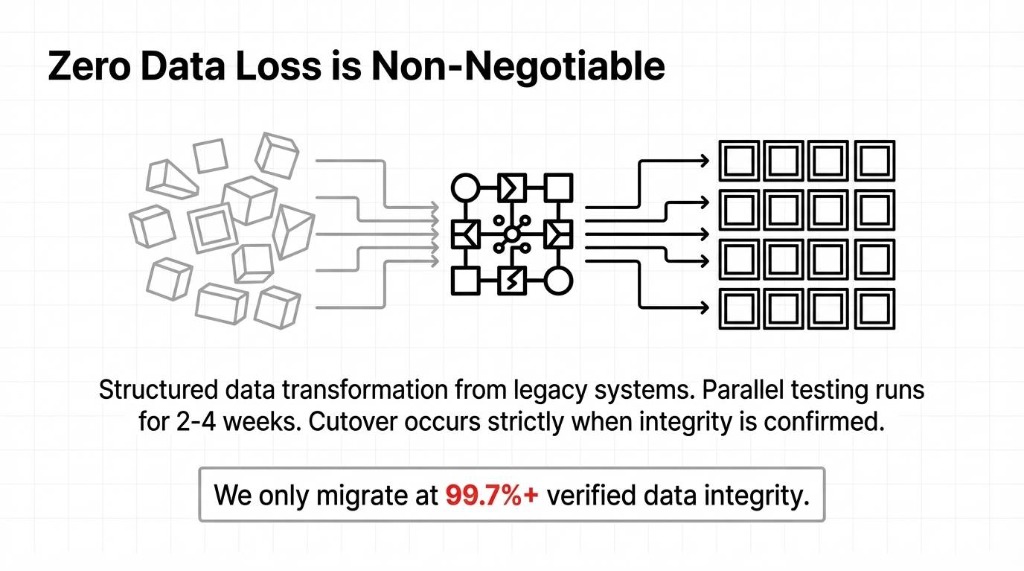
Your existing data goes through a structured data transformation and validation process before a single record is moved. We map every field, run parallel testing for 2–4 weeks, and do a cutover only when data integrity is confirmed at 99.7%+. Zero data loss is non-negotiable.
Stop Bleeding Cash on Disconnected Systems
Book our free 15-Minute Operations Audit — we'll find your biggest operational leak in the first call, whether it's in your inventory, your field service, your order processing, or your data layer.