
Quick Answer
Braincuber's AI engineering team consists of three specialized units — Agentic AI Architects, ML/Cloud Engineers, and AI Integration Engineers — who've shipped 500+ production-grade ai systems across e-commerce, manufacturing, healthcare, and financial services. Every ai engineer who scopes your project is the same person who builds it. No handoffs. No junior contractors. No wrapper tech disguised as custom ai.
Why Most AI Investments Go Nowhere
When a US business owner searches "ai for business" or "ai development companies," they get hit with 47 identical-looking ai agency websites promising to "use ai to transform your workflow." Same pitch decks. Same vague timelines. Same promise of a free ai chatbot that solves everything.
Then the contract closes. Ninety days later, that chatbot ai misroutes customer queries 68% of the time. The ai implementation is still in staging. The CFO is looking at a $47,000 invoice for an ai system that doesn't work in production.
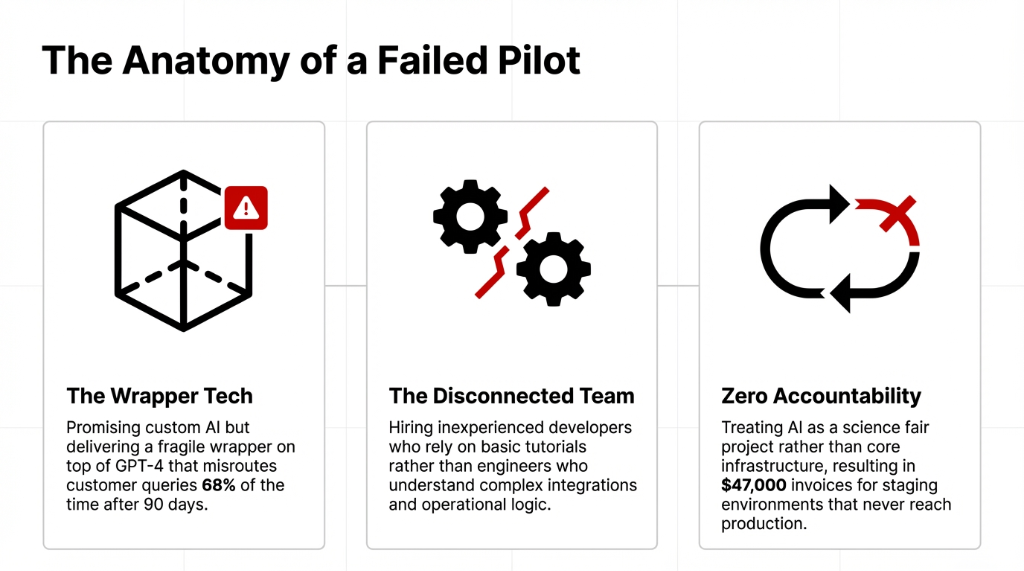
Not because ai and business don't mix. Because the ai engineer on the project couldn't connect ai and data pipelines to real operational logic. This is the gap the Braincuber team was built to close. Every single day ai problems like these land on our desk.
Who Is Actually Building AI at Braincuber
We are not an ai startup that hired 24-year-olds fresh off a YouTube ai tutorial and handed them a LangChain repo. Our engineering team has shipped production-grade ai systems across e-commerce, manufacturing, healthcare, and financial services for 4+ years — across 500+ projects delivered for companies with ai needs in the US, UK, UAE, and Singapore.
Here is who is actually behind the keyboard at this ai technology company.
The Agentic AI Architects
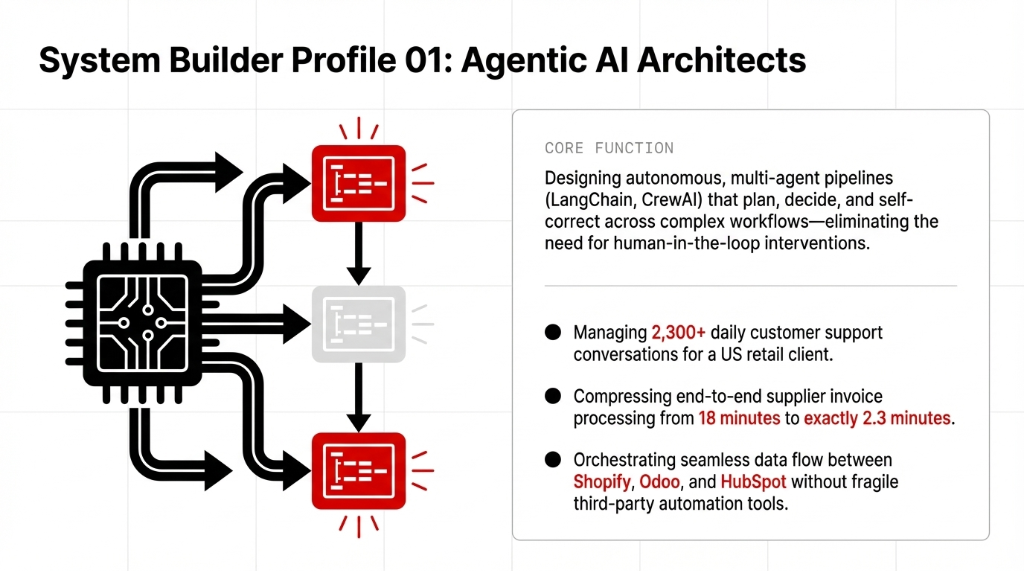
This is the team that most ai software companies don't have at all. Our agentic ai architects build intelligent agents ai systems — multi-agent pipelines using LangChain, CrewAI, and custom orchestration layers — that don't just respond to a question ai query. They plan, decide, and self-correct across complex, multi-step workflows.
One of our senior agentic ai engineers spent 3 years building autonomous document processing pipelines before joining Braincuber. He can spot a broken ai architecture in a workflow diagram before the client shares a single line of code.
What Our Agentic AI Team Builds
24/7 AI Agents
AI agents that run customer support without a human in the loop — handling 2,300+ conversations per day for one US retail client. Real ai agent deployment, not a chatbot ai demo.
Invoice Processing
Agentic ai pipelines that process supplier invoices end-to-end in 2.3 minutes vs. 18 minutes manually. That's ai in automation delivering measurable ROI from day ai one.
Zero-Duct-Tape Integrations
Intelligent agents ai workflows connecting Shopify, Odoo, and HubSpot without a single bolt ai fix or Zapier duct-tape integration. Real ai integrations, not automation and ai band-aids.
(Yes, we know you're currently running your "automation and ai" strategy on Zapier and Make. We've seen the spaghetti. It's okay. We've untangled worse.)
The ML/Cloud Engineers: Where AI and Data Actually Meet
Anyone can talk about ai and ml. Our ML engineers build the ml models that power real decisions — demand forecasting that cuts overstock by $23,400/month, ai e commerce recommendation engines that lift conversion by 18.7%, and churn prediction ai models that flag at-risk customers exactly 31 days before they cancel.
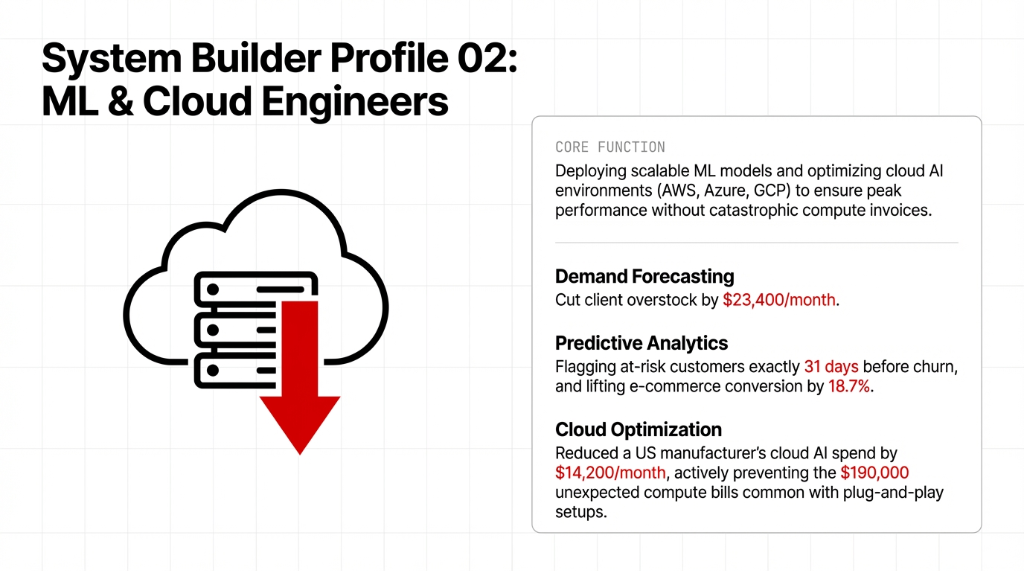
The cloud ai side is equally serious. Our aws ai specialists deploy ai in cloud environments using SageMaker, Bedrock, and Lambda at a scale that doesn't produce surprise bills. Ai in aws is not plug-and-play. Anyone at an ai technology company who tells you otherwise hasn't paid a $190,000 unexpected compute invoice. We have clients who came to us after exactly that.
Real Cloud AI Cost Recovery
Case: Our cloud engineers shipped ai in cloud deployments across AWS, Azure, and GCP — including MLOps pipelines, drift detection, and cost optimization that cut one US manufacturer's cloud ai spend by $14,200/month without touching model performance.
That's $170,400/year back in the operating budget.
This is what real ai technology looks like running in production. Not a demo. Not a POC that gets abandoned in staging.
The AI Integration Engineers: The Work Nobody Glorifies
Every ai technology company talks about building ai. Almost none of them talk about ai integration — the difficult, unglamorous work of connecting your new AI system to your legacy ERP, your 6-year-old Shopify store, your NetSuite account that three people understand (two of whom left last year), and your warehouse tool running on SQL Server 2012.
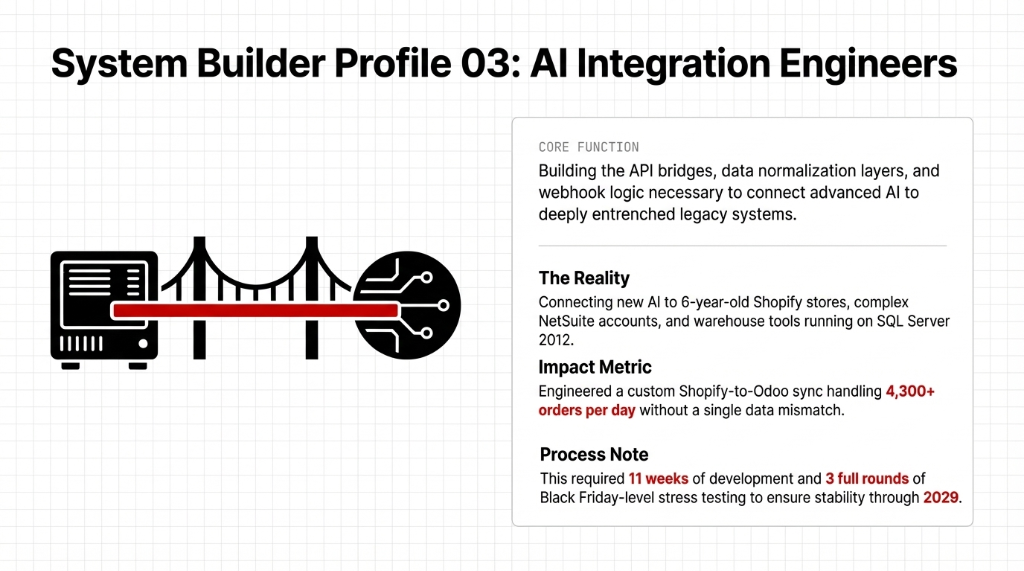
Our ai integration specialists build the API bridges, data normalization layers, and webhook logic that make ai integrations work in production — not just in a sandbox demo. This is the application of ai that separates companies that are developing ai from companies that ship it through our AI solutions.
The Integration Nobody Talks About
One of our integration engineers built a custom Shopify-to-Odoo sync that handles 4,300+ orders per day without a single data mismatch. That wasn't a quick bolt-together. That took 11 weeks and 3 full rounds of stress testing under Black Friday-level load.
This is the ai use case that never shows up in conference talks ai speakers give on the main stage. But it is the difference between an ai system that works for 60 days and one that still works in 2029.
How We Actually Build AI — The Architecture Nobody Shows You
Here is the ugly truth about ai how it works at most ai development companies: they hand you an ai product built on top of GPT-4 with your logo on it and call it "custom AI." It is not custom. It is a wrapper.
Our ai architecture process starts with a diagnostic, not a demo. Before we write a single line of code, our ai product manager sits with your ops team and maps every workflow that touches data. We find the $12,000-$38,000/month leaks hiding in manual processes, broken ai integrations, and ai bias baked into old decision logic nobody has questioned in years.
The 5-Layer AI System Architecture
1. Data Layer
Clean, structured, and AI-ready. Most companies skip this — it's why 88% of POCs never reach production, per IDC.
2. Model Layer
Custom ai models or fine-tuned foundation models based on your specific ai use case. Not a wrapper. Real ai modelling.
3. Agent Layer
Agentic ai orchestration for autonomous, multi-step task execution. Intelligent agents ai that plan, decide, act.
4. Integration Layer
Ai integrations across your existing stack — e commerce ai tools, ERP, CRM. The work that makes or breaks the project.
5. Monitoring Layer
MLOps, ai modelling drift detection, and live dashboards. Not "set it and forget it." Real ai for enterprise monitoring.
This ai strategy has held across 500+ projects. We have not changed it because it keeps working. That's building ai the right way — through our AI development services.
What 500 Projects Taught Us About AI for Enterprise
Frankly, the biggest ai limitations in the ai market right now are not technical — they are organizational. Companies want to use ai but have not decided who owns the outputs. They want ai in automation but have not defined what success looks like at 90 days.
$220,000 Burned With Zero Measurable Return
Real Case: We watched a $7M ARR US e-commerce brand spend $220,000 on ai investment with zero measurable return because nobody asked: "What specific decision does this AI change, and who is accountable for the outcome?"
The ai transformation projects that actually deliver — 40-60% operational cost reduction and 24/7 ai for automation — are the ones where the client treats AI as infrastructure, not a technology purchase.
Ai cost isn't just compute. It's the business of ai done wrong.
Companies with ai that works think of it the way they think about cloud. Not a science fair project. Not something the "AI committee" reviews once per quarter. Every book on ai and every book about ai will tell you that ai for enterprise requires executive sponsorship. What they don't tell you is that it also requires someone willing to kill a failing pilot in Week 6 instead of spending $80,000 more to save face.
Our engineers are the people who tell you that in Week 5. That's real ai for all — not a marketing slogan.
The Ethical AI Layer Nobody Covers
Here's what ethical ai looks like in production — not in a keynote, not in a book about ai ethics — in an actual ai system running on real data.
$1.2M Regulatory Exposure — Caught in 3 Weeks
Case: A US financial services client whose ai models were denying applications at a 34% higher rate for applicants in specific zip codes. The model wasn't intentionally biased — it was trained on historically skewed data. Nobody caught it until our ai audit flagged it 3 weeks into the engagement.
Our engineers build ethical ai checkpoints into every model pipeline — ai bias audits, fairness metrics, and explainability layers that a compliance officer can actually read.
Ai cost isn't just compute. It's the legal bill when your model makes a bad call 10,000 times before anyone notices.
This is what we mean when we say ai for all — a real commitment to building ai that's fair, auditable, and explainable before it touches production data. That's how we handle ai for companies through our AI ecommerce solutions.
5 FAQs About Braincuber's AI Engineering Team
What does a Braincuber AI engineer actually do?
Our ai engineers design, build, and deploy production-grade AI systems — from agentic ai pipelines and ml models to cloud ai infrastructure and full-stack ai integrations. They own the complete build cycle: architecture ai, development, testing, deployment, and MLOps monitoring.
How long does a typical AI implementation take?
A focused agentic ai or chatbot ai build runs 6-11 weeks from kickoff to production. Full ai transformation projects covering cloud ai, ml models, and ERP ai integrations typically run 12-20 weeks depending on data readiness.
Can you integrate AI with our existing AWS, Shopify, or Odoo setup?
Ai in aws, Shopify, and Odoo are our three most common environments. We've completed 200+ ai integrations across these platforms. We don't replace your existing stack — we make it intelligent.
Do you offer a free AI chatbot or free AI tools?
We don't build free ai or off-the-shelf free ai chatbot products. We build custom ai systems tied to measurable business outcomes — a chatbot ai that cuts support costs by 41%, not one that just generates answer ai responses. Every engagement is scoped to documented ROI.
What makes Braincuber different from other AI development companies?
We don't sell strategy — we ship systems. 500+ projects. Every ai engineer who scopes your project builds it. We run an ethical ai audit on every model before production. And we tell you in Week 5 if the approach isn't working.
Stop Experimenting. Start Operating.
We are not an ai agency that sells strategy decks and hands off execution to contractors. Every ai engineer who scopes your project is the same person who builds it. If you're a US business trying to use ai in 2026 and not sure where your current approach is losing money — we'll find your biggest operational gap on the first call.
No pitch decks. No sales theater. Just a direct look at where your ai systems are working and where they're quietly costing you money.