
Why Indian D2C Is Primed — But Not Ready
India's D2C eCommerce market sits at $87.5 billion in 2025 heading to $267 billion by 2030 at 25% CAGR. That is the tailwind. But the headwind is operational reality.
Over 20 notable Indian D2C brands have already established presence in GCC countries, the US, and the UK. Most hit the same three walls within 90 days: logistics costs eating 22–34% of order value, payment gateway failures because Indian Razorpay does not accept Visa in AED, and customs holds because the HS code was wrong.
India Post takes 15–20 days to the US. DHL does it in 5–7 days but charges 10x more for the same 500g package. There is no magic fix. There is only a decision: which markets can absorb the logistics cost?
The UAE Playbook: Start Here, Not Everywhere
The UAE is the right first market. Not because it is easy — but because the math works better. UAE eCommerce is projected to cross $17 billion in 2025. Average order values regularly exceed AED 150 (~$41). The population is 80% expatriate, meaning a significant portion already knows Indian brands. And the India-UAE CEPA agreement gives tariff cuts on qualifying categories.
Here is what most founders get wrong: they try to run it as a dropship operation from India. Do not do this.
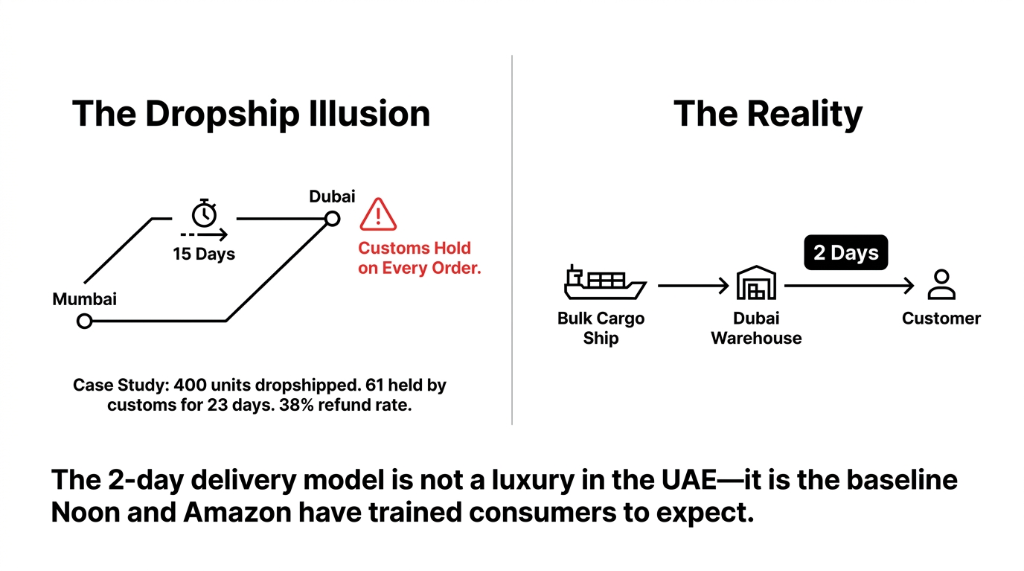
The Dropship Disaster We Saw in Q4 2024
A brand shipped 400 units from Mumbai to Dubai via dropship. Customs flagged 61 units for incorrect HS classification. They sat in a Dubai warehouse for 23 days. Customer refund rate hit 38% that month alone.
The 3-Step UAE Entry Model
▸ Register for UAE VAT once annual UAE revenue exceeds AED 375,000. Below that threshold, you are still subject to 5% import VAT on CIF value. Plan pricing before launch, not after your first refund dispute.
▸ Use a 3PL with a Dubai warehouse. Stock in Dubai ships in 2 days. Stock in Mumbai ships in 12–15 days and triggers customs clearance on every single order. The 2-day model is the baseline Noon and Amazon.ae have trained consumers to expect.
▸ List on Noon and Namshi before building your own Shopify UAE storefront. Indian brand Snitch entered UAE exactly this way — marketplace first, brand traffic second. Get real consumer feedback before committing to a UAE Shopify build.
Standard UAE import duty is 5% on CIF value. Setting up a full UAE entity costs AED 250,000+. Most early-stage brands do not need this. Start with a licensed fulfillment partner and test 500 orders before committing.
The UK Playbook: Brexit Changed Everything
Post-Brexit, the UK is a fully separate customs territory from the EU, with its own VAT registration, EORI number process, and declaration system. 73% of Indian D2C brands entering UK in 2023–24 got hit with delays in the first 60 days because documentation was built for pre-Brexit rules.
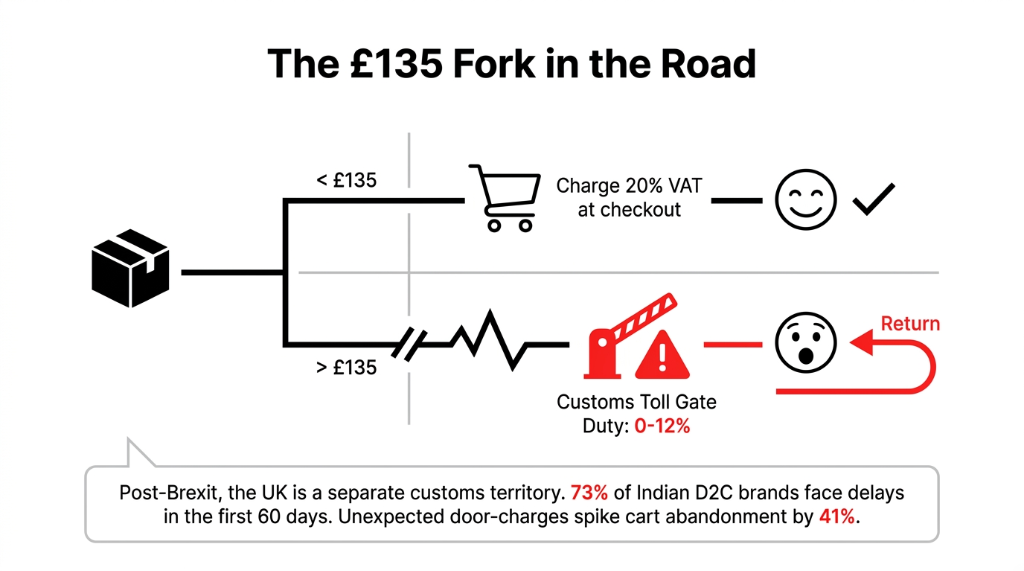
The £135 VAT Split
Under £135 Per Parcel
Register for UK VAT as non-UK business (HMRC requires this). Charge 20% VAT at checkout. Remit quarterly. No customs duty charged to customer. Clean experience.
Over £135 Per Parcel
Customs duty applies: 0–12% depending on HS code. VAT at 20% on CIF value + duty. Courier advances payment and bills recipient. Surprise charge at door = guaranteed return.
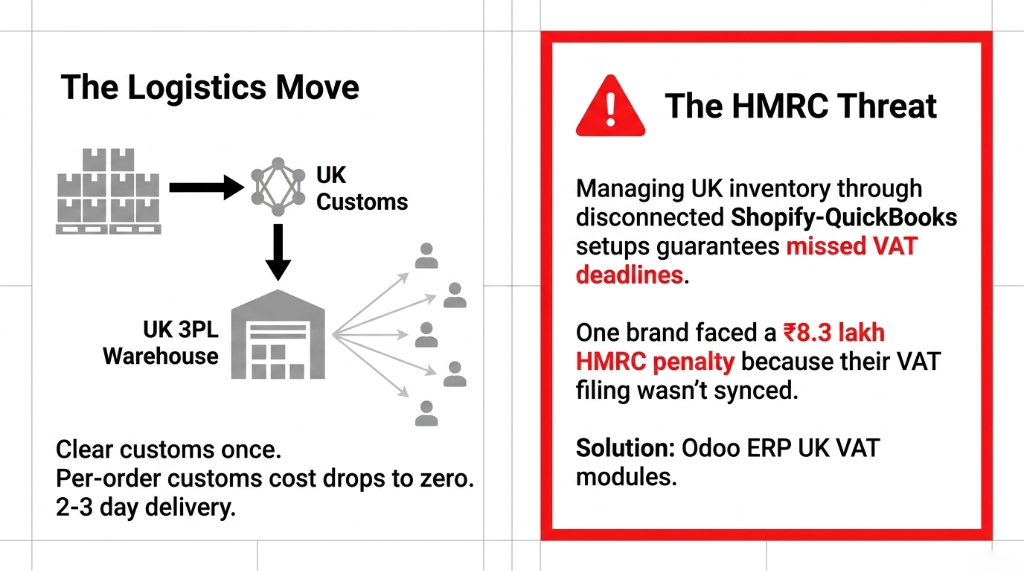
The smarter move: ship in bulk to a UK 3PL warehouse, clear customs once, fulfil domestically. Per-order customs cost drops to zero. Delivery drops from 10–14 days to 2–3 days. Customer never sees a surprise duty charge. UK cart abandonment spikes 41% when unexpected duty appears at checkout.
The $9,960 HMRC Penalty We Watched Happen
A brand we supported in Q1 2025 had a $9,960 HMRC penalty — entirely because their QuickBooks VAT filing was not synced with their UK Shopify storefront. A properly configured Odoo ERP with UK VAT modules handles this automatically and never misses a quarterly submission.
The US Playbook: The $800 Rule Is Your Best Friend
The US is highest-stakes, highest-reward. The rule that matters most: the US de minimis threshold is $800 per shipment. Every order under $800 enters duty-free. For most Indian D2C brands — apparel, beauty, wellness — individual orders fall well below $800. Effective customs duty on D2C US shipments is zero.
But the moment you shift to bulk FBA replenishment, you cross $800 instantly. Now you deal with Harmonized Tariff Schedule, a licensed Customs Broker as Importer of Record, Merchandise Processing Fees, and Harbor Maintenance Fees.
US Market Entry Sequence
1. Start with Amazon FBA + your own Shopify US store simultaneously. Amazon gives distribution. Shopify gives margin. Both need unified inventory via Odoo — otherwise you oversell on Amazon and cancel Shopify orders.
2. Price with 20–30% markup over INR base cost. A $9.60 product costs approximately $13.20–$16.80 to land in a US consumer's hands after freight, duty drawback gaps, and last-mile delivery.
3. Get your IEC (Import Export Code) from DGFT on Day 1 — free, takes 1–2 days. Without it, US export payments cannot be legally routed through your Indian bank. We see brands sitting on $12,000–$18,000 in stuck US payments because they skipped this.
4. Use Duty Drawback and LUT (Letter of Undertaking) on GST. Indian exports to US are zero-rated. Filing LUT lets you export without paying IGST and claim refund on unutilized input tax credit. Most founders do not use this. It is effectively free money back from the government.
The payment gateway problem in the US is underrated. Your Indian Razorpay instance does not natively support US Stripe-level conversion optimization. Our US-market clients consistently see 18–23% higher checkout conversion on Shopify Payments versus PayPal-only at checkout.
The Ops Stack That Powers All Three Markets
Running UAE, UK, and US simultaneously from a single India base requires one thing: a single source of truth for inventory, orders, and finance.
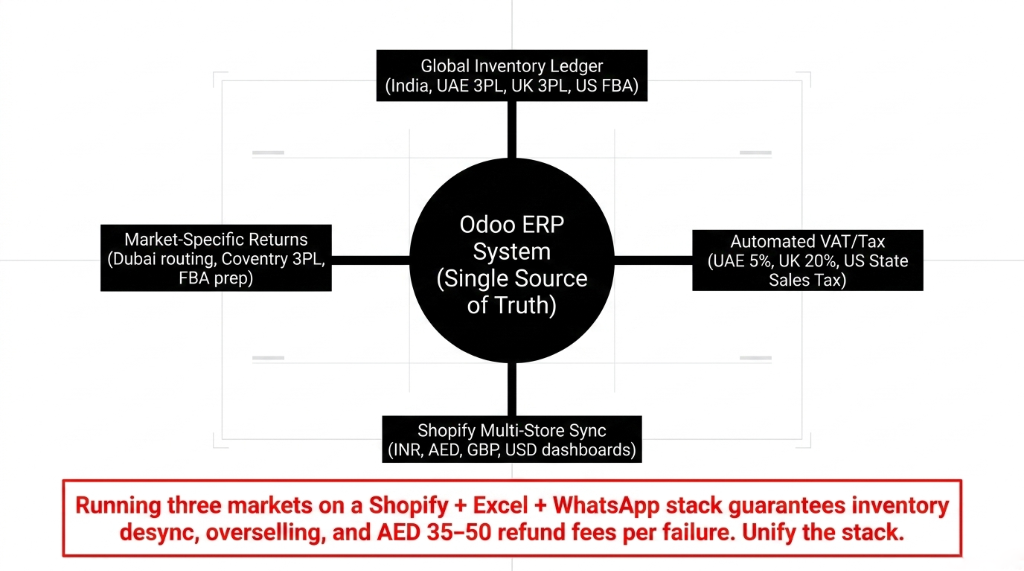
What Odoo ERP Delivers for Multi-Market D2C
▸ Single inventory ledger across India warehouse, UAE 3PL, UK 3PL, and US FBA
▸ Automated VAT/tax rules per market — UAE 5%, UK 20%, US sales tax by state
▸ Shopify multi-store sync for INR, AED, GBP, and USD storefronts in one dashboard
▸ Multi-currency purchase orders with automatic landed cost calculation
▸ Market-specific returns management — UAE returns to Dubai, UK returns to Coventry 3PL, US returns to FBA prep center
Case Study: $2.76M Surat Apparel Brand
A $2.76 million apparel brand based in Surat was running three market operations on four separate tools. After Odoo implementation, order reconciliation time dropped from 4.5 hours per day to 22 minutes. Cross-market inventory accuracy hit 97.3% within 60 days of go-live.
Frequently Asked Questions
Does an Indian D2C brand need a local company in UAE to sell there?
No. Sell into UAE via marketplace partnerships (Noon, Namshi) or through a licensed fulfillment partner without incorporating locally. A UAE entity is only needed when annual UAE revenue exceeds AED 375,000 or you require a local business license.
What is the cheapest way to handle UK VAT as an Indian seller?
Register for UK VAT on HMRC's portal (free). For orders under £135, charge 20% VAT at checkout and remit quarterly. For bulk shipments to a UK 3PL, VAT is cleared once. Both routes are cheaper than HMRC penalties starting at 5% of unpaid tax.
Do Indian exports to the US attract import duty?
Individual orders under $800 enter the US duty-free under the de minimis threshold. Bulk FBA replenishments above $800 attract duties based on HTS code plus Merchandise Processing Fees. Use a licensed Customs Broker as your Importer of Record.
What documents does an Indian D2C brand need before exporting?
At minimum: IEC from DGFT (free, 1–2 days), GST registration, AD Code from your bank for forex, and LUT filed on GST portal for zero-rated export. For UK add GB EORI number. For US verify HTS codes and appoint a Customs Broker.
Can one Odoo ERP instance manage UAE, UK, and US operations?
Yes. Odoo's multi-company and multi-currency modules handle separate tax rules (UAE 5%, UK 20%, US state-level), separate warehouses, and separate Shopify storefronts in a single backend. It also automates inter-company transfers between India and overseas 3PL locations.
Stop Building Markets on Broken Operations
International expansion is not a marketing problem. It is an operations problem that marketing eventually exposes. Book our free 15-Minute Operations Audit — we will map your exact international expansion gap and tell you which market to enter first based on your current margins, not your ambition.