
Layer 1: The Commerce Platform (Stop Overthinking This)
Shopify is the answer for 90% of Indian D2C brands. Full stop.
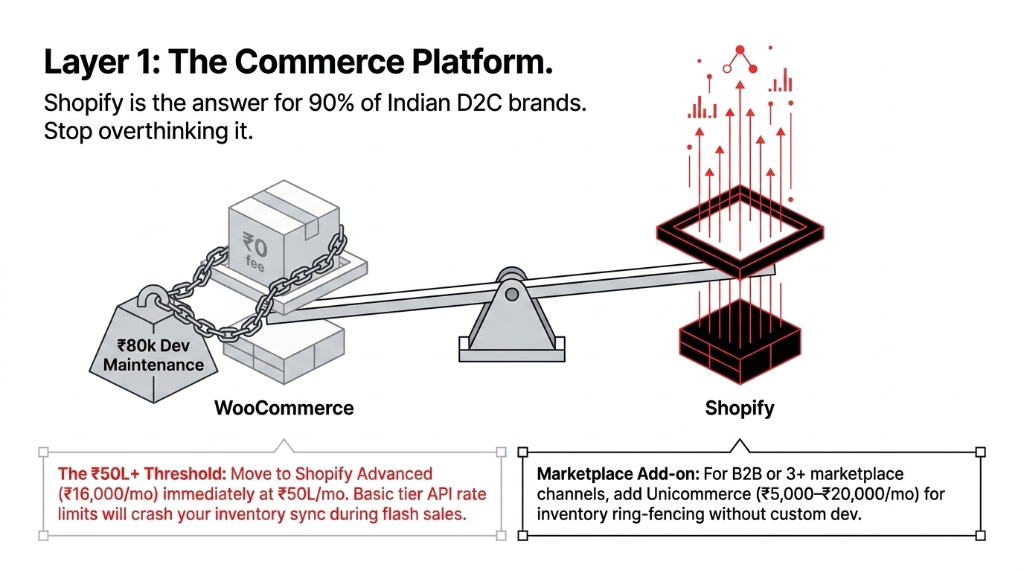
At $24/month (Basic plan), it handles everything up to $60,000 monthly revenue cleanly — Razorpay, PayU, Cashfree all integrate natively, and Shopify's API coverage is the best in the market for downstream tool connections.
The WooCommerce Trap
The mistake we see constantly: founders switching to WooCommerce to "save money." WooCommerce's $0 licensing fee sounds attractive until you spend $960 on a developer to maintain plugin conflicts every six months. Move to Shopify Advanced ($192/month) the moment you cross $60,000 monthly revenue — not because of features, but because Shopify's API rate limits at the Basic tier will break your inventory sync during sale events. We saw a flash sale kill 400 orders in a queue because the API hit its ceiling at 2 PM on a Sunday.
For brands with significant B2B or 3+ marketplace channels alongside D2C: Unicommerce at $60–$240/month is the only tool that handles channel-specific inventory ring-fencing without custom development.
Layer 2: Inventory and Warehouse (Where Most Brands Leak $2,400–$4,800/Month)
Here is the ugly truth: at $24,000 monthly revenue, your Google Sheets inventory system will break — and you will not notice for 11 days.
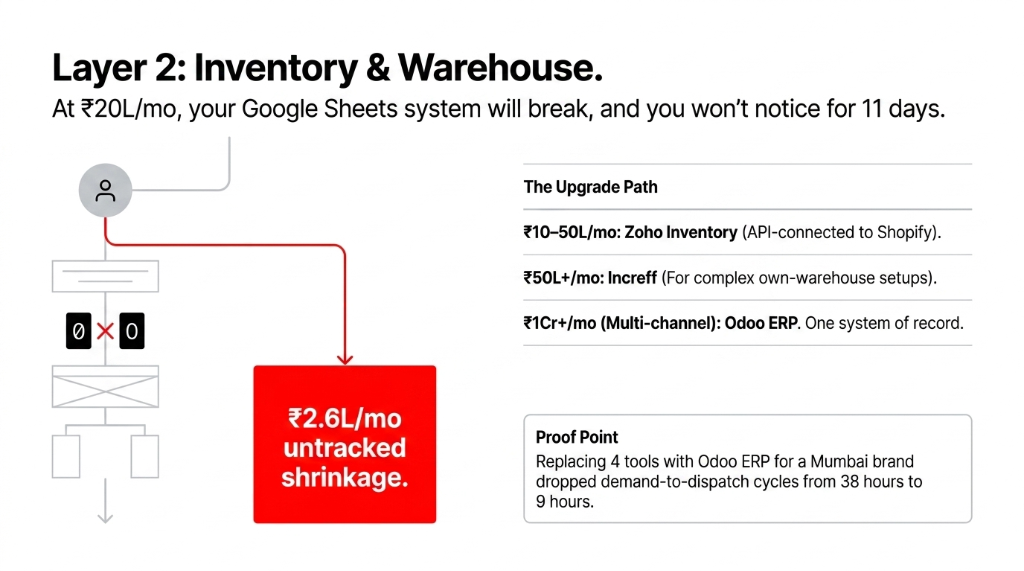
Warehouse teams are human. When a picker types a "0" instead of an "O" in the SKU field, you lose track of $60 worth of inventory. Multiply that by 3 pickers, 6 days a week, and you are looking at $3,120 in untracked shrinkage per month. (Yes, we have the receipts from a skincare brand in Bengaluru.)
The Upgrade Path That Works
$12,000–$60,000/month revenue: Zoho Inventory at $36–$96/month. API-connected to Shopify. Barcode scanning. Multi-location stock.
$60,000+/month: Increff at $120–$300/month for complex own-warehouse setups.
$120,000+/month with D2C + B2B + marketplace: This is where Odoo ERP Inventory + Manufacturing modules become the only sensible choice — one system of record, not four tools whispering to each other via Zapier.
Case Study: $360,000/Month Supplements Brand
Before Odoo: Zoho Inventory, separate WMS, Tally for accounts, Excel for demand planning — four systems, three people reconciling daily, $170/month in overstocking costs. After Odoo: demand-to-dispatch cycle dropped from 38 hours to 9 hours. Documented implementation outcome.
Layer 3: Logistics — The 3-Courier Rule No One Tells You
Stop relying on a single courier. Every Indian operator who has tried knows this ends in tears during peak season. The operational reality in 2026: you need three courier relationships running simultaneously.
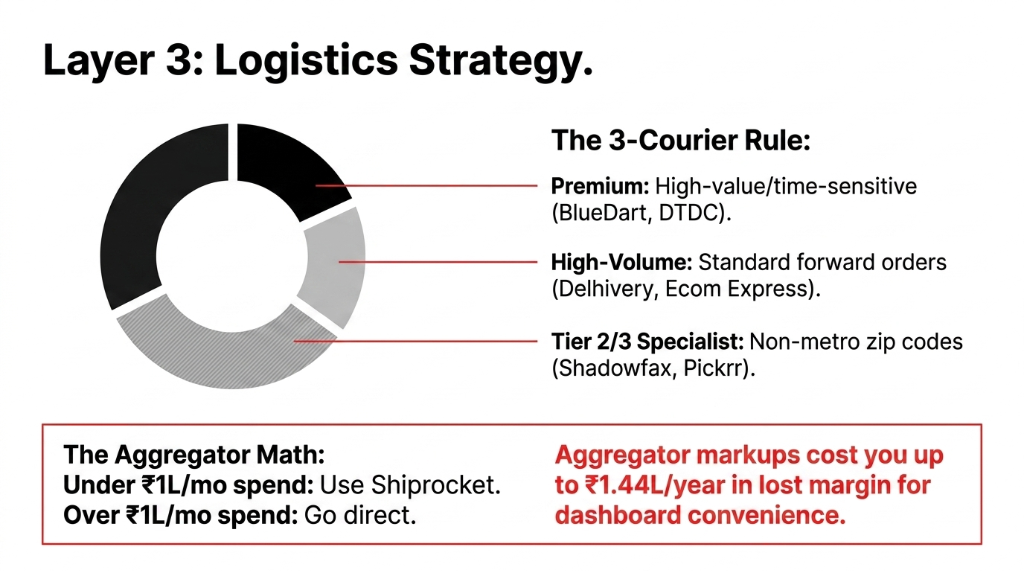
The 3-Courier Rule
Premium Partner
BlueDart or DTDC for high-value, time-sensitive shipments.
High-Volume Partner
Delhivery, Ecom Express, or XpressBees for standard forward orders.
Tier 2/3 Specialist
Shadowfax or Pickrr for the 40% of orders going to non-metro pin codes.
Under $1,200/month in shipping spend, use Shiprocket as your aggregator — it pulls all three into one dashboard for $12–$60/month flat. Controversial opinion: once you cross $1,200/month in shipping spend, dump the aggregator and go direct. Aggregator markup is 3–8% over direct rates. At $1,800/month, that is $54–$144 in margin you give away every month — $648–$1,728 per year — for dashboard convenience.
Layer 4: Customer Communication — COD Is Not Going Anywhere
40–60% of orders in most Indian D2C categories are still COD. If you are not running a COD verification layer, your RTO rate is quietly killing your unit economics.
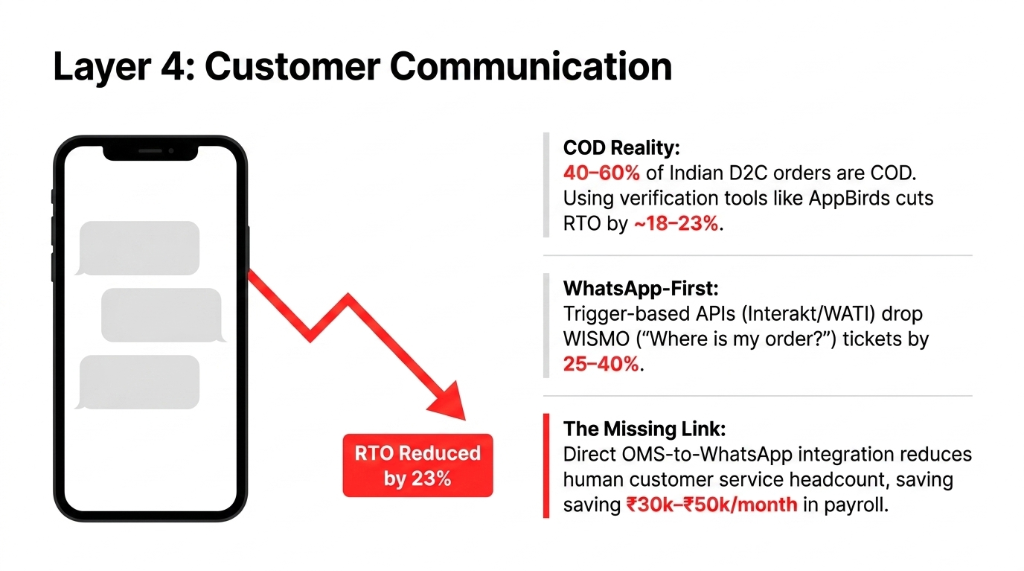
Apps like COD Order Confirmation by AppBirds use IVR calls to verify intent post-order. For a brand shipping 500+ COD orders per month, this single tool cuts RTO by 18–23%, translating to saving thousands in double-shipping costs annually.
Post-purchase communication in India is not email-first. It is WhatsApp-first. Interakt at $36–$96/month or WATI at similar pricing for WhatsApp Business API. Trigger-based messages — order confirmed, dispatched, delivered, review request. Automate this once, and your WISMO tickets drop by 25–40%.
The Integration Most Brands Skip
Connecting your OMS directly to the WhatsApp API reduces human customer service headcount by 1.5–2 FTE at $60,000+ scale. That is $360–$600/month in saved payroll for a single integration that takes 3 days to implement.
Layer 5: The Intelligence Layer — What Separates $60,000 Brands from $600,000 Brands
Every tool in your stack generates data. Almost no Indian D2C brand actually uses that data to make faster decisions. This is the most expensive passive mistake we see.
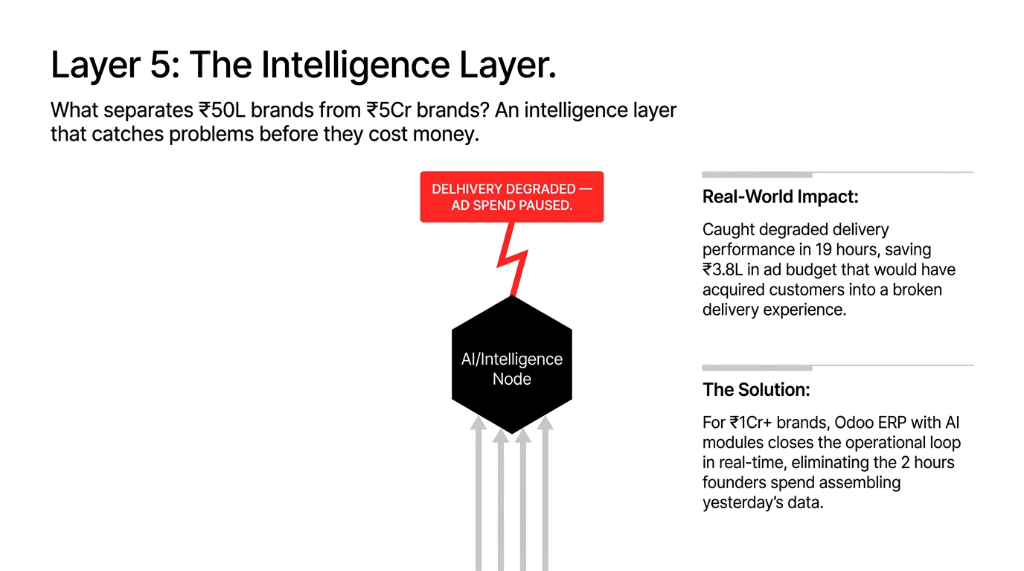
A Bangalore fashion brand we work with was running active Meta ad campaigns into three geographies where their Delhivery performance had silently degraded to 67% on-time delivery. The intelligence layer caught the signal in 19 hours. Without it, they would have spent $4,560 in ad budget acquiring customers into a broken delivery experience.
For brands at $120,000+ monthly revenue, Odoo ERP with AI-powered modules closes this loop — inventory forecasting, purchase order automation, financial reconciliation, and customer order management in one unified system. The result: the founder stops spending 2 hours every morning assembling yesterday's picture.
The Stack Reality Check by Revenue Stage
| Revenue/Month | Commerce | Inventory | Logistics | CRM/Comms | Intelligence |
|---|---|---|---|---|---|
| $6K–$24K | Shopify Basic $24/mo | Google Sheets + Zapier | Shiprocket aggregator | Interakt + basic email | Google Looker Studio |
| $24K–$96K | Shopify Advanced $192/mo | Zoho Inventory $36–$96/mo | Direct + aggregator backup | Interakt + Klaviyo | Zapier/Make alert workflows |
| $96K–$360K | Shopify Plus or Unicommerce | Increff or Odoo WMS | Multi-courier direct | Full CRM + WhatsApp + email | Odoo ERP + AI modules |
The Tools That Are Lying to You
NetSuite
Unless you are a $12M+ revenue business with a $60,000 implementation budget and a dedicated IT team, NetSuite will burn your cash flow and never fully go live. We have cleaned up three failed NetSuite implementations for mid-market Indian brands in the last 18 months.
Tally standalone. Fine for compliance. Not an operations tool. Using Tally as your inventory system at $60,000+ means you make purchase decisions based on data that is 72 hours stale. (Your accountant knows this. They will not tell you.)
Too many Zapier zaps. We saw a $144,000/month fashion brand running 47 active Zaps connecting 9 tools. When Zapier had a 4-hour outage in November, $9,960 worth of orders went un-synced to their warehouse. A connected ERP like Odoo does not have this failure mode — it is one system, not a string of SaaS duct tape.
Frequently Asked Questions
What is the minimum tech stack an Indian D2C brand needs at launch?
Shopify Basic, Razorpay or Cashfree, Shiprocket, and Interakt. That four-tool stack costs under $120/month total and covers 90% of operational needs at early scale.
When should an Indian D2C brand switch from Shopify to Odoo ERP?
The trigger is $96,000–$120,000 monthly revenue with multi-channel operations — D2C plus B2B plus 2+ marketplaces. At this scale, disconnected tools cost more than Odoo implementation within 7–9 months.
Is WhatsApp marketing better than email for Indian D2C brands?
For transactional and post-purchase: yes. WhatsApp open rates in India run 85–90% versus 18–22% for email. For retention campaigns, combine both via Klaviyo or WebEngage for best results.
How much does a proper Indian D2C tech stack cost at $120K/month revenue?
$660–$1,320/month across all tools — commerce, WMS, logistics, CRM, and intelligence. Brands spending more are over-tooled. Brands spending less are leaking the difference in operational inefficiency.
What is the single biggest tech mistake Indian D2C brands make?
Staying on Google Sheets inventory past $36,000 monthly revenue. Compounding data errors at that volume cost $2,520–$5,760/month in mis-buys, overstocks, and stockouts — more than any SaaS subscription would.
Stop Bleeding Cash on a Stack That Does Not Scale
In our last 23 Indian implementations, the average pre-implementation operational waste we found was $3,840/month — in manual reconciliation hours, untracked returns, inventory discrepancies, and preventable RTO losses. Book our free 15-Minute Operations Audit. We will find your biggest leak in the first call.