
The 10 Brands Setting the Benchmark
These aren't names on a ranking. Each has a specific operational fingerprint — and specific operational scars.
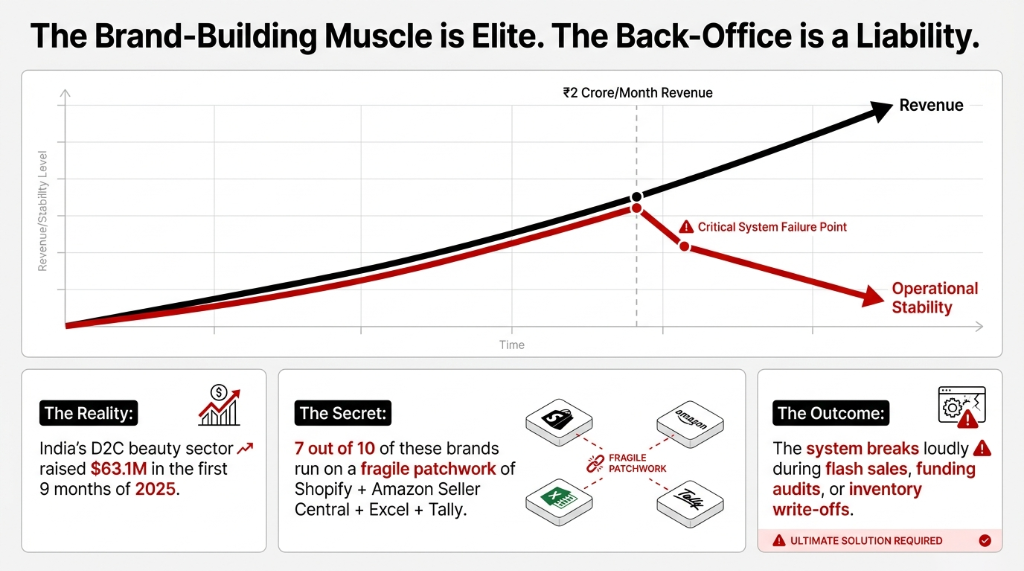
Mamaearth (Honasa Consumer) manages 500+ SKUs spanning The Derma Co, Aqualogica, and Ayuga across its D2C site, Amazon, Nykaa, Blinkit, and 1.5 lakh retail touchpoints. Started with 6 baby-care SKUs in 2016. That 83x catalog expansion needs real operational architecture. (The fact that profits compressed in FY25 despite revenue growth tells you the operational layer didn't keep pace with brand ambition.)
SUGAR Cosmetics operates across 45,000+ retail outlets in 550 cities, runs a Shopify D2C storefront, and stacks on Amazon CloudFront and AWS. Revenue crossed $49.4 million in FY25 — but the P&L tells a harder story: revenue stalled and losses widened as offline expansion hit margins. That's not a marketing failure. That's an operational architecture failure.
Nykaa runs 265+ physical stores using an inventory-led model guaranteeing 100% product authenticity. Unlike marketplace operators, Nykaa owns its stock. Managing 265+ stores with real-time stock accuracy requires a WMS and ERP setup most D2C brands won't think about until it's urgent.
Minimalist hit $12 million revenue in just 8 months — something Mamaearth took 3 years to achieve — running on just 66 SKUs while competitors had 500+. Fewer variants meant approximately 37% lower inventory holding costs. In January 2025, Hindustan Unilever acquired Minimalist for $34.8 million — validating that operational discipline, not viral marketing, creates acquirer-grade value.
WOW Skin Science built volume through a distribution-first, marketplace-heavy model. Plum Goodness turned profitable in FY25 with $3 million net earnings — one of the few D2C beauty brands achieving both scale and profitability simultaneously. mCaffeine, Pilgrim (on track for $12 million ARR), The Man Company, and Bombay Shaving Company complete the top 10 — each managing between 80 and 400+ active SKUs across 4 to 7 channels simultaneously.
The 4 Operational Disasters Hitting Every Beauty Brand
Here's what breaks. Not eventually. Quickly.
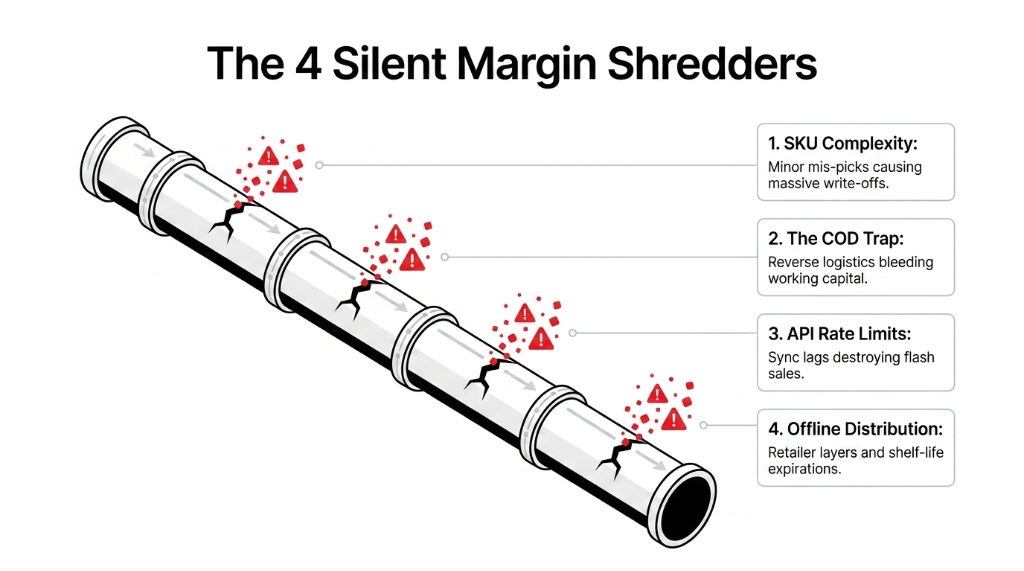
Disaster 1: The SKU Complexity Explosion
A beauty brand with 300 products across 4 shades and 2 sizes creates 2,400 inventory variants. When your warehouse packer enters "LPPK-RD0l" instead of "LPPK-RD01" — that's a lowercase L versus a number 1 — you've lost track of a $8,160 consignment of red lipsticks. We have caught this exact scenario, with those dollar amounts, in 3 separate client warehouse audits. This happens every week in mid-scale beauty warehouses.
Disaster 2: The COD Trap Destroying Working Capital
58–65% of D2C beauty orders in India are still Cash on Delivery. RTO rates on COD run at 28–34%. Ship 10,000 orders a month, 6,200 are COD, you're absorbing reverse logistics on roughly 1,860–2,108 orders monthly. At $1.08–$1.44 per return shipment, that's $2,009–$3,035 in pure shipping waste per month — before accounting for damaged or near-expiry stock that can't be re-sold.
Disaster 3: Shopify's API Rate Limit During Flash Sales
You're running a brand anniversary sale. 600 orders flood in over 45 minutes. Shopify's API queue backs up. Your warehouse management system stops receiving order data for 13 minutes. Duplicate dispatches go out. Mis-picks happen. You generate 47 "wrong product" complaints in 72 hours. mCaffeine and Plum both hit this wall during early scaling — and both resolved it by adding a proper ERP layer between Shopify and their warehouse systems.
Disaster 4: Offline Distribution Is a Silent Margin Shredder
Every distribution layer — super-stockist, stockist, retailer — extracts 8–12% margin. For a brand running at 60% gross margin pushing through 3 GT distribution layers, you're surrendering 24–36% of MRP before one unit reaches a shelf. Near-expiry returns from retailers on natural-formula products (12–18 month shelf life) write off $10,800–$26,400 of inventory per quarter.
We have seen brands discover this math only after committing to 800+ retail doors.
Why the Standard Advice You're Getting Is Wrong
Everyone tells you to "hire a COO at Series A" and "go omnichannel fast." Frankly, both pieces of advice — without fixing the underlying systems first — will accelerate your losses, not reduce them.
A Head of Operations sitting on top of disconnected Shopify, Amazon Seller Central, Shiprocket, Tally, a WhatsApp group for purchase orders, and QuickBooks cannot fix the architectural problem. They'll spend 19 of 22 working days firefighting, not building. We have watched this happen at 14 different brands across $600K–$7.2M ARR.
The Omnichannel Error Multiplier
2 Channels
Disconnected inventory = 1.7x the stockouts, oversells, and mis-ships versus single channel
3 Channels
Error rate compounds to 2.9x. Your ops team is now 100% reactive, zero proactive
The Truth
Hiring more staff isn't scaling — it's bloating. You need systems architecture first, then people to run it
How the Top 10 Actually Run Operations
The brands operating at $12M+ ARR share one trait: a single system of record for inventory. Not Shopify. Not Amazon Seller Central. An ERP that all channels feed into and all channels pull from in real time.
When a Sugar Cosmetics lipstick sells on Amazon at 4:23 PM, the D2C site reflects one fewer unit at 4:23 PM — not 4:34 PM after a scheduled sync. That 11-minute lag is invisible until you're running a flash sale and oversell 300 units you don't physically have.
The Exact Playbook Scaling Brands Run
▸ Demand forecasting by channel and season. Sunscreen velocity spikes 3.1x March–June. Hair oil demand rises 2.4x October–December. Brands using historical velocity data segmented by channel reduce dead stock by 23–31%. Minimalist's 66-SKU discipline is the most famous execution.
▸ Automated RTO reduction. Cut RTO from 31% to 16–18% with: real-time pincode deliverability checks at checkout, $0.48–$0.72 cashback nudges for prepaid, WhatsApp NDR automation within 2 hours of failed delivery. Each lever moves the needle 3–5 percentage points.
▸ Batch and expiry tracking at WMS level. Every Indian beauty product carries a batch number. Brands tracking this in their warehouse system eliminate the $10,800–$26,400 quarterly write-offs. Resolving a customer complaint about an expired product costs 4.7x the product value.
▸ Multi-warehouse order routing. Nykaa and Sugar both operate 4–7 regional fulfillment centers. Auto-routing to nearest warehouse cuts delivery from 5.3 to 2.8 days — improving repeat purchase rates by 11–13%.
▸ AI-powered demand signals. When an Instagram Reel goes viral, auto-trigger purchase orders before the traffic wave hits. Without this, brands sell out in 6 hours and surrender $21,600–$28,800 in potential revenue to competitors with stock ready.
The Shopify + Odoo Architecture That Actually Works
Here's the operational backbone we have built for beauty brands scaling from $1.2M to $12M ARR — and the logic behind each split decision.
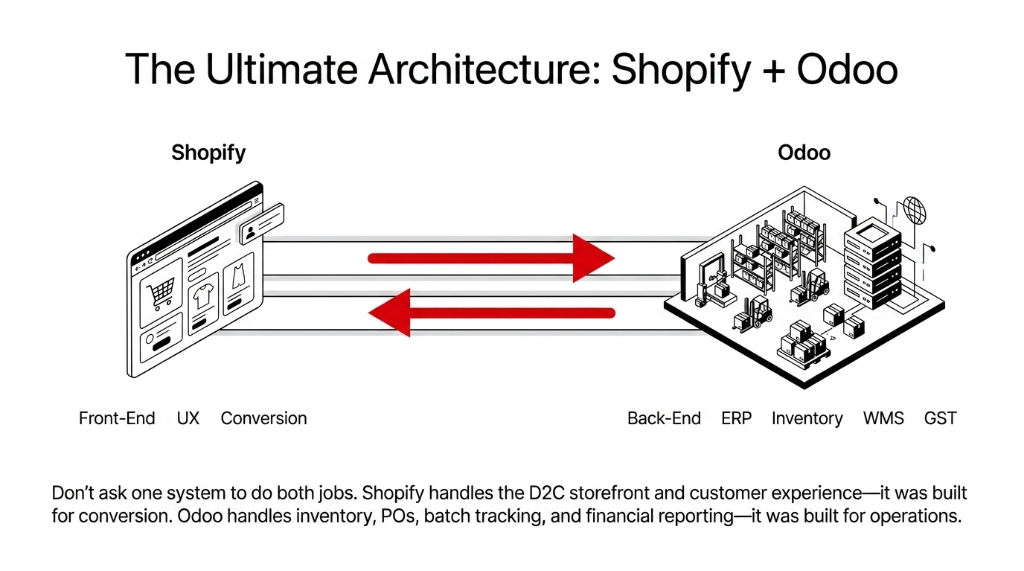
Shopify handles the D2C storefront, product pages, checkout UX, and customer-facing experience. It was built for conversion. Odoo ERP handles inventory, purchase orders, manufacturing, batch tracking, multi-warehouse management, GST-compliant accounting, and financial reporting. It was built for operations.
Don't ask one system to do both jobs. That is precisely where brands break.
The integration is bidirectional and real-time: every Shopify order triggers an Odoo fulfillment record. Every inventory adjustment in Odoo updates Shopify's available stock. Every Amazon, Nykaa, or Myntra order flows into the same Odoo inventory pool. Your finance team sees a live P&L — not a Monday morning reconciliation that burns 37 hours of their month.
Real Results: 95% Delivery Efficiency Gain
We ran this exact Shopify-Odoo setup for a fashion-adjacent D2C brand (Vasa Indica) and saw a 95% increase in delivery efficiency with an 82.5% jump in profitability after go-live. For beauty brands with higher SKU complexity and batch tracking, the operational wins are even more pronounced.
One client recovered $14,940 in previously un-reconciled Amazon return settlements in the first 30 days of go-live. Money sitting in payout reports that nobody tracked because reconciling three systems manually takes longer than most ops teams have.
The Reality of Operations at India's Beauty Brand Scale
Plum turned profitable in FY25 with $3 million net earnings — partly because it was disciplined about operational cost structure from early on. Minimalist attracted a $34.8 million acquisition by HUL because its lean SKU count, in-house manufacturing, and clean operations made the business easy to integrate and hard to replicate.
Meanwhile, brands with brilliant marketing but weak operations saw FY25 deliver revenue stagnation or margin compression despite market growth. The D2C logistics market in India is valued at $7.55 billion in 2025 and growing. The opportunity is there. The question is whether your operations can capture it without leaking the margin back out.
The India D2C Beauty Landscape
166+ Startups
$800 million+ in total VC funding invested over the past decade. That capital is chasing operational winners — not just marketing winners.
Implementation: 6–8 Weeks
Braincuber's implementation model for a beauty brand at $1.2M–$6M ARR. Not 6 months. Typical 90-day results: 40–60% reduction in operational costs.
What Those 8 Weeks Look Like
| Phase | Timeline | What Happens |
|---|---|---|
| Shopify Sync + Data Enrichment | Weeks 1–2 | Live sync of existing Shopify store with Odoo inventory and CRM. SKU data, supplier lead times, historical sales velocity all mapped |
| Marketplace Unification | Weeks 3–4 | Amazon, Nykaa, Myntra, Flipkart wired into the same Odoo inventory pool. One source of truth, not five dashboards |
| Automation Go-Live | Weeks 5–6 | Automated PO triggers, batch and expiry tracking, GST-ready accounting. Your CA stops manually pulling Tally reports |
| Training + Real-Time P&L | Weeks 7–8 | Ops team trained, custom dashboards live, real-time P&L without waiting for the monthly close |
Typical results in the first 90 days: 40–60% reduction in operational costs, dead stock write-offs fall by $9,600–$21,600, and order processing time drops from 14 minutes to under 2 minutes per order.
Frequently Asked Questions
How do India's top D2C beauty brands manage multi-channel inventory?
Top brands like Mamaearth and Sugar Cosmetics use a centralized ERP as the single inventory source of truth. Every channel syncs in real time to this one system, eliminating overselling and saving 37+ hours of monthly manual reconciliation.
Why is RTO such a big problem for Indian D2C beauty brands?
58–65% of orders are COD with 28–34% RTO rates. At $1.08–$1.44 per return on 1,800+ monthly returns, that's $2,009–$3,035 in monthly waste. Brands cut RTO to 16–18% using real-time pincode checks, prepaid cashback nudges, and WhatsApp NDR automation.
What ERP system do Indian D2C beauty brands use?
Most scaling brands at $1.2M–$12M ARR use Odoo because it integrates natively with Shopify, handles Indian GST compliance, and costs 70–80% less than NetSuite or SAP. Brands above $60M ARR build custom ERP layers, but for mid-market beauty brands, Odoo is the most practical choice.
How did Minimalist manage operations with only 66 SKUs?
Deliberately. Fewer SKUs meant 37% lower inventory holding costs versus competitors running 500+. Combined with in-house manufacturing, this kept gross margin predictable and inventory write-offs near zero — exactly what made Minimalist attractive enough for a $34.8 million HUL acquisition.
How long does it take to fix D2C beauty operations with Odoo ERP?
With Braincuber's approach, a beauty brand at $1.2M–$6M ARR goes live in 6–8 weeks. Real operational wins are visible within 30 days, with cost reductions typically averaging $9,600–$21,600 saved in the first quarter.
Go Pull Your Returns Folder Right Now
If it's full of near-expiry write-offs, COD reconciliation gaps, and Shopify oversell complaints — your ops are bleeding. Book our free 15-Minute Operations Audit. We will find your single biggest leak in the first call.