
Most companies ask "What AI should we build?" before they ask "What does this AI need to return?" That single ordering mistake is why, according to an MIT study cited across the industry, 95% of generative AI pilots fail to deliver measurable return on investment — despite $30–$40 billion pumped into enterprise AI annually.
We have seen this mistake play out across our implementations with US, UK, and UAE enterprises.
A company spends $180,000 on a custom AI model. Six months later, a VP of Finance is staring at a dashboard asking, "What exactly did this do for us?" No baseline. No benchmark. No answer.
You do not have a technology problem. You have a measurement problem. And it needs to be solved before you hire a single AI vendor.
The Real Numbers Behind the AI Investment Frenzy
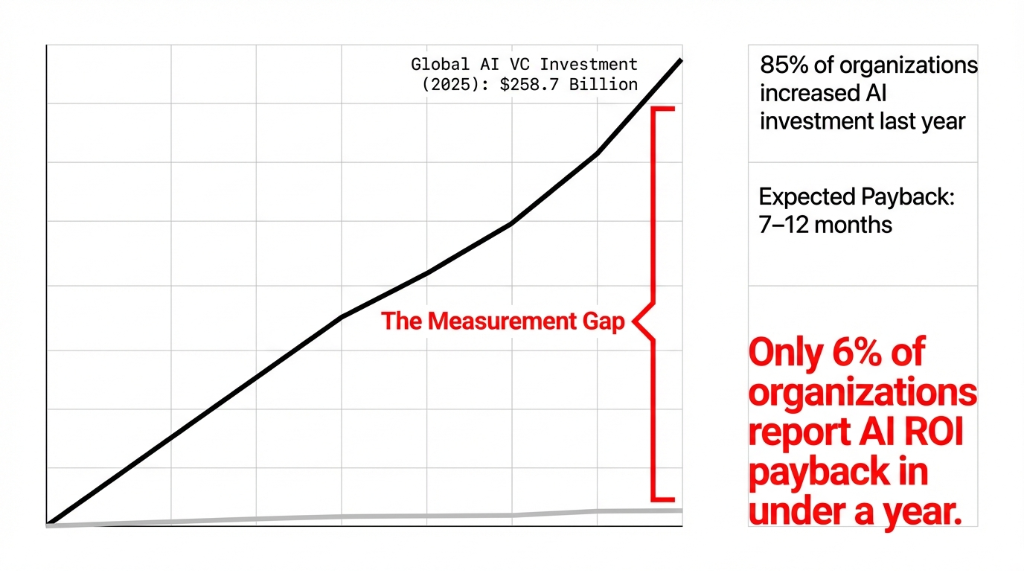
The hype is real. 85% of organizations increased their AI investment in the past 12 months, and 91% plan to increase again. VC investment in AI firms hit $258.7 billion globally in 2025 — over half of all venture capital deployed.
But here is what the press releases do not say: only 6% of organizations reported AI ROI payback in under a year. Most see returns in two to four years — more than double the 7–12 month payback window they expected when they signed the contract.
That gap between expectation and reality is not an AI problem. It is a measurement problem. And it starts before implementation, not after.
Why 39% of C-Suite Execs Cannot Prove Their AI Worked
Forbes Research surveyed C-suite executives across industries and found that 39% cited measurement challenges as the primary reason they cannot quantify AI business impact. Not technical failures. Not vendor problems. Measurement.
The Capability vs. Outcome Trap
Most teams build AI around a capability ("we want a chatbot") instead of a business outcome ("we want to cut Tier-1 support volume by 34% and reduce average handling time from 11 minutes to 4 minutes").
The capability gets delivered. The outcome never gets tracked. Six months later, nobody knows if the $140,000 project did anything.
The 64% of executives who do measure AI ROI use operational efficiency as their primary metric — shortened cycle times, increased output volume. They also track data quality improvements (50%) and employee productivity gains (48%). Notice what is NOT on that list: "general AI adoption" or "digital transformation progress." Those are not metrics. Those are excuses.
The 4-Step AI ROI Framework We Use Before Writing a Single Line of Code
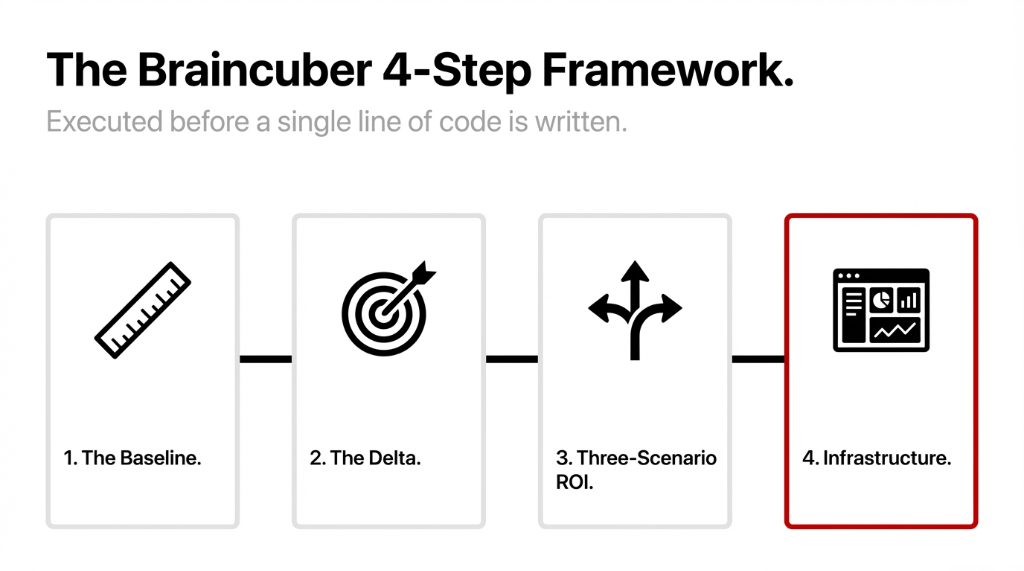
We run every AI project through this framework at Braincuber before a client spends a dollar on infrastructure. Here is exactly how it works.
The 4 Steps
Step 1: Document Your Baseline
Pull your current process data with embarrassing specificity. How many hours does your finance team spend on invoice reconciliation weekly?
Real example: A US logistics client answered "about 20 hours." The actual number was 37.5 hours when we counted correctly.
If you cannot answer with a specific number, you are not ready to buy AI. You are ready to buy data infrastructure.
Step 2: Define the Delta
Pick one primary metric per AI use case. Not five. One. Then define the minimum delta that justifies the investment.
Example: Loaded labor at $62/hour × 34 hours saved/week = $88,816/year in recovered capacity. Now you can evaluate whether a $95,000 AI build makes sense. (It does. Barely. In year two.)
Step 3: Three-Scenario ROI Model
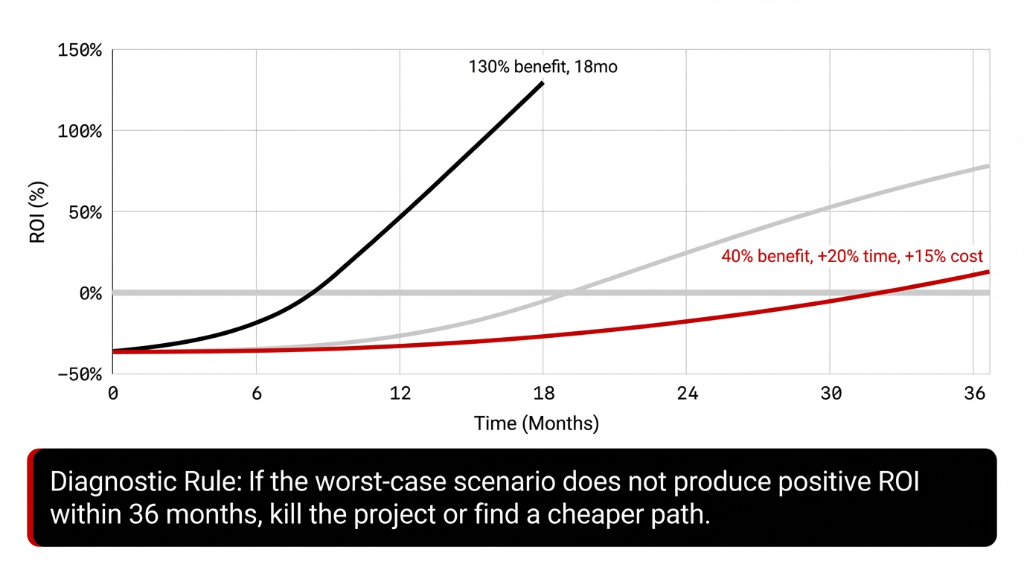
ROI (%) = (Net Benefit / Total Investment) × 100. Run it three times:
▸ Worst: 40% of projected benefit. +20% timeline. +15% cost.
▸ Base: Projected benefit delivered. Standard maintenance.
▸ Best: 130% of benefit within 18 months.
Step 4: Measurement Infrastructure
This is the step 91% of companies skip. Build the dashboard that captures baseline metrics and automatically tracks them post-deployment.
Your Odoo ERP should log invoice processing time before the AI layer activates. Your helpdesk must tag pre-AI and post-AI tickets differently.
No measurement infrastructure = no proof of value = no budget for Phase 2.
The 3 AI Use Cases With the Fastest Payback in US Enterprises
Not all AI investments are equal. Here is where we consistently see the shortest payback periods:
1. AI-Powered Customer Support Automation
Average time to positive ROI: 8–14 months
A US e-commerce brand we worked with cut their Tier-1 support volume by 41% using an agentic AI system, reducing support headcount costs by $183,400 annually. The build cost was $97,000. Year-one ROI: 89%.
2. AI Document Processing (Invoices, Contracts, Claims)
Average time to positive ROI: 6–11 months (fastest category)
Manual invoice processing costs $12–$15 per document. AI processing costs $0.40–$1.20 at scale. For a company processing 3,000 invoices/month, that is a $38,400–$42,600/month cost reduction — before you account for error reduction.
3. Predictive Analytics for Supply Chain & Demand Forecasting
Average time to positive ROI: 12–24 months (slower, but largest total value)
We have seen demand forecasting AI reduce inventory overage from 22.3% to 8.7% for a mid-market US retailer — freeing up $2.1M in working capital in the first year.
The Uncomfortable Truth About Agentic AI Timelines
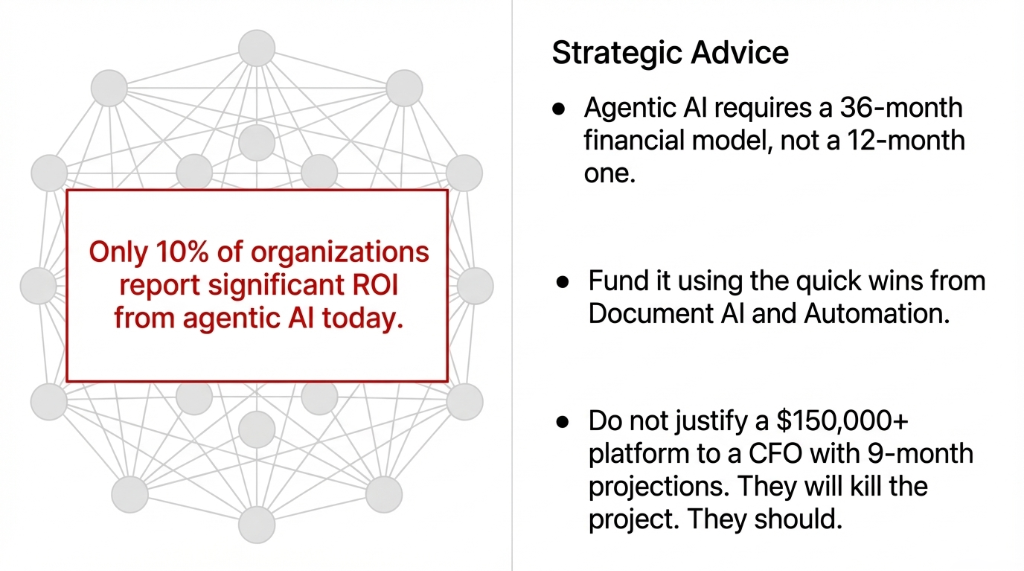
Everyone is pitching agentic AI right now. We use it ourselves — LangChain-based multi-agent systems for end-to-end process automation. And it works. But be honest with your board: only 10% of organizations currently report significant ROI from agentic AI, and another third expect it to take three to five years.
The Right Sequence
That is not a reason not to invest. That is a reason to invest with a 36-month financial model, not a 12-month one.
Build your ROI case on automation and document AI first.
Use those wins to fund agentic AI projects with longer payback windows. Do not try to justify a $400,000 agentic AI platform to a CFO using projections that assume full value capture in nine months. He will kill the project. He should.
Your AI ROI Scorecard: What to Track From Day One
| Category | Example Metrics |
|---|---|
| Financial | ROI %, payback period, labor cost saved, revenue added |
| Operational | Processing time, error rate, throughput, uptime |
| Customer | CSAT score, resolution rate, churn reduction |
| Workforce | Productivity per FTE, hours on low-value tasks, training time |
If you are 90 days post-deployment and none of these numbers have moved, you do not have an AI problem. You have an adoption problem — and those are fixed with change management, not more model training.
Stop Guessing. Start Measuring.
You do not need more AI hype. You need a 90-minute scoping call where someone tells you exactly what your AI investment should return — and what it will cost if it does not.
Pull up your last AI project’s original budget justification. Now compare it to actual measured outcomes. If those two numbers live in different documents — or one of them doesn’t exist — you know where to start.
Frequently Asked Questions
How do you calculate AI ROI before building anything?
Start with baseline data: current cost, hours, error rate. Define the minimum improvement that justifies investment. Then run three scenarios — worst, base, best — using ROI (%) = (Net Benefit / Total Cost) × 100. If worst-case ROI is still positive within 36 months, the project is worth scoping.
What is a realistic AI ROI timeline for a US business?
For document processing and customer support AI, expect 8–14 months to positive ROI. For predictive analytics and supply chain AI, plan for 12–24 months. For agentic AI, budget 2–4 years — only 6% of organizations report payback in under 12 months across all AI types.
What AI use cases deliver the fastest ROI?
Invoice and document processing, Tier-1 customer support automation, and demand forecasting. Document processing cuts per-invoice costs from $13 to under $1.20 at scale. Customer support AI reduces Tier-1 volume by 35–45%, depending on training data quality.
Why do most AI projects fail to show ROI?
Because measurement infrastructure was never built. 39% of C-suite executives cannot quantify AI impact due to measurement challenges alone — not technical failure. No baseline before deployment means no proof of improvement after. No proof means no budget renewal.
How much should a US company budget for an AI implementation?
Customer support AI agent: $65,000–$120,000. Document AI for invoice processing: $40,000–$85,000. Agentic AI with multi-workflow automation: $150,000+. Always add 18% for integration work your vendor will not mention in the initial quote.