
72% of AI projects stall before they generate a single dollar.
Not because the technology is bad. Because the builders solved the wrong problem. We have worked across 500+ AI projects at Braincuber Technologies. The pattern is embarrassingly consistent: a machine learning engineer spends 4 months building a technically impressive AI system, pitches it to three enterprise clients, and walks away with zero contracts.
They built a demo, not a product. They created AI — but not an AI product that replaces a business cost a CFO can point to on a spreadsheet.
If you cannot answer "what exact dollar line item does my AI product eliminate?" in 11 words or fewer, you are not building an AI product. You are building a science fair project.
The $173 Billion Market Nobody Is Selling Into Correctly
The U.S. AI market hit $173.56 billion in 2025 and is tracking toward $976.23 billion by 2035. That is not a niche. That is a category-defining shift. And yet, 42% of businesses abandoned most of their AI efforts in 2025 alone.
Here is the ugly truth: the AI market is exploding but most AI companies are leaving money on the table. Companies with AI integration generate an average return of $3.7 for every $1 spent on generative AI, and top performers are seeing $10.3x ROI. Those are not vanity metrics. That is the business of AI in hard numbers.
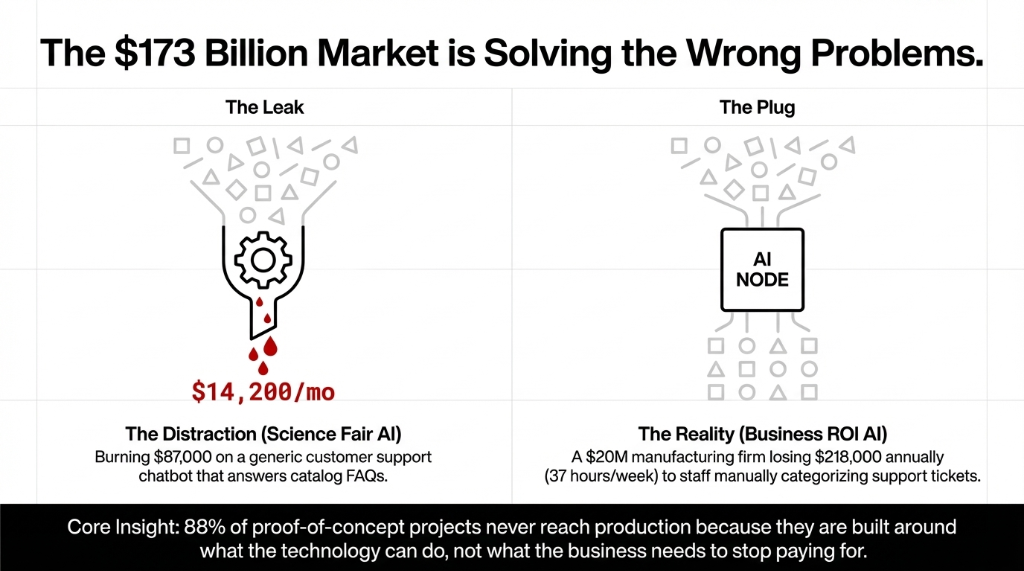
The problem is not AI technology. The problem is that most people trying to build AI are building AI tools for other AI enthusiasts — not for the operations director at a $20M manufacturing firm who has $14,200 leaking monthly from unstructured invoice data.
Why 95% of AI Projects Die Before Making a Dollar
Here is a number that should scare every AI technology company building products right now: 95% of generative AI pilots at companies are failing. Not struggling. Failing.
MIT's research does not blame the models. It blames the learning gap — the disconnect between a generic AI tool that works brilliantly in a sandbox and the reality of enterprise workflows that have 11 legacy systems, 3 departments that hate each other, and a data pipeline that has not been audited since 2019.
The $87,000 Chatbot That Solved Nothing
A client called us after burning $87,000 with a previous AI development tools vendor. The deliverable? A chatbot that could answer FAQs about their product catalog.
The problem they actually had? Their customer support team was spending 37 hours a week manually categorizing support tickets — a workflow costing them $218,000 annually in staff time. Nobody asked the right question before building.
88% of proof-of-concept projects never reach production. The reason is almost always the same: the AI project was built around what the technology could do, not what the business needed to stop paying for.
The Framework We Use to Develop an AI Product That Sells
When we build AI products at Braincuber, we follow one rule before writing a single line of code: we identify the exact workflow being replaced and price the cost of that workflow in annual dollars.
Here is the 4-step framework we use for every AI application development engagement:
Step 1 — Audit the Pain, Not the Tech
Before you create AI or even discuss machine learning, sit with the operations team. Ask: "What do you do manually today that you hate?" Then quantify it.
The Math: A warehouse team doing manual inventory reconciliation 3x/week at 2.5 hours each at $28/hour
= $10,920 annually. That is your baseline. Your AI product needs to beat that number to justify its AI cost.
Step 2 — Pick the Right AI Type for the Problem
Different AI types solve different problems. Picking the wrong type wastes 3-6 months and usually $60,000-$120,000.
AI agents (LangChain, CrewAI): Multi-step autonomous workflows
Machine learning models (AWS SageMaker): Prediction tasks — demand forecasting, house pricing models, churn prediction
Generative AI: Content generation, document parsing, natural language interfaces
Step 3 — Build the Smallest Version That Eliminates the Biggest Cost
Do not build your own AI in its full form on day one. Build the one AI application that automates the single most expensive manual task.
Real Example: A US-based logistics company needed AI for data analytics across delivery routes.
We did not build a full AI data science platform. We built one predictive model for route optimization.
Result: Cut their fuel spend by $23,400 in the first 90 days. Everything else got funded from those savings.
Step 4 — Package the Outcome, Not the Technology
Nobody buys machine learning. They buy "$96,000 in annual cost reduction on invoice processing." When you align AI and business language, the sale closes in 2 meetings instead of 6.
The best AI companies in the US — the ones growing 40-60% YoY — are not selling tools. They are selling specific, measurable business outcomes with a clear implementation of AI timeline and a defined ROI window.
The AI Applications That US Businesses Are Actually Paying For
Not all AI types generate equal revenue. Here is what the data says about AI applications that get budget approval fastest in 2025-2026:
| AI Application | What It Replaces | ROI Impact |
|---|---|---|
| AI agents for customer support | $18-$42/ticket manual resolution | $0.11/ticket. 61-74% cost cut. |
| AI for data analytics & reporting | 5-day reporting cycles | Cut to 6 hours. 4.4 days of analyst time freed. |
| Document AI (contract, invoice, compliance) | Back-office manual processing | $2-$10M/year BPO cost reduction |
| Predictive AI for supply chain | Reactive stockout management | Predicted stockouts 11 days earlier. $156,000 recovered/quarter. |
| AI analytics dashboards (NL querying) | Waiting for data team reports | COO types a question, gets instant answer. No SQL needed. |
This is AI and data analytics actually working for humans — not another dashboard nobody opens.
The Real Risks of AI Nobody in the Sales Deck Will Tell You
We are not going to pretend AI implementation is frictionless. Here are the actual AI limitations and risks of AI that we see kill projects:
Risk 1 — Bad Data Destroys Good Models
Using AI without clean, structured data for AI is like building a house on sand. 67% of the time, data for AI is the real project. If your CRM has 4 years of inconsistent customer records, your AI and data science model will confidently make wrong predictions. Data cleanup runs $8,000-$40,000 depending on volume before you can even train a model.
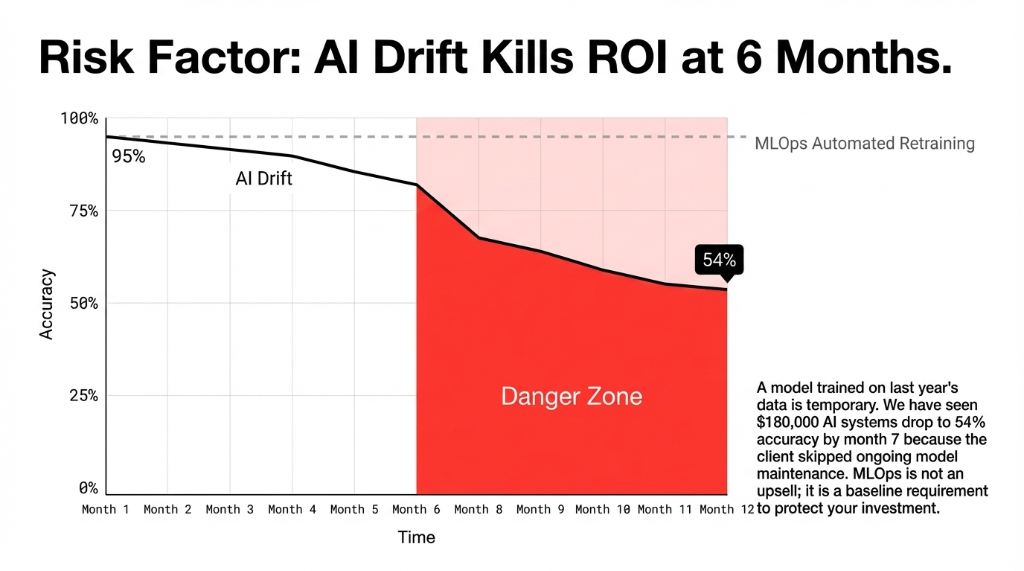
Risk 2 — AI Drift Kills ROI at 6 Months
A machine learning model trained on last year's data starts degrading in accuracy by month 4-6 unless you have an MLOps pipeline running automated retraining. Most vendors do not tell you this.
We have seen a $180,000 AI system drop to 54% accuracy by month 7 when the client skipped ongoing model maintenance. MLOps is not an upsell; it is a baseline requirement.
Risk 3 — Integration Kills Timelines
AI integration with legacy ERP, Salesforce, or custom databases adds 6-14 weeks to any timeline. The AI challenges here are not technical — they are organizational. Getting IT, Legal, and Operations aligned on data access permissions takes longer than building the model.
Risk 4 — Misaligned AI Strategy Creates Expensive Orphan Tools
Companies with AI tools that nobody uses are the most common outcome of rushed AI adoption.
Real case: A US manufacturing client had 3 separate AI apps built by 3 different vendors — none of them talked to each other.
They were paying $7,400/month in total for tools that added zero measurable efficiency.
Align AI initiatives to a single business objective before building. Or keep paying for shelfware.
How to Scale AI Without Burning Your Cloud Budget
Once your first AI product is generating ROI, AI scale becomes the next challenge. The typical mistake is running everything on-demand without reserved capacity — resulting in 3-5x higher cloud costs than necessary.
The Braincuber Cloud Cost Architecture
Training Pipelines
Run on Spot Instances — 60-70% cheaper than on-demand. Perfect for fault-tolerant batch ML jobs.
Inference Endpoints
Scale down to zero during off-hours, saving $2,100-$8,600/month for mid-sized deployments.
Data Pipelines
Optimized S3 + Glue architectures that cut storage and processing costs by 41% vs. naive setups.
This is what building your own AI at AI scale actually looks like — not just a working model, but a production infrastructure deployed via AWS consulting that does not multiply your bill every time usage doubles.
The Braincuber Difference: AI Expertise That Ships, Not Demos
We are not an AI experiment company. We do not build prototypes that impress investors and then disappear. Every AI project we take on at Braincuber Technologies ships to production — because we tie our project milestones to your business outcomes, not our code commits.
Our AI development tools stack includes LangChain and CrewAI for AI agents, AWS SageMaker and Bedrock for ML infrastructure, and a custom knowledge base AI layer for enterprise document intelligence. We have helped companies creating your own AI solutions across manufacturing, logistics, healthcare, and D2C retail — generating measurable ROI in 60-90 days from kickoff.
The Competitive Clock Is Ticking
78% of organizations now use AI — up from 55% the year before (Stanford HAI). The companies not yet using AI in businesses are not "avoiding risk AI." They are falling behind at $11,000-$43,000 per month in competitive disadvantage.
Talk to our AI team before another quarter passes while your competitors automate workflows you are still paying humans to do manually.
Frequently Asked Questions
How long does it actually take to build an AI product that generates revenue?
With a clear problem statement and clean data, we ship a first production-grade AI application in 8-14 weeks. The first 3 weeks are always data audit and workflow mapping — not coding. Companies that skip this step add 6-12 weeks of rework and lose an average of $34,000 in wasted development.
What is the realistic AI cost for a custom AI application?
A focused, single-workflow AI product built on AWS infrastructure runs $28,000-$85,000 for initial build. Ongoing MLOps, model monitoring, and cloud infrastructure adds $1,800-$6,500/month. If you are eliminating a $200,000/year manual process, the payback period is under 6 months.
What are the biggest AI limitations I should know before starting?
Data quality, integration complexity, and model drift are the top three killers. 67% of AI projects spend more time on data preparation than on the model itself. Budget for data cleanup ($8,000-$40,000), plan for a 6-14 week integration phase, and always include MLOps in your contract.
Can I build my own AI without a machine learning engineer on staff?
Yes — with the right AI development tools and a vendor like Braincuber managing MLOps and infrastructure. Making your own AI product does not require an in-house ML team if you partner with an AI technology company that handles training pipelines, model deployment, and ongoing monitoring.
What types of AI generate the fastest ROI for US businesses?
Document AI (invoice and contract processing), AI agents for customer support, and predictive analytics for inventory or pricing generate the fastest payback — typically under 90 days. AI for data analytics on operational workflows consistently delivers $2-$10M annually for mid-market companies.
Stop building AI demos nobody pays for.
Book our free 15-Minute AI Product Audit — we will identify the exact workflow your AI product should automate, the projected annual ROI, and the realistic build timeline. In the first call.