
An Ohio auto-parts manufacturer was paying $74,880/year — not to build parts, but to type the same vendor data into QuickBooks, shuffle invoices from scanned documents, and rebuild the same Excel report every Friday. We fixed all of it in 11 weeks.
Here’s the full story. Dirty details included.
The 40 Hours Nobody Accounts For
When their ops manager first called us, he had one complaint: "My AP clerk is working overtime every week and we still can’t close the books on time."
We sat down and mapped every single task — all hours, no exceptions.
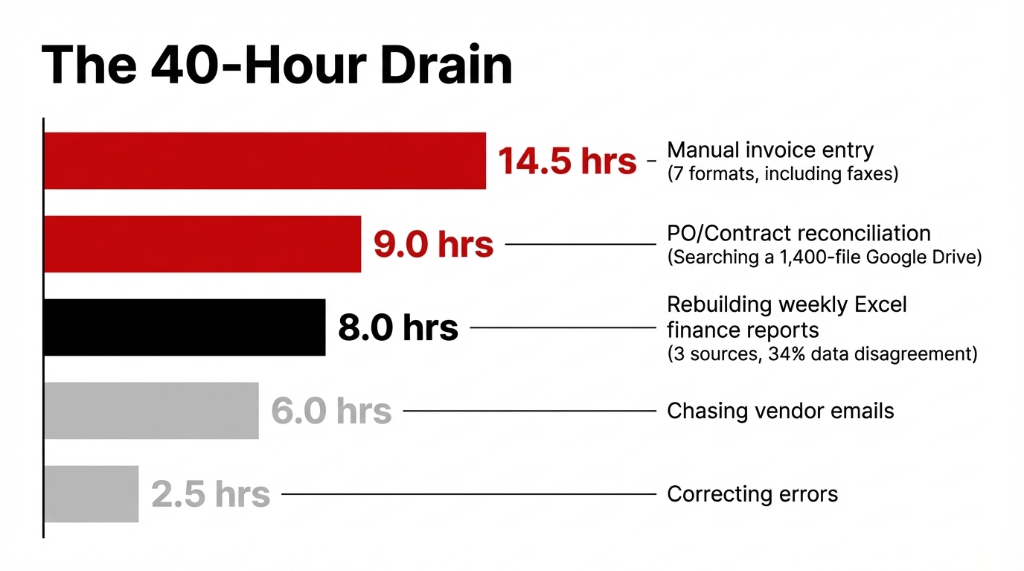
| Task | Hours/Week | The Dirty Detail |
|---|---|---|
| Manual invoice entry | 14.5 hrs | 7 formats — PDFs, photos, Word docs, and one supplier who still faxed |
| PO/contract reconciliation | 9.0 hrs | 1,400-file Google Drive folder. Finding one document took 15 minutes |
| Excel finance report rebuild | 8.0 hrs | 3 data sources disagreed with each other 34% of the time |
| Supplier email chasing | 6.0 hrs | Manual confirmations and purchase approvals over email |
| Error correction | 2.5 hrs | Cascade effect from all of the above |
At $36/hour blended rate: $74,880/year in pure labor waste.
Add $4,200 in late payment penalties and a $9,600 inventory write-off caused by a SKU miscounted for three months — and the actual operational bleed hits $88,680/year. On $5.8M in revenue, that’s 1.53% of topline burned before you’ve touched a single machine on the factory floor.
Why Hiring More People Isn’t the Answer
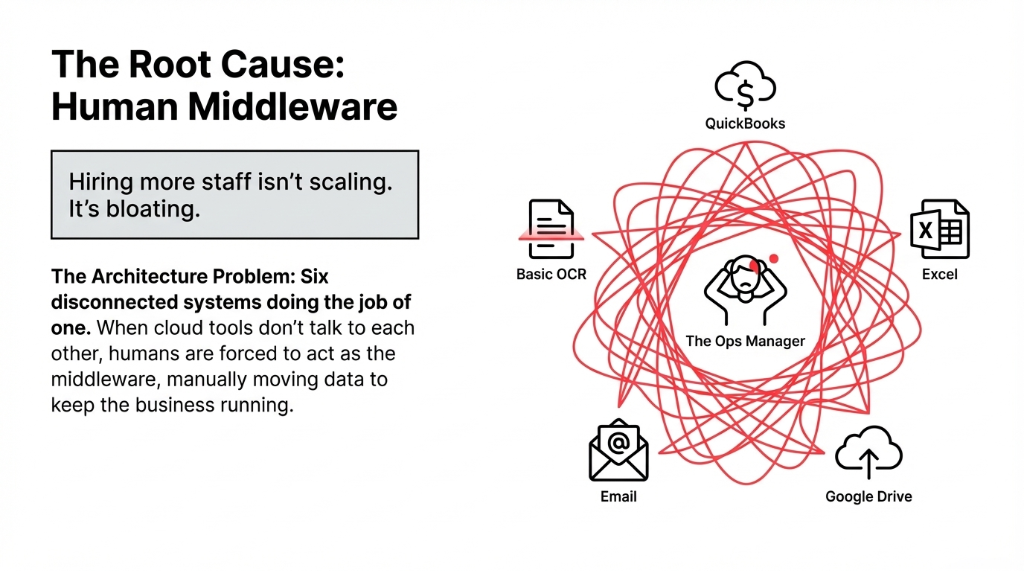
Hiring more staff isn’t scaling. It’s bloating.
This client’s ops manager had become the human middleware — manually moving data between six disconnected tools that never talked to each other. QuickBooks for accounting. A basic OCR tool that breaks every time a vendor changes their invoice format. A manual vendor management spreadsheet. Email for supplier communication. A shared drive as their entire document management. And Excel as the backup for everything.
Everyone tells you to look at NetSuite. Don’t — unless you have $400,000 to burn on an ERP implementation that takes 14 months and still doesn’t include intelligent document processing. We’ve cleaned up three of those NetSuite migrations in the past 18 months alone.
What We Actually Built: The AI+Odoo Stack
Intelligent Document Processing + OCR AI
We deployed a document AI layer combining OCR and AI with computer vision models. Not the basic OCR tool they were using before. This is AI document processing — a full intelligent document processing system — that reads any vendor invoice regardless of format. A scanned document, a PDF, a photo, even that fax. The AI scan extracts every line item, PO number, and vendor data in under 3 seconds per document.
$15–$16
Manual cost per invoice
$2.18
AI cost per invoice
$4,564/mo
AP savings on 340 invoices
14.5 hrs/week → 0.4 hrs/week. AP clerk now handles 11–14 exception reviews — not 340 manual entries.
Odoo as the Central Nervous System
We implemented Odoo software — Manufacturing, Purchase, Inventory, and Accounting modules — fully integrated as AI ERP cloud solutions hosted on AWS. This is the ERP implementation most US mid-size manufacturers keep delaying because someone quoted them $300,000 and nine months.
This project went live in 11 weeks. That’s what working with the right Odoo partners actually looks like.
Purchase orders auto-trigger at inventory thresholds. Vendor management tracks supplier performance and lead times. The ops manager now has a live AI dashboard drillable in 4 clicks. No more Friday Excel rebuild. No more three-source reconciliation.
Intelligent AI Chatbot for Vendor Communication
Not one of those free AI chatbots that answers FAQs from a static template — a purpose-built AI chatbot for business built with LangChain-based agentic AI. The bot handles outbound vendor confirmations, tracks acknowledgment timelines, and escalates to a human only when a supplier goes silent for more than 48 hours.
The 6 hours/week spent chasing email confirmations dropped to 19 minutes/week.
Finance AI: Replacing the Excel Graveyard
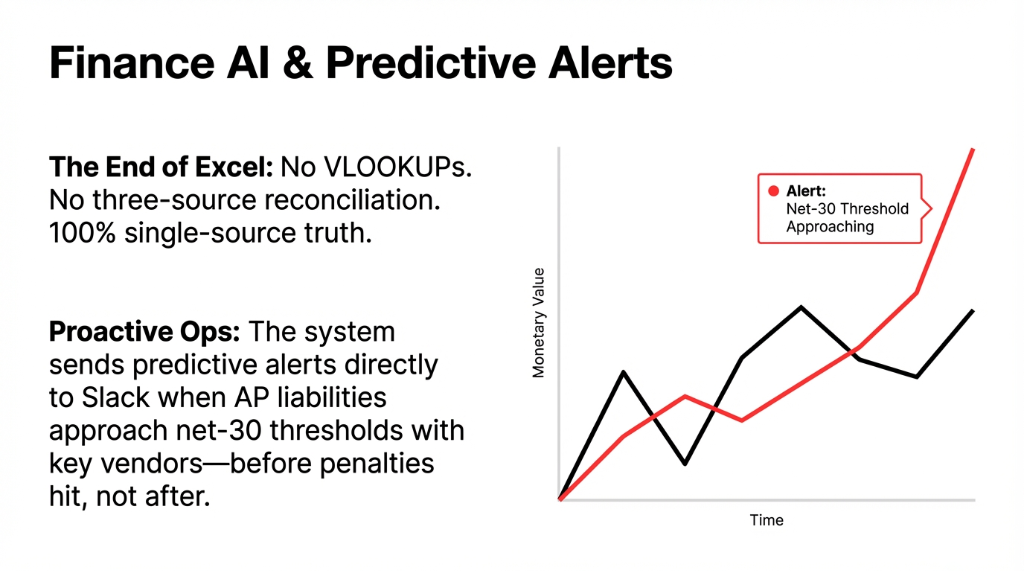
The 8 hours/week on Excel finance reporting got replaced entirely with Odoo’s finance AI module — one system with one source of truth. No VLOOKUPs. No reconciliation. No three-source conflict. The CFO now gets a Slack alert when AP liabilities are approaching net-30 thresholds with key vendors — before it becomes a penalty, not after.
The Actual Results: First 90 Days
| Process | Before | After | Saved |
|---|---|---|---|
| Invoice / document processing | 14.5 hrs | 0.4 hrs | 14.1 hrs |
| PO–vendor contract reconciliation | 9.0 hrs | 1.2 hrs | 7.8 hrs |
| Finance reporting (Excel) | 8.0 hrs | 0.5 hrs | 7.5 hrs |
| Supplier follow-up | 6.0 hrs | 0.3 hrs | 5.7 hrs |
| Error correction | 2.5 hrs | 0.3 hrs | 2.2 hrs |
| Miscellaneous admin | 4.0 hrs | 1.5 hrs | 2.5 hrs |
| TOTAL | 44 hrs/wk | 4.2 hrs/wk | ~40 hrs |
First-Quarter Financial Impact
$13,692
Saved in AP document processing costs (3 months × $4,564/month)
$4,200 → $0
Late payment penalties eliminated (first clean quarter in 4 years)
79% → 96.7%
Inventory accuracy improvement
31% drop
Production planning delays reduced via better real-time procurement visibility
The AP clerk wasn’t cut. She was redeployed to vendor contract review — actual strategic work. In her first month with free time to actually read the contracts, she found $14,200 in annual savings through better payment terms and early-pay discounts. That single redeployment covered 58% of the total project cost.
This Isn’t a $50M Enterprise Story
82% of US manufacturers are planning to increase their AI budgets — but 56% of them still aren’t sure their ERP system is even ready for AI integration. They’re buying AI services and ML tools on top of broken operational stacks. That’s like bolting a jet engine onto a car with four flat tires.
The pattern across every case study we’ve run — across 500+ projects — is identical: manufacturers who win with AI and automation are not the ones with the biggest budgets. They’re the ones who fixed their data flows first, then layered intelligent AI on top of a single source of truth.
This client was at $5.8M ARR. We’ve run the same playbook for brands at $1.4M and at $22M. The AI approach scales because the underlying architecture problem is universal.
If you’re an ops manager in US manufacturing still reconciling vendor contracts manually, still waiting for a Friday Excel report, still letting scanned documents pile up in someone’s inbox — you’re not running a factory. You’re running a spreadsheet with a factory attached.
The good news: fixing it takes 11 weeks, not 9 months.
Frequently Asked Questions
How long does AI+Odoo ERP implementation take for a mid-size manufacturer?
For manufacturers in the $2M–$20M revenue range, our standard AI+Odoo ERP implementation runs 8–14 weeks from kickoff to go-live. That includes OCR AI and intelligent document processing setup, ERP module deployment, AI chatbot development, and cloud infrastructure on AWS.
What ROI should a manufacturer expect in the first 90 days?
Most businesses see positive ROI within 60–75 days. Fastest gains come from AI document processing (invoice costs typically drop from $15 to under $3 each), elimination of manual reporting hours, and zero late-payment penalties. On a $5M revenue base, first-year recoverable value generally falls between $55,000 and $95,000.
We already have QuickBooks — do we replace everything at once?
Not always, but usually yes within 18 months. QuickBooks can coexist short-term during an ERP transition. If you’re processing 150+ invoices/month and managing vendor contracts across multiple suppliers, full AI ERP on Odoo outpaces the QuickBooks-plus-spreadsheet stack by month 14 in nearly every scenario.
How is AI document processing different from our basic OCR tool?
A standard OCR tool reads scanned documents using fixed templates — it breaks when a vendor changes their invoice format. Intelligent document processing uses trained AI models and computer vision to understand document context, extract line items from any format, and improve accuracy with every invoice. Error rate difference is roughly 5x: basic OCR averages 5–8% errors vs. 0.5–1% for production-grade doc AI.
Is our data secure running AI workloads on AWS?
Yes. Our cloud AI deployments on AWS follow SOC 2-aligned security architecture. All document management data, ERP transactions, and AI model outputs are encrypted in transit and at rest. SageMaker handles ML workloads in isolated environments with no cross-tenant data access. Role-based access controls inside Odoo ensure each team sees only what they need.