
You already know artificial intelligence is not a toy anymore. It is the quiet operator changing how money moves, how patients get treated, how kids learn, how factories run, and how content gets made. Across US healthcare, finance, education, manufacturing, and marketing, AI has moved from experiments to core infrastructure. Budgets and careers are tied directly to whether teams can actually use AI at scale.
We will walk industry by industry, side-by-side, and show where AI is truly paying off, where it is overhyped, and what it means if you run or advise a US business that has to stop pretending Excel plus one chatbot equals "digital transformation."
The Common Thread Across Five Industries
Look past the buzzwords and you see the same pattern everywhere.
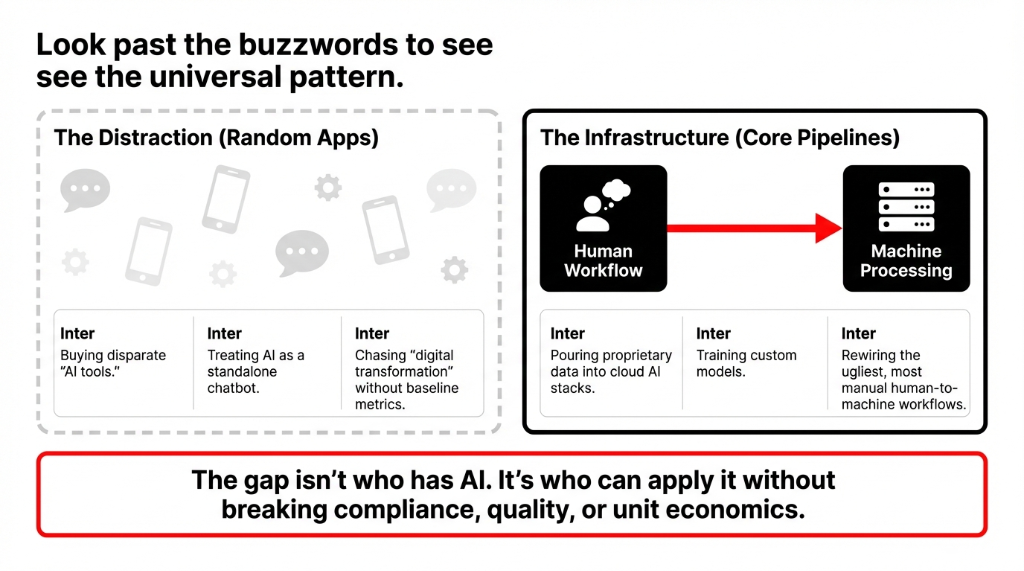
Every serious US organization is pouring data into cloud AI platforms, training custom models, and wiring them into day-to-day operations. Usually starting with the ugliest, most manual workflows. Teams are not just buying random AI apps. They are building entire stacks of AI tools and automation pipelines that rewire how work flows from human to machine and back.
Healthcare systems, banks, school districts, factory networks, and marketing teams all now run some mix of computer vision, generative AI models, and large language models to make decisions faster and cheapen repetitive work.
Where AI Is Biting First
| Industry | First High-ROI AI Use Cases |
|---|---|
| Healthcare | Imaging, triage, documentation, medical billing |
| Finance | Risk scoring, fraud detection, compliance reporting |
| Education | Personalized learning, grading, admin automation |
| Manufacturing | Predictive maintenance, quality inspection, demand planning |
| Marketing & Media | Content generation, targeting, translation, testing |
Now we zoom into each, with the messy details.
Healthcare: From Reactive Visits to Proactive, Data-Driven Care
If you sit inside a US hospital right now, you are not arguing about "if" AI in healthcare matters. You are arguing about which medical AI project actually reduces overtime and malpractice risk this quarter.
The US AI in healthcare market is already measured in billions of dollars and growing above 30% annually. Around 65% of US healthcare organizations say AI is already redefining their operations. 80% expect it to cut labor costs through automation.
Imaging and Diagnostics
What happens: Radiology teams use computer vision to read scans faster and highlight anomalies. Algorithms do not get tired at 3 a.m., and they can detect subtle patterns across millions of prior cases that a human would miss.
Impact: Catches issues hours or days earlier. Fewer misses on off-hour shifts.
Clinical Documentation and Revenue Cycle
What happens: Ambient AI assistants listen to patient visits and draft notes, codes, and prior-auth packets so doctors stop spending two hours in the EHR for every hour of care.
Impact: Recovers hundreds of hours per clinician each year. Real margin recovery, not a slide deck promise.
Care Pathways and Remote Monitoring
What happens: Predictive models flag which patients are trending toward readmission by combining vitals, notes, and devices into one AI modeling pipeline.
Catch issues three days earlier. Avoid a $18,500 readmission bill.
"Soft" areas are emerging fast too. AI therapy pilots mix human counseling with AI handoffs where bots triage, run risk scores, and escalate to clinicians instead of leaving everything in a voicemail queue. Medical AI also supports translation for multilingual discharge instructions, reducing dangerous misunderstandings.
If you run a US health system and still do not use AI for documentation, triage, or claims, the question is not "Should we use AI?" It is "How much margin are we throwing away each month because we refused to apply proven AI technology?"
Finance: Risk, Fraud, and Machine-Speed Decisions
Walk into a US bank or fintech and ask the CRO what keeps them awake: fraud rings, volatile markets, and regulators who expect machine-level oversight. That is exactly where finance AI and automation have been unleashed first.
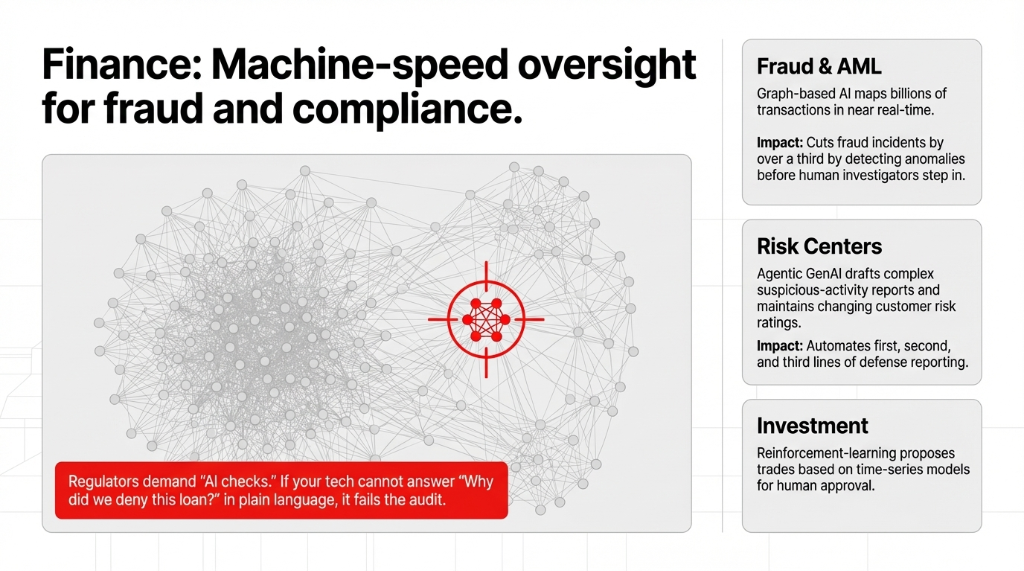
Banks now push credit-risk models that analyze thousands of variables and run stress tests on demand instead of waiting for quarterly spreadsheets.
Fraud and AML
The shift: Graph-based detection AI maps billions of transactions and spots money-laundering networks in near real time. Cuts some fraud incidents by more than a third once deployed at scale. AI-flagged anomalies are standard before a human investigator steps in.
One-third fewer fraud incidents. That is not a demo. That is production data.
Risk and Compliance
Agentic generative AI and analytical models draft complex suspicious-activity reports, summarize changing regulations, and maintain customer risk ratings. McKinsey projects these AI risk centers can automate large chunks of reporting and speed up risk decisions across first, second, and third lines of defense.
Instead of armies of analysts re-writing policies by hand.
Investment and trading: Reinforcement-learning agents and transformer-based time-series models support portfolio construction and hedging. Nothing "black box," but AI programs that propose trades the desk can accept or reject.
The flip side: boards, auditors, and regulators are obsessed with AI checks. They want AI test suites, AI testing frameworks, and AI text detection for model outputs. If your AI company sells into US finance and cannot pass that scrutiny, you are done.
Education: From One-Pace Teaching to Adaptive Learning
US education leaders are blunt about their reality: chronic attendance issues, burned-out teachers, and kids who were never going to thrive under one-size-fits-all worksheets. That is why AI and education is suddenly a board-level topic, not just a fun pilot.
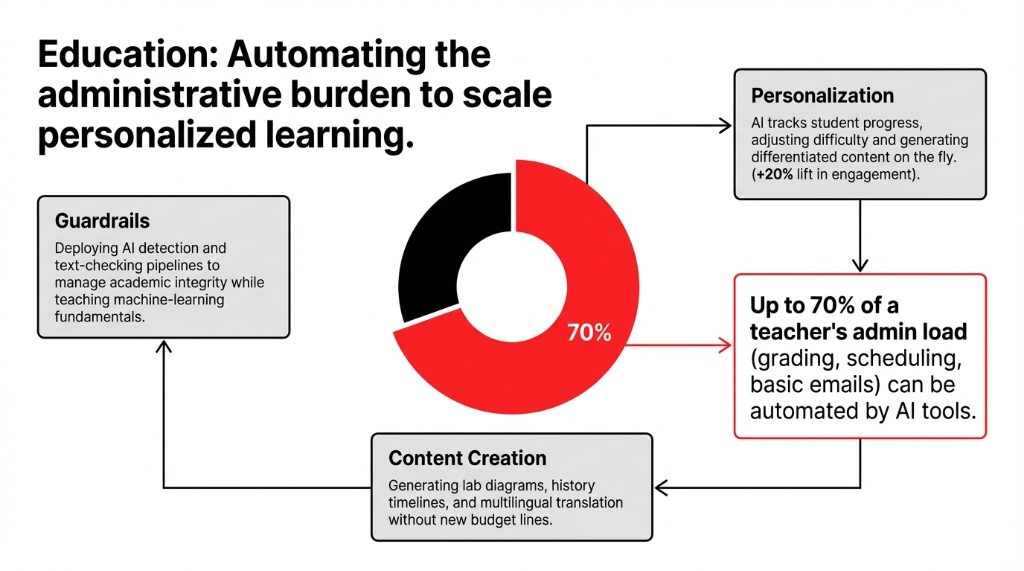
A 2024 national report found that roughly 70% of US K-12 district leaders now see AI apps as a way to enhance teaching and learning, up sharply from just over half the year before. Another study on AI-powered US classrooms showed around a 20% lift in student engagement when AI is used for interactive, data-driven lessons.
Three Levers That Actually Move the Needle
Personalized Learning at Scale
AI tracks how each student moves through content. Adjusts difficulty, pace, and examples on the fly. Teachers generate differentiated worksheets, quizzes, and projects. True content creation instead of copy-pasting from last year.
Teacher Workload and Burnout
Grading, attendance, scheduling, basic parent emails. These are exactly where AI assistants earn trust. Studies estimate AI could automate up to 70% of a teacher's admin load, freeing time for actual teaching.
Future-Proof Skills
Federal initiatives push AI-related curriculum and apprenticeships so students are not just using generative AI. They are learning machine learning and AI engineering fundamentals for jobs in AI and adjacent fields.
If you run a district or university, you are forced into an education in AI whether you like it or not. Students are already using generative AI for essays and math, whether you approve or not. The question is whether you build guardrails (AI detection, AI text detection, check-AI pipelines to catch abuse) and whether you design training so staff and students actually understand AI benefits and risks.
Done right, AI for content creation and AI for learning can turn a single teacher into someone who can create images for lab diagrams, generate images for history timelines, and deploy AI translation to support multilingual families. Without a new budget line every semester.
Manufacturing and Supply Chain: From Blind Spots to Live Telemetry
Manufacturing leaders rarely care about fancy chatbots. They care about late trucks, broken machines, and inventory write-offs that destroy margins. That is where AI in automation is already pulling weight.
Predictive Maintenance
The shift: Sensors feed computer vision and time-series models that flag a machine likely to fail three days out, not three minutes before.
One proper AI application here saves tens of thousands of dollars a month in lost output and emergency repairs.
Quality Inspection
The shift: Instead of random sampling, cameras capture every unit and AI models check for defects in real time. AI-created image overlays highlight anomalies, making it easy for operators to act.
Planning and Logistics
AI digests orders, supplier lead times, and shipping constraints to recommend production schedules that humans can override but do not have to build from scratch.
This cuts a lot of "Excel heroics" from planners' evenings.
In factories, the best AI is the one workers quietly trust, not the one with the flashiest demo. If your plant managers say "We will use AI when it stops hallucinating SKUs," your job is to deploy best-in-class AI stacks that solve one narrow, painful problem first and prove the benefits in dollars, not slides.
Marketing, Media, and Content: From Blank Pages to Perpetual Testing
Marketing teams used to spend three weeks arguing over a single hero creative. Now generative AI can create images, text, and full funnel variants while you drink your coffee. That is both the opportunity and the trap.
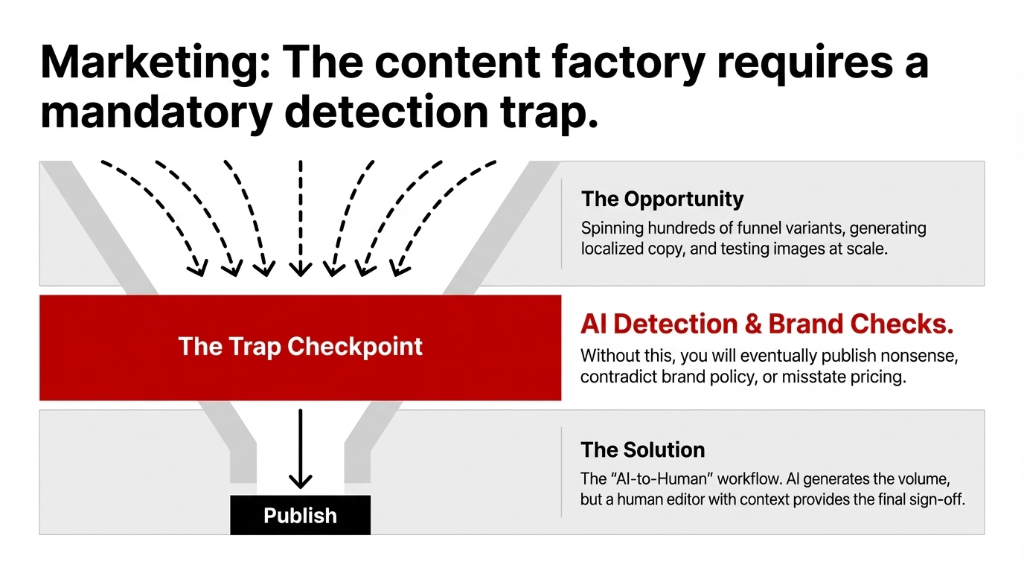
The Opportunity:
▸ Draft long-form copy, landing pages, and scripts for content creation in minutes.
▸ Generate images for campaigns, social posts, and product shots.
▸ Localize content via AI translation and adjust tone for different segments.
The Ugly Side:
▸ Without AI detection on your own pipeline, you will eventually publish nonsense.
▸ Assets that look right but contradict your brand or misstate pricing.
▸ Legal and brand teams now demand AI detection systems that can catch bad outputs.
That is why "AI-to-human" workflows matter: you let AI generate, but insist a human editor with context signs off. The best AI for marketing is rarely a pure "set and forget" tool. It is a layered stack where AI help plus human judgment plus tight testing equals campaigns that actually ship.
Trust, Safety, and the Rise of AI Checks
Across all five industries, trust is the real bottleneck, not GPUs. Boards now ask pointed questions:
The Three Questions Every Board Is Asking
1. Can we check AI outputs for bias and error?
2. Do we have AI checking and testing processes before deployment?
3. How do we handle AI text detection for academic integrity, finance disclosures, or clinical notes?
That is why a whole segment of AI companies now sells detection systems and monitoring dashboards focused only on watching other models. Banks use detection AI to watch for illegal activity from generative AI-coded algorithms. Universities use AI text detection to enforce policy. Healthcare teams run AI testing on medical AI apps before they ever touch a patient record.
If you plan to use AI for business at scale, you cannot ignore this. AI for companies comes with compliance strings attached. You will be judged not just on your AI benefits but on your guardrails.
Skills, Jobs, and the Coming Wave of AI Talent
All of this raises the same concern: what happens to people?
The Blunt Reality on AI Jobs
Exploding
Jobs in AI: engineering, product, data, and safety roles. Especially in US hubs tied to cloud providers and major AI companies.
Expected
Every industry now quietly expects basic AI learning. Whether through internal training or formal AI programs.
Hybrid
Nurse supervising medical AI triage. Risk manager tuning finance AI models. Teacher using AI learning tools. Factory supervisor owning AI automation stacks.
This does not remove humans. It just punishes teams who refuse to adapt. Most US professionals do not need to become researchers. But they do need a clear overview of AI, a working grasp of AI language models and code workflows, and enough knowledge to spot nonsense.
Use AI where it compounds your judgment. Do not outsource judgment itself.
So What Should a US Business Actually Do?
If you run a US company right now (healthcare, finance, education, manufacturing, or marketing), the worst move is to sit in "wait and see." The second-worst is to buy ten random AI apps with no plan.
A Better, Practical Sequence
1. Pick one painful workflow per department. Claims intake, fraud review, grading, line inspection, or content versioning.
2. Benchmark with numbers. Minutes per task, errors per 1,000 items, or chargebacks per 10,000 transactions.
3. Deploy narrow AI, not buzzwords. One or two AI tools per workflow: maybe AI agents for triage, computer vision for defects, or AI programs for risk scoring.
4. Build in checks by design. Require AI testing and AI detection before outputs hit production.
5. Train people, not just models. Run focused internal AI education: short tracks, internal study groups, and hands-on machine learning sessions for the people closest to the work.
Over time, this lets you move from scattered pilots to real AI at scale, with investment tied to actual P&L instead of vanity slides. You will use AI where it moves financial needles, not "because everyone else is doing gen AI."
FAQs
Which US industry is seeing the fastest AI adoption right now?
Healthcare, finance, and education are moving fastest because they face brutal cost, staffing, and compliance pressure, and federal and market forces are pushing AI into core workflows. Manufacturing and marketing follow closely as cloud AI infrastructure and tools become cheaper.
How can smaller companies start using AI without huge budgets?
Start with narrow use cases and off-the-shelf AI apps (think AI assistants for support, simple computer vision for QC, or AI translation for customer service), then grow into custom AI models only when your volumes justify it. Focus on AI benefits you can measure in weeks, not years.
Do employees need deep technical skills to work alongside AI?
No, but they do need fluency. Basic AI training on internal tools and short, focused programs are usually enough so frontline staff can safely use AI tools and flag bad outputs. Technical teams then handle deeper AI modeling and maintenance.
How do we keep AI use safe and compliant?
Treat safety as a first-class feature. Put AI detection and AI text detection checks in front of regulators and auditors. Maintain human review on high-risk outputs. Run ongoing AI testing regimes before models move from sandbox to production.
Where will the biggest AI-related job growth come from?
Expect growth in roles that blend domain knowledge with AI fluency: clinicians overseeing medical AI, analysts managing finance AI, educators leading AI learning initiatives, and engineers building and monitoring AI technology stacks. Pure "prompt jockey" roles will fade. Hybrid experts will win.
Pick One Workflow. Measure It. Then Call Us.
If your team is still buying random AI apps and hoping something sticks, you are burning runway. We build AI pipelines that tie to your P&L across healthcare, finance, manufacturing, or any industry where "wait and see" is quietly costing you six figures a year. 15-minute diagnostic. No slides. Just numbers.