
The Numbers Behind the AI Market Right Now
Let us start with the data, because most ai predictions you will read are embarrassingly vague.
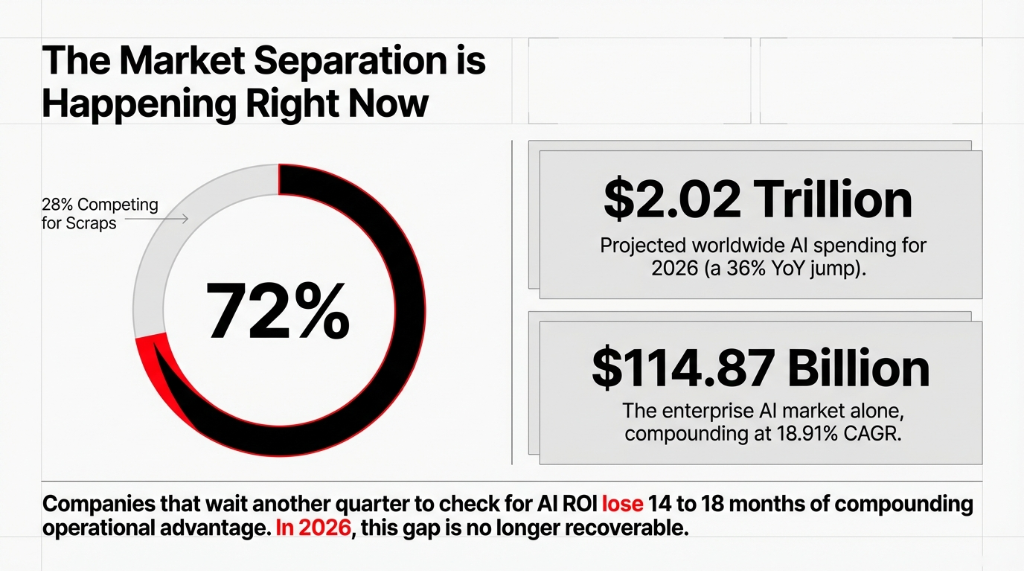
Gartner puts worldwide AI spending at $2.02 trillion for 2026 — a 36% year-over-year jump from 2025. The Enterprise AI market alone sits at $114.87 billion this year, compounding at a CAGR of 18.91%, on track to reach $273 billion by 2031. North America holds an estimated 42% share of enterprise ai revenue for the rest of this decade.
Top 6 AI Spending Categories in 2026
GenAI Smartphones
$298B — the largest single AI spending category. The ai market is being built from the silicon up, not from the boardroom down.
AI Services
$283B — consulting, implementation, and managed ai services. This is where companies with ai turn strategy into production.
AI-Optimized Servers
$268B — the infrastructure backbone. AI processing semiconductors add another $209B on top.
This is not an ai trend anymore. This is a structural reallocation of capital, and if you are in the US and not actively investing in AI right now, you are not being cautious. You are donating market share.
McKinsey data shows AI adoption has already jumped to 72% across companies, up sharply from 55% in 2023. The companies not in that 72% are competing for the leftover scraps. PwC projects AI could boost GDP by up to 26% for local economies by 2030 — but only for the organizations treating AI as operational infrastructure, not a software license.
AI Agents: From Demo Room to Digital Teams Running Your Operations
Here is the single number every COO in America should print out and tape to their monitor: 40% of enterprise applications will embed task-specific AI agents by the end of 2026, up from less than 5% in 2024. That is an 8x increase in two years.
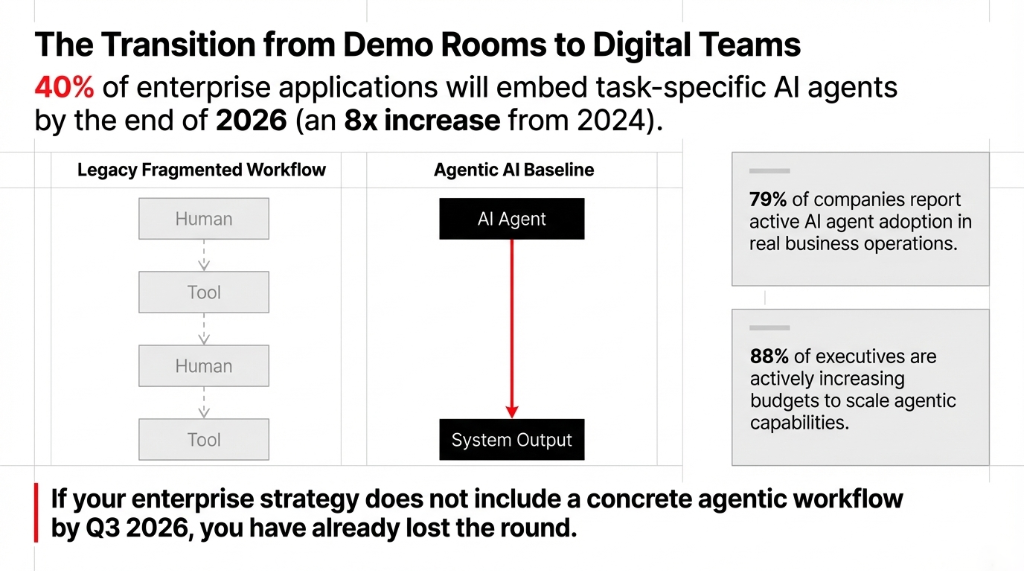
We are past the phase where ai agents are conference-room demos. 79% of companies already report active AI agent adoption in real business operations, and 88% of executives are actively increasing budgets to scale agentic capabilities further. The global AI agents market hit $7.8 billion in 2025 and is projected to exceed $10.9 billion in 2026. CB Insights mapped 400+ AI agent startups across 16 categories as of late 2025 — the ecosystem is exploding.
How We Build AI Agents at Braincuber
We build ai agents using LangChain and CrewAI that handle 24/7 customer support, document processing, and demand forecasting. Tasks that previously cost $23,000 to $47,000 per month in combined labor and tools now run for a fraction of that. The "agent model" is not a future concept — it is a deployment decision your competitors made in Q1.
Frankly, if your enterprise ai strategy does not include a concrete agentic workflow by Q3 2026, you are not behind. You have already lost that round.
According to Gartner and Forrester, the organizations seeing the fastest returns are not the ones with the largest ML teams — they are the ones putting ai tools directly into the hands of business users who understand the specific problem. When the person who owns the broken process can also build the fix, deployment happens in weeks, not quarters.
Frontier AI in H2 2026: GPT-5.4 vs. Gemini 3.1 vs. Claude 4.6
Here is what the ai platform vendors will not tell you upfront: choosing the wrong frontier ai model for your production stack is a $38,000 mistake waiting to happen.
As of March 2026, the three dominant frontier ai models in enterprise are OpenAI's GPT-5.4, Google's Gemini 3.1 Pro, and Anthropic's Claude 4.6 Opus — each with radically different agentic philosophies and pricing structures that are not linear at scale.
| Model | 2026 Revenue / Scale | Best For | Hidden Risk |
|---|---|---|---|
| OpenAI GPT-5.4 | Targeting $30B revenue in 2026 | Product velocity, enterprise copilots | Hidden pricing cliffs on chained agent pipelines. One client burned $14,200 in a single month. |
| Google Gemini 3.1 | World's largest knowledge corpus + proprietary TPUs | Google Workspace AI, google search ai, multimodal | Best performance requires GCP ecosystem. Third-party hosting degrades output quality. |
| Anthropic Claude 4.6 | Access to 1M+ TPUs by 2026 | Coding, long-context, ai for legal document processing | Limited distribution compared to OpenAI/Google. Smaller tool ecosystem for non-coding use cases. |
The Controversial Truth
There is no single "best ai" for every company. Anyone selling you a one-size-fits-all ai platform is selling you a shortcut to a wasted quarter. Pick your model based on your actual workflow — not the benchmark leaderboard. The cost difference between the right and wrong choice is $14,200–$38,000 per quarter at enterprise scale.
Laws for AI Are Hitting Hard in H2 2026 — This Is Not Optional
This is the section most ai software companies are criminally underprepared for. And the cost of that unpreparedness is not theoretical.
The Regulatory Deadlines You Cannot Ignore
Colorado's AI Act takes effect June 30, 2026, requiring security risk management programs, algorithmic impact assessments, and active measures to prevent algorithmic discrimination.
California already mandates pre-use notices, opt-out mechanisms, and disclosure requirements for how ai systems make consequential decisions — covering lending, healthcare, housing, and employment.
US federal agencies introduced 59 AI-related regulations in 2024 alone — more than double the previous year — while AI legislative mentions rose across 75 countries. President Trump's December 2025 Executive Order established a DOJ AI Litigation Task Force to actively challenge state AI laws deemed inconsistent with federal policy.
The FTC will also issue guidance this year on when its prohibition on "unfair and deceptive acts" applies to ai models and ai chatbot outputs — meaning ai for legal and compliance teams is no longer a specialty function. It is a baseline operational requirement.
Here is the ugly truth: 78% of organizations now use AI, but the compliance infrastructure to match that adoption does not exist at most of those companies. The ai and law gap is a lawsuit waiting to happen. If you are using ai programs to make decisions in HR, finance, or customer credit — and you have not done an AI impact assessment — you are exposed.
The intersection of ai and law in H2 2026 is where the first major enforcement examples will be made. Do not let your company be the case study.
AI in Security: The Attack Surface Just Got 10x Bigger
Here is something the industry is not saying loudly enough: ai cybersecurity is a two-sided war, and the attackers have access to the same ai tools you do.
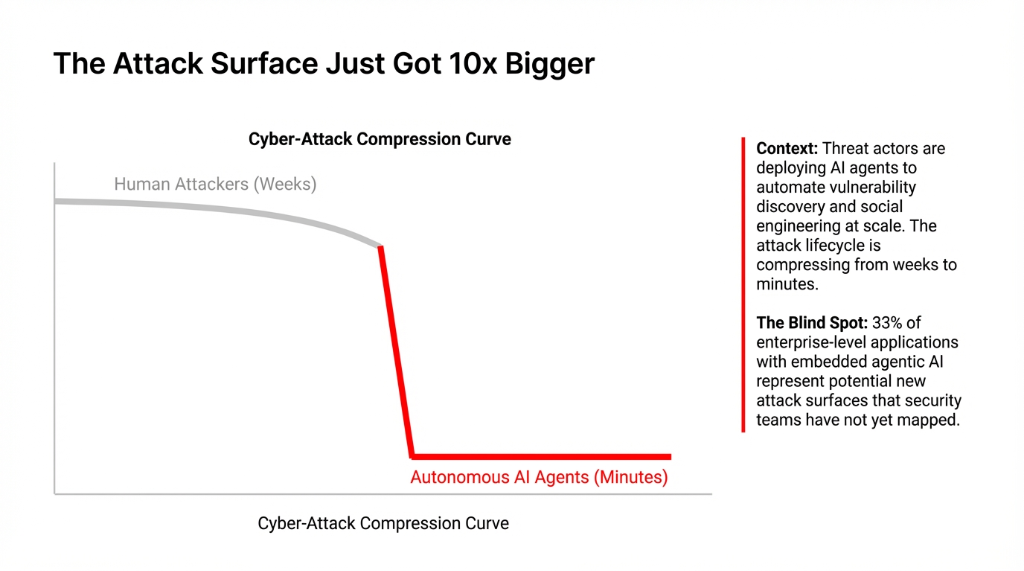
Autonomous AI agents are expected to compress the full cyberattack lifecycle — from initial access to full compromise — from weeks to minutes in 2026. Threat actors are already deploying ai agents to automate vulnerability discovery and social engineering at scale. 33% of enterprise-level applications with embedded agentic AI represent potential new attack surfaces that most security teams have not mapped. The World Economic Forum's Global Cybersecurity Outlook 2026 confirms this threat landscape is expanding faster than most enterprise defenses can adapt.
What H2 2026 Demands From Every Business — Right Now
The companies winning in the second half of 2026 are not the ones with the largest AI budgets. They are the ones who stopped running pilots and started running production.
The Practical H2 2026 Checklist
Audit your current ai tools — identify every manual handoff costing more than $5,000/month and map it to a candidate agentic workflow.
Lock down your ai data governance before Colorado's AI Act hits June 30 — or face the first wave of enforcement.
Choose your frontier AI model stack based on real workflow requirements, not vendor demos; the cost difference between the right and wrong choice is $14,200–$38,000 per quarter at enterprise scale.
Deploy ai in marketing, customer support, and supply chain as operational layers, not optional features.
Train your team — by the end of 2026, fluency with agent workflows will be as fundamental as knowing how to use a spreadsheet.
The gap between companies "using AI" and companies "generating compounding returns from AI" is still enormous. The best ai programs in H2 2026 are built by organizations that treat AI as infrastructure. The difference between that mindset and "AI as a software purchase" is roughly $2.3 million in missed efficiency gains over 24 months for a $10M ARR company — based on consistent patterns we see across our implementations.
FAQs
What are the top AI predictions for H2 2026?
The defining shifts are: AI agents moving from pilots to production (40% of enterprise apps will embed them by year-end), global AI spending crossing $2.02 trillion, Colorado's AI Act enforcement beginning June 30, 2026, and frontier AI models — GPT-5.4, Gemini 3.1, and Claude 4.6 — reshaping how enterprise AI stacks get built and priced.
How do AI laws affect US businesses in H2 2026?
Colorado's AI Act takes effect June 30, 2026, requiring impact assessments and anti-discrimination measures. California mandates pre-use notices for consequential AI decisions. The DOJ AI Litigation Task Force will challenge conflicting state laws under President Trump's December 2025 executive order. Companies in finance, healthcare, HR, and legal need compliance programs in place before June 30.
Is investing in AI worth it for mid-size US companies right now?
Yes — but only if you move past pilots. Enterprise AI hits $114.87 billion in 2026, and 88% of executives are actively expanding AI budgets. Companies deploying AI agents in targeted operations consistently achieve 40–60% cost reductions on those workflows. Waiting is not neutral; it is an active surrender of competitive position.
What is the difference between the leading frontier AI models in 2026?
OpenAI's GPT-5.4 leads in product velocity and distribution. Google's Gemini 3.1 Pro dominates multimodal and search-integrated use cases. Anthropic's Claude 4.6 Opus is the strongest option for coding and long-context tasks. Each has distinct agentic architectures and pricing structures — picking the wrong one can cost $14,000–$38,000 per quarter in wasted compute.
How should enterprises address AI security threats in H2 2026?
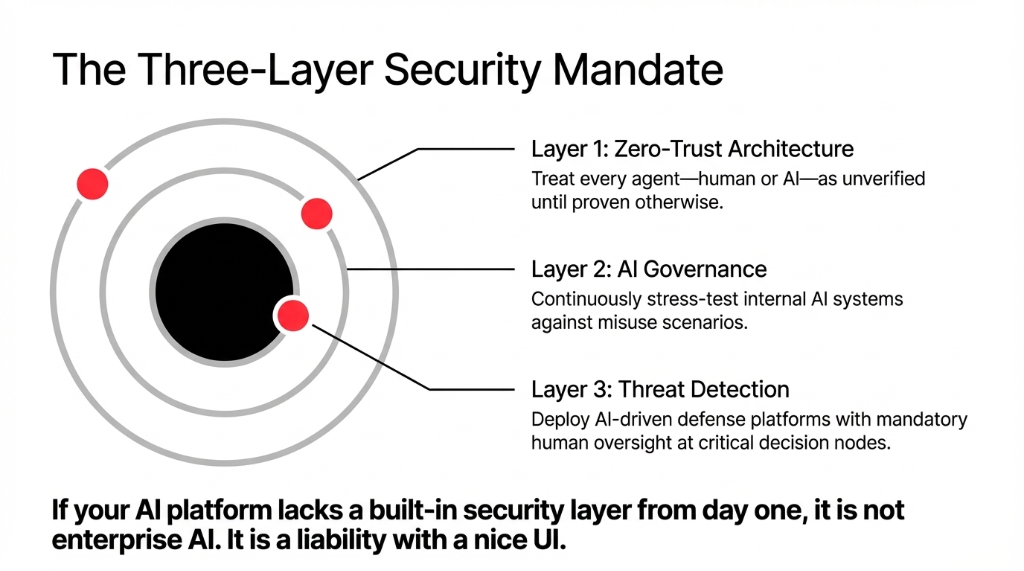
AI-driven cyberattacks now compress breach timelines from weeks to minutes. Enterprises need AI-powered threat detection with mandatory human oversight, zero-trust architectures, and governance layers that continuously test AI systems against misuse. Every agentic deployment is a potential attack surface — security reviews must happen before go-live, not after the first incident.
Stop Running AI Pilots That Die in a Slide Deck.
If your business is still mapping out "where to start" with enterprise ai, we will find your biggest operational bottleneck in the first 15 minutes — guaranteed. Braincuber has done this for 500+ companies across the US, UK, and UAE. We know exactly where the $23,000-a-month operational leaks are hiding. The companies who booked this call in Q1 are already running production AI. The ones who waited are still scheduling alignment meetings.