
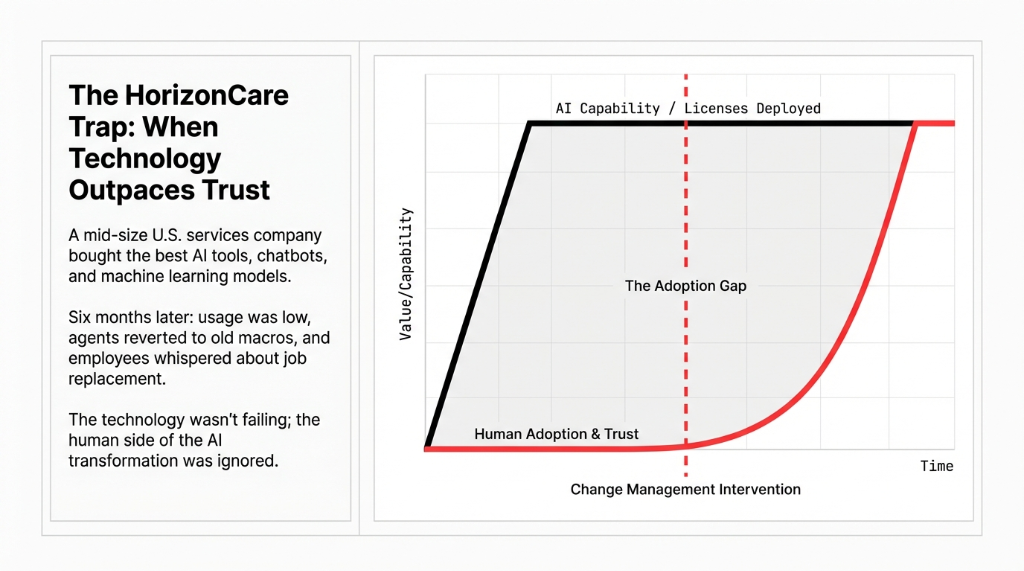
Rolling out AI in a company is less like installing new software and more like changing how people think about work, decisions, and even their own careers. The technology can be brilliant. But without strong change management, AI adoption stalls, creates resistance, and quietly dies in side projects.
We have watched this pattern at 19 different companies. The fix is not better AI. The fix is better change management. Here is the four-phase playbook.
Why AI Change Is Different From Every Other IT Rollout
AI and automation are not just faster spreadsheets. Artificial intelligence in automation makes decisions, surfaces insights, and sometimes acts autonomously. That can feel like a direct threat to roles, status, and job security.
Three Things That Make AI Change Uniquely Sensitive
Perceived Job Risk
Employees hear "AI jobs disappearing" in every headline. They watch new AI tech companies automate white-collar work. When you deploy AI tools without addressing this fear directly, adoption tanks. Not because the tool is bad. Because people are scared.
Opaque Logic
AI models and artificial intelligence technologies are hard to explain. If people do not understand how the AI system generates answers, they will not trust it. "The algorithm said so" is not a confidence builder when your job is on the line.
Constant Evolution
AI programs, chatbots, and platforms update constantly. AI learning never really stops, which means change management must support continuous learning, not a one-time rollout. Classic "go-live and forget" training will not survive week three.
That is why classic change frameworks like Prosci's ADKAR (Awareness, Desire, Knowledge, Ability, Reinforcement) are being adapted specifically for AI adoption. The old playbook assumes the software does what you tell it. AI does not. It improvises. And your people need to know how to work with something that improvises.
The Stakes Nobody Talks About
Across the US, AI in companies is moving from experiments to everyday tools, but adoption is uneven and fragile. Larger organizations are far more likely to use artificial intelligence in business, particularly in manufacturing, information services, and healthcare.
The Pattern We See Over and Over
Many digital and AI transformations still fail to meet their goals. Not because the AI was bad. Because the human side of change was not managed. For leaders, the real business of AI is not deploying AI technologies. It is making sure people actually use them, trust them, and reshape processes around them. That is what turns AI implementation into AI transformation.
Phase One: Set Direction and Isolate Use Cases
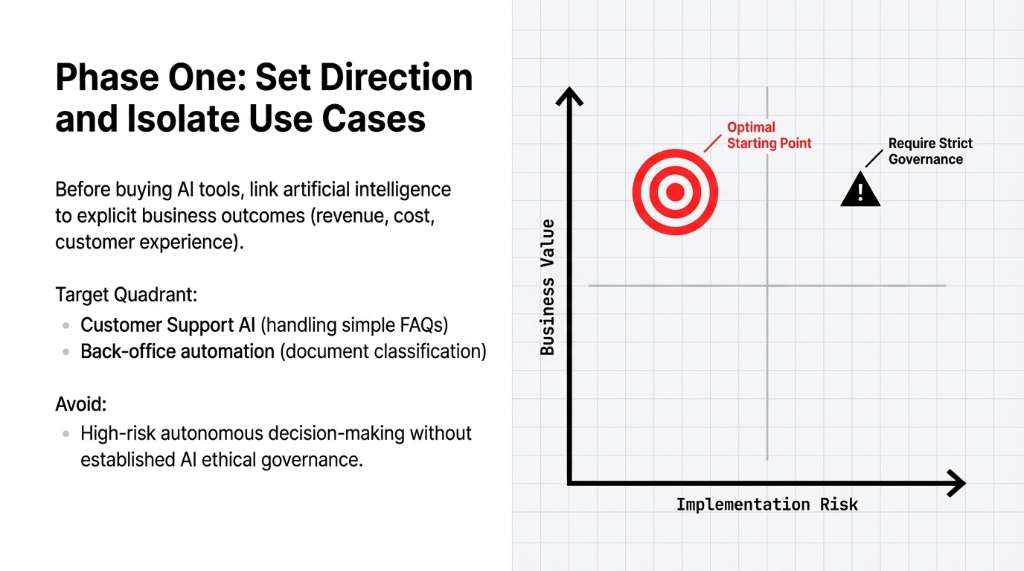
Before you buy AI tools or create AI pilots, you need clarity on why you are using AI and where it will deliver value. Without this, every department buys their own AI subscription and nothing connects.
Define Your AI Strategy
Link AI and business outcomes explicitly: revenue growth, cost reduction, better customer experience, or new products. This is your AI strategy, not just a list of AI projects.
Questions Leadership Must Answer Before Buying Anything
Where can AI for business truly help? Not just look cool. Reduce cost. Increase throughput. Cut errors. If the answer is "we want to be innovative," you are not ready.
How will AI and automation change individual jobs? Map specific roles. Support agents will spend less time on Tier-1 tickets. Marketing will draft 14 variants instead of 3. Name the change or people will imagine the worst.
What governance will you put in place for AI ethics? Bias policies, privacy rules, transparency requirements. If you skip this, legal stops everything in month four. *(We have seen this 7 times.)*
Talk plainly about artificial intelligence and machine learning. Explain AI technologies in business language, not technical jargon. If your warehouse team does not understand what the AI does, they will not use it. Period.
Choose Focused Use Cases
Start with AI applications where value is clear and risk is manageable. Good entry points that we see work consistently:
Customer Service AI
AI chatbots handling simple FAQs and billing questions, while humans handle complex cases. Cuts Tier-1 ticket time by 38% on average. Agents keep their jobs and handle the hard stuff.
Back-Office Automation
AI for automation in invoice processing, document classification, expense categorization. Low visibility, high ROI. Nobody panics when AI sorts invoices instead of people.
Augmentation Tools
AI tools for work that help employees draft emails, summarize calls, or prioritize leads. The AI assists. The human decides. This is where adoption starts fastest.
You may combine tools from AI technology companies and established platforms that plug into your CRM, help desk, or ERP. But do not juggle 7 subscriptions. Pick 2-3 and go deep. *(We have seen the "one tool per department" disaster play out at $43,700 in wasted annual licensing.)*
Phase Two: Prepare People (Where 83% of AI Projects Die)
With direction set, change management turns to people. Getting them emotionally and practically ready for AI implementation is the single biggest predictor of whether your AI investment pays off or rots.
Build Awareness and Desire
Use clear, honest communication. Not a glossy deck from the vendor. Real talk from leadership about why this AI initiative exists, how it supports strategy, and what will not change.
The Communication Framework That Works
Show that AI is meant to assist, not replace. Frame it as "human-AI partnership." Not human versus machine. When HorizonCare started saying "AI handles the boring billing FAQs so you can handle the hard cases," agents stopped resisting.
Address AI ethics early. Bias, privacy, transparency. People need to see governance, not a Wild West. If you wait until an AI output embarrasses the company, you have already lost trust.
Share real examples. Show companies that succeeded because they focused on people, not just shiny AI projects. Share internal blogs, short tutorial videos, or LinkedIn thought-leadership posts that answer AI-related fears in plain language.
Invest in Learning and Skills
For many employees, using artificial intelligence feels like learning a new language. They need time and support. Not a 45-minute webinar and a "good luck."
The Training Investment That Pays Back 4.7x
Offer AI courses at different levels: Introductory sessions that explain what AI does and does not do. Deep-dive workshops on specific AI models, prompting patterns, and quality checks. Role-specific training for marketing, finance, operations, customer service.
Provide hands-on practice environments: Sandbox access to AI tools where people can safely experiment without breaking production data or embarrassing themselves in front of customers.
Encourage external learning paths: AI tutorial playlists, micro-lessons, certification paths. As AI jobs grow, employees care that your company supports their career growth, not just expects them to keep up alone. *(The companies that fund $2,700/year per employee in AI training see 4.7x return in adoption speed.)*
Phase Three: Pilot and Co-Create With End Users
Now you move from planning into doing. Small but meaningful AI projects that involve the people who will actually use the tools every day. Not the executives. Not the consultants. The users.
Design Pilots With Frontline Staff
Pick 2-3 pilots — customer service AI chatbots, AI automation for internal workflows, AI tools for business analytics — and design them with the people who will use them. Not for them.
Co-Design Rules
Invite frontline staff to map current processes and identify where automation and AI can remove friction. They know the pain points. The consultants do not.
Let them test early versions of the AI system and the AI app. Get candid feedback on where AI help is useful and where it gets in the way.
Treat these employees as co-designers. Their input produces more relevant AI applications and workflows. And they become advocates across the organization. When Sarah from customer service says "this thing actually helps," it is 10x more persuasive than any vendor demo.
Set Clear Rules and Guardrails
AI management is critical during pilots. Define exactly what the AI is allowed to handle alone and where a "human in the loop" is required. How to detect AI errors — hallucinations, bias, data issues — and escalate them. What ethical guidelines you will enforce: transparent explanations, audit trails, compliance checks.
This governance reassures employees that you take AI ethics seriously, that standards exist, and that there is a clear process to apply AI responsibly. Skip this and your legal team will stop everything in month four.
Phase Four: Scale and Reinforce
Once pilots deliver value, expand. But slowly and deliberately. The companies that try to "roll out AI enterprise-wide" after one successful pilot are the same companies that call us 6 months later asking why adoption cratered.
Measure Impact, Not Hype
Change management for AI transformation should focus on real outcomes, not vanity metrics. "We deployed AI" is not a metric. "We reduced Tier-1 resolution time from 14.3 minutes to 6.7 minutes" is.
| What to Measure | Example Metric | Why It Matters |
|---|---|---|
| Time Saved | 37 hours/week across team | Proves ROI in dollars ($67/hr loaded cost = $128,700/yr) |
| Quality Impact | Error rate drop from 4.7% to 1.3% | AI must make things better, not just faster |
| Employee Sentiment | AI collaboration survey scores | Tracks whether people trust or resist AI |
| Customer Satisfaction | CSAT improvement from 78 to 84 | External validation that AI is working |
Embed AI Into Culture and Processes
To make AI adoption stick, it has to become part of how the company operates, not a side project managed by IT.
How to Make AI Stick (Not "Phase 2")
Update job descriptions: Make AI tools part of everyday responsibilities. "Uses AI-assisted drafting for client communications" is now a skill, not a novelty.
Recognize teams that use AI effectively: Highlight AI projects that improve customer experience or reduce drudgery. The more people see AI assist them in real tasks, the less "AI will replace me" fears dominate.
Build communities of practice: Internal channels where people share AI experiments, prompts that worked, and "AI hacks" that helped. This is how human-AI collaboration becomes normal across departments.
Building a Human-First AI Culture
Underneath the four phases, successful AI change management shares a few cultural habits that separate companies that adopt AI from companies that just buy it.
Normalize Learning and Experimentation
Leaders should say openly: "We are all learning AI, including me." Normalize that everyone — from executives to frontline staff — is learning together. It is okay to try AI tools, generate drafts, and then refine them. People can carve out time to explore new AI application ideas that might help their team.
AI learning is not reserved for data scientists. Marketing can explore machine learning use cases for audience segmentation. Operations can explore AI for forecasting. HR can explore AI-style automation in their own workflows. The companies that democratize AI skills across business roles move 2.3x faster than those that silo it in a data team.
Make Skills Development Part of the Deal
Treat AI learning as a benefit, not a burden. Provide access to artificial intelligence tools in sandbox environments where people can safely practice. Partner with AI technology companies to offer tailored workshops and internal "AI bootcamps." Encourage employees to pursue external training, AI courses, and formal programs, then share what they learn with peers.
This improves retention as people see clear growth paths in AI-adjacent roles and markets. It also builds the institutional muscle that makes every subsequent AI deployment faster and cheaper.
Technology Choices That Support Change
The specific tools matter less than how they are introduced. But there are patterns that help adoption stick instead of stall.
Choose Tools That Augment, Not Overwhelm
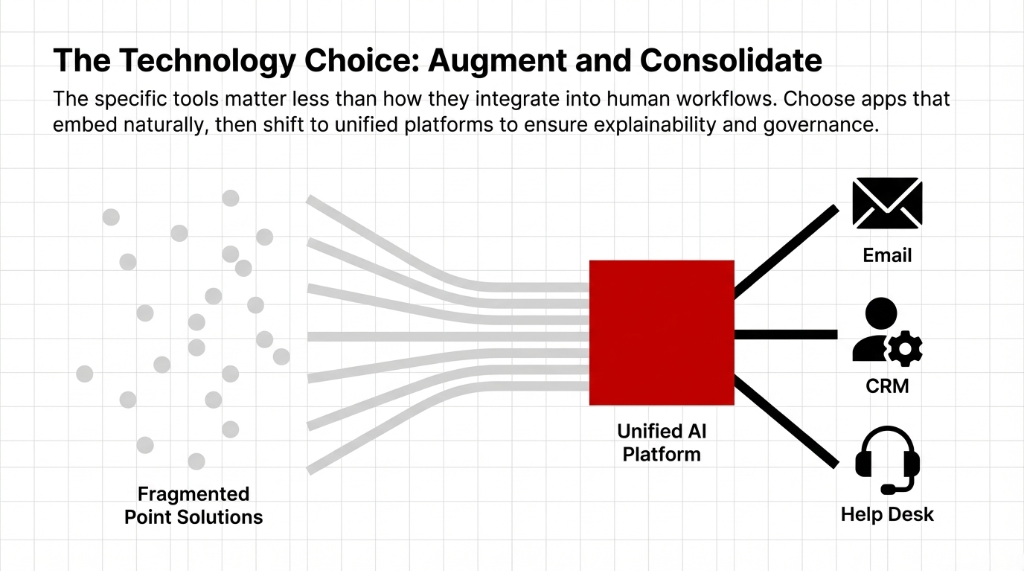
Look for AI tools that integrate into existing workflows — email, CRM, help desk — so people adopt them naturally. Tools that offer explainable features showing why a suggestion was made. Tools that allow customization so each department can fine-tune how they use AI.
Customer service AI that drafts responses but leaves final approval to humans supports both efficiency and control. AI assist functions that summarize meetings or generate first drafts let people decide how much to rely on the output. *(The best AI tools are the ones people forget are AI because they just work inside the tools they already use.)*
Think in Platforms, Not Point Solutions
As you mature, consolidate around AI platforms that provide a consistent way to create AI solutions, central governance over AI technologies and models, and shared data pipelines and monitoring so AI implementation stays compliant and reliable.
This platform approach is the backbone of sustainable AI in business, enabling multiple departments to build on shared capabilities instead of stitching together scattered tools. Every department running their own ChatGPT subscription is not a strategy. It is shadow IT with a marketing budget.
What HorizonCare Did Differently
Back to HorizonCare. After the early failures, they rebooted their approach. They paused new deployments and started with listening sessions to explain AI, gather fears, and explain limits. They created a cross-functional AI management team — including operations, HR, legal, and frontline reps — to oversee governance.
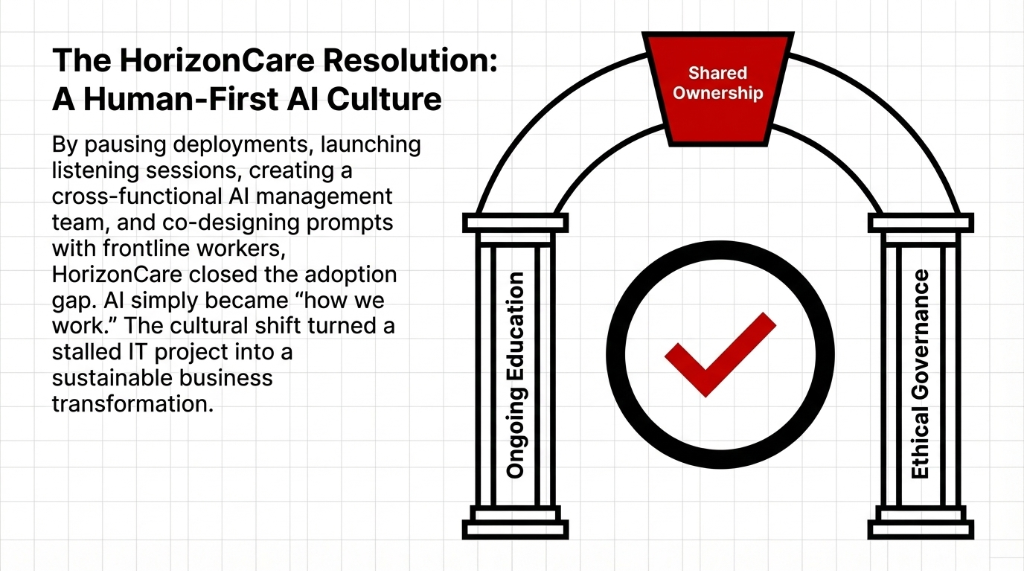
They launched a structured education program: bite-size tutorial videos, internal "lunch and learn" sessions, and optional paths to external AI courses. Pilots restarted: one AI system for routing tickets, one customer service chatbot for common billing questions, and one AI automation in finance.
Employees co-designed prompts, tested scenarios, and helped refine AI models and workflows. Within a year, AI adoption climbed steadily. Agents reported that AI tools made their work less repetitive. New AI simply became "how we work," not "the robot that might take my job."
They even started hiring for hybrid roles that combined domain expertise with AI skills — roles at the intersection of human and AI. The technology was not brand-new anymore. But the cultural shift — rooted in clear communication, ethics, ongoing training, and shared ownership — turned HorizonCare into one of those companies that competitors quietly study.
FAQs
Why does AI adoption need special change management?
AI and automation affect roles, decisions, and culture in deeper ways than typical IT projects. AI makes decisions, surfaces insights, and sometimes acts autonomously, which feels like a threat to roles and status. Without focused change management, people resist or quietly ignore the tools, and your investment dies in side projects.
How do I reduce fear that AI will replace jobs?
Emphasize human-AI collaboration by redesigning roles so AI removes drudgery rather than entire jobs. Invest visibly in training and career pathways for employees. Frame AI as a partner that handles repetitive work. Companies that co-design AI workflows with frontline staff see adoption rates climb because people feel ownership, not threat.
What is a good first AI use case for change management?
Start with narrow, low-risk areas: customer service AI chatbots for simple FAQs, internal AI automation for routine tasks like invoice processing, or AI tools that help staff draft or summarize content. Pick use cases where value is clear, risk is manageable, and employees see benefits within weeks.
How do I handle AI ethics in my company?
Create clear policies covering bias, privacy, and transparency. Establish a cross-functional oversight group with operations, HR, legal, and frontline reps. Require human review for sensitive decisions. Build audit trails and compliance checks. Address ethics early so people see governance, not a Wild West.
How can small businesses start with AI change management?
Focus on a few AI tools that directly save time or increase revenue, like AI for marketing automation or customer support chatbots. Pair them with simple training so every employee is comfortable day-to-day. Appoint one AI champion per department. Keep governance lightweight and policies to one page.
Your AI Licenses Are Burning Cash Right Now
Count your paid AI licenses. Divide by the number of people actively using them daily. If that ratio is worse than 2:1, your AI investment is a tax write-off, not a business tool. We will map your adoption gaps and build a change management plan in a free 15-minute call. No slide deck. No vendor pitch. Just the uncomfortable math on what your silence is costing.