
If you run a US logistics business on thin margins, AI inside Odoo is not a buzzword. It is the difference between surviving and dominating next year. This guide walks through exactly how we use AI plus Odoo to slash logistics costs, reduce lead time, and fix the broken parts of the supply chain.
The ugly math of US logistics margins
Look at your last P&L. Transportation, labor, and warehousing are eating everything. Customers keep demanding faster delivery and lower rates.
Meanwhile, AI in inventory management is helping operators reduce logistics costs by 15.3%, drop inventory levels by 34.7%, and improve service levels severely.
When we audit US supply chain companies, we see the pattern. You have the data, but no real-time intelligence on top of Odoo.
How one US 3PL stopped bleeding cash
Let's start with a real disaster we fixed. A midwest 3PL doing $37,800,000 a year was running Odoo. They still used Excel to guess labor needs and suffered every peak week.
Their broken reality
▸ Inventory days bouncing between 12 and 41
▸ Inventory turn stuck at 4.2 while competitors sat at 7.3
▸ Lead time promises missed by 18-36 hours
After we wired AI directly into Odoo and the warehouse flows, three metrics changed in 90 days:
- Turnover moved from 4.2 to 6.1 without new racks.
- Late orders dropped by 63.4% across their largest client.
- Freed $412,500 in dead stock across "just in case" SKUs.
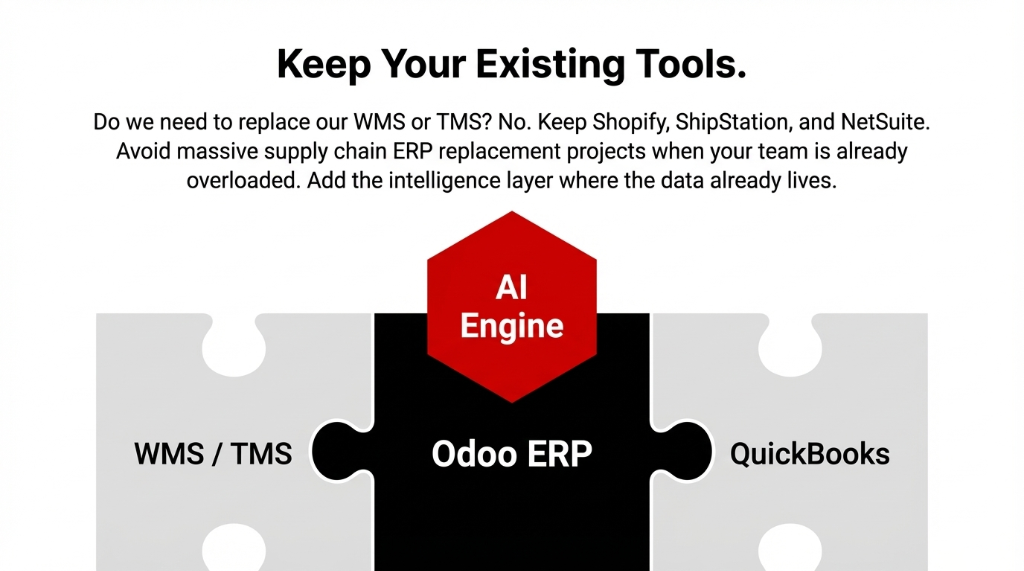
None of that required a massive supply chain ERP replacement. We connected AI models to the Odoo data they already owned.
Drowning in buzzwords instead of fixing reality
Your problem is not ignorance. You've sat through pitches about "supply chain synergy" and generic operations management fluff.
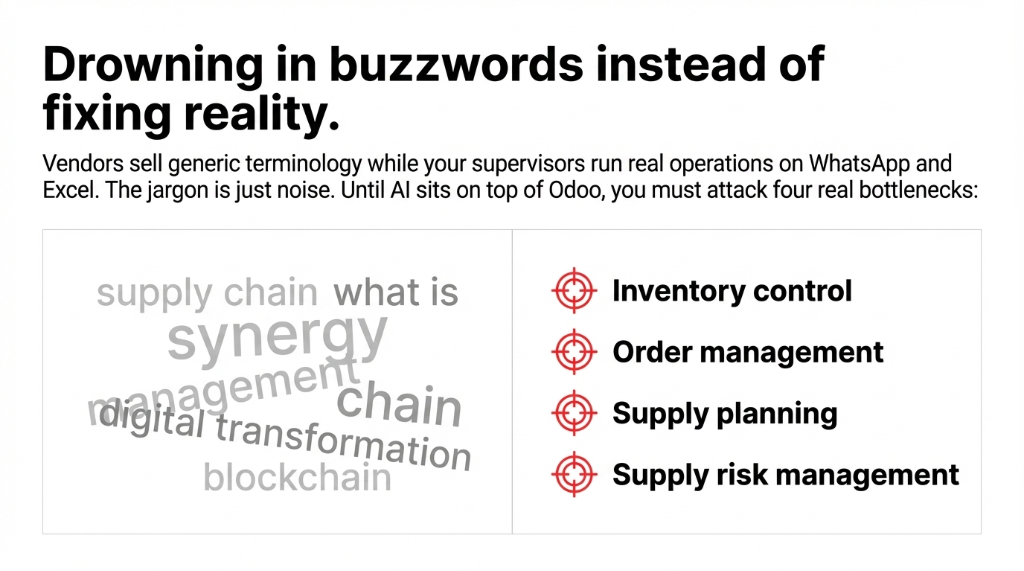
Nobody fixes the actual supply chain software screens where your planners live. Our view is blunt.
Until AI sits on top of Odoo and attacks real bottlenecks, the jargon is just noise.
Where AI actually pays off inside Odoo
1. AI + Odoo as your cash control room
Odoo gives you real-time tracking, but adding an AI layer cuts stock costs massively.
▸ Predict inventory days and suggest safety stocks by SKU-location using past orders.
▸ Highlight customers destroying stock turnover averages.
The Shift
Insight: Don't rely on static min/max rules. AI proposes replenishment dynamically.
Saved Hours: 37 hours/week
2. Transport and last-mile routing
Fuel and driver hours burn your margin. Stop reacting to disruption and build resilience.
▸ Feed Odoo shipment data into models to detect chronic delay risk.
▸ Provide AI-backed route suggestions instantly to dispatch.
3. Planning and control tower
Stop treating Odoo as a passive database. Make it an active supply chain intelligence engine.
▸ Run AI demand forecasting on Odoo sales channels instead of moving averages.
▸ Implement a control tower to catch lead time slips before carriers alert you.
The True Value of Active ERP
Demand
Accurate labor planning
Replenish
AI-driven purchase rules
Risk
Early delay detection
The part nobody tells you: Data and People
The biggest blockers are not algorithms. They are messy data and burned supervisors who hate new software fads.
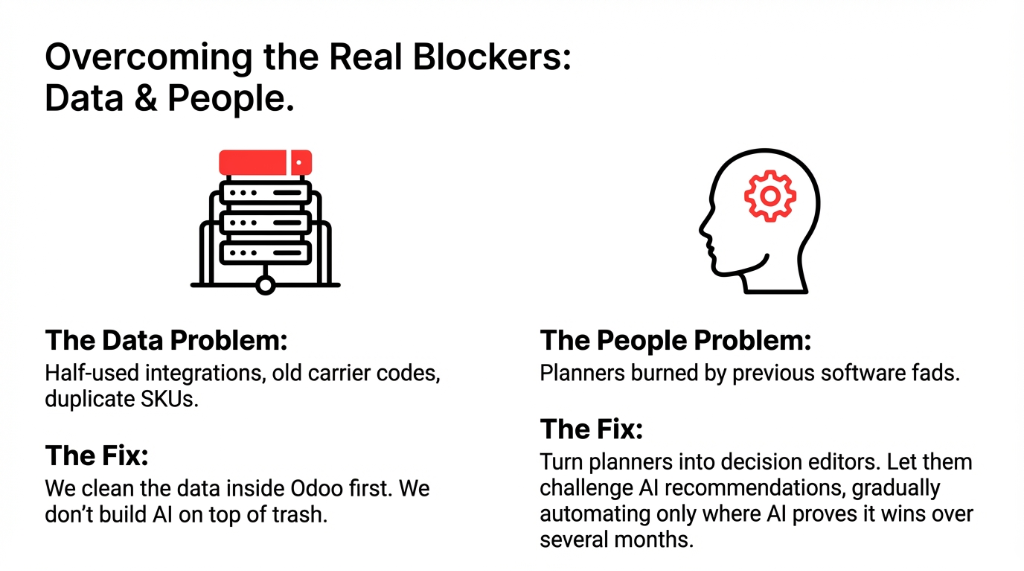
We clean the data inside Odoo first. We refuse to build AI on top of trash.
Then, we let planners challenge the AI. They gradually automate what wins.
How we roll this out safely
We do not rip out NetSuite, Shopify, or your TMS. We weave Odoo integrations efficiently.
1. 90-minute diagnostic on live Odoo data.
2. 8 to 12 week targeted pilot on one warehouse or high-value client.
3. Scale out and automate only after proving hard numbers.
Quick FAQs for US logistics leaders
How fast can we see results from AI on Odoo?
Usually within 8-12 weeks on a focused pilot, improving lead time accuracy directly.
Do we need to replace our current WMS or TMS?
No. Keep your existing stack. Adding an AI layer over Odoo works without full replacements.
Stop Bleeding Cash Today
Book our free 15-Minute Operations Audit. We will point to your biggest margin leak immediately, whether you hire us or not.