
The Real Cost of AI-Blind Tax Planning
The IRS rolled out inflation-adjusted income tax thresholds that most finance teams still have not processed into their budget models. The 2026 standard deduction jumped to $16,100 for single filers and $32,200 for married filing jointly — up from $15,750 and $31,500 in 2025.
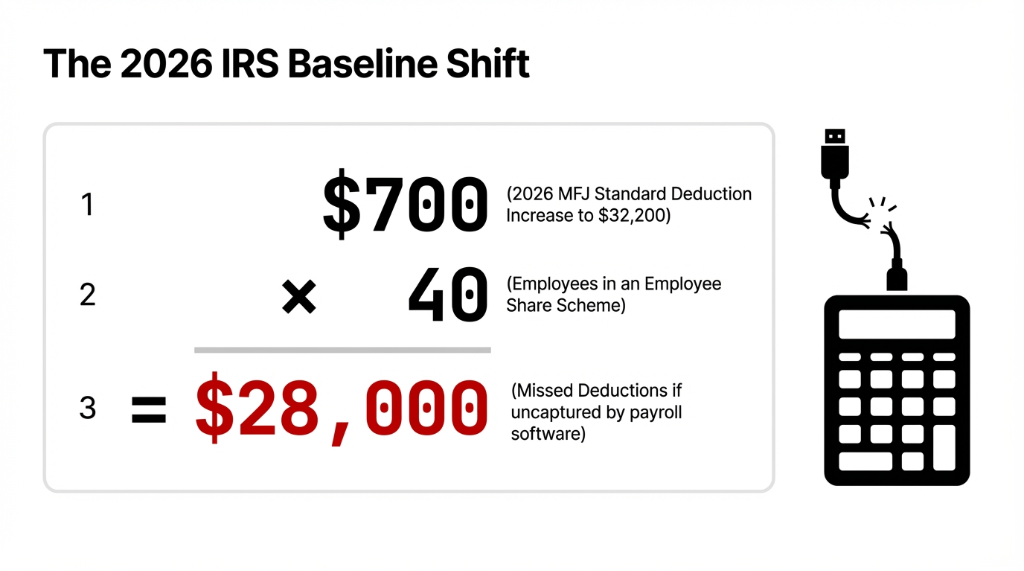
That $700 bump sounds small. Multiply it across 40 employees in an employee share scheme, and you are looking at $28,000 in missed deductions your payroll software did not catch.
| Tax Rate | Taxable Income (MFJ) — 2026 |
|---|---|
| 10% | $0 – $24,800 |
| 12% | $24,801 – $100,800 |
| 22% | $100,801 – $211,400 |
| 24% | $211,401 – $403,550 |
| 32% | $403,551 – $512,450 |
| 35% | $512,451 – $768,700 |
| 37% | $768,701+ |
Your AI budget plan for FY 2026-27 must account for where your business income lands on this income tax scale — because moving $18,000 in AI software spend from Q4 to Q1 can drop you from the 32% bracket to the 24% bracket. That is a real $14,400 tax reduction on a $200,000 income swing. Most CFOs do not model this. We do.
Why Your Current AI Budget Framework Is Wrong
Stop treating AI spending as a tech line item. That is a $23,000-a-year mistake for any company with over $3M in annual revenue.
The 3 Things "Just Expense All AI Tools" Ignores
1. Short-term capital gains tax exposure from AI-generated investment decisions and automated trading modules. Your robo-advisor made $47,000 in gains? That is taxed at your ordinary income rate — up to 37%.
2. Employee tax implications under PAYE tax setups versus contract-based AI vendor payments. Misclassifying contractors as vendors changes your employer payroll tax exposure by thousands.
3. Post-tax deductions that turn a $50,000 AI platform fee into a net $34,500 cost at the 31% effective rate. If you are not modeling this, you are overstating your AI cost by 31%.
Gartner projects global IT spending to surpass $6 trillion in 2026, with AI taking the lion's share. Companies allocating 25%+ of their IT budget to AI are expected to jump from 27% to 52% this year. BCG's 2026 AI Radar Survey of 2,360 executives found companies plan to spend 1.7% of revenue on AI — more than double the 0.8% in 2025. But 53% of companies report only 1-5% ROI. If your competitors are writing off AI smarter than you, they have a direct tax advantage you are not seeing.
The AI Budget-Tax Strategy (5 Steps)
Step 1: Classify AI Spend Against the Right Tax Category
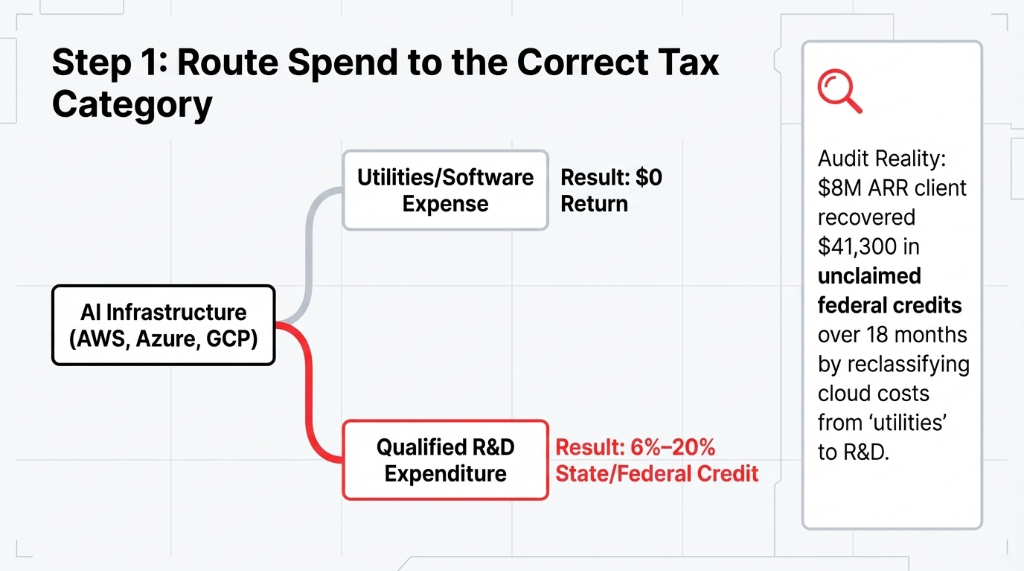
AI infrastructure (AWS SageMaker, Azure ML, GCP Vertex AI) qualifies for R&D tax credits in many states. This is not income tax trivia — it is a real 6%-20% credit on qualified AI R&D expenditure. We had a client in the $8M ARR range recover $41,300 in federal credits they had left unclaimed for 18 months because their QuickBooks setup tagged all cloud costs as "utilities."
Step 2: Time AI CapEx Against Capital Gains Events
2026 Long-Term Capital Gains Tax Rates (MFJ)
0% rate: Taxable income up to $98,900. If your employee share scheme participants fall under this threshold after AI deductions, their long-term gains are tax-free.
15% rate: Taxable income up to $613,700. This is the range where most mid-market founders land. Where your taxable income lands after AI deductions determines which CGT rate you pay.
20% rate: Above $613,700. If you are in this bracket, timing AI capital expenditure against capital gains events can save tens of thousands. A $200,000 AI investment timed correctly can shift you from the 20% to the 15% bracket — saving $10,000 on every $200,000 in long-term gains.
Step 3: Fix Payroll Tax Exposure Before Hiring AI Talent
2026 Payroll Tax: The Numbers That Changed
Social Security
6.2% each for employer and employee on wages up to $184,500 (up from $176,100 in 2025). Maximum payroll tax per employee: $11,439. That is an increase of $520.80 per head.
Medicare
1.45% each, no wage cap. Additional 0.9% employee tax on wages above $200,000. Three AI engineers at $185,000 salary each? Your employer payroll tax exposure increased by $1,572 per head compared to last year.
The Real Number
$4,716 in additional payroll taxation for three AI hires you need to budget for. FUTA stays at an effective 0.6% on the first $7,000. But the Social Security wage base increase is the one that bites.
Step 4: Model Dividend Tax Exposure From AI Investment Tools
AI-driven robo-advisors and tax investment platforms are generating dividend taxable income faster than accountants can track it. The tax rate on dividends in 2026 mirrors the long-term capital gains rate structure — 0%, 15%, or 20% — but most automated platforms do not issue correct 1099-DIV classifications. We have seen clients overpay $8,700 in dividend tax in a single year because their AI investment tool miscategorized reinvested dividends.
Step 5: Budget for AI Tools That Actually Reduce Your Tax Burden
AI Tools That Pay for Themselves in Tax Savings
Bloomberg Tax AI — Monitoring new tax laws and tax reforms in real time. Critical given the One Big Beautiful Bill Act currently reshaping income tax in the United States.
Agentic AI platforms (LangChain, CrewAI frameworks) — Automating income tax forms preparation and flagging bracket-shifting opportunities across the income tax scale.
AI-powered Odoo ERP modules — Connecting payroll and taxes, employee share scheme accounting, and tax deduction tracking into a single dashboard. Cutting reconciliation time from 14 hours/month to under 2 hours.
What the Numbers Look Like When You Do This Right
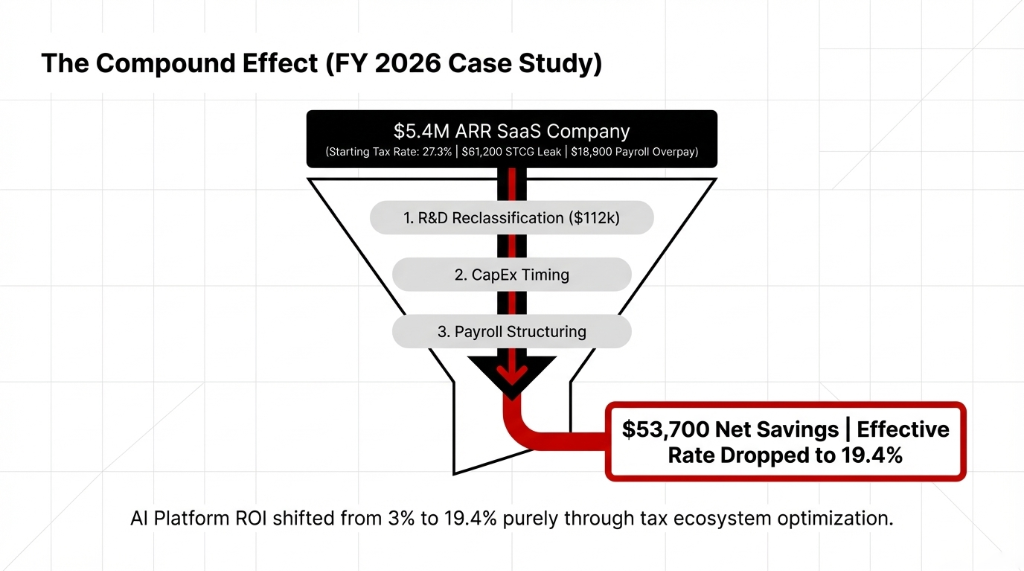
We ran this framework for a US-based SaaS company at $5.4M ARR last quarter.
Before AI-Aligned Budget Planning
Effective income tax rate: 27.3%
Short-term capital gains tax: $61,200 from poorly timed stock liquidations
Overpaid payroll tax: $18,900 due to misclassified contractor payments
After Restructuring
$112,000 in AI spend reclassified as R&D
Long-term capital gains timed against the 15% threshold
Total savings: $53,700 — AI platform ROI went from 3% to 19.4%
That is not magic. That is what happens when you stop treating business taxation as a compliance checkbox and start treating it as a budget variable. The tax system rewards planning. It penalizes ignorance with compound interest.
The Implementation Timeline (No Sugarcoating)
Month-by-Month Checklist
April-May 2026: Audit all AI tool expenses and reclassify against R&D, capital expenditure, or operating expense categories. Run your 2026 tax bracket scenario models now.
June-July 2026: Lock in your employee share scheme structure for H2. Decide whether to accelerate or defer long-term stock gains based on projected Q3 income.
August-September 2026: Review payroll deductions setup as new AI hires come onboard. Confirm PAYE tax and post-tax deduction configurations are updated for the $184,500 SS wage base.
October-November 2026: Run a mid-year tax reconciliation. Check whether AI platform spend qualifies for tax-free allowance thresholds under applicable state rules.
December 2026-January 2027: Execute remaining capital gains harvesting strategies before year close. Confirm short-term capital gains tax bracket exposure. Decide whether to hold or sell appreciated assets. *(Yes, this is the actual checklist — not the sanitized version your tax software gives you at year-end.)*
FAQs
What is the capital gains tax rate in the USA for FY 2026-27?
Long-term: 0% up to $98,900 taxable income (MFJ), 15% up to $613,700, 20% above that. Short-term capital gains are taxed as ordinary income — up to 37% at the top bracket.
How does AI spending affect my taxable income in 2026?
AI software, cloud infrastructure, and agentic AI tools can be expensed as R&D or operating costs, directly reducing taxable income. A $100,000 AI platform at the 24% bracket generates $24,000 in real tax savings. Classification under the right IRS category is what matters.
What are the 2026 payroll tax rates for US employers?
Social Security: 6.2% each on wages up to $184,500 (max $11,439 each). Medicare: 1.45% each, no cap. FUTA: 0.6% on first $7,000. Additional 0.9% Medicare on employee wages above $200,000.
How much should a business budget for AI in FY 2026-27?
BCG found companies plan to spend 1.7% of revenue on AI in 2026. Financial services leads at 2.0%. But 53% of companies report only 1-5% ROI, meaning most spend without a tax or operational framework.
What is the standard deduction for 2026?
$16,100 for single filers. $32,200 for married filing jointly. Up from $15,750 and $31,500 in 2025. Taxpayers 65+ get an additional $2,050 (single) or $1,650 (married).
Stop Losing Money on AI That Should Be Paying You Back
The tax percentage on capital gains, the updated income tax thresholds, the revised payroll tax structure — none of this is theoretical. Every dollar you misclassify in your AI budget is a dollar you have donated to the IRS. We offer a free 15-minute AI Budget & Tax Strategy Audit. In the first call, we will find exactly where your FY 2026-27 AI spend is misaligned with your tax strategy — and give you a specific number for what it is costing you.