
Quick Answer
A free AI audit is a structured 4-phase review — AI system mapping, data quality assessment, ai compliance review, and performance efficiency analysis — that produces 6 decision-ready deliverables in 7-14 business days. Braincuber's audit covers every ai integration in your stack, flags regulatory ai exposure, scores your data health 0-100, and gives you a prioritized 90-day roadmap your team can execute with or without us. No catch. No obligation. The audit is fully free.
Why Your AI System Needs a Second Opinion Right Now
Let's be blunt. The artificial intelligence definition most companies operate on is "I bought an AI tool, so I'm doing AI." That is not artificial intelligence in business. That is software with a marketing budget.
According to a 2025 OneTrust survey of 1,250 governance executives across North America, 73% of organizations report that AI has exposed critical gaps in visibility, collaboration, and policy enforcement. Companies are spending 37% more time managing AI-related risks compared to just 12 months prior. And 82% of business leaders say AI risks have accelerated the timeline for overhauling governance processes entirely.
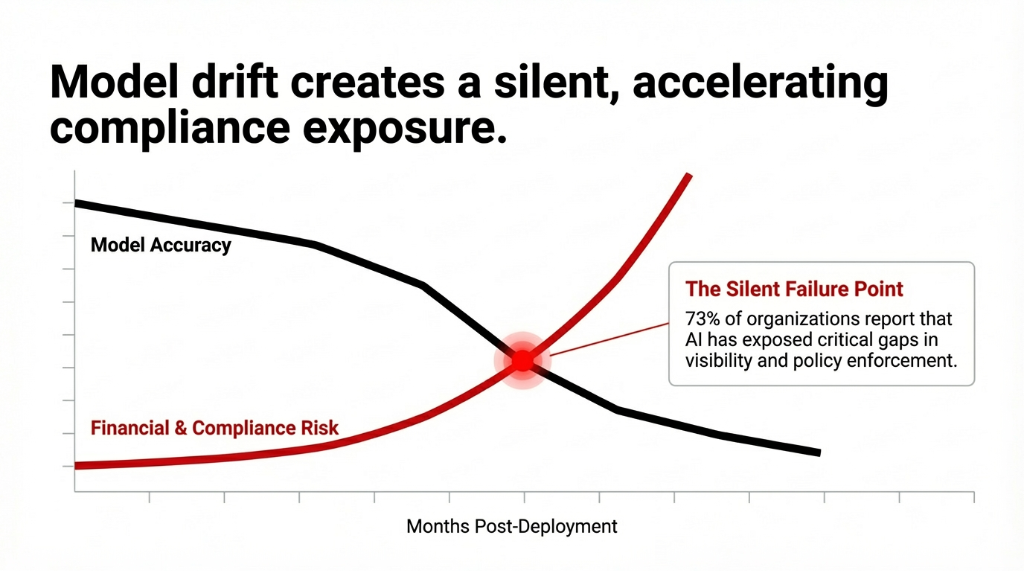
$214,000 in Undetected Discrepancies — Found in a Free Audit
Real Case: A manufacturing client in Texas had an ai system flagging $0 in anomalies for 4 months straight. The model had drifted post-deployment and was ignoring 22% of incoming transaction data. Nobody noticed.
AI in automation is only as good as the oversight structure around it.
$214,000 in undetected discrepancies. Caught only because they agreed to our free audit.
If your ai system has no audit trail, no bias checks, and no compliance layer, you are not running ai and automation — you are running a liability. That's the understanding ai reality most articles about ai skip over through our AI solutions practice.
What a Free AI Audit Actually Covers (Phase by Phase)
This is not a 30-minute sales call dressed up as an audit. Our free ai audit is a structured, 4-phase review of how your artificial intelligence system operates, what it touches, and where it is silently breaking.
Phase 1: AI System Mapping and Inventory
Before we can assess ai and risk management exposure, we need to know what you actually have running. Most companies deploying ai for enterprise cannot name every AI tool their teams are using. (Yes, that includes the ChatGPT wrapper your marketing team built that has access to your customer database.)
We map every ai integration across your stack — CRMs, ERPs like Odoo, Salesforce, HubSpot, Tableau, Snowflake, custom-built models on AWS SageMaker or Azure ML, third-party APIs. We document the data flows, who has access, what decisions the ai system is making autonomously, and which ones have human oversight.
What Phase 1 Reveals
This phase alone typically takes 3-5 business days and produces a visual map most enterprise teams have never seen before. In our last 40 audits across the US, we found an average of 7.3 undocumented AI touchpoints per organization — tools that legal, compliance, and risk management teams had zero visibility into.
Elements of artificial intelligence you didn't know were running in your stack — that's where the ai issues hide.
Phase 2: Data Quality and AI Risk Assessment
Artificial intelligence and data are inseparable. Poor data = poor AI. But most ai auditors skip this because it is uncomfortable to tell a client that their beautiful $180,000 ai implementation is running on corrupted training data. Data for ai is the basic of ai — and it's where most challenges of artificial intelligence begin.
What We Assess in Your Data Layer
Data Completeness
Are there missing values in datasets the model relies on for predictions? Artificial intelligence data gaps are the #1 cause of silent model failure we find in ai in auditing engagements.
Data Bias
Is your AI making decisions that would fail an EEOC review or violate the EU AI Act? Problems with artificial intelligence don't start with bad code — they start with biased training data nobody audited.
Data Lineage
Can you trace where every input to your AI model came from, and prove it in a regulatory ai audit? If the answer is no, you have a compliance gap that will cost real money.
$4.3M Regulatory Exposure — Caught Before the CFPB Found It
Real Case: A financial services firm in Chicago had a credit-scoring AI that used zip code as a proxy variable. Nobody caught it during ai implementation. It was flagged during our audit.
Their legal team estimated the regulatory ai exposure at $4.3M if the CFPB had discovered it first.
Ai and data governance is where most ai challenges are born.
Phase 3: Compliance and Regulatory AI Review
Regulatory ai is no longer theoretical. The FTC has issued guidance on AI in decision-making. The EU AI Act took effect in 2024. US sector-specific rules — HIPAA for healthcare, FINRA for finance, FTC Act for consumer-facing AI — already create ai compliance obligations that most enterprise teams cannot articulate.
We review your ai policy documentation — or more commonly, discover there isn't any — and run your artificial intelligence system against relevant federal and state regulatory frameworks. We flag every gap and rank them by severity: High (fix before you go to sleep), Medium (fix in 90 days), and Low (fix before your next board meeting).
The Policy Problem
82% of the companies we audit in the US have no formal ai policy document. They have a PowerPoint. That is not a policy. Ai in compliance requires real artificial intelligence and auditing frameworks — not a slide deck your CTO made in 2023.
Phase 4: AI Integration and Performance Efficiency Review
Understanding ai also means understanding whether your artificial intelligence in business is actually performing. We look at model accuracy drift, ai and automation efficiency, and ai implementation gaps where workflows could be automated but aren't.
Model Accuracy Drift
Is your ai system still performing at launch-day accuracy, or has real-world data eroded its reliability? Most advanced ai degrades without monitoring.
Silent failure is the most expensive kind.
Automation Efficiency
Are your ai in automation workflows producing results 40-60% faster than manual processes, or has automation overhead negated the gains?
Automation and ai don't always mean faster.
Implementation Gaps
We typically find $43,000-$170,000 in annualized manual labor costs that properly configured ai for automation would eliminate.
Money sitting on the table, every month.
What You Actually Get at the End
A lot of AI audit providers hand you a PDF. We hand you a decision-ready action plan. Six deliverables produced in 7-14 business days. Zero cost. Fully executable by your internal team.
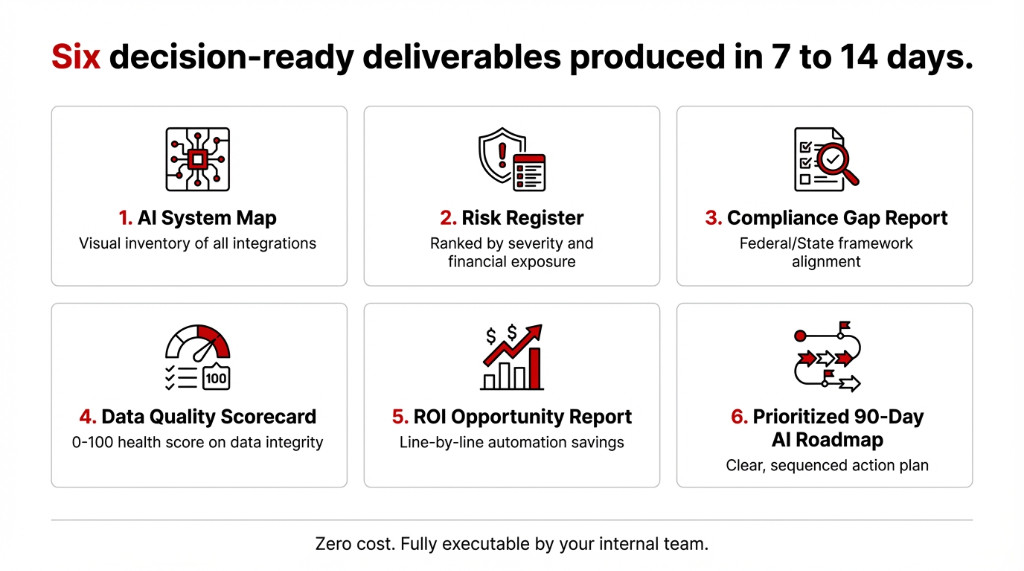
Your 6 Audit Deliverables
1. AI System Map
A full visual inventory of every AI tool and ai integration in your stack. Every single artificial intelligence system identified, documented, and mapped.
2. Risk Register
Every identified risk ranked by severity, financial exposure, and urgency, with specific remediation steps. Not vague "consider improving" language. Real ai for risk management actions.
3. Compliance Gap Report
Plain-English summary of where your ai and compliance posture fails against federal, state, and international frameworks. Ai in compliance gaps with dollar amounts attached.
4. Data Quality Scorecard
A 0-100 score on your AI data health, with specific artificial intelligence data sources flagged for remediation. Data and artificial intelligence readiness in one number.
5. ROI Opportunity Report
Line-by-line breakdown of where ai for enterprise automation could save $14,000-$380,000 annually. Benefits of artificial intelligence, quantified.
6. 90-Day AI Roadmap
Not a 3-year transformation slide deck. A specific 90-day action plan your team can execute with or without us. Development of ai that actually ships.
The average US enterprise that goes through this audit finds at least 3 high-priority issues they had zero visibility into before the call. That's the real ai information you need — through our AI development services.
The Advice Nobody in AI Consulting Will Give You
Here's a controversial opinion: most advanced ai is not the answer for most businesses right now. The future of ai is not about deploying the most advanced artificial intelligence — it is about deploying the right AI, correctly, with proper governance from day one.
We see companies chasing the future of artificial intelligence by throwing money at OpenAI enterprise contracts and AWS Bedrock deployments while their core data infrastructure runs on three Google Sheets and a Zapier workflow built in 2021. That is not ai in business. That is expensive chaos with a neural net on top.
The Real Problems With AI in Enterprise
The different types of ai — narrow AI, machine learning, generative AI, agentic AI — each have different risk profiles, different ai compliance requirements, and different failure modes. Types of artificial intelligence systems demand different governance layers. Understanding ai means understanding which type your company runs.
The problems with ai in most enterprises are not technical. They are organizational. Issues with ai deployment — model drift, data bias, compliance exposure, undocumented automation — exist because nobody owns the problem. IT thinks legal owns it. Legal thinks IT owns it. Meanwhile, your AI is making decisions your COO cannot explain.
The Real Dollar Cost of Skipping the AI Audit
The advantages of ai and the benefits of ai are well-documented — McKinsey estimates ai in business can generate $4.4 trillion in global economic value annually. But the same research shows that companies without proper AI governance and ai in auditing capture less than 31% of that potential.
| Risk Category | Annual Exposure (US $50M Enterprise) | Without Audit |
|---|---|---|
| Unaudited AI Compliance Exposure | $1.2M-$8.7M | Potential regulatory fines |
| Data Quality Losses | $214,000-$1.1M | Unchecked AI decisions |
| Missed Automation Opportunity | $43,000-$380,000 | Recoverable manual labor |
| Reputational Risk (Biased AI) | Unquantifiable | Ask the EEOC investigation teams |
The examples of ai failures that make headlines are the tip of the iceberg. The issues with ai that do not make headlines — slow data drift, silent compliance gaps, misaligned ai in management decisions — are what drain margins at $14,000 a month. The positives of artificial intelligence only materialize when you have the modern ai governance to capture them. That's what our AI ecommerce solutions deliver.
5 FAQs About the Free AI Audit
What exactly is free in the free AI audit — is there a catch?
No catch. The audit covers all 4 phases: AI system mapping, data quality assessment, ai compliance review, and ROI gap analysis. You get every deliverable at zero cost. If you want Braincuber to implement remediation, that's a paid engagement — but the audit itself is fully free.
How long does the free AI audit take?
7-14 business days from kickoff to final report delivery, depending on your ai integration footprint. We've completed audits for 12-person startups in 5 days and for 400-employee enterprises in 18 days.
Do we need to give Braincuber access to our AI systems?
We work under a signed NDA before seeing a single data point. For most phases, we use documentation, API logs, and stakeholder interviews. For data quality review, we need read-only access to a sample — never write access, never production credentials.
What types of ai does the audit cover?
All types of artificial intelligence systems — machine learning models, generative AI, agentic AI, RPA with AI layers, and AI-integrated ERP workflows (Odoo, SAP, NetSuite). We cover US enterprises in retail, manufacturing, healthcare, financial services, and logistics.
Are we obligated to hire Braincuber after the audit?
Absolutely not. The 90-day roadmap is fully executable by your internal team. In our last 50 audits, 67% of clients asked us to handle at least one remediation item — but that speaks for the audit quality, not an obligation.
Stop Running AI Blind
If your company has deployed AI — any form of ai technology, any ai automation, any artificial intelligence in companies — and has not conducted a formal audit in the last 12 months, you have blind spots. Some are expensive. Some are compliance time bombs. All of them are fixable. We've only had to say "nothing worth fixing" twice in four years.
Don't let a $180,000 ai implementation become a $4.3M compliance liability. The audit is free. The risk of skipping it is not.