
Why Your AWS Bill Looks Fine But Is Not
Here is the ugly truth about AWS cloud compute costs: the aws console makes it really easy to spend money and really hard to see where it went.
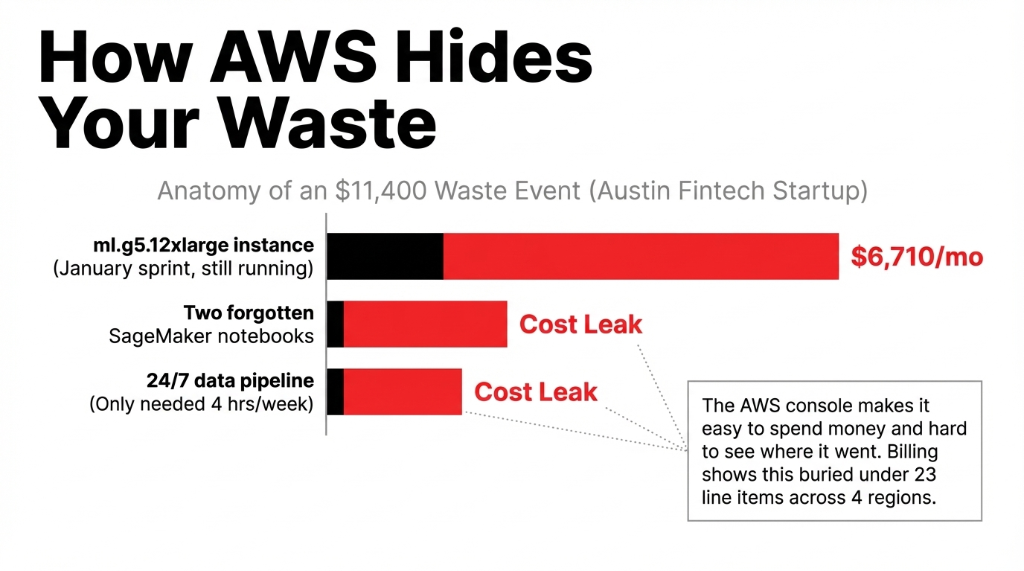
This is not a hypothetical. We saw this exact scenario last month with a fintech startup in Austin scaling from $2M to $8M ARR. They had three idle GPU endpoints, two forgotten SageMaker notebooks, and a data pipeline running 24/7 that needed to run for exactly 4 hours per week. Total monthly waste: $11,400.
AWS cloud based infrastructure is genuinely powerful — but it rewards engineers who actively manage it, not ones who trust AWS's default settings to keep costs down.
What the AWS Well-Architected Framework Actually Reveals (And Why Most Teams Skip It)
At Amazon re:Invent 2025, AWS expanded the AWS Well-Architected Framework with three AI-specific lenses: the updated Machine Learning Lens, the new Generative AI Lens, and the brand-new Responsible AI Lens. These are not marketing materials. They are structured checklists covering the six core pillars — operational excellence, security, reliability, performance efficiency, cost optimization, and sustainability — now mapped directly to AI workloads.
What the Well-Architected Framework Should Be Checking
SageMaker Endpoints: Whether they are running Auto Scaling or burning money at fixed capacity around the clock.
Amazon CloudWatch: Whether alarms are configured before an AWS incident, not after you get the bill.
Amazon CloudFront: Whether your data is being cached correctly or creating redundant egress charges.
AWS Organizations: Whether your structure actually separates dev, staging, and production billing — or whether your developers are accidentally deploying $400/hour Bedrock calls to prod.
The well architected framework is free to run via the AWS Well-Architected Tool in the aws dashboard. Most teams open it, answer 8 questions, and close it. That is not an architecture review. That is checkbox theater.
A real review takes 3–4 hours, covers 93 specific checkpoints, and produces a prioritized remediation list with cost estimates attached to each finding. We do that review. For free. Until midnight tonight.
The Real Cost of Skipping This Until Q2
Let us talk about what aws downtime and architectural drift actually cost US companies.
AWS outages — even partial ones like the us-east-1 degradation events that hit in 2024 — expose bad architecture fast. Teams without multi-AZ deployments, proper CloudWatch alerting, or circuit breakers built into their AI inference pipelines saw customer-facing failures lasting 47–90 minutes. That is not an AWS problem. That is an architecture problem that aws incidents just exposed.
| Waste Category | Avg Monthly Cost (We Find This Regularly) |
|---|---|
| Oversized EC2 and SageMaker endpoints | $4,200–$7,800 |
| Idle training clusters (no auto-shutdown) | $1,400–$3,100 |
| CloudWatch log retention (never cleaned) | $340–$890 |
| Cross-region data transfer (unoptimized) | $620–$2,400 |
| Bedrock API calls in dev hitting prod tokens | $800–$1,900 |
Add those up. For a 15–40 person engineering team, $9,000 to $16,000/month in AWS cloud costs is completely normal waste. And that number does not even touch what you are not getting from your aws ai services because they were never architected for performance in the first place.
How AWS AI Services Are Priced — And Where Teams Get Burned
Here is something your AWS account manager will not tell you in the first call: AWS AI service pricing is layered, and the sticker price is almost never what you pay.
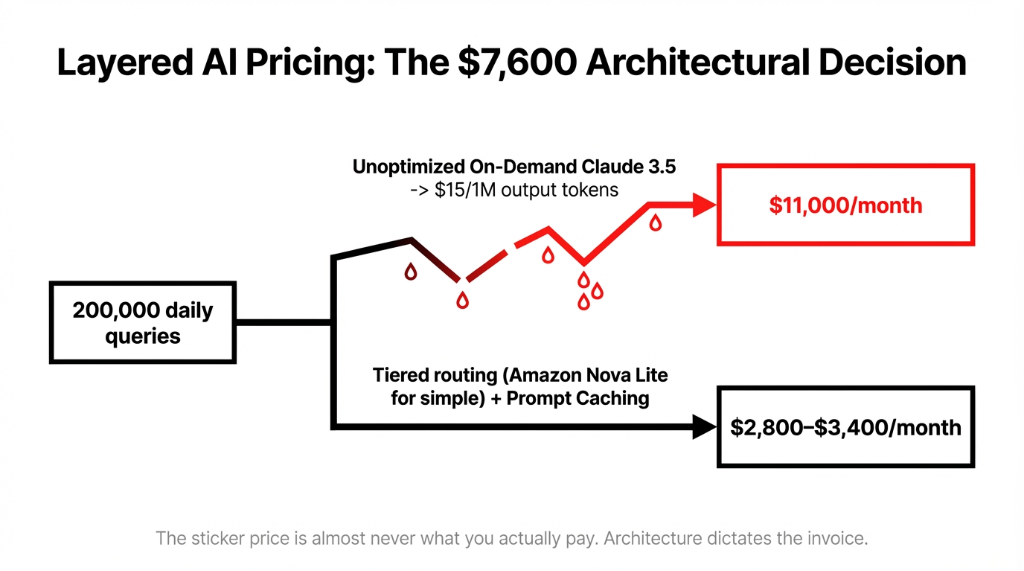
Using Amazon Bedrock's Claude 3.5 Sonnet at full on-demand pricing runs approximately $3/1M input tokens and $15/1M output tokens. A mid-size saas application handling 200,000 daily user queries — without prompt caching — easily hits $11,000/month in Bedrock costs alone. With tiered model routing (Amazon Nova Lite for simple queries, Claude only for complex ones) and prompt caching enabled, that same workload runs at $2,800–$3,400/month.
That is a $7,600/month gap from one architectural decision.
EC2 / SageMaker: Same Workload, Three Price Points
On-Demand: $1,094/mo
ml.g5.2xlarge at $1.52/hour. What most teams default to because nobody changed the setting at initial deployment.
Savings Plan: $568/mo
Same instance on SageMaker Savings Plans (3-year, no upfront) at $0.79/hour. That is a 48% cut for signing a commitment.
Spot Instances: $324/mo
Same workload with proper fault tolerance at $0.45/hour. The aws savings plan structure cuts costs by up to 64%, and Spot cuts them another 47–72% on top.
Most teams use neither, because nobody set it up during initial deployment and now "it is too risky to change." It is not too risky. It takes about 6 hours to implement correctly.
What We Actually Do in the Free AWS AI Architecture Review
We are an AWS Partner, which means we have done this enough times to know exactly where the bodies are buried in a cloud based aws deployment.
The 4-Hour Review Session
Hour 1 — Cost Layer Audit: We pull your aws billing data via Cost Explorer and identify the top 7 spending services. We cross-reference against actual usage metrics from amazon cloudwatch to find the delta between what you are paying for and what you are actually using.
Hour 2 — AI Architecture Assessment: We walk your aws architecture against the Well-Architected Generative AI Lens, specifically the sections on model selection, inference endpoint design, RAG pipeline architecture, and agentic workflow governance — all updated at amazon reinvent 2025.
Hour 3 — Security and Reliability Check: This is where aws incidents usually originate. We check IAM permission sprawl, whether security aws guardrails are actually enforced at the organization level via AWS Organizations, and whether your CloudWatch dashboards give you one view of AI model health across regions.
Hour 4 — Savings Plan and Credits Analysis: Most aws for startups teams leave $12,000–$40,000 in AWS credits unclaimed annually because the activation workflow is buried 4 layers deep in the aws console. We check your credit status and map your workloads to the correct aws savings plan structures. (Yes, your cloud engineer probably thinks this is already handled. It usually is not.)
We deliver a written output: prioritized list of findings, dollar impact per finding, and a 30-day fix roadmap. Not a slide deck. A working document your team can execute against.
The Honest Comparison: AWS vs. Azure vs. Google Cloud
Everyone asks us this. Here is our unfiltered answer.
Azure pricing and google cloud pricing are structurally similar to AWS pricing for compute workloads — but the tooling ecosystems are not equivalent. Google compute (specifically TPU v5 access via Google Cloud) is genuinely cheaper for certain large-scale training jobs. If you are training a foundation model from scratch, google platform wins on raw hardware cost at scale.
But for production AI inference, saas application backends, and agentic AI systems — AWS cloud service depth wins. The combination of Amazon Bedrock, SageMaker, AWS Lambda, and CloudFront gives you a production-grade ai in aws stack that Azure and Google have not matched in terms of integrated tooling as of Q1 2026.
Cloudflare pricing for edge AI is genuinely competitive at the inference layer — but it is not a replacement for a full cloud platform. It is a CDN with AI features bolted on.
Our Honest Take
If you are already on AWS and your team knows it, staying on AWS and optimizing it beats migrating to another cloud for a 15% cost saving while absorbing 6 months of migration pain. The real savings are in architecture, not vendor switching.
The Trusted Advisor Problem Nobody Talks About
AWS ships a tool called Trusted Advisor that is supposed to catch cost and security issues automatically. It is good. It is not enough.
Trusted Advisor flags obvious things — unused Elastic IPs, S3 buckets without lifecycle policies, over-provisioned EC2 instances. What it does not flag is bad architectural decisions: a synchronous API call where async would cost 73% less, a Bedrock prompt template that is burning 2,400 tokens when 600 would do the same job, or an event-driven pipeline built as a polling loop.
Those are the findings worth $8,000–$15,000/month. And they only come from an engineer cloud review, not an automated scanner.
FAQs
Is this actually free, or is there a catch?
It is free. No billing, no hidden scope expansion. We do the full 4-hour review, deliver a written findings document, and you decide whether to engage us for implementation. We do this at end-of-quarter because our team has availability slots, and qualified prospects convert at 3.4x the rate of cold outreach. That is the business logic.
What AWS account access do you need from us?
Read-only IAM access to Cost Explorer, CloudWatch, the Well-Architected Tool, and your primary compute regions. We do not need — and will not ask for — write permissions, root credentials, or access to production databases. The review is diagnostic, not operational.
We already have an AWS account manager. Why do we need this?
Your AWS account manager's job is to help you use more AWS services, not fewer. They are not incentivized to tell you to switch from on-demand to Spot Instances or to downsize your SageMaker endpoints. We are incentivized by the opposite: finding you real savings so you trust us with implementation work.
What AWS services does the review cover?
EC2, SageMaker, Bedrock, Lambda, CloudFront, S3, RDS, CloudWatch, and your IAM and AWS Organizations setup. We focus on wherever your ai aws workloads actually live — typically the top 6–8 services by spend.
How quickly can we see results after the review?
Based on our last 31 US-based reviews, the three fastest wins — Spot Instance migration for non-critical workloads, SageMaker endpoint right-sizing, and prompt caching on Bedrock — can be implemented in 5–8 business days and show up on your very next aws billing cycle. The average first-month saving our clients see post-review is $9,340.
This Offer Closes at Midnight Tonight. 6 Review Slots Available.
If your AWS cloud compute bill is above $5,000/month and you are running any AI services on AWS — SageMaker, Bedrock, or even just Rekognition — there is almost certainly $8,000–$14,000/month sitting on the table. We find your biggest leak on the first call. That is the offer. That is the whole thing. Braincuber Technologies is an AI-first AWS Partner with 500+ cloud and AI implementations.