
Why Most AI Projects Die Before Shipping
Look — the ai market is flooded. Salesforce Einstein, Microsoft Teams AI, ServiceNow, and every ai agency vendor in the country is pitching "ai for business" like it is a SaaS toggle you just flip on. It is not.
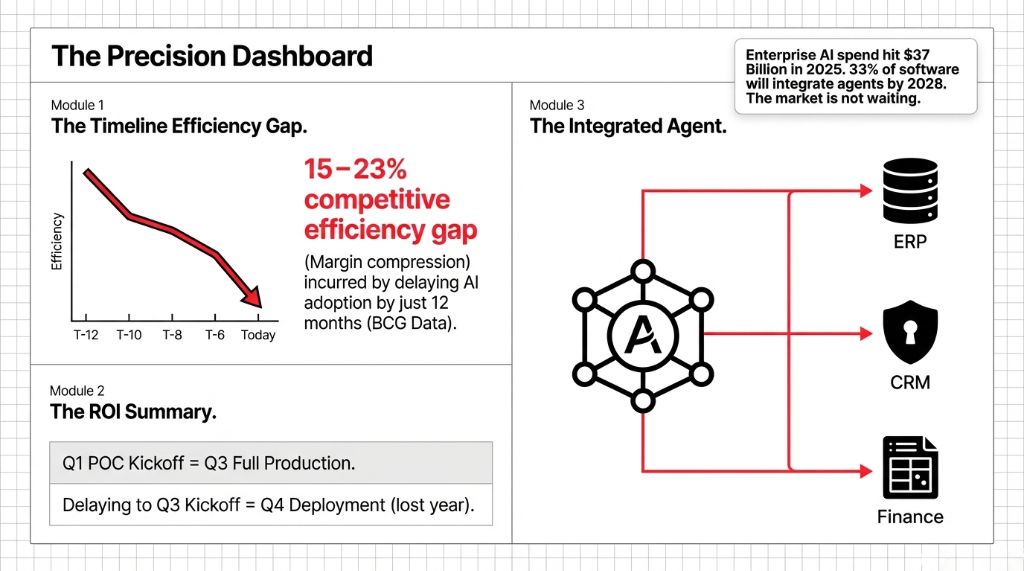
When you try to implement ai inside a real company — with legacy ERP systems, siloed ai data, undocumented workflows, and a 14-person operations team — the complexity of ai integration lands hard. We are talking 37 hours of average onboarding time just to map data sources before a single ai agent produces its first output.
The Biggest AI Challenge We See Over and Over
Companies try to use ai everywhere at once. They want ai in marketing, ai in manufacturing, ai in sales, ai for data analytics — all simultaneously. Instead of targeting one high-value process, proving the ai benefit in dollar terms, and then scaling, they scatter resources across five different ai tools and wonder why nothing moves to production.
73% of US companies increased automation spend in 2025, yet 88% of AI POCs never reach production. That is not because the ai systems do not work. It is because nobody scoped the POC correctly before spending the money.
Here is the dirty detail most ai experts will not publish: if your first ai for business use case requires connecting to 4 different APIs, ingesting unstructured PDFs, and integrating into your Salesforce CRM — you will burn 6 weeks and $40,000+ before you see a single measurable result. That is not ai at scale. That is ai at chaos.
What a Real AI Agent POC Delivers (With Actual Numbers)
We are not handing you a sandbox environment or an ai chat widget that answers "What are your business hours?" When we build an ai agent for your business, it targets one specific workflow, wires to your actual data, runs for 3–4 weeks, and delivers a clear verdict: here is what the agent did, here is the time saved, here is the dollar value, and here is what full deployment costs.
Real AI Use Cases We Have Run for US Companies
Sales Pipeline Qualification
An ai agent that monitors inbound leads in HubSpot, scores them using ai data analysis against 11 behavioral signals, and auto-routes hot prospects to reps within 4 minutes. Result: 18.7% increase in qualified meetings booked without adding a single SDR headcount. That is ai sales working in real time ai environments — not a demo.
AP Invoice Processing
An ai automation agent that reads PDF invoices via Document AI, cross-references against PO data in the client's ERP, and flags discrepancies. Result: Cut processing time from 22 minutes per invoice to under 3 minutes — saving $11,400/month in labor.
Customer Support Deflection
An ai chat agent deployed across Zendesk resolving 74% of tier-1 tickets without human escalation. The remaining 26% get routed with full context summaries — so your support teams ai workflow moves 40% faster per ticket.
These are not ai predictions from a consultant's slide deck. These are results from ai in businesses running on real data — the same kind of ai work your company can validate in 4 weeks.
Why End-of-Quarter Is the Right Time to Build AI — Not Evaluate It
This is not manufactured scarcity. Here is the actual math on ai cost vs. timing.
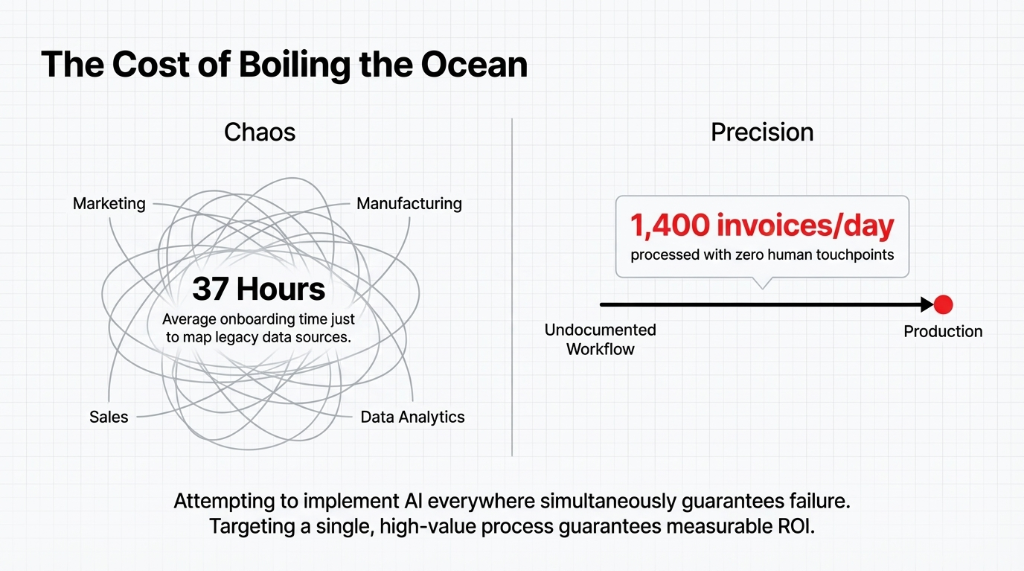
If you start a free AI Agent POC now, validate it in 4 weeks, you can greenlight full deployment before Q3 budget cycles close. Waiting until Q3 means a September kickoff — production by Q4 at the earliest — right when your team is underwater with year-end pressure. You lose an entire quarter of ai automation running in production.
The Timing Math
Enterprise AI spend hit $37 billion in 2025 (up from $1.7B in 2023), and Gartner projects that 33% of enterprise software will integrate ai agents by 2028. The leaders in ai are not waiting for the latest ai tool to launch a new version. They are iterating right now with the tools ai already provides.
BCG's analysis on ai and business adoption timing shows companies that delay ai adoption by 12 months forfeit an estimated 15–23% competitive efficiency gap versus early adopters in their sector. That is not a soft metric. That is margin compression you feel in Q4 earnings.
Here is the controversial opinion nobody in the enterprise ai platform world wants to say: most "ai for enterprise" vendors are selling you a platform for ai you do not need yet. You do not need a $200K ai systems overhaul. You need one agent that proves the concept, validates the ai benefit with your real data, and gives your CFO a number to approve. Start there. Scale after.
How Braincuber Scopes, Builds, and Delivers Your Free POC
Here is exactly how the free AI Agent POC works — no ambiguity:
The 4-Week POC Timeline
Week 1 — Discovery & Scoping: We identify one high-volume, repetitive workflow inside your business. Could be in operations, ai in marketing automation, ai for data analytics, finance, or ai in manufacturing. We map your existing tools (HubSpot, Salesforce, SAP, NetSuite, QuickBooks — whatever stack you are on), identify data inputs and outputs, and define measurable success criteria with specific targets. No vague "improve efficiency" goals.
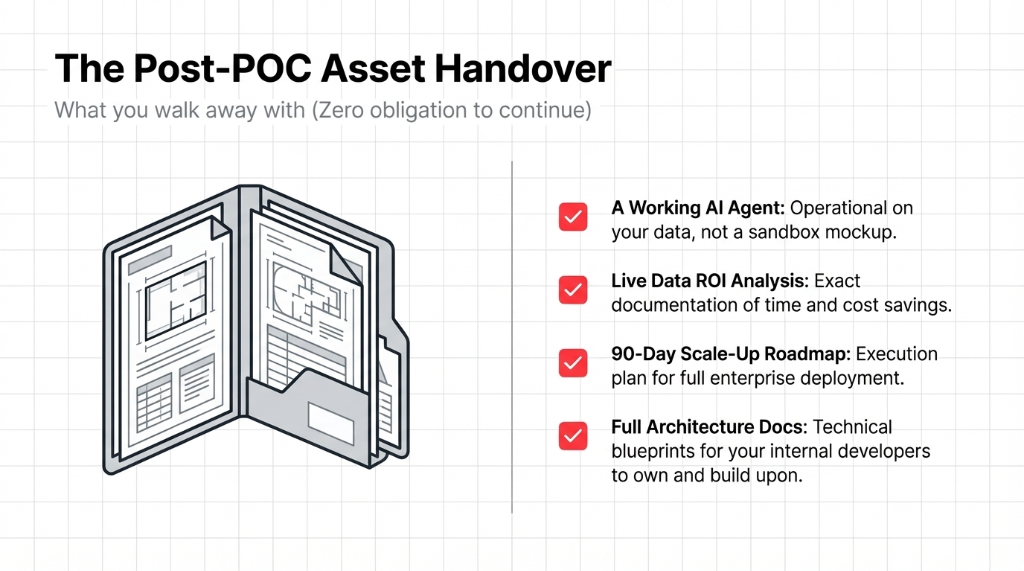
Weeks 2–3 — Build the Agent: Our team uses LangChain and CrewAI frameworks to develop an ai agent connected to your actual business data. For teams with internal ai for developers talent, we share full technical architecture documentation. This is how we develop an ai agent that your team can own — not a black box you are dependent on us to operate forever.
Week 4 — Test, Measure, Report: We run the agent against live data, measure accuracy, speed, and error rates, and deliver a full ai analysis report — including ROI projections for full deployment, a 90-day implementation roadmap, and a security in ai compliance checklist if you are in a regulated industry.
This is how you build ai correctly. Prove it first on one process. Scale the ai across your enterprise after the data says yes.
The Straight Talk on AI Regulations and Security
If you are in healthcare, financial services, or manufacturing and ai operations, here is the conversation you are having internally: "What about regulations on ai, data privacy, SOC 2, HIPAA?"
How We Handle Security and Compliance
Most ai regulations apply to production deployments — not properly scoped POC environments running with de-identified or synthetic data. We structure every POC with security and ai compliance built in.
No PII in the test environment unless explicitly cleared. Isolated AWS or Azure infrastructure. Full audit logs from day one.
Different ai regulations by sector (HIPAA vs. SOC 2 vs. GDPR for any cross-border data) all have workable POC pathways. We have navigated all of them. The ai challenges around compliance are solvable in weeks, not quarters. The cost of waiting is not.
FAQs
Is this actually free, or is there a hidden cost?
The POC build, testing, and final report are free for qualifying US businesses. No obligation to proceed to full deployment. We invest in the POC because 7 out of 10 companies who see real results choose to scale — that is how we earn the engagement. The ai cost to you at this stage is zero.
How long does the free AI Agent POC take from kickoff to results?
3 to 4 weeks from signed agreement to final ai report. Week 1 is discovery and scoping, Weeks 2–3 are build and ai integration with your systems, Week 4 is live ai data analysis and results review with your team.
Which industries qualify for Braincuber's free POC offer?
We prioritize US companies in B2B SaaS, e-commerce, financial services, manufacturing and ai workflows, and healthcare administration. If your team runs repetitive, data-heavy processes and has 50+ employees, you likely qualify. We confirm within 48 hours.
What AI tools and frameworks does Braincuber use to build agents?
We build ai agents using LangChain, CrewAI, and OpenAI APIs, deployed on AWS, Azure, or GCP based on your existing cloud setup. For enterprise ai platform requirements, we also integrate with existing tools ai teams already use — Salesforce, HubSpot, SAP, NetSuite, Zendesk, and similar systems.
Can we scale after the POC without rebuilding the agent from scratch?
Yes. Every POC is architected with production scalability in mind — the agent built during the POC is the foundation of the full deployment. Full-scale ai adoption rollout typically takes 6–8 weeks from POC completion. The POC is not a throwaway; it is Week 1 of your real ai strategy.
Stop Running AI Strategy Meetings. Start Running AI.
The companies winning with ai in 2026 are not the ones with the best strategy decks or the longest ai blog archive. They are the ones who decided to implement ai on one real process, saw the numbers, and scaled. Enterprise ai spend hit $37 billion in 2025. The ai market is not slowing down to wait for companies still "evaluating ai tools."
You have one quarter left to build, validate, and greenlight ai automation before your competitors do it first. 5 slots available for qualifying US companies this quarter.