
Why Sellers Start Looking for an EasyEcom Alternative
EasyEcom's sweet spot is small retailers doing ₹1–5 crore GMV with 1,000–5,000 orders per month, mostly COD, with limited IT support. It works fine at that scale. Flat monthly pricing of ₹12,000/month, plug-and-play Shopify setup, one-click COD flagging — it does the job.
But here is what the sales pitch does not tell you:
No Native RTO Dashboard
When your Return-to-Origin rate spikes from 18% to 31% in a festive season (as it does every October–November for fashion and lifestyle brands), you are pulling data from Delhivery, Shadowfax, and DTDC manually and stitching it in Excel. That is 11–14 hours per week of warehouse ops time burned on reconciliation.
No Predictive Inventory
You are reordering based on gut feel. Which means you are either sitting on ₹8–12 lakh of dead stock or you are stocking out of your top 3 SKUs during a Flipkart Big Billion Day sale. Both are margin killers.
Analytics Hit a Ceiling
The dashboards show you what happened last week. They do not tell you what will happen next week, or which courier is killing your NPS score in Tier-2 cities.
The moment a business crosses ₹5 crore GMV or 5,000 orders/month, EasyEcom starts leaking value faster than it saves it.
The Real Alternatives — Not a Generic List
Most "alternatives" blogs will throw 15 tool names at you and walk away. We are not doing that. Here are the four platforms we actually see Indian sellers migrate to, with the honest trade-offs.
Unicommerce — The Indian Enterprise Standard
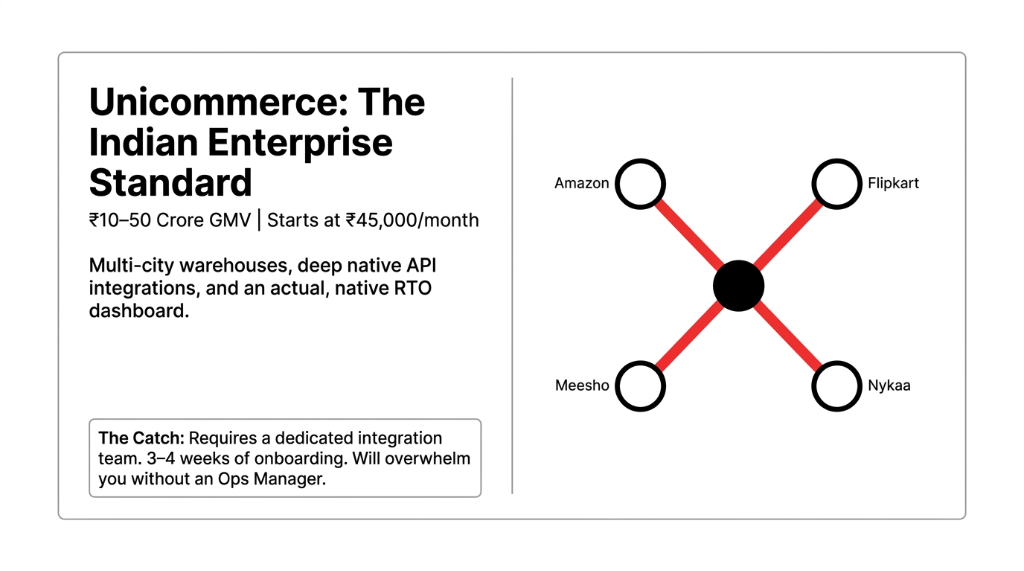
G2 calls Unicommerce the best overall EasyEcom alternative, and for mid-to-large sellers, that is accurate. Unicommerce is purpose-built for Indian e-commerce supply chains: it handles multi-city warehouse operations, deep Flipkart and Amazon India API integration, GST-compliant returns management, and it has an actual RTO dashboard — not a third-party workaround.
The Advanced plan starts at ₹45,000/month. That number scares small sellers off. It should not scare sellers doing ₹50 lakh+ monthly GMV. At that scale, the cost of not having predictive inventory and automated reconciliation easily exceeds ₹1.2 lakh/quarter in invisible losses.
Unicommerce: The Catch
It requires a dedicated integration team for full feature utilization. Plan for 3–4 weeks of onboarding, not 3 days. If you don't have an ops manager, this tool will overwhelm you.
Zoho Inventory — The Right-Sized Middle Ground
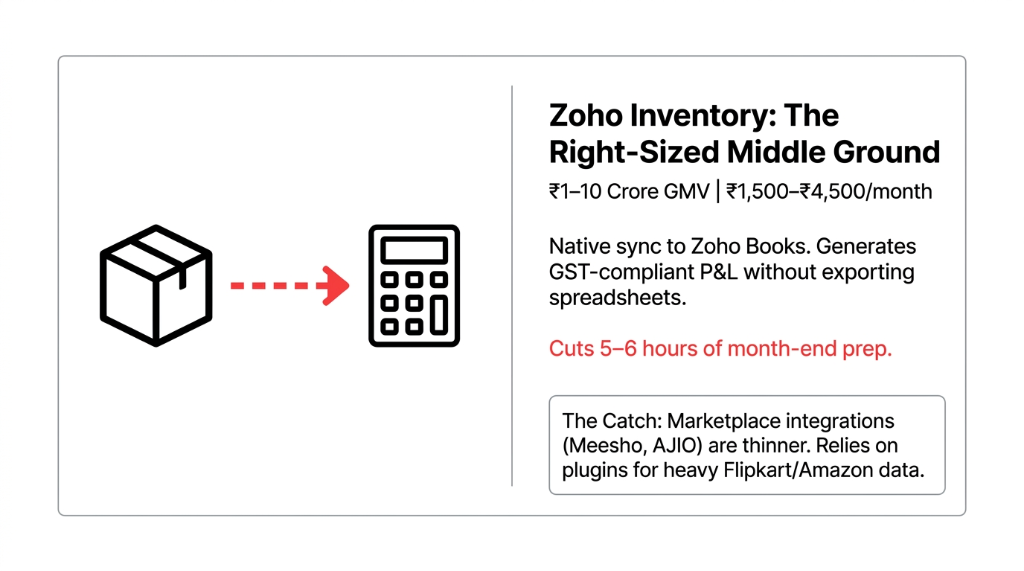
Zoho Inventory is the most underestimated EasyEcom alternative in India right now. It is built for SMBs, deeply integrated with the Indian GST framework, supports barcode scanning, serial and batch tracking, multi-warehouse management, and ships with Zoho Books for accounting — all in one suite.
The differentiator? It talks to your accountant. Every Zoho Inventory instance connects natively to Zoho Books, which means your CA can pull GST-compliant P&L reports without you exporting six spreadsheets. That alone cuts 5–6 hours of month-end prep.
Zoho Inventory: The Catch
Marketplace integrations (especially Meesho, AJIO) are thinner than Unicommerce. If you are heavily dependent on Flipkart Seller Hub data or Amazon FBA reconciliation, you will need plugins or custom API work.
Odoo ERP — When You Need More Than Middleware
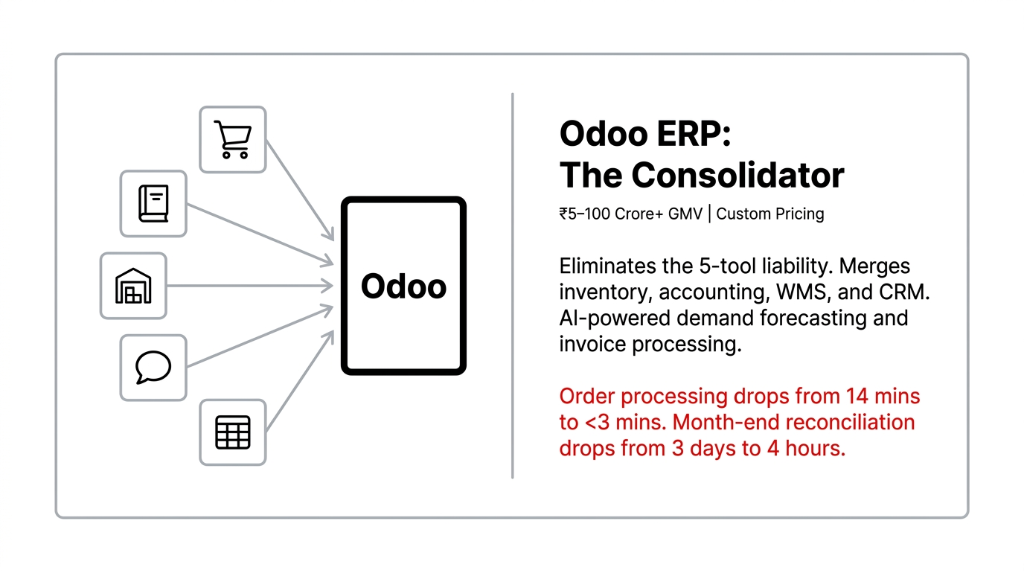
Here is the controversial opinion: most Indian sellers are not looking for better middleware. They are looking for a way to stop using five different tools that never talk to each other.
EasyEcom for orders. Tally for accounting. A separate WMS for warehousing. WhatsApp for customer support. Shopify for the D2C store. And Google Sheets (yes, still) to tie it all together. That is not a tech stack. That is a liability.
Odoo ERP consolidates inventory, order management, accounting, purchase orders, warehouse operations, CRM, and your Shopify store into one system. We have implemented Odoo for Indian sellers scaling from ₹3 crore to ₹25 crore in GMV, and the operational shift is visible within the first 60 days.
What Happens in the First 60 Days on Odoo
Order Processing
Drops from 14 minutes per order to under 3 minutes. Picking, packing, dispatch, and invoice generation happen in a single workflow.
Month-End Recon
From 3 days of manual cross-referencing to 4 hours of automated matching. Amazon payouts matched against shipped orders in real time.
RTO Tracking
Return processing becomes trackable at the SKU level. No more pulling data from Delhivery, Shadowfax, and DTDC manually.
Braincuber Case: Surat Fashion Seller
AI-powered automated reorder triggers reduced stockouts by 34% and freed up ₹6.8 lakh in working capital tied up in overstock. That is the kind of outcome middleware cannot produce.
Vinculum Vin eRetail — For High-Volume Marketplace Sellers
Vinculum is the choice for large sellers managing 10,000+ orders/day across Flipkart, Amazon, Myntra, Nykaa, and Ajio simultaneously. It handles complex multi-warehouse routing, carrier-level SLA tracking, and has deep integrations with Indian 3PLs like Delhivery and Xpressbees.
The pricing is premium and opaque (you need to request a custom quote), and onboarding typically takes 6–8 weeks with a dedicated integration team. This is an enterprise-grade platform for enterprise-grade operations.
Vinculum: The Catch
If you are not at ₹50 crore+, Vinculum is too much gun for the problem. You'll pay for features you'll never use.
The Comparison You Actually Need
| Platform | Best GMV Range | Pricing | RTO Dashboard | GST Native | AI/Forecasting |
|---|---|---|---|---|---|
| EasyEcom | ₹1–5 Cr | ₹12,000/mo flat | No | Yes | No |
| Zoho Inventory | ₹1–10 Cr | ₹1,500–4,500/mo | Limited | Yes | No |
| Unicommerce | ₹10–50 Cr | ₹45,000/mo+ | Yes | Yes | Basic |
| Odoo ERP | ₹5–100 Cr+ | Flexible/Custom | Yes | Yes | AI-powered |
| Vinculum | ₹50 Cr+ | Custom | Yes | Yes | Basic |
The Braincuber Case: What Switching Actually Looks Like
A Surat-based lifestyle brand came to us in Q3 2024. They were doing ₹7 crore/year across Amazon, Flipkart, and their own Shopify store. They were on EasyEcom for orders and Tally for accounting.
Their specific problem: every month, ₹1.8–2.4 lakh worth of marketplace deductions were going unreconciled. Their accountant was manually cross-referencing Amazon settlement reports against Tally entries. It was taking 37 hours/month. The founder was sleeping 5 hours a night during month-end.
We implemented Odoo with a Shopify integration and built automated reconciliation flows that matched Amazon payouts against shipped orders in real time.
Result in 90 Days
Reconciliation Time
37 hours/month dropped to 3.5 hours/month
Recovered Deductions
₹2.1 lakh recovered in the first 60 days
Stockout Rate
Dropped from 11.3% to 3.7% after demand forecasting went live
Founder Sleep
Now sleeping 7.5 hours a night. Not tracked in any dashboard but matters.
This is not a features story. This is an operations story. The right platform does not just process orders — it stops your business from leaking money through cracks you cannot even see yet.
Who Should NOT Switch from EasyEcom
Look, we are not here to sell you something you do not need.
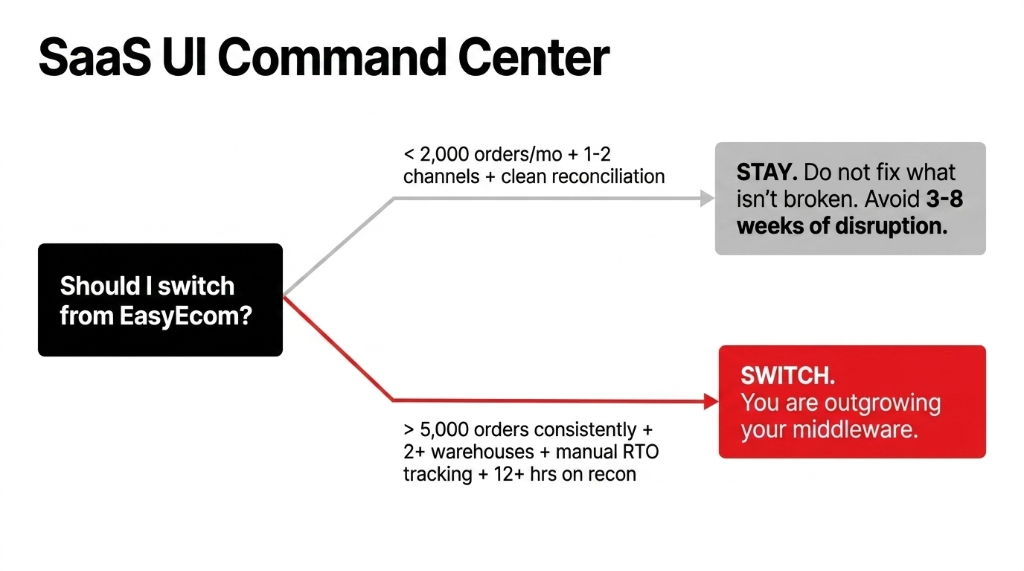
If you are doing fewer than 2,000 orders/month, selling on 1–2 channels, and your reconciliation is clean, stay on EasyEcom. It is genuinely good at what it does at that scale. Switching platforms has a real cost: 3–8 weeks of onboarding disruption, data migration risk, team retraining. Do not fix what is not broken.
Switch When You Hit 3 of These 6 Triggers
1. Monthly orders cross 5,000+ consistently
2. You operate 2+ warehouses
3. RTO tracking is manual or third-party
4. Month-end reconciliation takes more than 12 hours
5. You are launching D2C alongside marketplace sales
6. You want GST + inventory + accounting in one place, not three
FAQs: EasyEcom Alternative for Indian Sellers
Is Odoo ERP good for small Indian ecommerce sellers?
Odoo ERP works best for sellers doing ₹5 crore+ GMV who want to consolidate inventory, accounting, and orders in one place. For sellers under ₹3 crore, Zoho Inventory is more cost-effective and easier to set up, with native GST support and integration with Zoho Books for accounting.
What is the cheapest EasyEcom alternative in India?
Zoho Inventory starts at approximately ₹1,500–4,500/month and is the most affordable structured alternative. It includes barcode scanning, multi-warehouse management, and GST billing — features that EasyEcom's base plan handles partially.
Does Unicommerce support Meesho and Flipkart in India?
Yes, Unicommerce has deep native integrations with Flipkart, Amazon India, Meesho, Myntra, and Nykaa, making it one of the strongest middleware platforms for Indian marketplace-first sellers. Its Advanced plan at ₹45,000/month is designed for high-volume, multi-channel Indian operations.
How long does it take to migrate from EasyEcom?
Migration timelines vary: Zoho Inventory takes 1–2 weeks, Unicommerce takes 3–4 weeks with an integration team, and Odoo ERP implementation typically runs 4–8 weeks depending on customization depth. Always run both systems in parallel for the first 2–3 weeks.
Can Odoo handle Indian GST, e-way bills, and marketplace reconciliation?
Yes. Odoo with proper India localization handles GST invoicing, e-way bill generation, HSN code mapping, and TDS/TCS compliance. With a Braincuber implementation, automated marketplace reconciliation (Amazon, Flipkart settlements matched against shipped orders) is built directly into the accounting module — eliminating the manual reconciliation cycle entirely.
The difference between a ₹7 crore brand and a ₹25 crore brand is rarely the marketing budget. It is almost always the ops infrastructure. Sellers who scale past ₹10 crore have one thing in common: they stopped using middleware as a crutch and built a real system.
If you are spending more than 12 hours/month on manual reconciliation, you are already losing money you can measure.
Book a free 15-Minute Operations Audit with Braincuber. In the first call, we will identify your biggest operational leak and tell you exactly which platform fits your current GMV — EasyEcom, Zoho, Unicommerce, or Odoo. No fluff. Just the answer.
Book Your Free 15-Min Audit