
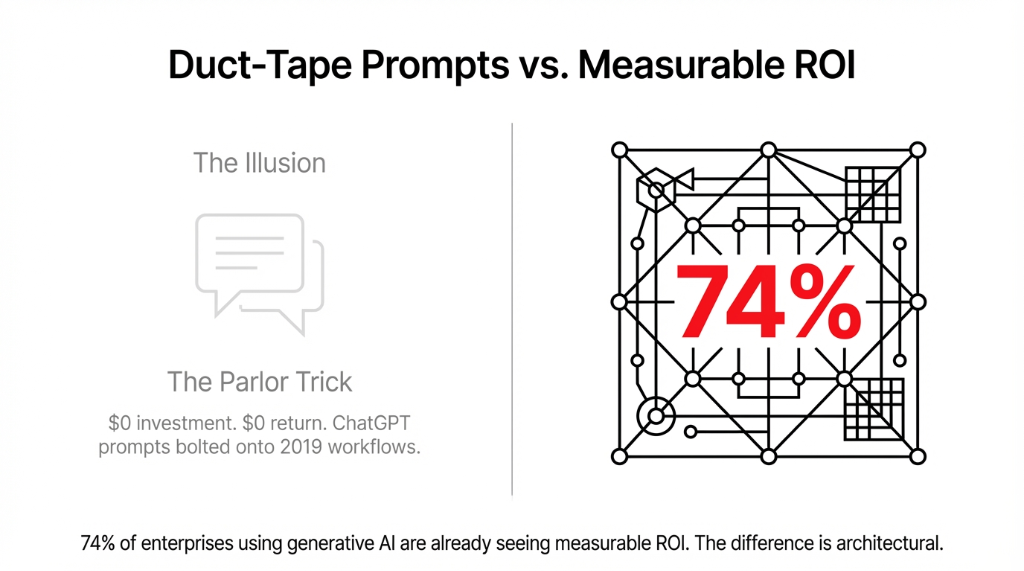
Why Most AI Strategies Collapse at Pillar One
We have worked on 500+ projects across the US, UK, UAE, and Singapore. And the #1 failure mode we see is this: a company buys access to one of the popular AI platforms — maybe Microsoft Copilot, maybe a free AI tool they found on a listicle — and then calls it “AI transformation.”
Six months later, nothing has changed except the software budget.
The Real Problem
The problem is not the AI technology itself. The problem is buying a tool without a structure.
Real enterprise AI implementation runs on four distinct pillars. Miss one, and the whole thing falls apart.
Each pillar connects to the next, like load-bearing walls. Pull one out and the roof comes down.
This is what the Braincuber AI Playbook covers — all four pillars, no fluff, no vendor pitch theater.
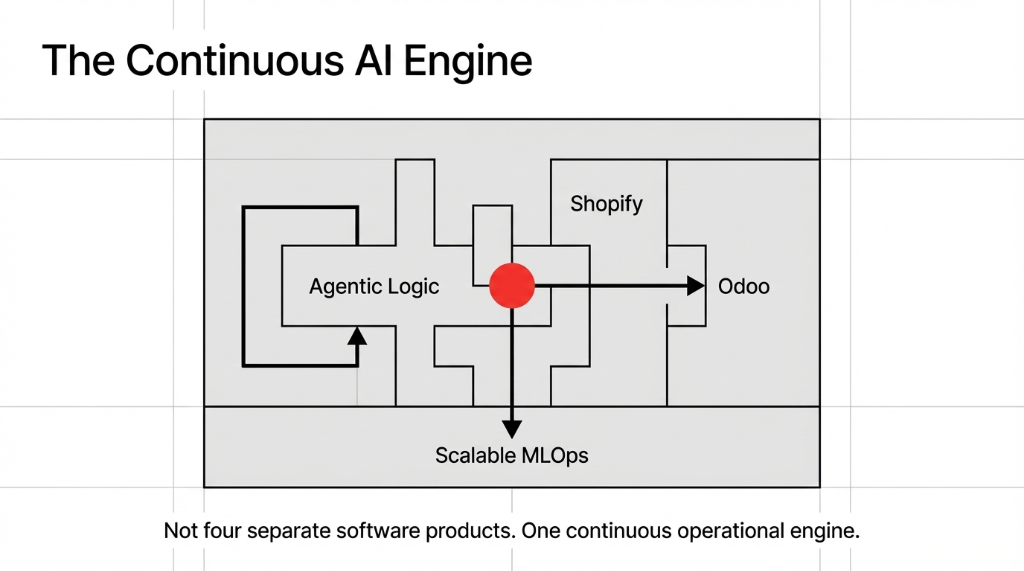
Pillar 1 — AI Agents That Actually Do Work
Every company wants AI automation. Most companies deploy a chatbot that answers “What are your business hours?” and declare victory.
That is not automation. That is a dressed-up FAQ page.
Real AI agents — built on frameworks like LangChain and CrewAI — execute multi-step business logic without human handholding. We are talking about agentic AI that can pull a customer’s order history from your Shopify store, cross-reference it with your inventory data in Odoo, flag the anomaly, and draft a resolution email — all in 47 seconds, at 2 AM, on a Sunday.
What We Have Seen in US D2C Implementations
✓ Customer service AI response time: 3.8 hours dropped to under 6 minutes
✓ Support ticket volume: dropped by 68% because the agent resolved issues before they escalated
The Piece Most Companies Completely Ignore: Document AI
If your accounts payable team is manually keying invoice data — and most teams still are — you are burning an average of $14,300 per year per employee in pure re-entry labor, plus a 3.7% error rate that creates downstream reconciliation nightmares.
Braincuber Document AI
Our Document AI models read, classify, and route invoices with 97.3% accuracy from day one. The question is not whether to build AI agents. The question is which operations bleed the most money without them.
Pillar 2 — Cloud AI Infrastructure That Does Not Break Under Load
Something no one tells you: the best AI models in the world mean nothing if they are sitting on infrastructure that chokes at 400 concurrent users.
The Pattern We See Constantly
A company invests in building a custom GPT-style solution for their internal ops team. Works beautifully in testing. Then they roll it out to 200 employees and the thing slows to a crawl — latency spikes to 8 seconds per query — and the team goes back to using Excel.
The AI budget gets blamed. The real problem was the cloud AI architecture was never built to scale AI workloads.
AI cloud infrastructure — across AWS SageMaker, Azure OpenAI Service, and Google Cloud Vertex AI — needs to be designed specifically for AI inference patterns, not treated like a regular web app deployment. These are fundamentally different workloads.
Braincuber Cloud AI Optimization Results
Clients served: Brands spending $4,200/month to $83,000/month on cloud
Average Cloud Spend Reduction After MLOps Optimization:
41.7% lower monthly cloud spend without any degradation in model performance
On a $40,000/month cloud bill, that is $16,680 back in your pocket. Every month.
AI and cloud are inseparable. If your cloud AI strategy is “spin up a VM and pray,” you will lose both the performance and the ROI.
Pillar 3 — AI for E-Commerce That Converts, Not Just Recommends
Most AI ecommerce implementations stop at “product recommendations.” Amazon does it, so everyone copies Amazon. The problem is Amazon has 47,000 engineers and a dataset of 300 million users. Your Shopify store has neither.
Braincuber’s approach to ecommerce AI goes three layers deeper:
The 3-Layer E-Commerce AI Architecture
Layer 1: AI Search
Standard Shopify search returns keyword matches. Our AI-generated smart search understands intent.
“Summer dress that doesn’t wrinkle” returns relevant results, not garbage. One US fashion brand: search conversion 2.3% to 6.1% — a 165% improvement.
Layer 2: AI Customer Support
A free AI chatbot bolted onto your Shopify store is not customer support. It is a liability.
Real customer support AI handles 74% of inquiries without human intervention — returns processing, order tracking, upsell triggers.
Layer 3: Shopify–Odoo Integration
Shopify’s API rate limit during peak traffic hits a hard ceiling. 600 orders sitting unsynced while your warehouse flies blind.
We fixed this for 11 US e-commerce brands. A message queue buffer that prevents the kind of Black Friday disaster that cost one client $22,700 in mis-shipped orders.
Pillar 4 — AI-Integrated ERP That Makes Finance Actually Useful
Controversial opinion: if your finance team is still closing the month manually in QuickBooks, and your operations team is running on a patchwork of spreadsheets and Slack messages, hiring more accountants is not the answer. That is $85,000/year per head for a problem that AI solves at $600/month.
Finance AI embedded in Odoo ERP does three things that your current setup cannot:
The 3 Finance AI Capabilities Your Setup Is Missing
1. Demand Forecasting — Uses 18 months of your sales history, seasonal patterns, and external market signals to predict SKU-level inventory needs 8 weeks out. One US apparel brand reduced overstock write-offs by $31,400 in their first quarter.
2. Automated Invoice Matching — The AI matches purchase orders to invoices to delivery receipts in 12 seconds. What used to take your AP team 2.5 hours every morning is now done before they finish their first coffee.
3. Real-Time Financial Dashboards — Pull live data from every operational module — inventory, sales, procurement, HR — and surface anomalies automatically. No more waiting until the 15th to find out your margin eroded in the first week.
The Bottom Line
AI in finance is not about replacing your CFO. It is about making sure your CFO is looking at real numbers, in real time, instead of last month’s reconciled guess. McKinsey confirms: companies using generative AI in finance operations report revenue increases of 10% or more within 12 months of deployment.
The Numbers You Should Hold Us To
We do not pitch vague outcomes. Here is what US companies working across all four Braincuber pillars typically see within the first 90 days:
| Metric | Before Braincuber AI | After 90 Days |
|---|---|---|
| Customer inquiry response time | 3.8 hours avg | Under 6 minutes |
| Monthly cloud infrastructure spend | Baseline | 41.7% reduction |
| Invoice processing time | 2.5 hrs/day | 12 seconds automated |
| Overstock write-off rate | Variable | Down 28–35% |
| Support ticket volume | Baseline | Down 60–70% |
The IDC Math
According to IDC research cited by Microsoft, generative AI delivers 3.7x return on every dollar invested — and for top-performing adopters, that number climbs to $10.30 per dollar.
The math is not complicated. The execution is where most companies stall.
The Reality of Implementation
We are not going to tell you this is a plug-and-play situation. AI training, data preparation, and workflow mapping require 3–6 weeks of upfront work before the first automated process goes live.
What we can tell you is what gets easier immediately:
The 90-Day Implementation Timeline
Week 1
Your team stops manually routing support tickets
Week 3
Invoice processing runs on autopilot
Week 6
Your cloud costs start dropping
Week 12
Your first full AI-powered monthly close in Odoo
The companies that fail at AI transformation are the ones who want the outcome without the process. The ones who succeed treat the first 90 days like an implementation sprint, not a product evaluation.
AI for business is not a test. It is not something you try on a free tier and assess. It is infrastructure — like deciding whether to build your warehouse or rent someone else’s forever.
FAQs
How long does it take to see ROI from the Braincuber AI Playbook?
Most clients see measurable ROI within 47–90 days of go-live across the first two pillars — typically through cloud cost reduction and support automation. Full four-pillar ROI is typically confirmed at the 6-month mark, with an average return of 3.7x per dollar invested based on IDC benchmarks.
Do I need existing AI infrastructure to get started?
No. We assess your current stack — whether you are on AWS, Azure, GCP, or a bare-metal server — and build the AI infrastructure from the ground up. Most clients start with zero prior AI deployment and are running production-grade AI agents within 6–8 weeks.
Is the Braincuber AI Playbook relevant for businesses not on Shopify or Odoo?
Yes. While Shopify and Odoo integration is a core strength, the AI automation, cloud AI, and agentic AI pillars apply to any business running any e-commerce or ERP platform. We have implemented across WooCommerce, Magento, NetSuite, and SAP environments.
What AI models does Braincuber use — proprietary or third-party?
Both. We use best-fit AI models depending on the use case — GPT-4 variants, Claude, Mistral, and fine-tuned open-source models — deployed on your own cloud infrastructure so your data never leaves your environment. We do not lock you into one vendor’s ecosystem.
How is Braincuber different from hiring an in-house AI team?
An in-house AI engineer in the US costs $147,000–$195,000/year in salary alone, and takes 3–4 months to onboard before writing a single line of production code. Braincuber deploys a full team — AI engineers, cloud architects, ERP consultants — from day one, at a fraction of the cost, with 500+ projects of institutional knowledge behind every decision.
Stop Running on Half a Playbook
The market does not reward companies that are “exploring AI.” It rewards companies that deploy it, measure it, and scale it — across all four pillars, not just one. If you are running AI tools in one department and ignoring the other three pillars, you are getting maybe 22% of the value your competitors are building toward right now. Book our free 15-Minute AI Operations Audit — we will identify your single biggest operational leak in the first call.