
What This Post Will Show You
▸ Why ROAS is a vanity metric that hides your actual losses
▸ The 5 numbers you must know before spending ₹1 on ads
▸ Why hiring a CFO at ₹4.5-7L/month is slower and worse than system integration
▸ The step-by-step fix: SKU-level P&L in Odoo in 6 weeks
▸ Real outcome: D2C wellness brand went from ₹-3.1L to ₹+6.8L monthly net profit
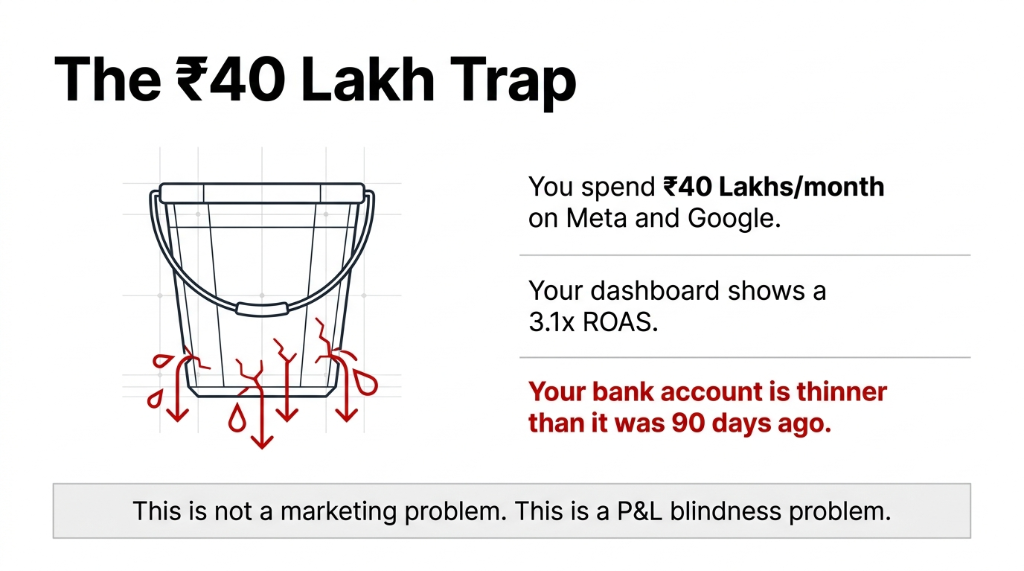
The Story of a ₹40L/Month Trap
A skincare brand, 18 months old, ₹2.1 crore in monthly GMV, ₹40L going into Meta ads every single month. The founder believed they were growing because revenue was climbing. What nobody told her was this: her contribution margin per order was ₹63.
Sixty-three rupees. Per order. Her AOV was ₹1,480. COGS: ₹590. Shipping + RTO provisioning: ₹210. Payment gateway: ₹38. Ad cost per order: ₹510. That left ₹132 before platform fees, team salaries, warehousing, and founder salary. After all of that — ₹63 per order. If there were no returns.
Her return rate was 19%. She was not building a brand. She was operating a loss machine at scale, funded entirely by her own ad budget.
Why Your ROAS Number Is Lying to You
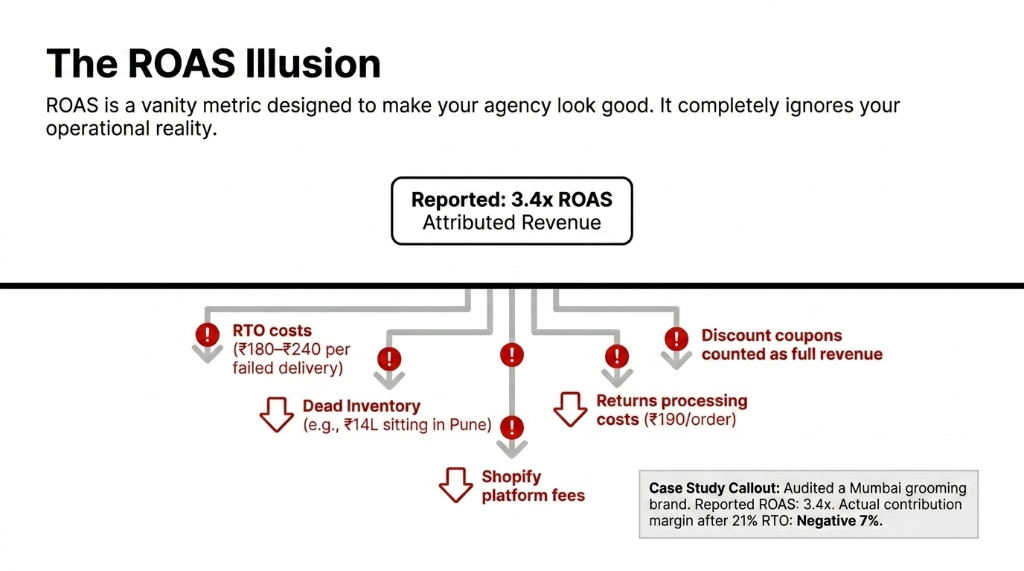
ROAS is a vanity metric designed to make your agency look good. A 3x ROAS on Meta tells you that for every ₹1 spent, ₹3 came back in attributed revenue. It tells you nothing about RTO costs (₹180-₹240 per failed delivery), contribution margin after returns, the ₹14L worth of SKUs sitting in your Pune warehouse since November, or discounts your agency counts as full-price revenue.
The Mumbai Grooming Brand Audit
Spending ₹28L/month on ads. Reported ROAS: 3.4x. Actual contribution margin after accounting for 21% RTO, ₹190/order returns processing, warehouse fees, and Shopify transaction fees?
Negative 7%. They were paying ₹28 lakhs a month to lose money faster.
₹40L Ad Spend: With vs. Without a P&L
Two brands side by side — both spending ₹40L/month on ads, both showing ₹2 crore in GMV. Completely different outcomes.
| Metric | Brand A (No P&L Visibility) | Brand B (Real-Time P&L via Odoo) |
|---|---|---|
| Reported ROAS | 3.2x | 3.2x |
| RTO Rate | 23% (unknown) | 23% (tracked per SKU) |
| Contribution Margin/Order | ₹47 (unknown) | ₹47 (visible) |
| Blended CAC (real) | ₹643 (invisible) | ₹643 (known, acted on) |
| SKUs killing margin | 7 SKUs (no idea) | 7 SKUs (paused in 48 hrs) |
| Monthly cash leak | ₹8.3L (not visible) | ₹8.3L (stopped in month 2) |
| Decision made | Increase ad budget | Fix ops, kill bad SKUs first |
Brand A fires their agency and hires a new one. Brand B fires the 7 bad SKUs and reallocates ₹14L of ad budget to 3 high-margin heroes. Same ad spend. Completely different outcome.
The 5 Numbers You Must Know Before Spending ₹1 on Ads
If you cannot answer all five of these without opening a spreadsheet and waiting 45 minutes, your ad budget is a gamble — not a growth strategy.
1. Your real blended CAC, post-RTO
Not Meta's attributed CAC. Your total ad spend divided by orders actually delivered and paid. For most D2C brands in India, this number is 28-41% higher than what your dashboard shows.
2. Your contribution margin per SKU, not per brand
3 SKUs generate 87% of your profits while 9 SKUs destroy it. A ₹499 impulse-buy product with a 31% return rate is not a growth product. It is a cash drain.
3. Your LTV:CAC ratio at the 90-day mark
Healthy benchmark: above 3:1. Most Indian D2C brands run at 1.4:1 without realizing it. You're spending ₹2 to make ₹1 back over 90 days.
4. Your real inventory turnover, not your GMV growth
GMV going up while inventory days-on-hand goes from 43 to 71 means you are stuffing the channel. We've seen brands with ₹22L of dead stock they're still running ads for.
5. Your RTO-adjusted gross margin by channel
Your Meesho channel has a 34% RTO rate. Your D2C website: 11%. Running equal ad spend on both? You are knowingly subsidizing your worst channel.
Why "Hire a Better CFO" Is Bad Advice
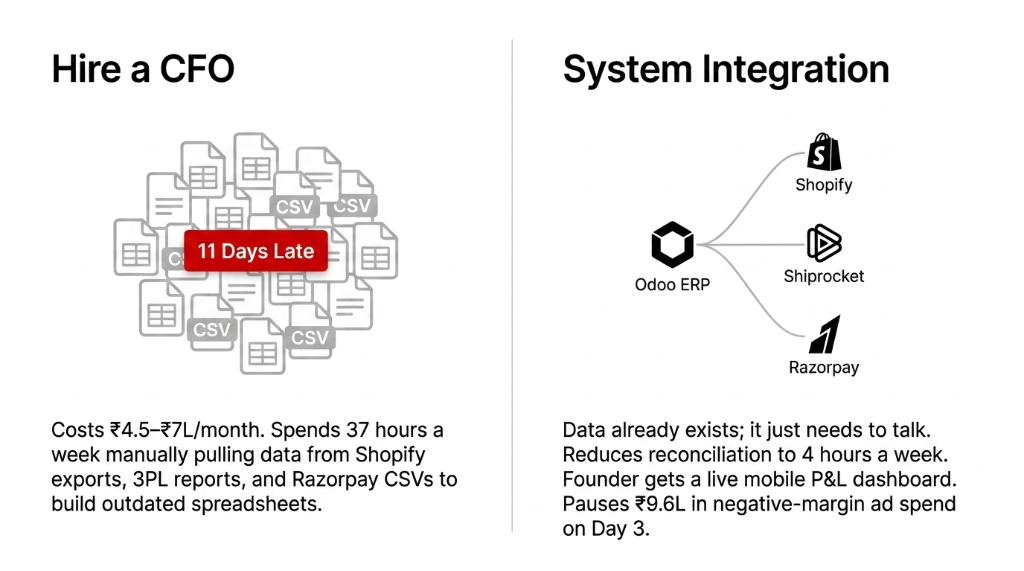
A good CFO for a ₹2-₹5 crore/month D2C brand costs ₹4.5-₹7L/month. They will spend their first 60 days trying to pull data from Shopify exports, 3PL Excel reports, Razorpay payout CSVs, and your agency's attribution tool. Then they'll build you a beautiful spreadsheet that is 11 days out of date by the time you see it.
That is not operations. That is archaeology. The data already exists. Your Shopify has every order. Your 3PL has every fulfillment event. Your payment gateway has every transaction. The problem is none of these systems talk to each other.
When we connected Shopify + Shiprocket + Razorpay + Odoo ERP for a D2C fashion brand in Bengaluru, their finance team went from 37 hours/week on manual reconciliation to 4 hours. The founder got a live P&L dashboard on his phone. On day 3, he paused ₹9.6L worth of ad spend going to 4 negative-margin SKUs. His agency certainly was not going to tell him.
Why Your Agency Has Different Incentives Than You
Your agency is paid on ad spend, not on your profit. A 10% agency fee on ₹40L/month is ₹4L. If your budget goes to ₹60L, their fee goes to ₹6L. They have a structural incentive to grow your spend, not your margin.
ABM done right means you know exactly which customer segments are profitable at which CAC, and you tell your agency to target only those. That requires your P&L to be connected to your CRM and ad platforms — not sitting in a PDF report emailed every Friday at 7 PM.
ABM With Real-Time Margin Data: The Results
CAC Reduction
31.7%
Average across 18 D2C implementations globally
Total Ad Spend
Unchanged
Stopped spending on wrong people, not less spending
Timeline
90 Days
US, UAE, Singapore, India implementations
What the Fix Actually Looks Like (Step by Step)
Step 1 — SKU-level P&L in Odoo (Week 1-2)
Connect your Shopify catalogue to Odoo's inventory and costing module. Tag every SKU with landed cost, not purchase price. This alone will shock you.
Step 2 — Live RTO Reconciliation (Week 2-3)
Integrate your 3PL or Shiprocket into Odoo so every return is automatically deducted from revenue attribution. Your "real GMV" number will drop. That is a feature, not a bug.
Step 3 — Channel-wise P&L View (Week 3-4)
Separate Meesho, Amazon, and D2C website into distinct P&L lines. You will almost certainly find one channel is profitable and one is not.
Step 4 — Ad Spend Signal Into P&L (Week 4-6)
Using Braincuber's Odoo + Meta/Google integration, ad cost per SKU flows directly into your margin calculation. When a SKU's contribution margin drops below ₹120, an automated alert fires. No more waiting for the Monday report.
Step 5 — ABM Audience Rebuild (Week 6-8)
With real LTV data visible, rebuild Meta custom audiences around your top 23% of customers — those with LTV above ₹4,200 at 90 days. CPM will go up. ROAS will drop. Profit will go up. (Yes, your agency will hate this conversation.)
Real Outcome: D2C Wellness Brand, ₹3.4 Crore/Month GMV
Spending ₹52L/month on ads. ROAS reported: 2.9x. Not profitable. Founder had taken ₹80L in personal loans over 14 months.
After a full Odoo implementation + Shopify integration + ABM rebuild, here is what changed at the 90-day mark:
90-Day Transformation
Ad spend: Reduced from ₹52L to ₹38L/month (cut ₹14L, not revenue)
Profitable orders: Increased from 61% to 84% of total orders
RTO rate: Dropped from 24% to 16% (better customer targeting)
Monthly net profit: From ₹-3.1L to ₹+6.8L
Cash flow recovered: ₹9.9L/month without growing GMV. The brand didn't grow. It became real.
Frequently Asked Questions
How do I know if my D2C brand's ad spend is actually profitable?
Pull total ad spend for 30 days. Divide by delivered-and-paid orders only (exclude RTO). Subtract COGS, shipping, payment fees, platform fees from AOV. If the remaining number is below ₹150 for an AOV under ₹1,000, you are at breakeven or loss. Most brands discover this number is 40-60% lower than their dashboard shows.
What is contribution margin and why does it matter more than ROAS?
Contribution margin is revenue minus all variable costs per order — COGS, shipping, RTO losses, payment fees, and ad cost. ROAS only measures revenue returned per ad rupee. A 4x ROAS with 28% return rate and ₹240 RTO cost per failed delivery can still produce a negative contribution margin.
How long does it take to set up a real-time P&L for a D2C brand using Odoo?
For a brand on Shopify with one 3PL and one payment gateway, a functional SKU-level P&L in Odoo takes 3-5 weeks. First live dashboard ready in week 3. Full ABM signal integration takes 5-7 weeks total.
Should I cut my ad budget while fixing my P&L operations?
Not necessarily cut — reallocate. We typically pause 20-35% of ad spend on bottom-performing SKUs within the first 30 days. That money gets redirected to high-margin SKUs or held while operations stabilize.
How is Braincuber's Odoo setup different from hiring a CFO?
A CFO builds reports from historical data, 7-14 days delayed, at ₹4.5-7L/month. Braincuber's Odoo integration creates a live operational P&L where every Shopify order, Shiprocket return, and Razorpay payout reconciles automatically — real-time margin visibility for ₹22,000-₹45,000/month.
Stop Funding the Problem. Start Reading the P&L.
Book our free 15-Minute Operations Audit — we'll find your biggest margin leak in the first call. We've done it for 150+ brands. Your turn.