
Marcus Reid didn’t call us because he was excited about technology.
He called us because his $6.2M Ohio-based metal parts manufacturing company was losing money every month—and nobody on his team could tell him exactly where it was going.
(Sound familiar? It should. We hear this from 7 out of 10 US manufacturers we speak with.)
After a 3-day operations audit, we found $18,400 draining out every single month, broken down like this:
The $18,400 Monthly Bleed
$7,200
Un-reconciled vendor invoices sitting in QuickBooks for 30+ days
$6,800
Production downtime caused by raw material stockouts his team never saw coming
$4,400
Customer service rework from wrong shipments and manual order entry errors
He was running QuickBooks for finance erp, a Google Sheets inventory tracker, and a legacy MRP tool last updated in 2019. His supply chain team pulled data from three different places to build a weekly report that was already 4 days old by the time Marcus read it.
That is not an erp system. That is three leaking buckets duct-taped together with Zapier.
Eighteen months later, Marcus sent us a note: “AI transformed our entire Odoo ERP experience. I just wish we had done this two years earlier.”
Here is exactly what happened—no sales pitch, just the mechanics.
The $18,400 Problem That “Good Operations” Was Hiding
Marcus’s business looked like it was running fine. Orders were going out. Invoices were getting paid. His team was busy.
Busy and profitable are not the same thing.
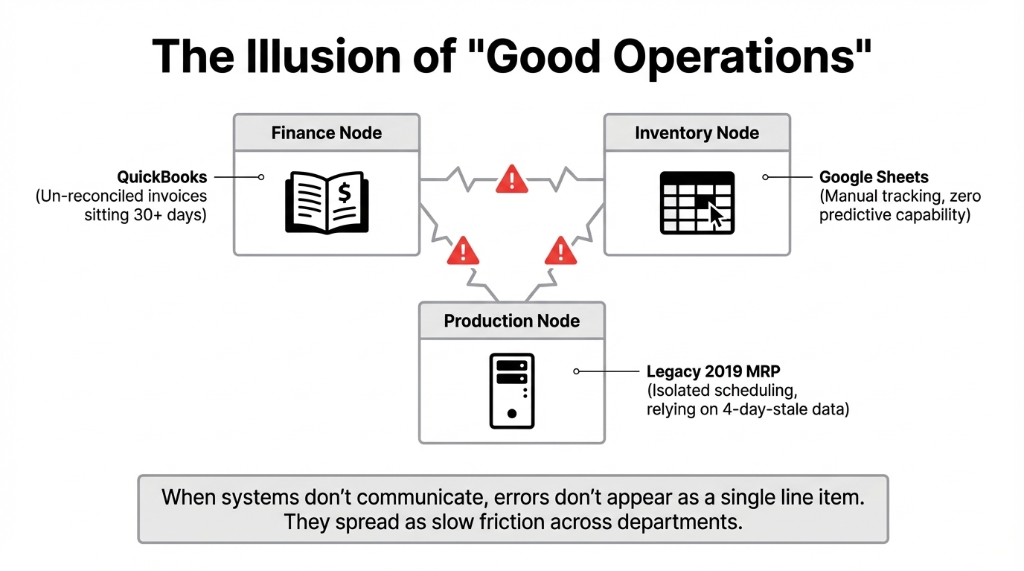
The fragmented enterprise resource planning setup was bleeding money in invisible ways. When your erp and finance lives in QuickBooks, your inventory lives in a spreadsheet, and your production scheduling lives in a legacy tool—nobody sees the full picture. Your finance team reconciles what they have. Your warehouse team tracks what they can see. Your ops team makes decisions with data that is 4 days stale.
In our last 60+ implementations across US manufacturers, every single client running this kind of disconnected setup had between $12,000 and $25,000 in monthly operational leaks they could not locate. The reason it stays hidden is simple: when your erp tools don’t talk to each other, errors don’t appear as a single line item—they spread across departments as slow friction. Last-minute stock purchases at premium prices. Customer service calls that shouldn’t exist. Duplicate vendor entries nobody audits.
The Market Reality
The global erp software market has hit $92.6 billion, with the US market alone valued at $20.81 billion in 2026. The reason enterprise resource planning systems keep growing is because businesses keep discovering—usually painfully—that the cost of not having unified business erp operations is far higher than the cost of fixing them.
Marcus was paying $18,400/month to run disconnected software. That is $220,800 a year. For less than 10% of that figure, he could have had a top-tier Odoo ERP system with AI automation embedded from Day 1.
Why the “Best ERP” Advice Marcus Got Almost Cost Him Everything
Before he called us, Marcus had already spoken to two other consultants. Both recommended NetSuite.
Don’t do that.
NetSuite starts at $99–$125/user/month—and that is before implementation, which starts at $10,000 and routinely hits $100,000+ for mid-market businesses. SAP S/4HANA? Plan to spend between $75,000 and $500,000+ just to go live. These are not small business erp solutions. They are systems designed for 500+ employee enterprise erp organizations with dedicated IT departments and 18-month implementation budgets.
Marcus had 62 employees and one part-time IT consultant.
The Dirty Secret of “Best ERP” Conversations
Here is the ugly truth about how most US businesses pick an erp system: they Google “best erp,” see NetSuite and SAP at the top, and assume that must be the right answer. The consultants recommending those platforms earn significantly higher commissions on those deals. Everyone tells you NetSuite is the safe choice. For a $6M manufacturer, it will crush your cash flow before it ever helps your operations.
Odoo ERP at Custom tier: $24.90–$37.40/user/month
Same enterprise resource planning capabilities. 40–60% lower total cost of ownership than NetSuite. And critically—architected to accept ai erp natively, not as a $150,000 bolt-on integration project.
When we showed Marcus an odoo demo that included live AI-powered demand forecasting and automated invoice reconciliation running in real time, his exact words were: “Why did nobody show me this before?”
What AI-Powered Odoo ERP Actually Did to Marcus’s Numbers
Let’s get specific. This is not a fin erp marketing deck. These are the actual 90-day results from a real odoo erp implementation in Ohio.
Finance, Odoo Accounting & AI Automation
$3,100/month recovered
The finance erp module paired with ai automation through OCR and auto-reconciliation cut invoice processing from 14 minutes per invoice to under 90 seconds. Marcus’s team was processing 340 vendor bills a month. That recovered 73 labor hours per month.
The Friday VLOOKUP sessions that his finance team dreaded every week? Gone. Odoo accounting with artificial intelligence data analysis running nightly now auto-reconciles transactions at 11 PM. His finance team uses those Friday afternoons for actual financial analysis instead of data plumbing.
*(His accountant hated this for about three weeks. Now she requests AI features we haven’t even built yet.)*
Manufacturing ERP & Supply Chain
$4,900/month recovered — single largest win
Marcus’s production floor was averaging 11.3 hours of unplanned downtime per month due to stockouts. His team was catching material shortages only 2 days in advance—not enough time to source alternatives without paying expediting premiums that sometimes doubled the raw material cost.
The ai erp demand forecasting layer inside odoo erp—pulling live data from the erp supply chain module—started predicting material shortages 17 days in advance. The ai supply chain visibility across his erp for inventory management modules meant his warehouse team stopped firefighting and started planning.
Result: Unplanned downtime dropped from 11.3 hours to 1.8 hours/month. Direct cost recovery: $4,900/month. That is what erp system for manufacturing industry operations with ai in supply chain management look like.
CRM, Customer Service & Ecommerce ERP
87% complaint reduction
Before our engagement, Marcus was handling 67 customer complaints per month related to wrong shipments and delayed orders. His team was spending an average of 4.2 hours resolving each complaint—that is 281 hours per month of skilled people doing damage control.
After deploying ai in customer service workflows inside crm odoo, complaint volume dropped to 9 per month. Average resolution time fell from 4.2 hours to 31 minutes. The ai for customer experience processes now auto-detect order discrepancies before they ship.
For clients running ecommerce erp operations—specifically those connecting Shopify to Odoo as an e commerce erp system—we have seen D2C brands lose 500 orders during a peak sale because Shopify’s API rate limit fails at 2 AM and nobody is watching. The enterprise resource planning in e commerce integration with AI monitoring eliminates that risk entirely.
Total Monthly Financial Recovery After 90 Days: $17,800
Marcus’s $18,400 problem was solved in one quarter. Finance artificial intelligence handled the invoices. AI in manufacturing killed the stockouts. Artificial intelligence customer service caught the errors before they shipped.
The AI Mesh: What Most Odoo ERP Implementations Miss
Here is the insider information most odoo partners will not put in their proposals:
Odoo erp out of the box is a solid erp enterprise resource planning platform. AI erp—Odoo with intelligent automation and ai embedded into workflows using Agentic AI frameworks—is a fundamentally different category of tool.
Most implementations stop at go-live. The partner configures erp applications, trains the staff, and hands over the keys. That approach treats enterprise resource planning solutions like a sophisticated filing cabinet—better organized, still passive. The result is a system that records what happened. Not one that acts on what’s about to happen.
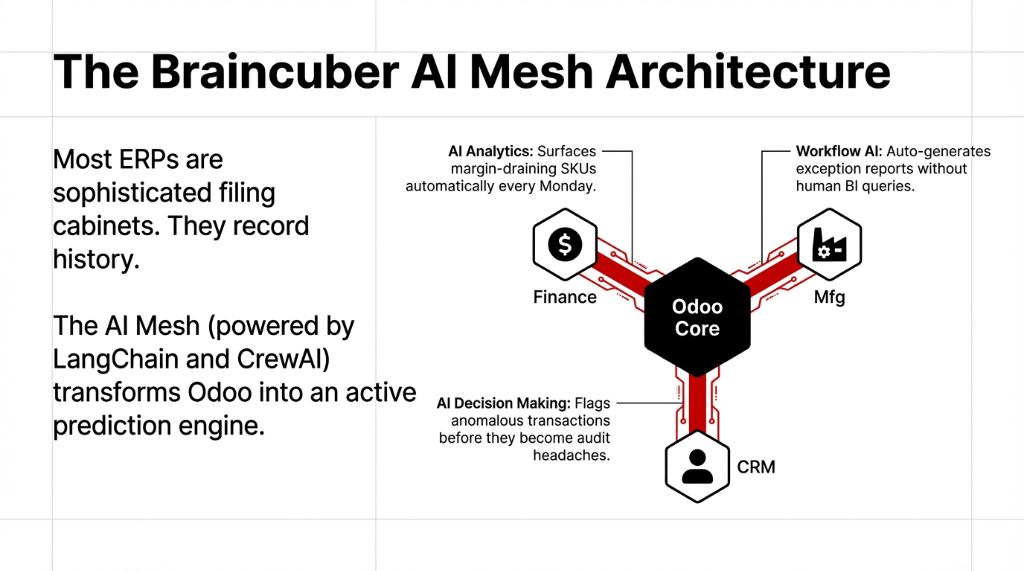
At Braincuber, we deploy what we call the “AI Mesh”—a suite of ai workflow automation layers built directly into odoo apps using LangChain and CrewAI frameworks. Here is what that looks like in daily operations:
The AI Mesh in Daily Operations
▸ AI Demand Forecasting
Adjusts purchase triggers based on live sales velocity, not static reorder points someone set in 2022. AI for erp demand planning.
▸ AI Analytics
Surfaces your top 3 margin-draining SKUs every Monday morning—automatically, without a BI analyst running queries. Ai in data analytics on your own patterns.
▸ AI Decision Making
Inside odoo accounting, flags anomalous transactions before they become audit headaches, not after. Data analytics and ai working together.
▸ Sales AI + CRM
Inside crm odoo, scores and prioritizes leads using your actual historical win/loss patterns. Best ai crm capability, not generic rules.
▸ AI Customer Support
Resolves Tier 1 inquiries 24/7, escalating only genuine human-required cases—cutting average response time by 73%. Using ai for customer service at scale.
▸ Workflow AI
Inside the erp module stack, generates exception reports, procurement alerts, and summaries without anyone writing a single query. Workflow ai at its best.
Enterprise AI results: 73% higher efficiency, 40% faster processing, 60% better accuracy. 340% ROI in year one for companies that implement properly.
This is using ai to enhance business operations in a way that is measurable from Week 1. Not a dashboard that looks impressive. Not a pilot project that never scales. Ai technology in business at this level means every erp integration gets smarter over time through artificial intelligence for data analysis on your own business patterns.
The US manufacturing segment holds 53.71% of the cloud ERP market. The manufacturers winning right now are running manufacturing enterprise resource planning systems with advanced ai embedded in the core—not checking MRP reports in Monday morning meetings.
What the 47-Day Implementation Actually Looked Like
Marcus was live in 47 days. Here is the real breakdown:
Days 1–14: Data Migration & Audit
Pulled all data from QuickBooks, Google Sheets inventory tracker, and legacy MRP tool.
Found $29,400 in duplicate vendor entries inflating accounts payable since 2021. Nobody had caught it—not his accountant, not the QuickBooks ProAdvisor who reviewed his books annually.
Days 15–28: Module Configuration
Full erp module stack: odoo accounting, manufacturing (MRP), erp for inventory management, procurement, crm odoo, and ecommerce erp connection. Every module fed data into the AI layer from Day 1.
Days 29–40: AI Workflow Activation
Activated ai automation tools workflows—demand forecasting triggers, invoice anomaly detection, ai in customer experience routing. Ran parallel systems for 12 days until every data stream was confirmed clean.
Day 47: Full Cutover
Old system off. Odoo erp live. Ai erp workflows running. By Month 3, Marcus was running his entire enterprise resource planning off Odoo dashboards—real-time ai analytics, ai for business intelligence built in, zero PowerPoint slides built from stale Excel exports.
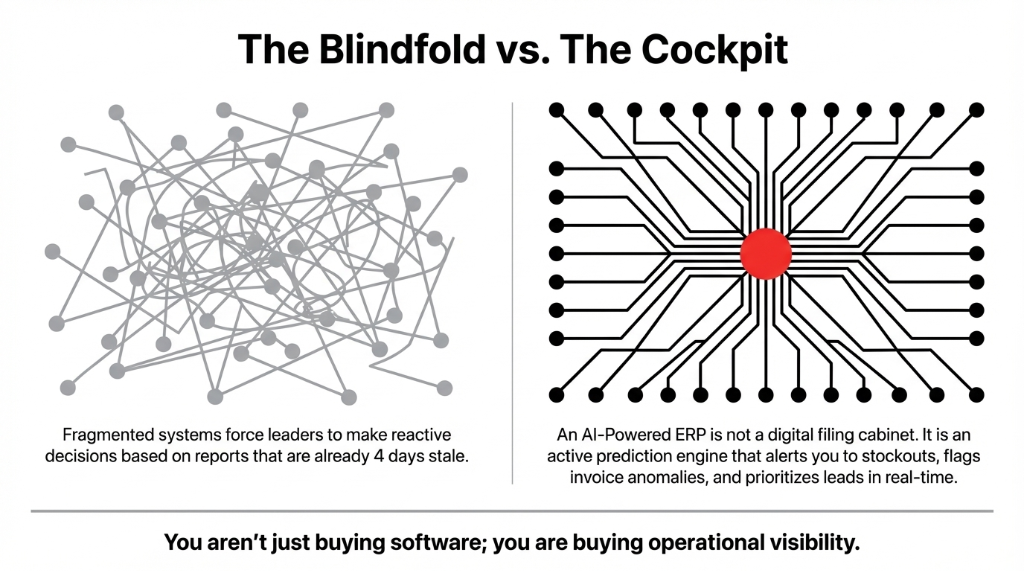
Marcus’s words on a follow-up call: “It’s like I finally have a cockpit instead of a blindfold.”
What This Means for US Manufacturers and Businesses Right Now
If you are running a manufacturing, distribution, or D2C business between $1M and $25M ARR in the US, and you are still patching together it erp system modules from three different vendors—you are running Marcus’s old operation.
Erp stands for more than just enterprise resource planning. In 2026, it stands for the difference between a business that sees its numbers in real time and one that discovers its problems 4 days late.
Artificial intelligence and business are no longer two separate conversations. Ai and automation inside odoo erp is how 170,000+ businesses across 5 continents—including 3 of the world’s Big Four audit firms—are running operations right now. Odoo reached 13,000+ new clients per month as of late 2025 and hit a record €20M in new ARR in January 2026. This is not a niche open erp experiment. It is the fastest-growing enterprise resource planning platform in the world.
Ai technology business is not about replacing your team. It is about giving your 62-person company the operational intelligence that used to require a 200-person team. Ai for business at the ERP layer means your finance, manufacturing, supply chain, and customer service systems are all running on the same real-time data—and acting on it automatically.
Marcus’s Results in Black and White
$17,800/month recovered within 90 days
$29,400 in hidden errors uncovered during migration
Customer complaint volume down 87%
Production downtime reduced 84%
He now books quarterly Odoo reviews not to troubleshoot—but to see what new AI capabilities he can deploy next.
That is what it looks like when ai helps a real business stop leaking and start scaling.
Frequently Asked Questions
How long does an Odoo ERP implementation take for a US manufacturer?
Most US manufacturers in the $1M–$20M ARR range go live in 30–60 days with Braincuber. The speed depends on how clean your existing data is, not how big your team is. Messy QuickBooks exports with years of uncategorized transactions add 2–3 weeks. We run parallel systems for a minimum of 10 days before full cutover—nothing disappears, nothing gets cut over blind.
What ROI can we realistically expect from AI-powered Odoo ERP in the first 90 days?
Based on our last 60+ US implementations, clients recovering $10,000–$25,000 per month within 90 days is the norm. Fastest wins come from automated invoice reconciliation, eliminating stockout-driven downtime, and cutting customer service rework. Companies with mature ai erp integration report up to 340% ROI in year one.
Is Odoo a good ERP for small business and mid-market manufacturing in the US?
Yes—it is the only top erp systems for manufacturing we recommend for US businesses between $1M and $30M ARR. At $24.90–$37.40/user/month for the custom tier, it delivers the same erp for manufacturing capabilities—MRP, PLM, Quality, Maintenance—as SAP and NetSuite at 40–60% lower total cost of ownership.
How is Braincuber’s Odoo implementation different from a standard partner?
Standard odoo partners configure modules. We embed ai automation into every workflow using Agentic AI frameworks—ai workflow automation, predictive demand forecasting, ai in customer service routing, and real-time ai analytics dashboards. The system predicts problems and automates responses, not just records history. That embedded ai and business intelligence layer drives 90-day ROI instead of 18-month payback periods.
What happens to our existing QuickBooks or legacy ERP data during migration?
We run a full data audit before migration—which uncovers duplicate entries, missing cost allocations, or uncategorized transactions worth real money in 73% of our cases. All historical data migrates into Odoo. We run parallel systems for 10–15 days before full cutover. Nothing is deleted without your explicit sign-off, and every historical transaction is accessible in Odoo from Day 1.
Stop Letting Disconnected ERP Tools Drain Your Margins
Book our free 15-Minute Operations Audit—we will find your biggest operational leak in the first call. No slides. No pitch deck. Just a direct diagnosis from a team that has fixed this exact problem 150+ times globally.
Book Your Free 15-Minute Operations AuditAlready running Odoo but not seeing ROI? Ask about our Odoo AI Activation Sprint—we deploy the AI layer your original partner left out.