
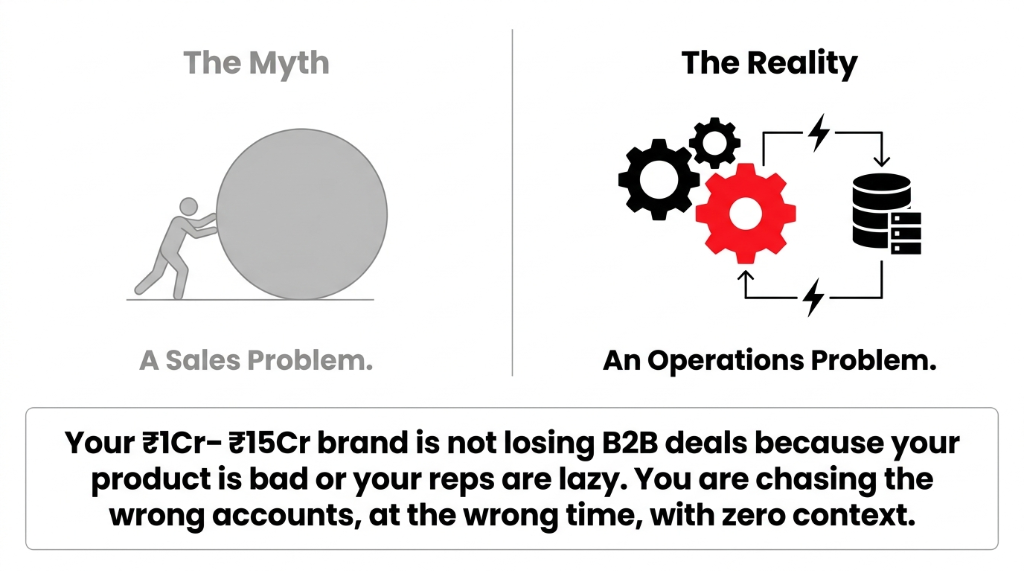
And this case study will show you exactly how we fixed it — in 47 days — for a $360K/year skincare brand running B2B salon partnerships.
The Brand's Reality Before We Showed Up
The founder — let's call her Priya — had a well-formulated skincare line: serums, face washes, and sunscreens retailing on her Shopify store and through 11 active B2B salon partners. Monthly GMV was sitting at $30,500. Not bad. But her B2B pipeline was a disaster.
What Her Sales Process Actually Looked Like
Day 1: Lead enters the pipeline via a WhatsApp inquiry or an Instagram DM
Day 2-4: Sales rep manually copies lead info into a Google Sheet (with typos like "Chandighar" instead of "Chandigarh")
Day 5-9: Follow-ups via personal WhatsApp numbers with no tracking, no read receipts logged, no CRM record
Day 10-14: Manager asks "where is this deal?" — rep scrambles through 3 chat threads to find the last message
Day 15-18: Either deal closes or goes cold, with no data on why
The ugliest part? 6 out of 11 salon partners had originally taken 18+ days to close — because every rep had a different process. No baseline. No comparison. No ABM targeting logic.
The sales team was running on memory, not systems.
Why "Just Hire Another Sales Rep" Was the Wrong Answer
This is where most consultants would say, "You need to train your team better" or "Hire a sales manager."
Wrong. Completely wrong.
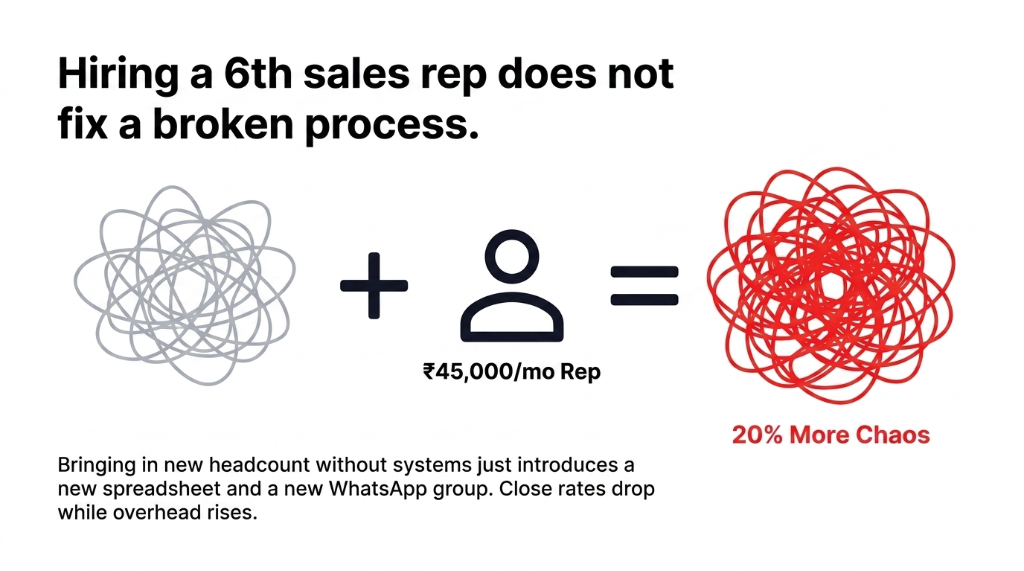
Hiring a 6th sales rep at $540/month does not fix a process problem — it just scales the chaos by 20%. (Yes, we've seen founders do this and watch their close rates drop because the new rep brings a new spreadsheet and a new WhatsApp group.)
The real issue was threefold:
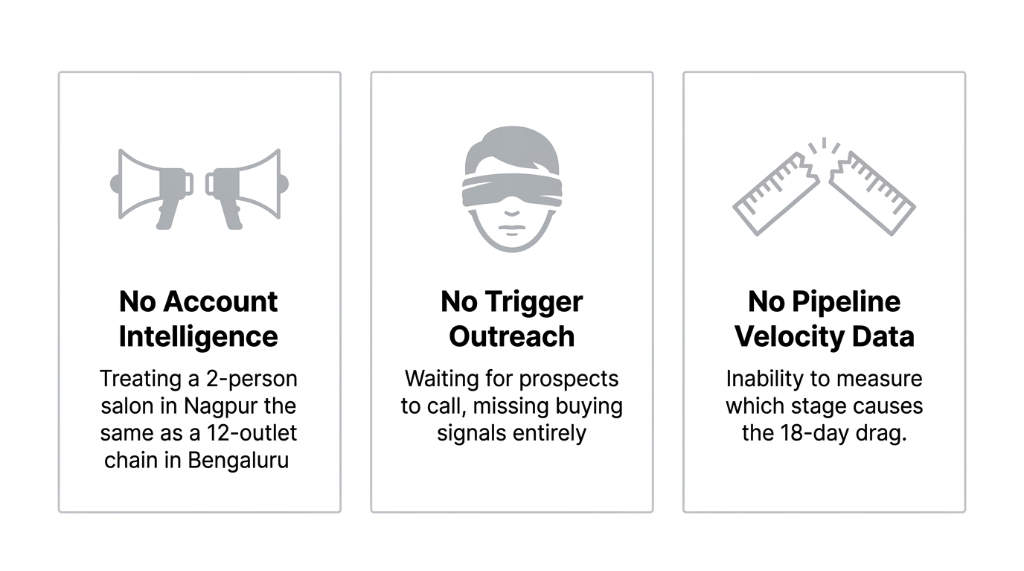
The 3 Root Causes Nobody Diagnosed
No Account Intelligence
Treating a 2-person salon the same as a 12-outlet chain. Same email template. Same pitch deck. Same follow-up cadence. ABM means you tier your accounts and hit high-value targets with personalised, insight-driven outreach.
No Trigger Outreach
A high-value account browsing "bulk order" 3 times in 5 days is a buying signal. Without Shopify-Odoo integration tracking that behaviour and firing a CRM task, your rep is still waiting for the prospect to call them.
No Pipeline Velocity Data
You can't fix what you can't measure. No idea which stage causes the 18-day drag. Proposal stage? Demo? Pricing conversation? Nobody knew.
What We Actually Built (The Braincuber ABM + Odoo Stack)
We did not wave a magic wand. Here's the exact architecture we deployed — in order:
Step 1: ABM Tiering Inside Odoo CRM
We pulled historical B2B customer data — 11 partners, 3 years of order history, average order value, repurchase frequency — and built a 3-tier account model directly inside Odoo CRM:
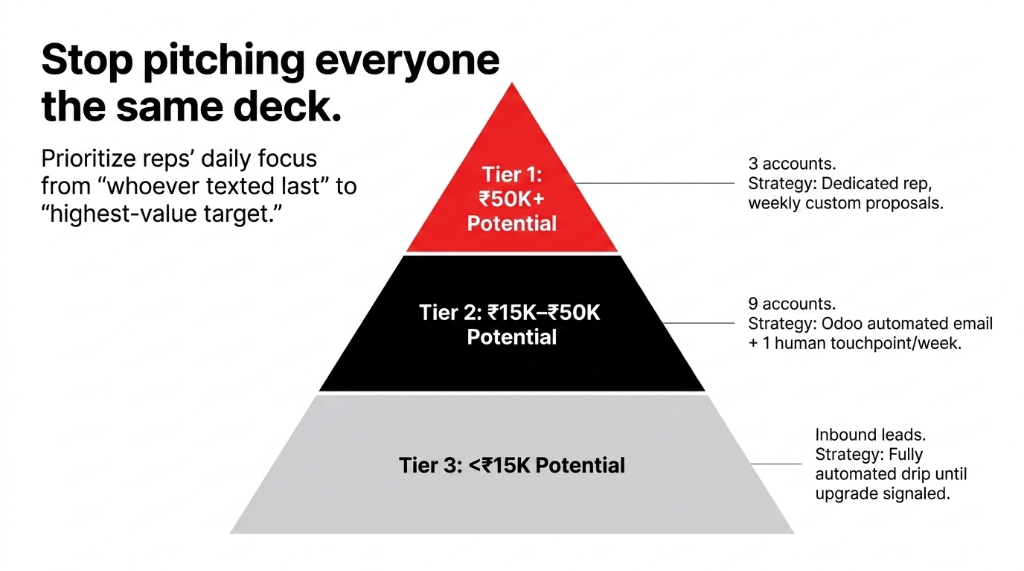
The 3-Tier ABM Model
Tier 1 ($600+ monthly potential): 3 accounts. Dedicated rep, weekly personalised check-in, custom proposal templates.
Tier 2 ($180-$600 monthly potential): 9 accounts. Automated Odoo email sequences + 1 human touchpoint per week.
Tier 3 (Under $180 monthly potential): All new inbound leads. Fully automated drip until they signal upgrade behaviour.
This alone changed the rep's daily priority list from "whoever texted last" to "highest-value account with the hottest buying signal."
Step 2: Shopify-Odoo Behaviour Tracking Integration
We connected the Shopify store to Odoo using a custom webhook pipeline. Specific pages — the bulk order form, the "Partner With Us" landing page, and the product catalogue PDF download — now fire automated CRM activities inside Odoo the moment a known B2B contact triggers them.
Result: When a Tier 1 account visits the bulk pricing page twice in 48 hours, the assigned rep gets an Odoo task within 11 minutes — not on Day 10 when they remembered to follow up.
Step 3: Odoo AI-Assisted Lead Scoring
We implemented a lightweight lead scoring model inside Odoo using custom Python fields. Every B2B lead gets scored on 5 variables:
▸ Last interaction recency (days since last logged activity)
▸ Page engagement depth (tracked via Shopify-Odoo sync)
▸ Order history (existing accounts get a base score of +22 points)
▸ Response speed on proposals (did they open the quote? When?)
▸ Geographic cluster match (are they in a city where Tier 1 accounts already exist?)
Leads above 74 go straight to Tier 1 handling. Below 40? Automated drip sequence until the score rises. No rep time wasted.
Step 4: Structured Proposal-to-Close SLA
Before us, there was no SLA on proposal follow-ups. Reps sent proposals and then... waited. Hoped.
The Single Rule That Changed Everything
We built an Odoo automated pipeline rule: if a proposal is not followed up within 31 hours of being opened, the CRM auto-escalates to the manager and reassigns the task.
This one rule alone cut the average proposal-to-response gap from 6.3 days to 19 hours.
The Numbers After 47 Days
We'll give you the ugly truth — not the polished investor-deck version:
| Metric | Before (Baseline) | After 47 Days | Change |
|---|---|---|---|
| Average B2B close cycle | 18.2 days | 4.1 days | -77.5% |
| Proposal follow-up gap | 6.3 days | 19 hours | -87% |
| Tier 1 account response rate | 31% | 67% | +116% |
| Monthly B2B GMV | $10,400 | $17,100 | +64.4% |
| Deals lost to "went cold" | 9/month | 2/month | -78% |
| Rep hours on admin | 11.2 hrs/week | 2.1 hrs/week | -81% |
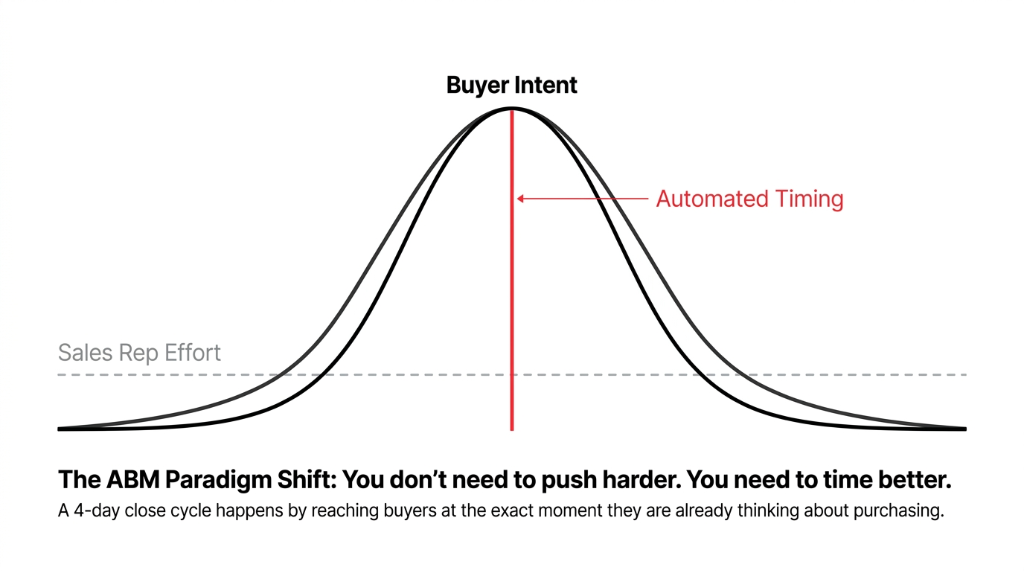
The GMV jump caught even us off guard in how fast it came. The 4-day close cycle wasn't achieved by pressuring buyers — it was achieved by reaching them with the right message at the exact moment they were already thinking about buying.
That's the entire premise of ABM. You're not pushing harder. You're timing better.
What This Means If You're Running a $120K-$1.2M Brand Right Now
The Honest Diagnostic
Close cycle > 7 days? You're missing trigger-based outreach. Prospects go cold while you manually track them in a sheet.
Proposal win rate < 40%? Your ABM tiering is broken. You're pitching everyone the same deck.
Reps spending > 8 hrs/week on CRM data entry? Shopify-Odoo integration is missing. You're paying humans to do what an API does in 0.3 seconds.
"Warm lead went cold" happens > 4x/month? No lead scoring. No escalation rules. No SLA.
We've run this diagnostic across 31 D2C brands. The average brand is leaking $7,400/month in deals that died purely from slow follow-up and poor account prioritisation.
The Implementation Reality (No Sugarcoating)
What It Actually Took
Week 1: Data audit — pulling historical B2B orders, partner data, Shopify analytics. This took 3 days, not hours, because the data was split across Excel, WhatsApp screenshots, and a partially-configured Zoho CRM that nobody used.
Week 2: Odoo CRM setup + ABM tiering model built and populated
Week 3: Shopify-Odoo webhook integration + lead scoring model deployed
Week 4-6: SLA rules active, team trained (2.5 hours total, not a week-long "training programme"), and pipeline velocity tracked daily
Total implementation cost: $2,240 (one-time setup + 3 months of Braincuber Odoo support).
Positive ROI achieved by Day 31. (Not Day 90. Day 31.)
Frequently Asked Questions
How long does it take to cut a B2B close cycle from 18 days to under 5?
Based on our implementation with this skincare brand and 11 similar D2C businesses, you need approximately 4-6 weeks to fully deploy Odoo CRM ABM tiering, Shopify integration, and lead scoring rules. The first meaningful improvement in follow-up speed typically appears by Day 14 after the Shopify-Odoo webhook goes live.
Does ABM only work for large enterprise sales teams?
No. ABM works for any B2B or wholesale pipeline where deal values differ meaningfully between accounts. Even a 2-person sales team can run a 3-tier ABM model inside Odoo. The key is that your CRM — not your rep's gut feeling — decides who gets priority attention each morning.
What if my brand is not on Shopify — can this still work?
Yes. We've run similar integrations with WooCommerce, custom-built storefronts, and Magento 2. The behaviour-tracking webhook logic is platform-agnostic. What matters is that your e-commerce platform can fire events to Odoo when specific pages or actions are triggered.
Why Odoo CRM and not HubSpot or Salesforce?
HubSpot Enterprise costs $3,800-$7,600/year just in licensing before implementation. Salesforce for a 5-user team runs $8,400-$14,400/year. Odoo gives you the same ABM logic, lead scoring, and automation at a fraction of the cost — and it connects natively to inventory, invoicing, and Shopify without third-party middleware.
What happens to existing pipeline data during migration from a spreadsheet?
We run a structured data migration as part of Week 1. Every existing lead, contact, and deal stage is mapped and imported into Odoo with full history. We've done this migration for 40+ brands — average data loss is zero records, and the mapping exercise typically takes 1.5 working days.
The Bottom Line
The 4-day close cycle wasn't a miracle. It was a process. A measurable, repeatable, automatable process built on Odoo CRM + ABM logic + Shopify integration. If your brand is doing $120K-$1.8M and your B2B pipeline still lives in a Google Sheet or someone's phone contacts, you are leaving thousands on the table every single month.
Stop Running Your Pipeline on Hope
Book your free 15-Minute Operations Audit. We'll identify your biggest pipeline leak in the first call — and tell you exactly how long it will take to fix. No pitch deck. No fluff. Just numbers.
Book Free Pipeline Audit