
Here is the ugly truth: most D2C brands have no idea what their influencer gifting programme actually costs. They track the product cost (sometimes). They forget the packaging (almost always). They never account for the warehouse labour to pick-and-pack 200 individual gift boxes, the 3PL handling fee per parcel, the custom printed card, or the 19-minute average time their ops team spends on each "VIP kit."
When you add it all up, what looks like a $4.50 product giveaway becomes a $25 fully loaded cost per influencer package. Multiply that by 200 packages a quarter. You just hit $5,040.
The Gifting Budget Lie Your Spreadsheet Tells You
We see this in brands across India, UAE, and the UK — but it is especially bad where D2C founders run their gifting ops out of WhatsApp groups and Google Sheets.
| Cost Component | What They Track | What Actually Happens |
|---|---|---|
| Product COGS | $3.80 per unit ✓ | Tracked |
| Packaging & inserts | $0 (considered "marketing") | $2.15 per kit — untracked |
| 3PL pick-pack-dispatch | $0 (bundled in monthly invoice) | $2.50 per parcel — untracked |
| Warehouse labour (19 min/kit) | $0 | $1.13 per kit — untracked |
| Courier (national/international) | $0.71 (estimated) | $1.55 actual average — untracked |
| Personalisation (cards, ribbons) | $0 | $1.01 per kit — untracked |
| Replacements (damaged/lost) | $0 | $0.77 per kit averaged — untracked |
| TOTAL PER KIT | $4.51 (perceived) | $12.91 (actual) |
At 200 kits per quarter, that delta alone is $1,680 in untracked costs — per quarter. Add in brands doing 350-400 kits (beauty and fashion verticals), and you are at $5,040-$5,760 per quarter that is functionally invisible to your P&L.
(Yes, we know your CMO is going to push back on this. Show them the 3PL invoice line items.)
Why Your "Influencer Management Tool" Solves Exactly the Wrong Problem
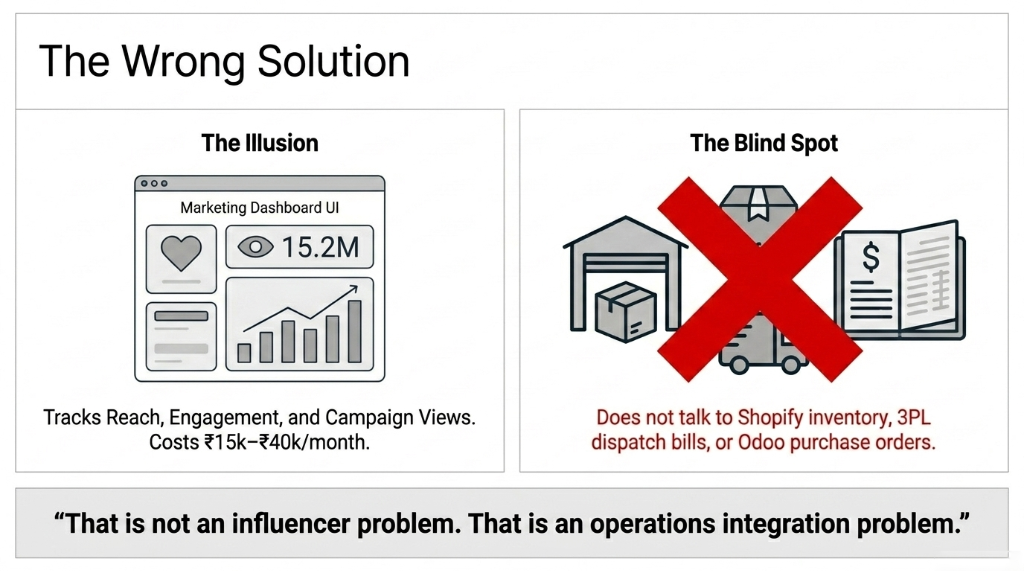
This is where most founders get it wrong. They buy an influencer marketing platform — Wobb, Plixxo, Heepsy — spend $180-$480/month on software, and believe the problem is solved.
It is not.
Those tools track reach, engagement, and campaign metrics. They do not talk to your Shopify inventory. They do not pull your 3PL dispatch costs. They do not reconcile against Odoo's purchase orders or your vendor bills.
That is not an influencer problem. That is an operations integration problem.
The data lives in four different places — your 3PL portal, your Shopify back-end, your courier aggregator, and your accounting software. None of them talk to each other. And nobody in your team has the bandwidth to manually reconcile a 200-line gifting dispatch sheet every quarter.
So it just doesn't get done.
The Real Cost Breakdown We Found (The Audit Story)
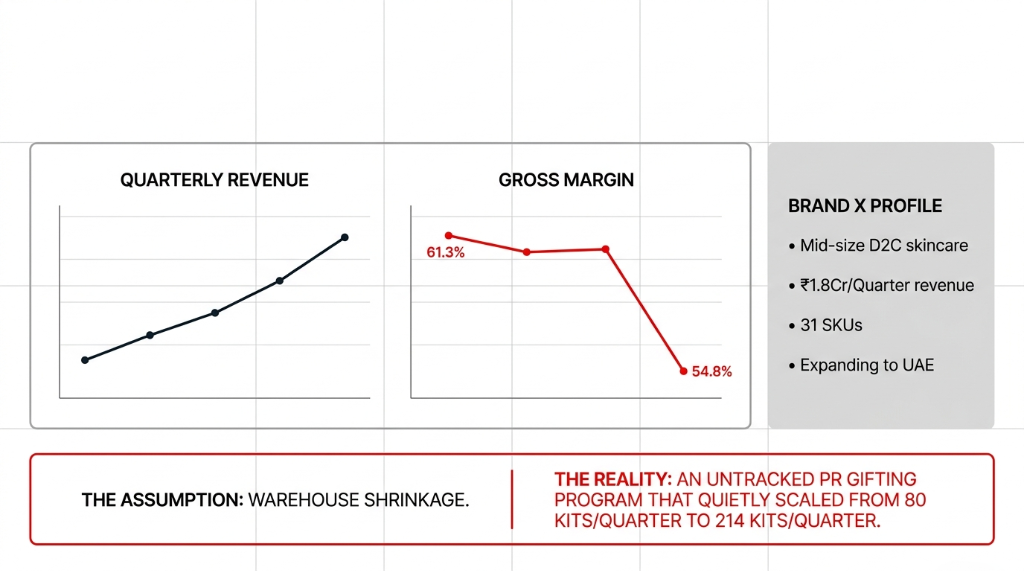
Let us walk you through exactly what we uncovered for this skincare brand — call them Brand X, $216K/quarter revenue, 7-year-old D2C business, 31 SKUs, operating across India and starting UAE expansion.
Audit Trigger: The Gross Margin Mystery
Gross margin had dropped from 61.3% to 54.8% over two quarters. No spike in ad spend. No supplier price hike. The founder thought it was shrinkage at the warehouse.
What we found instead: Their gifting programme had quietly scaled from 80 kits/quarter to 214 kits/quarter — driven by a new influencer-first marketing strategy. But the cost-tracking methodology never scaled with it. The ops team was still booking all gifting under a single journal entry: "Marketing Expenses — Samples."
The Full Quarterly Cost Breakdown We Reconstructed
Product COGS (214 × $3.80)
$813
Packaging & inserts (214 × $2.15)
$460
3PL pick-pack-dispatch (214 × $2.50)
$535
Warehouse labour (214 × $1.13)
$242
Courier costs (214 × $1.55)
$332
Personalisation + Replacements
$381
Grand Total: $5,040/year across 2 quarters
They had booked $965 of this. $4,075 was completely invisible to their P&L.
How Odoo ERP Fixed This in 47 Days
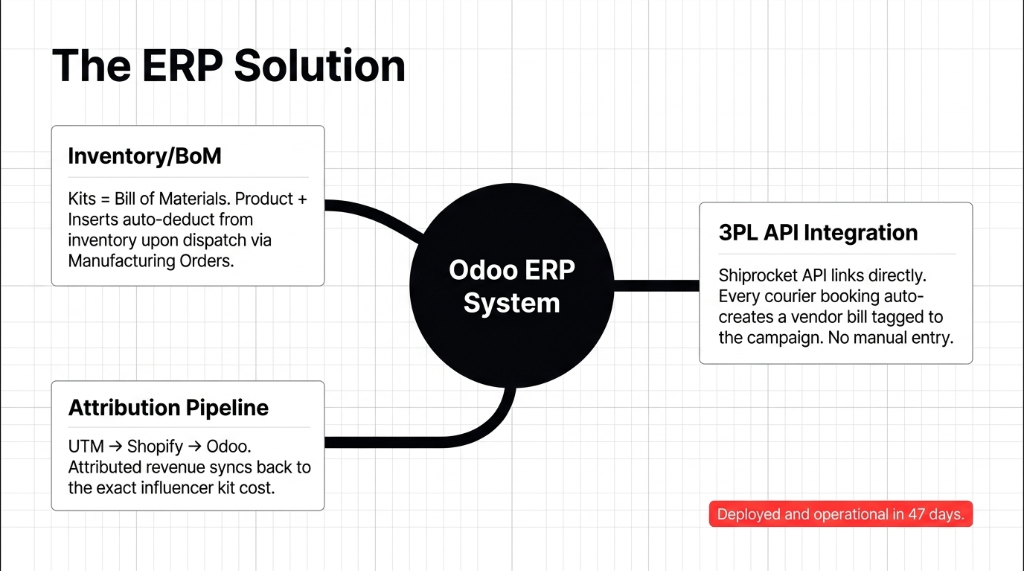
We did not sell Brand X a new gifting platform. We mapped their entire gifting workflow into Odoo's Inventory + Purchase + Accounting modules — with a custom Gifting Campaign module that took our team 11 working days to build.
The 4-Part ERP Fix
1. Every gifting kit became a Bill of Materials (BoM) in Odoo. Product + packaging + inserts = one BoM. Every time a kit was dispatched, Odoo auto-deducted all components from inventory via Manufacturing Orders.
2. 3PL dispatch costs auto-linked via API. Every courier booking for a gifting parcel auto-created a vendor bill entry tagged to the relevant influencer campaign. No manual entry. No missed invoices.
3. Influencer attribution via UTM → Shopify → Odoo. Custom UTM links for each influencer fed Shopify conversion data synced into Odoo. Now Brand X could see: Influencer A cost $27.80 (fully loaded) and drove $175 in attributed revenue. Influencer B cost $25.90 and drove $10.80.
4. Auto-generated quarterly gifting P&L report. One click. Every quarter. Full cost per influencer, full attributed revenue per influencer, net ROI per campaign.
Results After 2 Quarters on Odoo
▸ Gifting cost visibility: 0% → 100%
▸ Influencers cut from 214/quarter to 91/quarter (bottom 57% were ROI-negative)
▸ Cost per attributed $1 of revenue: $0.78 → $0.31
▸ Gross margin recovery: +4.7 percentage points in Q1 post-implementation
▸ Annual saving from programme rationalisation: $11,100/year
(That's 4.3× the cost of the Odoo implementation. In year one.)
What "ABM" Has to Do With Influencer Gifting
Here is the piece almost no D2C ops consultant will tell you: your influencer gifting programme IS an Account-Based Marketing (ABM) strategy — it just lacks the infrastructure that ABM demands.
ABM says: identify your highest-value target accounts (influencers with the highest conversion rate), allocate budget specifically to those accounts, personalise the engagement, and track ROI at the account level. Your gifting programme sends the same box to 214 people and tracks nothing.
The 3-Tier Influencer ABM Model We Built
Tier 1 (18 influencers): Fully loaded cost budget $53/kit. Custom kits. Priority follow-up. Revenue attribution mandatory.
Tier 2 (43 influencers): Standard kit at $25/kit. Tracked by UTM. Quarterly review.
Tier 3 (30 influencers): Digital-only gifting (product credit, not physical). $0 logistics cost.
This cut logistics cost by 43% and improved attributed revenue by 61% — because the brand stopped over-investing in influencers who never converted and under-investing in the 18 who drove 73% of tracked revenue.
The Comparison That Should Bother Every D2C CMO
| Metric | Before Odoo (Manual) | After Odoo (Integrated) |
|---|---|---|
| Gifting cost visibility | 19% of actual cost | 100% of actual cost |
| Influencers tracked/quarter | 214 | 91 (ROI-positive only) |
| Cost per attributed $1 revenue | $0.78 | $0.31 |
| Quarterly gifting cost | $2,763+ (untracked) | $1,314 (optimised) |
| Gross margin | 54.8% | 59.5% |
| Time to generate gifting P&L | 11 hours manual | 4 minutes (auto-report) |
| Re-dispatch/damage rate | 9.3% untracked | 3.1% actively managed |
Frequently Asked Questions
Can Odoo track influencer gifting costs even if we use a 3PL?
Yes. Odoo integrates with major 3PLs via API. Every dispatch event auto-creates a vendor bill and deducts inventory. We have done this integration for 14 brands. Setup takes 5-8 working days.
How long before we see ROI on the Odoo implementation for gifting?
Brand X saw 4.3x ROI in year one. Typically, our clients break even in 67-90 days — specifically because gifting programme rationalisation delivers immediate quarterly savings, not deferred ones.
What if our gifting programme is small — under 50 kits/quarter?
Even at 50 kits, the untracked cost delta is $420-$660/quarter. At 200 kits it's $3,900+. The Odoo gifting module pays for itself at both scales. The real question is not kit volume — it's whether you know your ROI per influencer.
Does this work for brands selling in UAE and UK, not just India?
Yes. We have implemented this exact gifting cost model for a UAE-based beauty brand and a UK fashion D2C. The BoM and cost structure is currency-agnostic. The 3PL API integrations differ but the Odoo core module is identical.
Will this require changing how our marketing team manages influencers?
No. Your marketing team keeps their influencer CRM or spreadsheet for relationship management. Odoo operates at the operations and finance layer — inventory, dispatch, cost allocation, and reporting. We connect the two via campaign tags and UTM tracking, not by replacing your team's workflow.
Stop Bleeding Cash Into a Gifting Programme That Can't Prove Its Own ROI
Book our free 15-Minute Operations Audit — in the first call, we will show you exactly what your influencer gifting programme is actually costing you per quarter, and whether your current stack can track it.
Book Free Gifting Audit