
Quick Answer
An Ohio auto parts manufacturer (94 employees, $11.3M revenue) was losing $203,400/year across manual data re-entry, quality defect scrap, rush orders from supply chain blind spots, and sales admin waste. Braincuber deployed a custom AI agent built on LangChain + CrewAI that integrated with their existing SAP and QuickBooks — no rip-and-replace. In 90 days: data entry hours dropped 95%, scrap rate fell from 2.3% to 0.6%, rush orders cut 80%, and sales admin reclaimed 19 hours/week. Total build: $47,200. Payback: 2.8 months.
The Mess We Walked Into
When we got on the first call, the VP of Operations said something we hear from business owners every single week: "We're busy but not growing."
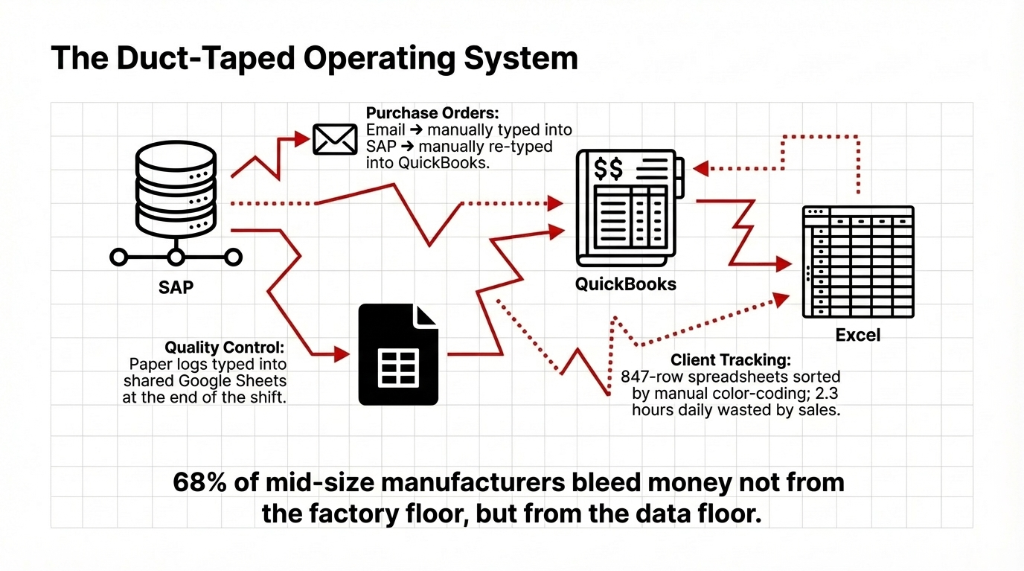
That phrase is a red flag. It means your business operations are burning labor on process, not progress. We asked for a simple walkthrough of one work day — from the moment the first shift started to the moment the last order was shipped. What we found was not a business operating system. It was three disconnected tools duct-taped together with Excel, SAP, and QuickBooks — none of which talked to each other.
The Work Day From Hell
Purchase orders came in via email. Someone manually entered them into SAP. Someone else manually re-entered them into QuickBooks. A third person updated the client tracking spreadsheet — 847 rows deep, sorted by color coding. (Yes, color coding.)
The sales team spent 2.3 hours every day updating their crm client management records manually because their client management system didn't pull from SAP.
Quality: Paper First, Data Later
Quality inspection results were logged on paper, then typed into a shared Google Sheet at the end of each shift — sometimes the next shift. The business process management here wasn't management. It was organized chaos.
68% of mid-size manufacturers bleed money not from the factory floor — but from the data floor.
The $203,400 Leak — Broken Down to the Dollar
Before we talk about the fix, you need to see the math. Because if you're a business owner reading this and thinking "that's not us," check your own numbers first.
| Leak | Root Cause | Monthly Cost |
|---|---|---|
| #1: Manual Data Re-Entry | 4 employees x 1.5 hrs/day copying between SAP, QuickBooks, and client tracking software at $34/hr | $6,200/mo |
| #2: Quality Defect Scrap | Reactive QC with paper logs. 2.3% scrap rate on monthly volume at $94/part avg cost | $5,800/mo |
| #3: Rush Orders | No supply chain visibility. 3-5 SKU shortages/month, $1,680/rush order avg expedited shipping | $8,400/mo |
| #4: Sales Admin Waste | Leads from website to shared inbox to spreadsheet. 23 hrs/week admin vs. 4 hrs needed. 19 wasted hrs/rep/week | $3,200/mo |
| Total Confirmed (after overlap adjustment) | $16,950/mo = $203,400/yr | |
Why Adding More Software Would Have Made It Worse
Controversial opinion that our b2b partners hate us for: buying better management software is rarely the answer.
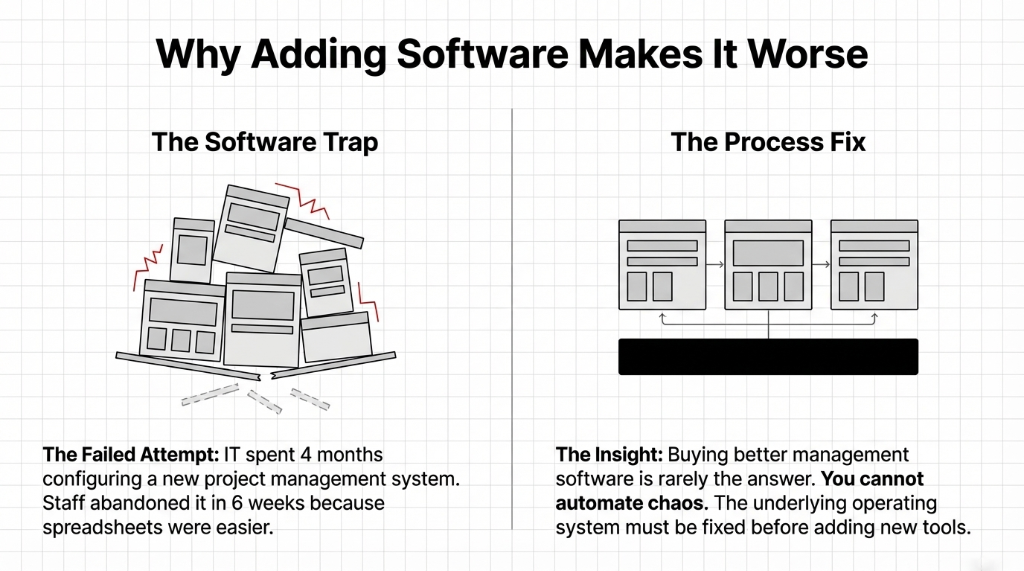
This client had already tried. Two years before we arrived, they purchased a project management system — one of the well-known ones. Their IT team spent 4 months configuring it. Their staff management used it for 6 weeks, then went back to the spreadsheet because "it was easier."
The Real Problem
The problem wasn't the tool. The problem was that nobody built the business operating system that sits underneath the tools. The data flows, the triggers, the decision rules — none of that existed. Most business process management software implementations fail not because the software is bad but because the process itself was never designed.
You can't automate chaos. You have to fix the process first, then automate it. That's process improvement done right — through our AI solutions.
What We Actually Built
We deployed a custom AI agent using LangChain + CrewAI, integrated directly with their existing SAP instance and QuickBooks — no rip-and-replace, no 9-month implementation.
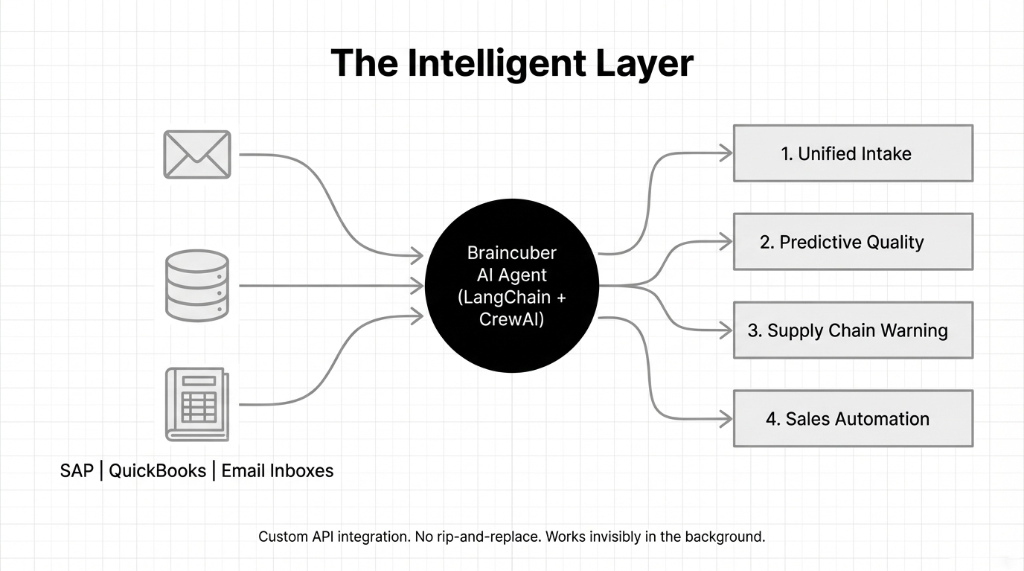
The 4-Layer AI Agent Architecture
Layer 1: Unified Data Intake
Every purchase order, supplier update, and quality log flows into one system. The AI agent reads incoming data from all three sources and normalizes it automatically. No human typing. Zero re-entry. The client management system, the ERP, and the accounting tool stay in sync in real time. Work management that actually works.
Layer 2: Predictive Quality Monitoring
Instead of logging defects after the fact, the AI agent monitors 11 production variables per shift and flags anomaly patterns before a batch goes bad. Defects dropped from 2.3% to 0.6% in 67 days. That's $5,100/month recovered on material waste alone. Data driven decisions on quality.
Layer 3: Supply Chain Early Warning
The agent monitors supplier lead times from their vendor portal, cross-references against current inventory and production schedule, and fires alerts 11 days before a projected stockout. Rush orders: 5/month to 1/month. Monthly expediting costs: $8,400 to $1,680. Sales and operations finally in sync.
Layer 4: Sales Process Automation
Every new lead auto-qualified, assigned to a rep, logged in client tracking software — within 4 minutes of form submission, all hours of the day. The sales system makes data driven decisions on lead priority based on company size, industry, and inquiry type. Sales team reclaimed 19 hours/week to actually sell.
The Results at 90 Days
We don't do estimates. Here are the actual numbers from their first 90-day review:
| Metric | Before | After 90 Days |
|---|---|---|
| Monthly manual data entry hours | 248 hrs | 11 hrs |
| Quality defect scrap rate | 2.3% | 0.6% |
| Rush orders per month | 5 | 1 |
| Lead response time | 6.2 hours | 4 minutes |
| Sales team admin hours/week | 23 hrs | 4 hrs |
| Monthly operational savings | $0 recovered | $16,950/month |
The Bottom Line
$203,400
Annualized savings confirmed after full audit. Not a projection. Not a forecast. Actual recovered operational cash from the first 12 months.
$47,200
Total build cost. Includes integration, testing, and 90 days of managed support. No hidden licensing fees. No annual SaaS trap. You own it.
2.8 Months
ROI payback period. Under 3 months from deployment to full cost recovery. Scaling a business doesn't mean hiring more people — it means making your existing business systems work harder.
This Is Not a "Futuristic" Story
The AI in manufacturing market in the US was valued at $0.9 billion in 2023 and is projected to hit $6.0 billion by 2028 — a 46% CAGR. Companies that implement agentic AI in manufacturing report 20-40% reductions in operational costs and 50-80% decreases in quality defects.
This Ohio manufacturer wasn't some Fortune 500 company with a $10M tech budget. They had 94 employees, $11.3M in annual revenue, and a VP of Ops who spent 3 hours every work day putting out fires that the AI agent now handles before they start — through our AI development services.
The Real Insight: Scaling a business doesn't mean hiring more people. It means making your existing business systems work harder than your people do. When your management operating system is broken, no amount of team management software, agency management systems, or business operating software will fix it. You need the underlying process rebuilt first — and then automated. That's what we do at Braincuber.
5 FAQs: AI Agent for Manufacturing
How long does it take to deploy an AI agent for a manufacturing business?
6-9 weeks from kickoff to go-live for mid-size manufacturers with existing ERP and accounting tools. Includes process mapping, integration, agent training, and staff onboarding. First measurable savings usually appear in week 3 or 4.
Does the AI agent replace existing management software?
No. It works alongside SAP, QuickBooks, NetSuite — whatever you're running. Connects via API, reads and writes data, acts as the intelligent layer your current business process management software never was. Your team keeps using the tools they know.
What does it cost to build an AI agent like this?
Most mid-size manufacturing implementations run $38,000-$65,000 depending on integrations and automation layers. Average payback across our last 12 US manufacturing projects: 2.4 months. The ROI math is not complicated — it's the decision to act that slows most business owners down.
Do we need to "clean up our data" first?
Partially. Dirty data is real, but it's the most overused excuse to delay automation. In 9 out of 10 implementations, we automate business processes using existing data while building cleaner architecture simultaneously. Waiting for perfect data keeps manufacturers stuck for 3 more years.
We tried project management software and our team stopped using it. How is this different?
An AI agent doesn't require your team to change behavior — it changes the system behavior around them. Staff management doesn't need to log into another platform. The agent pulls from where the work already happens. Adoption isn't a challenge when the tool works invisibly in the background.
Stop Bleeding Operational Cash
If you're a US-based manufacturer doing $3M-$30M in annual revenue and you're running SAP, QuickBooks, NetSuite, or a mix of legacy tools glued together with spreadsheets — your business is almost certainly leaking money in one or more of these four areas. We'll find it in 15 minutes. No pitch decks. No fluff. Just numbers.
Braincuber Technologies — 500+ AI and ERP implementations across the US, UK, UAE, and Singapore. Custom AI agents, Odoo ERP, and cloud infrastructure for manufacturers who are serious about save time and increase revenue.