
The Quarter Agentic AI Stopped Being a Demo
The single biggest story of Q1 2026 was not a new model release. It was the moment AI agents stopped being a conference slide and became a production reality.
Gartner projected that 40% of enterprise applications would embed AI agents by end of 2026 — up from less than 5% in 2025. We watched that number start materializing in real-time this quarter. Companies stopped asking "should we use agents?" and started asking "which orchestration framework do we deploy first?"
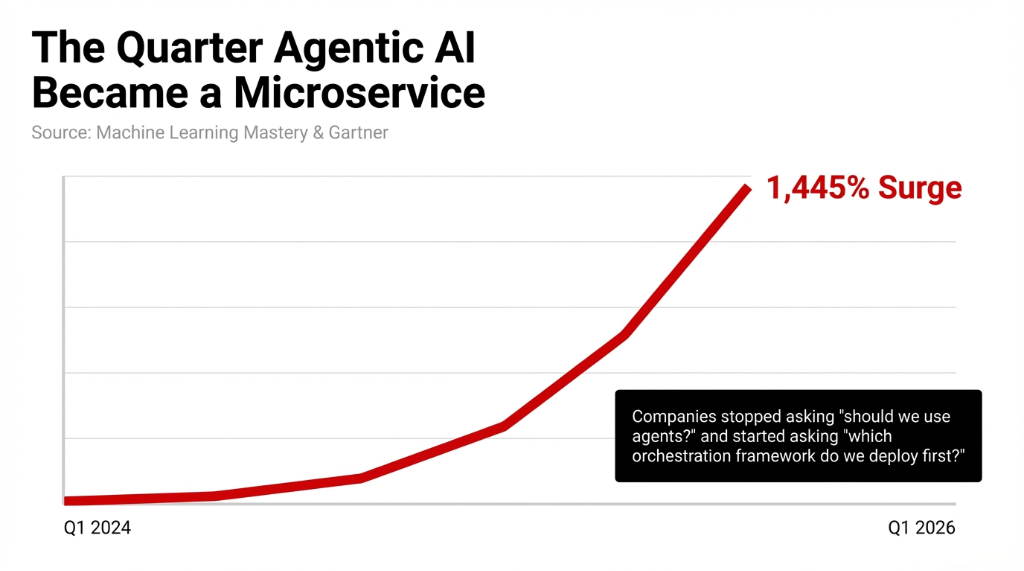
The best AI blog content on this came from Machine Learning Mastery, which published "7 Agentic AI Trends to Watch in 2026" in early January. It detailed the shift from single-purpose AI models to multi-agent systems — what they called the "microservices moment" for artificial intelligence. Gartner reported a 1,445% surge in multi-agent system inquiries from Q1 2024 to Q2 2025. That number is why every serious AI company is now building agent orchestration infrastructure rather than another chatbot.
The Three-Tier Agent Ecosystem
Tier 1: Hyperscalers
AWS, Azure, GCP owning foundational compute. They provide the infrastructure layer — SageMaker, Bedrock, Vertex AI. Not sexy. But nothing runs without them.
Tier 2: Enterprise Vendors
Salesforce, SAP, Odoo embedding agents into existing platforms. This is where most $3M-$10M companies will first encounter agents — inside tools they already pay for.
Tier 3: Agent-Native Startups
Building from scratch with agents as the primary interface. This is where the disruption is happening. If you run an AI agency or are building an AI application, watch this tier.
What MIT Sloan Review Got Right About AI Trends
MIT Sloan Management Review kicked off the year with "Five Trends in AI and Data Science for 2026" — and it remains the most cited AI blog post from January.
The Five Trends MIT Sloan Flagged
1. AI Bubble Deflation: The technology hype cycle is correcting. Investors are demanding ROI proof, not pitch decks with "AI" in the title.
2. Factory Infrastructure: All-in AI adopters building dedicated compute and data factories — not renting API calls.
3. Generative AI Goes Organizational: Shifting from personal productivity toys to company-wide operational tools.
4. Agentic Value (Despite Hype): Real production deployments happening despite the noise surrounding agent capabilities.
5. Governance Black Hole: Who is accountable when the cloud AI model makes a wrong decision at scale? Most organizations cannot answer this. That is the problem.
That last point hit hardest. AI and cloud infrastructure has scaled so fast that most organizations cannot answer a basic question: who is accountable when the cloud AI model makes a wrong decision at scale? This gap between AI technology deployment speed and governance maturity is what the best artificial intelligence content of Q1 kept circling back to.
The Generative AI Numbers That Stopped Timelines Cold
The Boston Institute of Analytics dropped a piece in late March with a data point that froze every business timeline: $7 trillion — the projected economic impact of generative AI now in active discussion.
Why This Number Matters for Your Budget
The shift: Generative AI models are no longer experiments. They are infrastructure. Businesses are adopting them the way they adopted email — not because they understand them fully, but because not adopting means falling behind competitors who have.
The Hiring Math That Broke
Hiring a machine learning engineer costs $180,000/year in the current market. AI training courses and enrollment spiked in Q1 because the smarter play is training existing teams to operate AI tools — not waiting for a hire who may never come.
AI learning is a budget line item now. Not optional.
The Deep Learning Breakthroughs Worth Bookmarking
Fueler published "10 Key AI Research Breakthroughs from 2026 So Far" — and it belongs on every AI engineer and machine learning practitioner's reading list.
Q1 2026 Research Highlights
▸ Native Video Comprehension: Frame-by-frame context retention that finally makes video a first-class input for AI application pipelines. Not summarizing video — understanding it.
▸ Multimodal Reasoning: AI systems processing text, images, speech, and sensor feeds in real-time inside a unified architecture. No more stitching together 4 separate models.
▸ Self-Supervised Learning at Scale: Reducing dependence on labeled datasets. Enormous for AI coding, healthcare, and any domain where data labeling costs $14,200+ per project.
▸ Model Quantization: Compressing models from 32-bit to 8-bit weights, making deep learning deployable on consumer hardware — not only in cloud AI environments with a $2M compute budget.
The deep AI research community has worked on these problems for years. Q1 2026 is when several of those bets converged into production-ready capabilities. For anyone serious about learning deep learning or machine learning, this piece is required reading — not for inspiration, but for understanding what is now technically feasible without an enterprise compute budget.
The AI Ethics Posts That Actually Have Teeth
The best piece on AI ethics in Q1 came from AIHub.org: "Top AI Ethics and Policy Issues of 2025 and What to Expect in 2026."
The Ugly Truth Most AI Blogs Skip
Regulation is not slowing down AI development — it is reshaping who captures value from it. In the US, Trump overturned Biden's 2023 executive order on AI safety, reducing reporting obligations. Meanwhile, the EU AI Act requires risk-level categorization, red-team tests, and transparency reports for any high-risk AI system.
Colorado AI Act — the first comprehensive US state law targeting high-risk AI — becomes enforceable June 30, 2026. If your AI platform touches consumer decisions in Colorado, you need a lawyer reading this, not just a product manager.
AI ethics is no longer a philosophy seminar topic. For any AI company deploying in employment, credit, or healthcare in the EU, non-compliance means enforcement risk — not a sternly worded letter.
The Best Practical Posts on AI Tools and Platforms
SeekTool.ai published their monthly AI tools tracker for January 2026, and it revealed something counterintuitive: the best AI apps by traffic included tools most enterprise teams had never heard of.
Meanwhile, Synthesia published a clean-cut list: "The 12 Best AI Tools for 2026 (That People Actually Use)." No fluff.
| Tool | Best For | Why It Matters |
|---|---|---|
| ChatGPT | Content, document analysis, video | Still the Swiss Army knife. Now handles video input natively. |
| Gemini | Complex research compilation | Best at synthesizing large document sets into actionable briefs. |
| Claude | AI coding, process automation | Crushes code generation and workflow automation tasks. |
| NotebookLM | Q&A against your own documents | Most underrated AI assistant in enterprise workflows. Period. |
| Lovable | Building AI web apps from plain English | No developer required. Shipping production apps from prompts. |
If your team is debating which AI platform to standardize on in 2026, these two posts together give you a faster answer than any consultant pitch deck. The IAB NZ AI tools tracker (updated March 2026) also confirmed Meta AI is deepening native integration across its apps — targeting quick creative brainstorming at the point of social engagement. That changes the calculus for any brand using AI for business on paid social.
The AI Blog Post Most Practitioners Missed
TLDL.io published "Best AI Blogs & Newsletters 2026: 20 Sources Engineers Actually Trust" in February. The list included sources that most mainstream AI news roundups ignore: Gwern, LessWrong, Berkeley Artificial Intelligence Research (BAIR), and Hacker News curations that filter signal from noise.
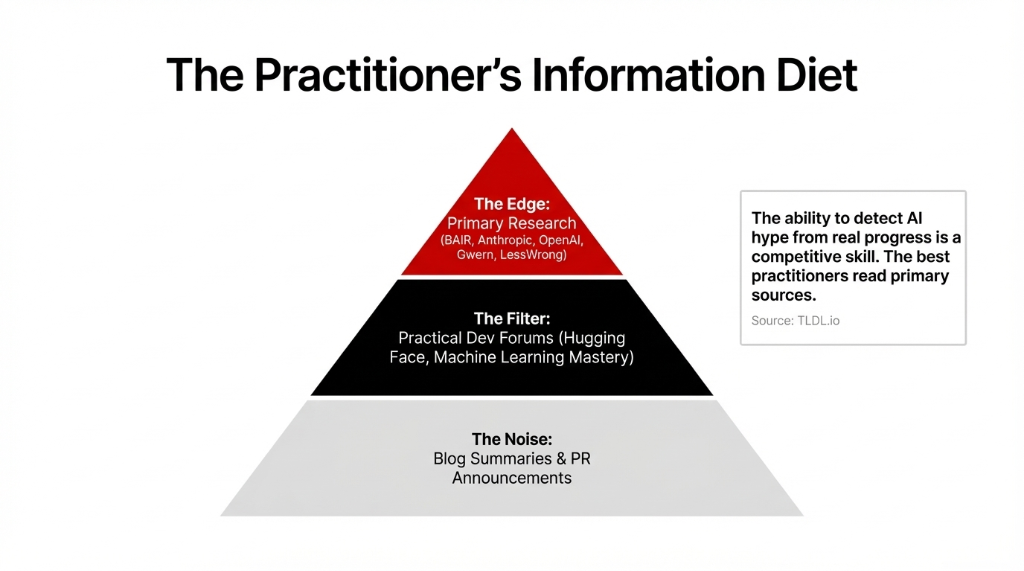
What makes this post valuable is not the list itself — it is the implicit admission that the AI technology space has a massive information quality problem. There are now hundreds of AI programs being marketed as breakthroughs. The ability to detect AI hype from real progress is itself a competitive skill.
The Information Diet That Separates Winners From Victims
Learning artificial intelligence from secondary summaries is fine for getting oriented. But if you are an AI developer, machine learning engineer, or someone responsible for AI development decisions at a company, your edge comes from the primary sources — the papers, the BAIR posts, the Anthropic research blog, the OpenAI technical updates.
The practitioners building the best AI models in 2026 are reading research, not press releases.
What Q1 2026's Best AI Writing Means for Your Monday Morning
Look — most AI blogs give you information. The best ones change what you do on Monday morning.
What Q1 2026 Is Actually Telling Business Leaders
✓ AI agents are production-ready. If you are still "evaluating," your competitor who shipped in January is already 90 days ahead.
✓ Generative AI ROI is real — but only when deployed as an organizational tool, not a personal toy.
✓ AI ethics compliance is no longer optional in any market where the EU AI Act applies — and US state laws are catching up fast.
✓ The best educational AI content is moving to primary research sources, not blog summaries.
✓ AI for coding, deep learning, and multimodal systems are now accessible without enterprise-level compute costs.
The companies using artificial intelligence effectively in Q1 2026 are not the ones with the biggest budgets. They are the ones whose teams actually read the right AI blogs, then acted on what they learned faster than everyone else.
FAQs
What were the biggest AI trends in Q1 2026?
Agentic AI moving into production (1,445% surge in multi-agent inquiries), generative AI shifting from personal to organizational tools, multimodal deep learning breakthroughs, tightening AI ethics regulation under the EU AI Act, and the explosion in AI training courses for non-technical teams.
Which AI blogs do engineers trust most in 2026?
Primary research sources: BAIR, Anthropic Research, OpenAI Research, Google DeepMind, LessWrong, and Gwern. For practical machine learning content, Machine Learning Mastery, Towards Data Science, and Hugging Face remain the top picks for AI developers building real applications.
How is AI ethics changing for businesses in 2026?
The EU AI Act requires risk-level categorization, red-team testing, and mandatory transparency reports for high-risk AI systems. The Colorado AI Act becomes enforceable June 30, 2026. Deploying AI in employment, credit, or healthcare means treating AI ethics compliance as a legal obligation — not a PR exercise.
What is the best AI tool for business use in 2026?
ChatGPT, Claude, and NotebookLM lead for enterprise. Claude dominates AI coding and process automation. NotebookLM is the most underrated AI assistant for knowledge-intensive workflows. Lovable is the go-to for building AI web apps from plain English prompts without a developer.
Is learning machine learning still worth it in 2026?
Yes — but the focus shifted. You do not need to train models from scratch. The value is in directing, evaluating, and integrating AI models into real business workflows. Companies invest in AI learning programs for existing teams because hiring machine learning engineers at $180,000+ annually is not scalable.
Stop Reading About AI. Start Running It.
The companies that won Q1 2026 were not the ones with the biggest budgets. They were the ones that deployed AI agents that actually work inside their operations — not PowerPoint slides about them. We build production-grade AI agents, custom AI platforms, and cloud AI infrastructure for D2C brands and enterprises across the US, UK, UAE, and Singapore. 500+ projects. 4+ years. 40-60% cost reduction via AI.