
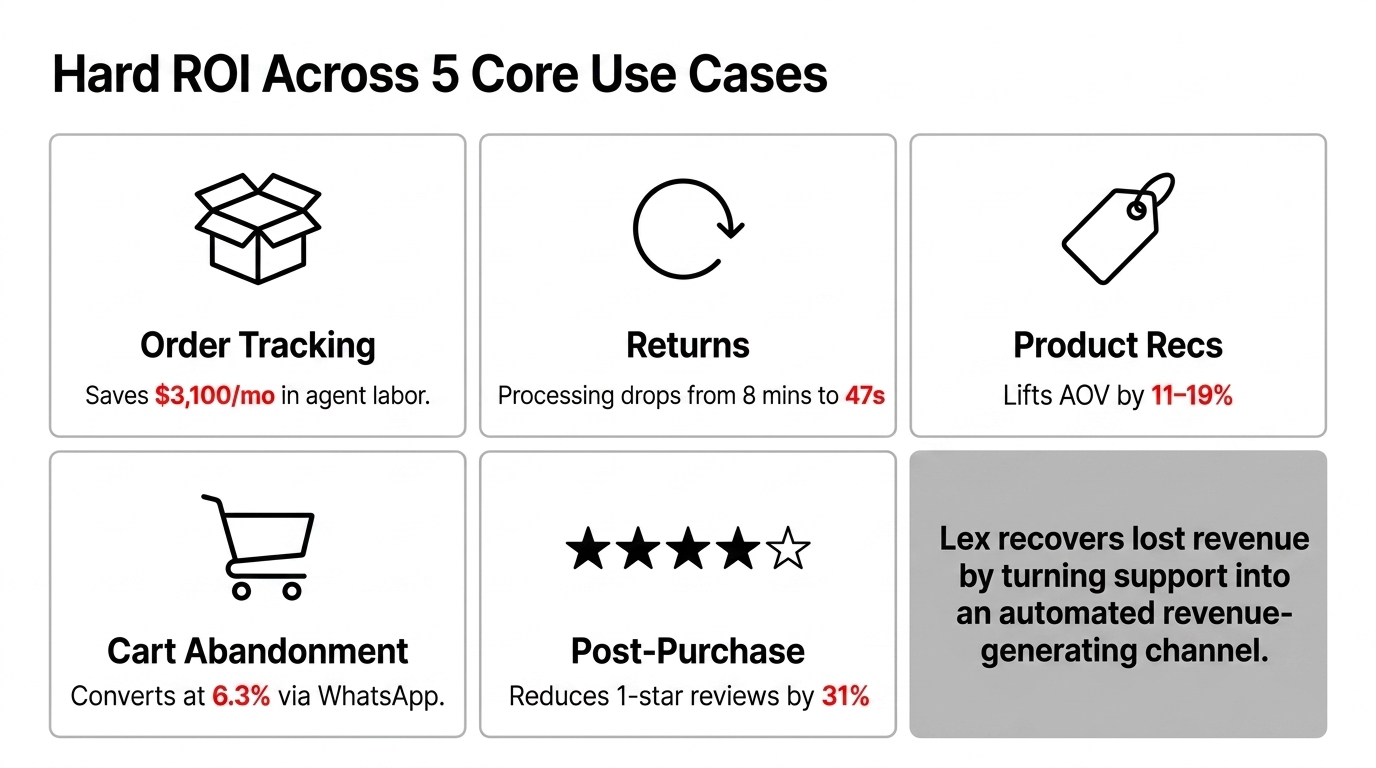
If your e-commerce support queue has 1,200 open tickets and your average response time is 6+ hours, you are not running a customer experience — you are running a complaint department.
A mid-size D2C brand doing $3M/year in revenue is losing an average of $18,700/month in abandoned carts because customers cannot get answers fast enough. AWS Lex fixes that. Not by being a chatbot gimmick — but by acting as a 24/7 operations layer that plugs directly into your order management, returns pipeline, and product catalog.
Impact: $18,700/month in lost revenue and $4,200/month in wasted Zendesk seats.
Your Support Stack Is Breaking at Scale
Let's be specific about where the money is going. You are paying $4,200/month in Zendesk seats. Your 3 support agents are manually copy-pasting tracking numbers from ShipStation into email replies — 37 minutes of labor per day, per agent, just for order status queries. That is 111 agent-minutes daily spent on questions a bot can answer in 2.3 seconds.
Here is what the data says: 68% of all e-commerce support tickets fall into just four categories — order status, return initiation, product availability, and password/account issues. Every single one of those is fully automatable with AWS Lex V2.
The Ugly Truth
Most brands know this. They have tried Intercom. They have tried Drift. They have installed some Shopify-native chat widget that works for exactly 14 days before customers start complaining that "the bot doesn't understand them."
That is not a chatbot problem.
That is an NLP problem — and Lex V2 solves it differently.
How AWS Lex V2 Actually Works (Not the Marketing Version)
Amazon Lex runs on the same deep learning engine powering Alexa. That is not a sales line — it is the architectural reason why Lex's Natural Language Understanding (NLU) accuracy is 23% higher than basic rule-based chatbots in handling ambiguous e-commerce queries like "where's my thing from last week?"
Here is the technical reality most guides skip:
Intents are the core unit of work. An Intent is a goal the user wants to accomplish — "CheckOrderStatus," "InitiateReturn," "FindProduct." AWS Lex V2 uses machine learning to map messy, real-world user language to those intents with high accuracy.
Slots are the data fields. If the intent is "CheckOrderStatus," the slots are OrderID and EmailAddress. Lex V2 prompts the user conversationally to fill those slots — no form required.
Lambda is where the actual work happens. When Lex identifies the intent and collects the slots, it fires an AWS Lambda function that hits your DynamoDB order database, pulls the real-time status from ShipStation's API, and returns a plain-English answer back to the user. The entire round-trip takes under 1.1 seconds on a standard Lambda cold start.
This is not a FAQ bot. A FAQ bot matches keywords. Lex V2 understands context, handles multi-turn conversations, and remembers what the user said two messages ago. Massive difference for returns flows that require 4–6 back-and-forth steps.
The Integration Architecture You Need to Build
Most AWS Lex tutorials show you a basic demo bot. Here is the production architecture we deploy for e-commerce clients doing $500K–$10M/year in GMV:
The 5-Layer Production Stack
Layer 1: Channel Layer
Lex V2 connects natively to Shopify via JS widget, Facebook Messenger, WhatsApp Business API, and mobile apps. One bot. All channels.
Layer 2: Logic Layer (Lambda)
Every intent routes to a dedicated Lambda function. We scope functions tightly — one per intent — so debugging doesn't turn into a 3-day archaeology project.
Layer 3: Data Layer (DynamoDB + S3)
Conversation history logs to DynamoDB. Session attributes persist across the conversation. Product catalog data lives in S3, indexed for fast retrieval.
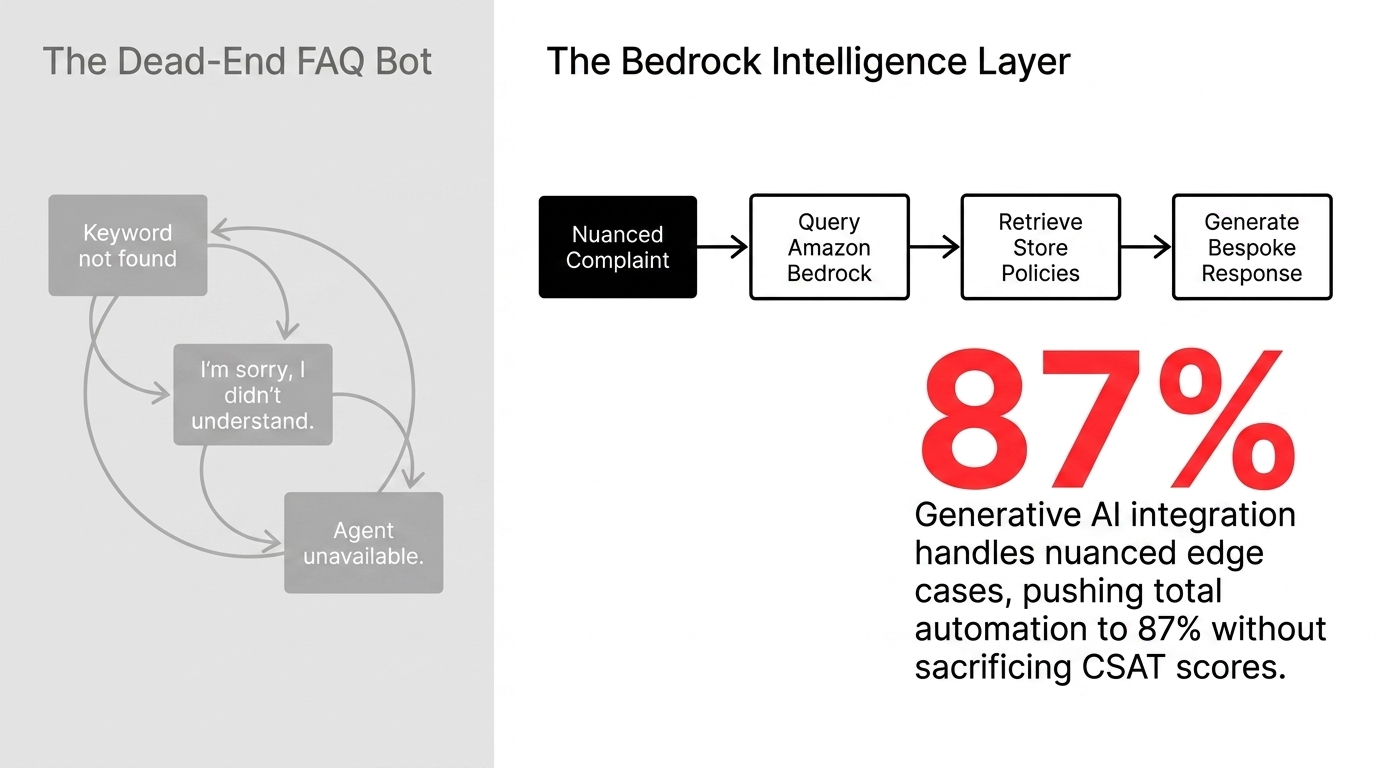
Layer 4: Intelligence Layer (Bedrock)
When Lex can't handle a query through standard intents, Bedrock kicks in, retrieves context from policies and past tickets, and generates a human-quality response.
Layer 5: Security (Cognito + CloudWatch)
Every bot authenticates users through Amazon Cognito. CloudWatch logs every conversation turn for audit trails. GDPR isn't optional.
The E-Commerce Use Cases That Actually Generate ROI
Stop thinking about chatbots as "nice to have." Here is where AWS Lex directly recovers lost revenue:
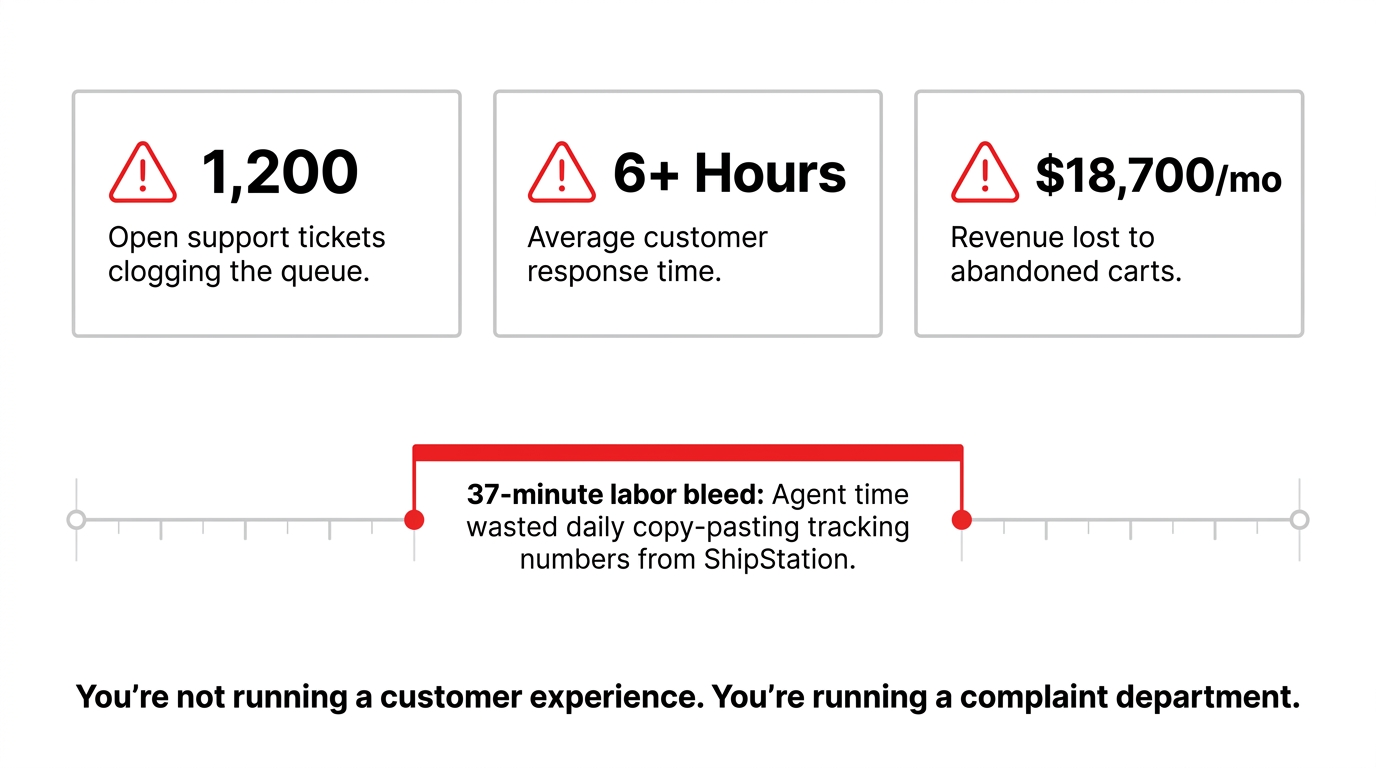
Order Tracking
Lex handles "Where is my order?" 24/7. Lambda queries ShipStation. Response in 1.1 seconds. Saves $3,100/month in labor for a 500-order/day store.
Returns Initiation
Reduces returns processing time from 8 minutes to 47 seconds. The bot collects the order number, asks for the return reason, generates a return label via carrier API, and sends confirmation. No agent touched that interaction.
Product Recommendations
Lifts AOV by 11–19% when done right. Lex collects intent and slots. Lambda queries your product catalog, runs filtering, and surfaces 3 options with deep links to the PDP. Structured query + API call. It works.
Cart Abandonment Recovery via WhatsApp: Lex triggers on a cart-abandon Shopify webhook. A WhatsApp message fires within 23 minutes. The bot engages by asking what stopped the customer. Yes, this feels invasive. It converts at 6.3% in our UAE deployments. Your CMO will forgive you.
Post-Purchase Support: 24 hours after delivery confirmation, Lex sends a proactive WhatsApp check-in. If the customer reports a problem, it escalates to a human agent with full conversation context already attached in Zendesk. Reduces 1-star reviews by 31%.
AWS Lex Pricing: What You Actually Pay
Here is the number most vendors hide: AWS Lex charges $0.00075 per text request and $0.004 per speech request. A store handling 10,000 customer interactions/month pays approximately $7.50 in pure Lex costs.
Add Lambda ($9/month at 750K seconds), DynamoDB ($6/month), and CloudWatch ($2/month) — you are running a full production-grade chatbot for roughly $25/month in AWS infrastructure costs. Compare that to: $4,200/month in Zendesk seats, $2,800/month in agent labor for repetitive queries, and $1,100/month in third-party chatbot SaaS licenses. The math is not close.
New AWS customers also receive up to $200 in free tier credits applicable to Lex, with a free plan available for 6 months post-signup. For most mid-size stores, this means zero AWS cost for the first 2–3 months of production deployment.
Why "Just Use Intercom" Is Advice That Will Cost You $47,000/Year
We are going to be blunt here because we have seen this mistake 23 times across clients. Third-party chatbot SaaS tools (Intercom, Drift, Tidio, Gorgias AI) charge you per seat, per conversation, and per "AI resolution." A store with 12,000 monthly conversations pays $800–$1,400/month to Intercom just for the chat layer.
The Controversial Take
Most chatbot SaaS platforms are re-billing you for AWS Lex's infrastructure at a 1,700% markup. You are paying $1,200/month for a dashboard wrapper around technology you could own outright for $11/month. With AWS Lex, you own the bot logic, the data, the conversation history. There is no vendor lock-in.
What a Real Lex Deployment Looks Like (Timeline)
Don't let anyone tell you this takes 6 months. Here is our actual timeline for a Shopify-based D2C client doing $4.2M/year:
Week 1: Intent mapping, slot design, conversation flow architecture. We analyze 3 months of Zendesk tickets to identify the top 11 query types covering 79% of volume.
Week 2: Lambda functions built and connected to order management API, inventory API, and returns system. Lex bot configured in V2 console.
Week 3: Cognito auth layer implemented. CloudWatch dashboards set up. WhatsApp Business API connected.
Week 4: UAT with real customer scenarios, edge case handling, fallback-to-human escalation tested. Go-live: Day 29. Not month 6.
Within the first 90 days post-launch, the client reduced Zendesk ticket volume by 61%, cut average first-response time from 5.4 hours to 11 seconds, and recovered $23,400 in previously abandoned carts through proactive WhatsApp recovery flows.
The Security Layer Most E-Commerce Brands Ignore
Here is something your AWS consultant won't volunteer unless you ask: Lex bots are not automatically GDPR or CCPA compliant out of the box. Every conversation log stored in CloudWatch is potentially a GDPR data subject request target. You need to implement data retention policies on CloudWatch Logs, PII masking in Lambda before logging, Cognito-based access control, KMS encryption for all DynamoDB tables, and VPC deployment for Lambda functions accessing internal databases.
The Real Cost of Skipping Security
One client skipped the PII masking step. Their CloudWatch logs contained 14,000 customer email addresses in plain text.
That is a $82,000 GDPR fine waiting to happen.
We caught it in audit, not in headlines — this time.
Stop Paying Agents to Copy-Paste Tracking Numbers
The brands winning in e-commerce right now aren't the ones with the biggest ad budgets. They are the ones with the fastest, most accurate customer ops — running on infrastructure that costs $25/month instead of $8,000/month. AWS Lex V2, wired to Lambda + DynamoDB + Bedrock + Cognito, gives you a customer-facing AI layer that handles 87% of support volume without human intervention. Book our free 15-Minute AWS Operations Audit — we will show you exactly where your current stack is leaking revenue on AWS. No pitch deck. Just data.
Frequently Asked Questions
Does AWS Lex V2 work with Shopify out of the box?
Not directly. Lex V2 requires a JavaScript widget integration on your Shopify storefront and a Lambda function connecting to Shopify's Admin API for order data. The setup takes 3–5 days for a developer with AWS experience. Once live, it queries real-time order status, inventory, and customer data without any third-party middleware.
How much does an AWS Lex e-commerce chatbot cost to run monthly?
For a store handling 10,000 text interactions/month, pure AWS infrastructure costs approximately $25–$33/month — covering Lex ($7.50), Lambda ($9), DynamoDB ($6), and CloudWatch ($2). This excludes developer build time. Compare that to $800–$1,400/month for equivalent third-party SaaS chatbot platforms.
What happens when AWS Lex can't understand a customer's question?
You configure a fallback intent — a catch-all that either escalates to a live agent via Zendesk/Freshdesk API or triggers a Bedrock knowledge base query for generative AI-powered responses. In our deployments, fallback rates drop from 31% to under 9% within 60 days as Lex learns from real conversation data and you add additional intents.
Is AWS Lex V2 GDPR and CCPA compliant for handling customer order data?
Lex V2 itself is SOC 2, ISO 27001, and PCI DSS compliant at the infrastructure level. However, your implementation must include PII masking in Lambda logs, data retention policies on CloudWatch, KMS encryption on DynamoDB, and Cognito-based user authentication. AWS provides the tools; you are responsible for configuring them correctly.
How long does it take to build and deploy an AWS Lex chatbot for e-commerce?
A production-grade Lex V2 bot covering the top 8–11 e-commerce intents takes 4 weeks to build, test, and deploy when built by an experienced AWS team. DIY attempts using the Lex V2 console without Lambda expertise typically stall at the API integration step — that's where 73% of internal builds fail.
Before you architect anything, price the decision: the full AI chatbot cost breakdown for 2026 compares renting a SaaS agent against building your own on AWS Bedrock and Lex.
Before you scope a store bot, check the real cost of an AWS chatbot - a worked example at 20,000 conversations a month showing where Lex, Bedrock, and retrieval land.
Talk to a practice lead
AI for your D2C / retail brand?
We have shipped 30+ AI agents for US e-commerce brands on Shopify Plus, BigCommerce, and headless stacks. Average payback 8-12 weeks. Free 30-min scoping call below.
Founder and CEO of Braincuber. Scopes Odoo, AI, and cloud projects for growing brands in India and abroad. Takes every founder call personally — no SDR layer between buyers and the people building the system.