
Your e-commerce AWS environment is one misconfigured security group away from a data breach — and one manually-patched CloudFormation template away from an outage during your next flash sale.
A client scaling from $2M to $8M ARR had 17 manually-managed CloudFormation stacks. No consistent naming. No drift detection. Zero WAF rules on their payment API. When Black Friday hit, they lost $23,400 in revenue in 41 minutes because an unconfigured Auto Scaling group couldn't keep up with a 9x traffic spike.
Impact: $23,400 lost in 41 minutes. $1,200–$3,800/month in infrastructure debt. One motivated script kiddie away from a full PII leak.
The Real Cost of Manual AWS Infra
When your team manages AWS resources manually through the console, or worse — through YAML files that nobody commits, nobody reviews, and nobody tests — you are accumulating infrastructure debt at roughly $1,200–$3,800 per month in remediation labor alone. That's not counting the breach risk.
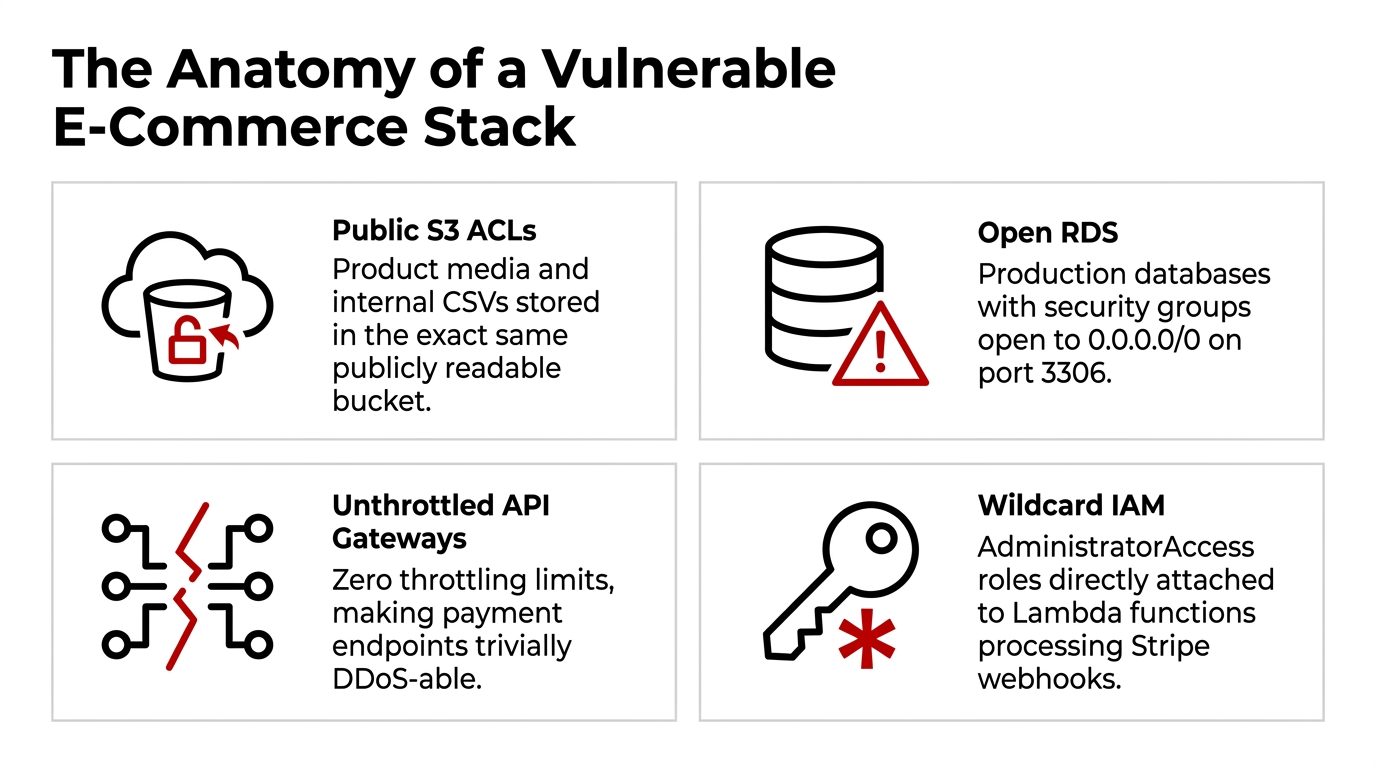
We audited one mid-size fashion brand's AWS account before onboarding them. They had:
Public S3 ACLs storing product media AND internal CSVs in the same publicly readable bucket
Open RDS — production databases with security groups open to 0.0.0.0/0 on port 3306
Unthrottled API Gateways with zero throttling limits, making payment endpoints trivially DDoS-able
Wildcard IAM — AdministratorAccess roles directly attached to Lambda functions processing Stripe webhooks
AWS CDK in TypeScript is the architecture pattern that prevents all of this — not by magic, but by making the secure path the default path.
Why TypeScript CDK (And Not Terraform or Raw CloudFormation)
Terraform is not always the right tool for AWS-native e-commerce teams. Terraform is excellent for multi-cloud. But if you're 100% AWS — and most e-commerce brands are — you're adding a provider abstraction layer that costs you 3–6 weeks of ramp-up time and requires every engineer to learn HCL.
CDK with TypeScript gives you the same GitOps-ready, version-controlled IaC without leaving the language your backend team already writes in. Raw CloudFormation YAML? That's 900 lines of whitespace-sensitive markup to describe what CDK does in 40 lines of typed, testable TypeScript.
AWS CDK compiles down to CloudFormation anyway. So you get the full power of CloudFormation's native integrations — plus the TypeScript type system catching your mistakes at cdk synth time, not at 2 AM during deployment.
The Architecture: What a Production E-Commerce CDK Stack Actually Looks Like
Here's the real picture. Not "hello world." The architecture you need on Day 1 for a store doing $500K–$10M ARR on AWS.
Stack 1: NetworkStack (VPC + Subnets + Endpoints)
Three-Tier Subnet Design
Public: ALB, CloudFront origins
Private: ECS/Lambda compute, ElastiCache
Isolated: RDS, secrets
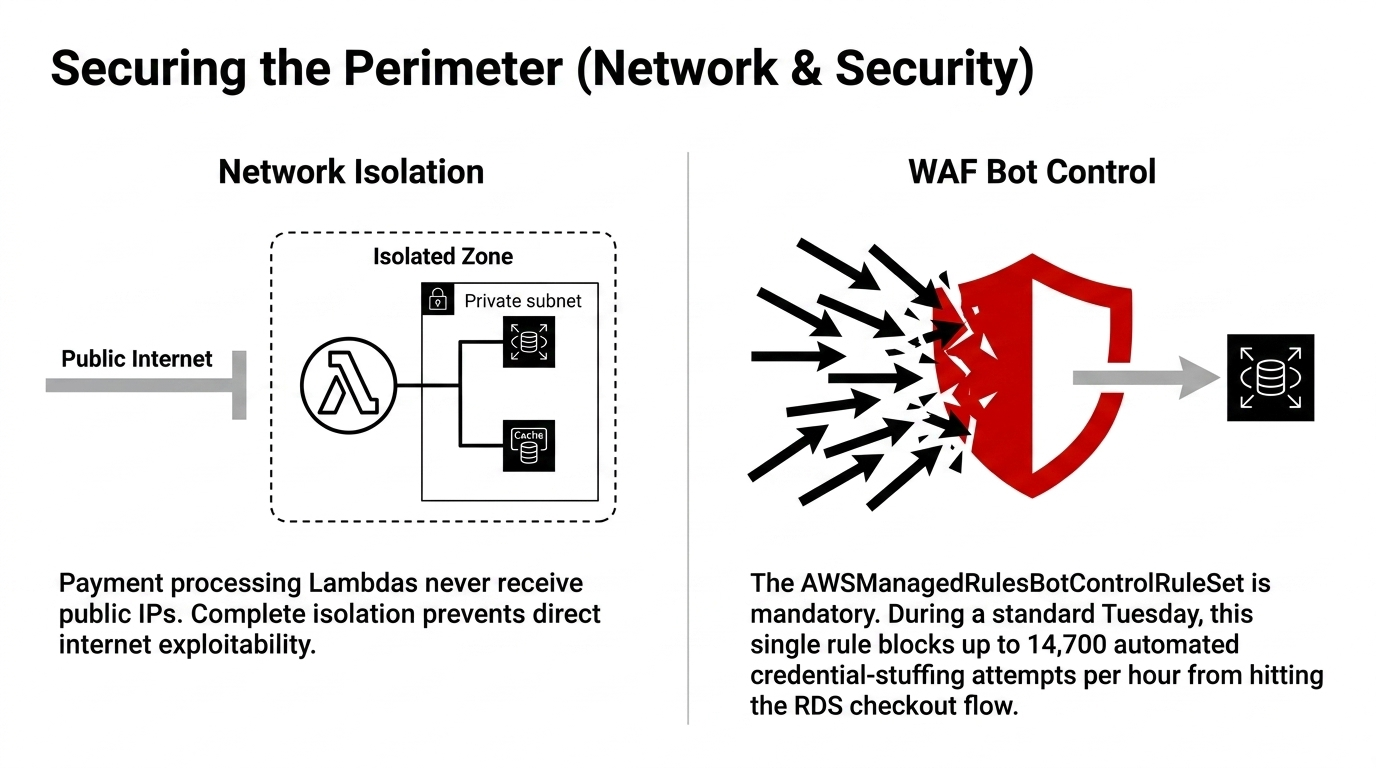
Your payment processing Lambda never needs a public IP. If it has one, that's a vulnerability, not a feature.
Stack 2: SecurityStack (WAF + KMS + IAM)
This is where 90% of teams underinvest.
WAF Bot Control That Actually Works
The AWS-AWSManagedRulesBotControlRuleSet rule alone will filter out the credential stuffing attacks that hit checkout flows. We saw one client's checkout page receiving 14,700 automated login attempts per hour on a regular Tuesday.
Without Bot Control, that's your RDS taking the full hit. With it, those attacks never reach your database.
Stack 3: ComputeStack (ECS Fargate + ALB + Auto Scaling)
Two critical details most teams get wrong:
Compute Best Practices
Secrets Management
Secrets come from AWS Secrets Manager, never from environment variables hardcoded in the task definition
Auto Scaling Threshold
CPU scale-out at 65%, not 80%. At 80%, new Fargate tasks take 90 seconds to register — by then your flash sale has already returned 502s to 3,000 users
Stack 4: DataStack (RDS Aurora + ElastiCache + S3)
storageEncrypted: true with your KMS key. deletionProtection: true. backup.retention at 14 days minimum. None of these are optional — they are the floor, not the ceiling.
The $140,000 Mistake
CDK will happily delete your Aurora cluster when you run cdk destroy unless you set deletionProtection explicitly. We've seen it happen. $140,000 of orders in that database. Gone in 6 seconds.
The Security Deep Dive: What CDK Enforces That You'd Miss Manually
Here's the insider reality that AWS's own documentation undersells: CDK's L2 constructs bake in security defaults that the average engineer wouldn't know to configure manually.
When you use new s3.Bucket() with blockPublicAccess: s3.BlockPublicAccess.BLOCK_ALL and encryption: s3.BucketEncryption.KMS, CDK emits a bucket policy that denies non-HTTPS requests (aws:SecureTransport: false). Try doing that manually in 5 minutes without a 400-line YAML policy document.
cdk-nag: Security as a Pull Request Check
cdk-nag is the tool nobody talks about enough. It's an AWS CDK plugin that runs security rule checks at cdk synth time — before anything deploys. It enforces AWS Security Hub controls, NIST 800-53, PCI DSS rules, and the AWS Well-Architected Framework checks as compile-time errors.
37 Critical Misconfigurations Caught
One line of code: cdk.Aspects.of(app).add(new AwsSolutionsChecks({ verbose: true })). Now your CI/CD pipeline fails the build if anyone tries to ship an unencrypted S3 bucket or an IAM wildcard action to production. We call this security as a pull request check — and it's caught 37 critical misconfigurations across our client implementations this year alone.
IAM Least Privilege in CDK — The Right Way
Bad vs Good IAM Patterns
Bad: Attaching AmazonDynamoDBFullAccess managed policy to a task role
Good: Using orderTable.grantReadWriteData(taskRole) — CDK generates the exact minimum-privilege IAM policy for that resource
No wildcards. No over-permissioned Lambda functions that can dynamodb:DeleteTable in production.
The CI/CD Layer: GitHub Actions + CDK Pipelines
Deploying manually with cdk deploy from a developer's laptop is how you get configuration drift. It is not acceptable in production.
CDK Pipelines gives you a self-mutating pipeline — when you push changes to the CDK code itself, the pipeline updates itself before deploying your stacks. The production pattern:
Production Deployment Pattern
1. Synth step runs npm ci, build, test, and cdk synth
2. Staging environment deploys automatically
3. Manual approval gate before production
4. Production only after a human reviews the cdk diff output
This is the pattern that keeps a misconfigured security group from reaching prod.
What Your First 90 Days Looks Like
Here's the realistic implementation timeline for a brand migrating from console-managed AWS to CDK TypeScript:
Week 1–2: Bootstrap CDK in all accounts, set up NetworkStack and SecurityStack, integrate cdk-nag into CI
Week 3–4: Migrate ECS services to ComputeStack, wire Secrets Manager, test Auto Scaling behavior
Week 5–6: DataStack migration (RDS Aurora, ElastiCache), validate backup/restore procedures
Week 7–8: CDK Pipelines configured, GitHub Actions integration, staging environment live
Week 9–12: Full production cutover, monitoring dashboards in CloudWatch, WAF rules tuned based on real traffic patterns
The part that gets easier immediately: drift detection. Once everything is in CDK, cdk diff tells you in 8 seconds if someone changed a security group manually in the console. We've seen that save clients from "mystery changes" that would have taken 4–6 hours to diagnose during an incident.
The part that takes longer than expected: IAM least privilege. Getting the exact grant scopes right for 12+ services takes 3–4 weeks of iteration. Budget for it.
Don't Make These Mistakes
We see these every week across e-commerce AWS accounts:
Single-Stack Architecture
Putting all resources in one CDK stack means every cdk deploy touches everything. One stack per concern: Network, Security, Compute, Data.
Hardcoded Account IDs and Region Strings
Use this.account and this.region. Hardcoded values are how you accidentally deploy a prod stack to a dev account at 11 PM.
No deletionProtection on RDS
CDK will happily delete your Aurora cluster when you run cdk destroy unless you set this explicitly. We've seen it happen. $140,000 of orders in that database. Gone in 6 seconds.
Skipping VPC Endpoints for Secrets Manager
Without a VPC endpoint, your Lambda in a private subnet calls Secrets Manager over the internet through a NAT Gateway. At 10M invocations/month, that's $43/month in unnecessary NAT charges and a wider network attack surface.
Stop Managing AWS Infrastructure With Duct Tape and Prayer
Braincuber has implemented cloud infrastructure across 500+ projects on AWS, Azure, and GCP. Our CDK-first approach has reduced infrastructure incident response time by 67% for e-commerce clients scaling from $1M to $15M ARR. We also provide cloud consulting and AI development services.
Frequently Asked Questions
Does AWS CDK TypeScript require deep TypeScript knowledge?
No. You need basic TypeScript — interfaces, types, classes. If your team writes Node.js or modern JavaScript, they'll be productive in CDK within 1–2 weeks. The CDK construct library handles the hard parts. Most e-commerce teams are shipping CDK stacks within 3 weeks of starting.
How much does migrating to CDK cost in engineering hours?
For a mid-size e-commerce stack (10–15 AWS services), expect 160–240 engineering hours to fully migrate from manual/CloudFormation to CDK TypeScript. That pays back in roughly 90 days through reduced incident response time and eliminated manual-change errors.
Is AWS CDK secure enough for PCI DSS-compliant e-commerce?
Yes — but only if you configure it correctly. CDK with cdk-nag running PCI DSS rule packs enforces PCI-relevant controls at build time. You still need to scope WAF rules, enable VPC Flow Logs, and configure CloudTrail. CDK is the delivery mechanism; security design is still your responsibility.
Can CDK manage multi-region e-commerce deployments?
Yes. CDK supports cross-region stack references and can deploy the same stack to multiple regions with environment-specific props. WAF for CloudFront must always deploy to us-east-1, but your compute and data stacks can deploy to any region your users are closest to.
What happens to existing AWS resources when we adopt CDK?
Existing resources don't get touched unless you import them into CDK using cdk import. You can run CDK alongside your existing resources, adopt them incrementally, and only take ownership of what you're ready to manage. No big bang migration required.
Talk to a practice lead
Getting hit by surprise AWS bills?
Free AWS cost audit. Send your last 3 invoices and your Cost Explorer view; we return a written report with the top 3 cost leaks and projected savings in 48 hours.
Founder and CEO of Braincuber. Scopes Odoo, AI, and cloud projects for growing brands in India and abroad. Takes every founder call personally — no SDR layer between buyers and the people building the system.