
Your e-commerce logs are scattered across six different systems. And you are missing the fraud signals hiding inside them.
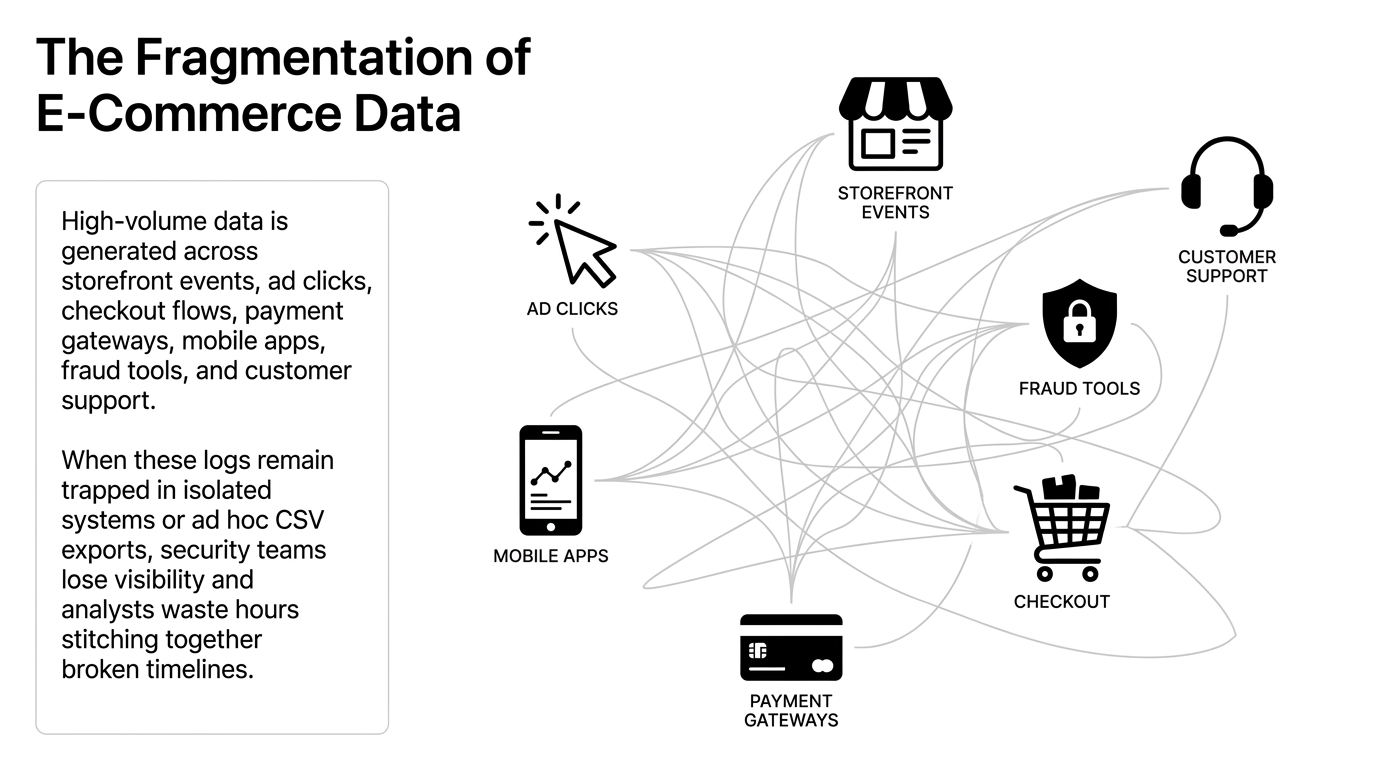
Storefront events, ad clicks, checkout flows, payment gateways, mobile apps, fraud tools, and customer support systems all generate logs. When those logs stay trapped in separate systems or ad hoc CSV exports, teams waste hours stitching together a broken timeline of events. Meanwhile, payment fraud, bot attacks, and checkout failures go undetected for days.
Impact: Lost revenue, slow incident response, and blind spots your security team cannot afford in 2026.
AWS Athena is a fast way to query e-commerce logs directly in Amazon S3 without building and managing a database first, which makes it a strong fit for clickstream, order, payment, and application-event analysis at scale. For security-heavy teams, the real value is not just speed; it is the ability to centralize logs, apply access controls, and investigate customer and transaction activity without moving data around unnecessarily.
The E-Commerce Logging Problem
E-commerce businesses generate messy, high-volume data across storefront events, ad clicks, checkout flows, payment gateways, mobile apps, fraud tools, and customer support systems. When these logs stay trapped in separate systems or ad hoc CSV exports, teams waste time stitching together a broken timeline of events, and security teams lose visibility into suspicious behavior. Athena solves that problem by letting you query data in place on S3 using standard SQL, which means analysts and engineers can explore logs without first loading them into a warehouse.
That matters more than it sounds. A checkout failure that looks like a frontend bug may actually be a bot attack, a payment processor timeout, a misconfigured Lambda function, or a region-specific incident. If your logging setup cannot connect those dots quickly, you end up with lost revenue, poor customer experience, and a slow incident response process.
Why Athena Fits AWS Security Deep Dives
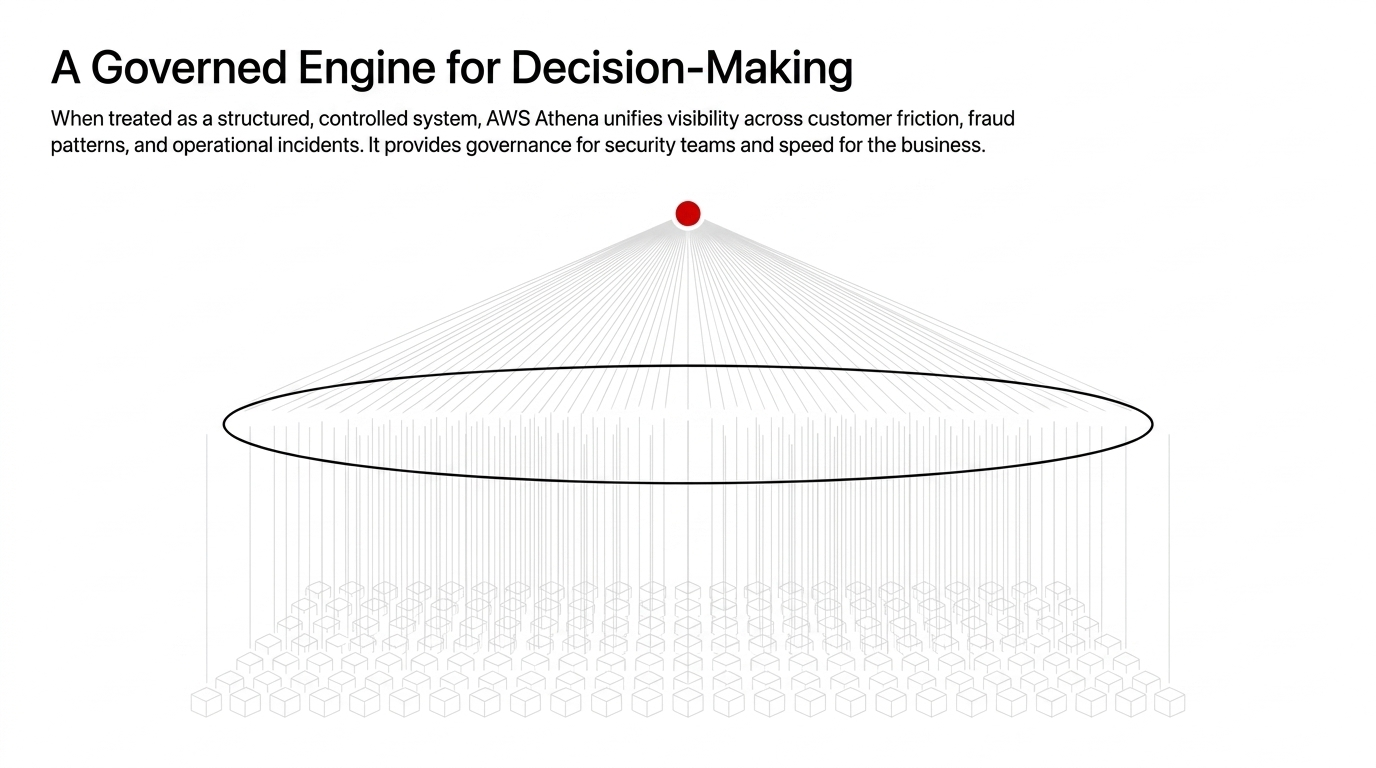
Athena works especially well in AWS security deep dives because it sits naturally inside an AWS-native logging architecture. Logs can live in S3, metadata can be managed by AWS Glue Data Catalog, access can be controlled with IAM and S3 bucket policies, and queries can be audited through CloudTrail and workgroup settings. That combination gives security teams a practical balance: broad visibility for investigation, but tight governance over who can query what.
Athena also supports features that matter in regulated or multi-team environments, such as encryption at rest, query result location control, and workgroups for separating workloads and enforcing settings. In e-commerce, that is useful because finance, marketing, fraud, and security often want the same raw data for different reasons, but they should not all have the same level of access.
A Story from the Storefront
Picture a fast-growing online retailer on AWS. Orders are landing, ads are converting, and the team thinks everything is healthy because the main dashboard looks green. Then support tickets start rising: customers say orders were charged but not confirmed, and some users report repeated login prompts during checkout. The incident seems small at first, but conversion has dipped, refund requests are climbing, and the security team needs answers fast.
With Athena, the team can query S3-stored logs across the checkout service, API Gateway, CloudFront, WAF, Lambda, and payment webhook events in one place. Instead of waiting for engineering to build a special report, the analysts can trace a customer session from page view to cart add to payment attempt, then compare successful and failed sessions by region, user agent, IP, or device type. That investigation path is where Athena becomes more than a query engine; it becomes an evidence layer for the business.
Data Architecture That Works
A clean Athena setup for e-commerce log analytics usually starts with disciplined S3 organization. Raw logs should be written into partitioned prefixes such as date, hour, region, or source system so that queries scan less data and cost less. Glue Data Catalog tables should describe the schema, and Athena views can simplify repeated investigations or combine multiple event streams into a usable analyst-friendly model.
A Practical Athena Architecture
| Layer | Purpose | Example |
|---|---|---|
| Raw S3 logs | Immutable storage for original events | CloudFront, ALB, app, payment logs |
| Glue catalog | Schema and table definitions | Clickstream, checkout, fraud tables |
| Athena workgroups | Access and cost control | Security, finance, marketing groups |
| Curated views | Faster analysis and safer querying | Session funnels, failed payments |
| Results bucket | Query output storage | Encrypted S3 query results |
The biggest mistake is dumping everything into one flat bucket and hoping SQL will save the day. It will not. Athena is powerful, but it rewards structure: consistent naming, partitions, documented schemas, and retention rules that keep cost and complexity under control.
Security and Governance
This is where e-commerce teams often underbuild. Log analytics is not just a reporting exercise; it is also a security control. Athena queries can expose customer identifiers, IP addresses, order details, auth failures, and sometimes payment-adjacent metadata, so access needs to be handled like a sensitive data pathway, not a casual BI sandbox.
The core security controls are straightforward. Use IAM least privilege, restrict S3 access to specific buckets and prefixes, encrypt data and query outputs, and isolate workgroups so different teams cannot override guardrails. If your organization handles regulated customer data, you should also be intentional about data masking, log redaction upstream, and tightly scoped cross-account access for incident response.
What to Query First
The best Athena queries for e-commerce are the ones that answer a business or security question immediately. Start with funnel abandonment, failed checkout attempts, payment gateway error spikes, suspicious login bursts, and bot-like request patterns. Then move into correlation analysis: which error codes align with which device types, traffic sources, regions, or app versions.
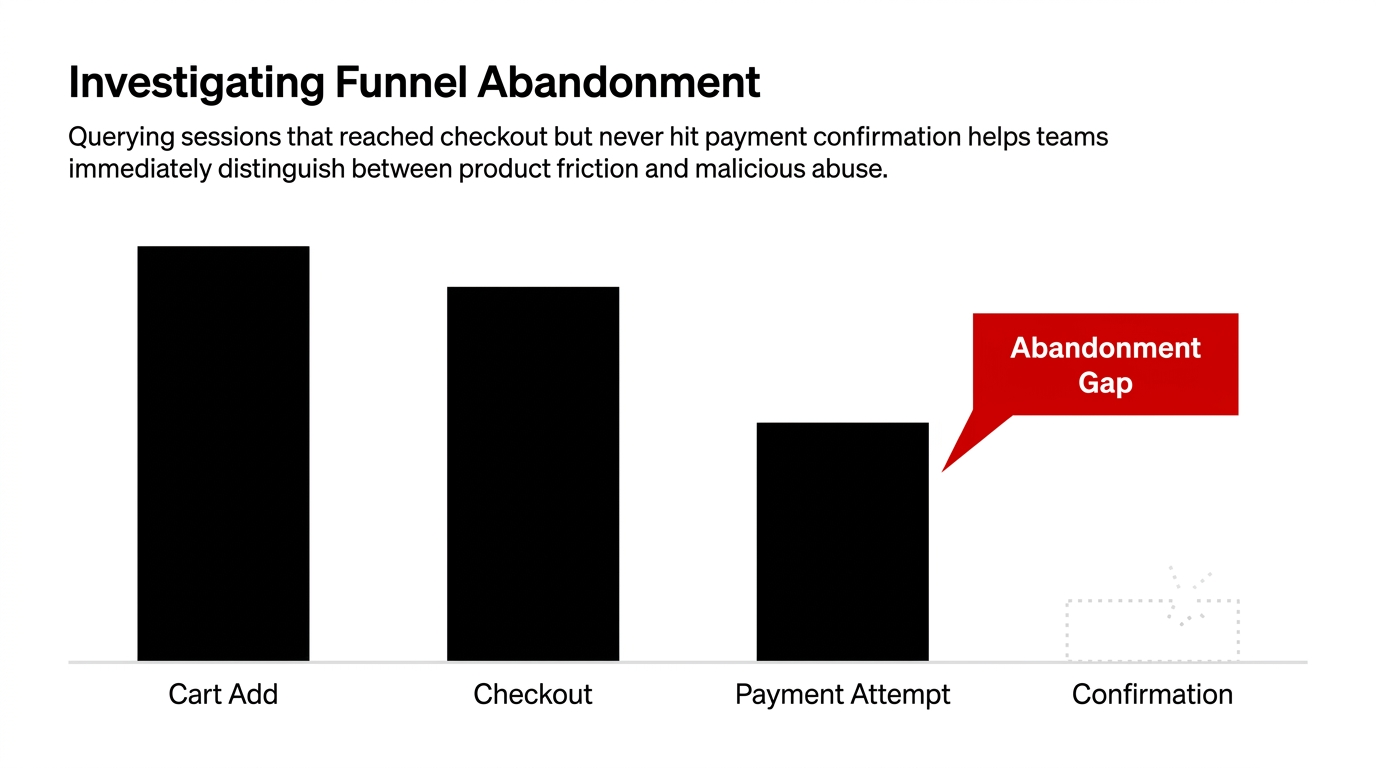
Useful queries often include: sessions that reached checkout but never reached payment confirmation; orders with repeated payment retries inside a short window; IPs or user agents with abnormal request volume; WAF blocks tied to specific endpoints or campaigns; and region-specific latency or timeout spikes during peak traffic. These patterns help teams distinguish product issues from abuse, and they make incident reviews much faster.
Key Athena Query Categories for E-Commerce
Funnel Abandonment
Cart to checkout to payment to confirmation. Identify exactly where buyers drop off and whether it is a UX issue or a security attack.
Fraud Patterns
Suspicious IPs, repeated payment retries, abnormal user agents, and WAF blocks that correlate with chargebacks or disputes.
Performance Incidents
Region-specific latency spikes, gateway timeouts, and Lambda cold starts that correlate with conversion rate drops.
Cost and Performance Discipline
Athena is not expensive because it exists; it becomes expensive when it scans too much data. The main levers are partitioning, compression, columnar formats like Parquet or ORC, and query design that avoids full-table scans. If your logs stay in raw JSON forever and every analyst runs wildcard queries across months of data, your bill and your latency will both become problems.
For e-commerce security teams, performance discipline matters because incident response is time-sensitive. The point is to get to the truth in minutes, not to run the prettiest SQL in the company. Good table design, meaningful partitions, and curated views usually beat heroic querying every time.
Operational Playbook
A solid Athena operating model usually follows a repeatable rhythm. First, ingest logs into S3 with a standard schema and partition strategy. Second, catalog the tables in Glue and define workgroups for each team. Third, create a small library of saved queries for the highest-value business and security questions. Fourth, review access, retention, and query costs on a regular schedule.
That playbook works because it turns Athena from a one-off analytics tool into an operating layer. Security teams get consistent investigations, analysts get reusable logic, and leadership gets a clearer view of customer friction and threat patterns. The result is not just faster reporting; it is better decision-making under pressure.
Common Mistakes
Most Athena projects fail for boring reasons. Teams do not partition logs properly, they keep too much raw noise, they ignore schema evolution, or they let access sprawl until nobody trusts the data anymore. Another common failure is using Athena as a replacement for data modeling rather than as a query layer on top of disciplined storage and governance.
E-commerce logs also create privacy risk if teams casually expose identifiers, tokens, or sensitive behavioral data. Security and analytics should coordinate on what is collected, how long it is retained, and which fields must be masked or excluded before they ever hit shared query surfaces. If that discipline is missing, the analytics stack becomes a liability instead of an advantage.
The Mistake List That Kills Athena Deployments
1. Flat S3 buckets without partitioning -- queries scan terabytes instead of gigabytes. 2. Raw JSON forever -- no compression, no columnar format. 3. Access sprawl -- everyone can query everything. 4. No schema evolution plan -- table breaks every time log format changes. 5. Sensitive data in shared queries -- payment tokens, passwords, PII visible to marketing.
Hidden cost: $2,400 to $7,100 per month in unnecessary Athena scan charges and incident response delays.
Braincuber Insider Note
Braincuber Technologies helps e-commerce teams deploy AWS Athena as part of a controlled log analytics system, not just a SQL convenience tool. We build partitioned S3 architectures, Glue schemata, and workgroup isolations that turn scattered logs into a single evidence layer. Our AI Development Services can layer anomaly detection on top of your Athena data so you do not even need to run the queries manually.
Stop Treating Log Analytics as a Reporting Exercise
If your e-commerce team is still exporting CSVs and stitching timelines by hand, you are not analyzing customer behavior. You are building a case for why the incident took three days to resolve. Athena is not magic. But if you treat it as part of a structured system, it becomes an actual security control, not just a query engine.
Free 15-Minute Athena Architecture Review
We will review your current S3 log setup, identify partitioning and schema gaps, and recommend the Athena architecture that turns scattered logs into actionable intelligence. No pitch deck. Just the architecture that actually works.
FAQ: AWS Athena for E-Commerce
What is AWS Athena used for in e-commerce?
Athena is used to query log and event data stored in S3 with SQL, which makes it useful for funnel analysis, checkout troubleshooting, fraud checks, and incident investigation.
Is Athena good for security logs?
Yes. Athena is useful for security investigations because it can query CloudTrail-style and application logs in place, especially when paired with S3, Glue, IAM, and workgroup controls.
Does Athena replace a data warehouse?
No. Athena is best as an ad hoc and exploratory query layer over S3 data, not as a full replacement for a modeled warehouse in every use case.
How do you keep Athena costs low?
Use partitions, compressed columnar formats, narrow queries, and well-designed tables so Athena scans less data per query.
What should e-commerce teams secure first?
Secure S3 buckets, query result locations, IAM permissions, and sensitive fields in logs before broad team access is granted.