
For many small business owners in the USA, "AI is too expensive" feels like a simple truth, not a myth. Yet when the numbers are unpacked, the real story is not that AI is unaffordable, but that most small businesses misread where the money actually goes and what it quietly returns.
Meet Lisa: A Realistic Small Business Story
Imagine Lisa, who runs a 12-person marketing company in Ohio that builds websites and runs social ads for local clients. She has grown her small business from the ground up over six years and now juggles sales, hiring, client work, and marketing all at once. Like many company owners, she keeps hearing about AI tools, smarter marketing, and small business automation, but every quote she sees looks like another drain on business expenses.
Lisa's first reaction is familiar: "I don't have enterprise money." She assumes AI is for giant companies and Fortune 500 firms, not for small companies like hers. But she also sees a problem: her team is drowning in repetitive work — reporting, drafting emails, creating first-draft ads, and answering the same support questions again and again. These are exactly the kinds of tasks that AI now automates cheaply when applied well.
The Real Question
The question is no longer "Is AI for me?" It is: What does it really cost this specific small business to adopt AI — and what does it cost her not to?
The Myth: AI Is Only for Big Enterprise
Early AI stories in the media focused on huge enterprise companies spending millions on custom systems. That set a mental model: AI equals giant servers, data scientists, and multi-year projects. At the same time, consultants loudly talk about six-figure AI roadmaps. Full custom generative AI projects can run between $50,000 and $100,000 upfront, and $200,000 to $500,000 over five years when maintenance and scaling are included.
For a small business, that is obviously out of reach. But this picture hides the other half of the market: ready-made AI SaaS tools that start under $50 per user per month and require no custom development. Many small business owners now rely on AI-enhanced email marketing, CRM, chatbots, and document tools inside platforms they already pay for.
Custom or Semi-Custom AI
High upfront costs (often tens of thousands of dollars) plus ongoing infrastructure and staff. Typically $50K-$100K upfront.
Off-the-Shelf AI SaaS
Low monthly subscription, usage-based pricing, and minimal setup. Often under $50/user/month.
Lisa does not need a research lab. She needs targeted automation inside her core business workflows.
Typical AI Cost Buckets for Small Businesses
| Cost Category | What It Covers | Typical Range (10-25 Employees) |
|---|---|---|
| Software Licensing | AI features in CRM, marketing, helpdesk, office suite | $500 - $2,000/month |
| Infrastructure | Cloud hosting, storage, extra compute for AI workloads | $400 - $1,800/month |
| Professional Services | Setup, integration, training, process redesign | $5,000 - $25,000 one-time |
| Ongoing Maintenance | Support, tuning, model updates, monitoring | $49 - $500/month |
First-year investments often range from $15,000 to $65,000 for a 10-25 person company, combining setup and operating costs. But this assumes a fairly ambitious rollout. Many low-cost businesses begin much smaller.
The Subscription Trap: Why AI Feels So Expensive
If AI SaaS is so cheap, why do so many small business owners still say "AI is too expensive"? One main culprit: subscription sprawl. Research in 2025 found that many SMBs now run more than 10 disconnected AI tools — for copywriting, chat, scheduling, meeting notes, analytics, SEO, social media, and more — with combined costs between $3,000 and $6,000 per month.
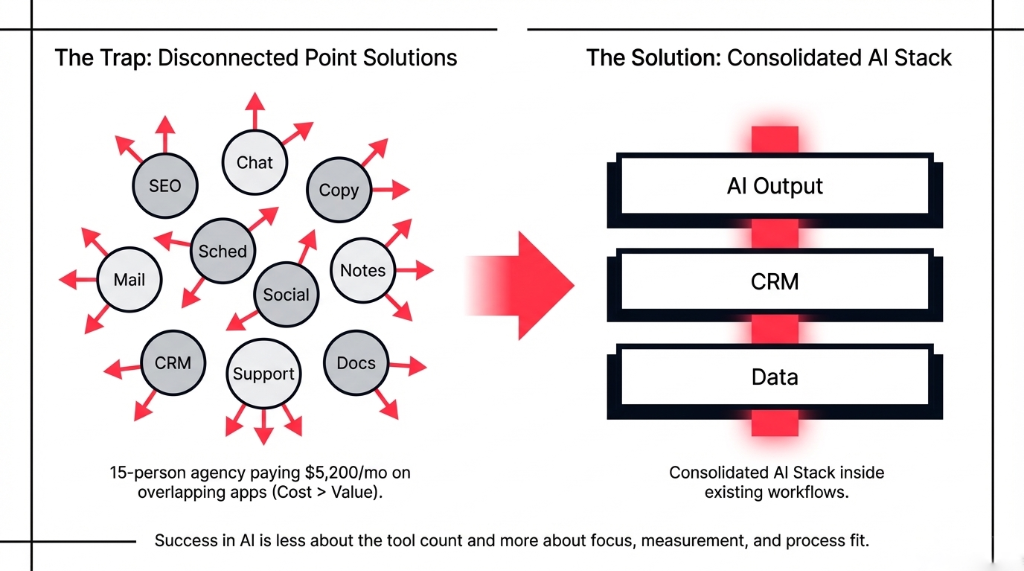
It is not one AI subscription. It is death by a dozen tiny AI subscriptions spread across teams. Each line item feels small, but together they start to look like a mid-level salary. One report describes a 15-person agency paying $5,200/month on 10 AI apps — more than two full-time salaries — with no ownership of the underlying technology.
The Fix
A simple cost calculator becomes powerful here. Adding each tool's monthly fee, user count, and usage overages reveals the true monthly expenses of AI — often far above what company owners assume. Success in AI is less about the tool count and more about focus, measurement, and process fit.
The Hidden Costs: Data, Integration, and Change
Beyond visible invoices, AI adoption often includes hidden expenses that sink unprepared teams.
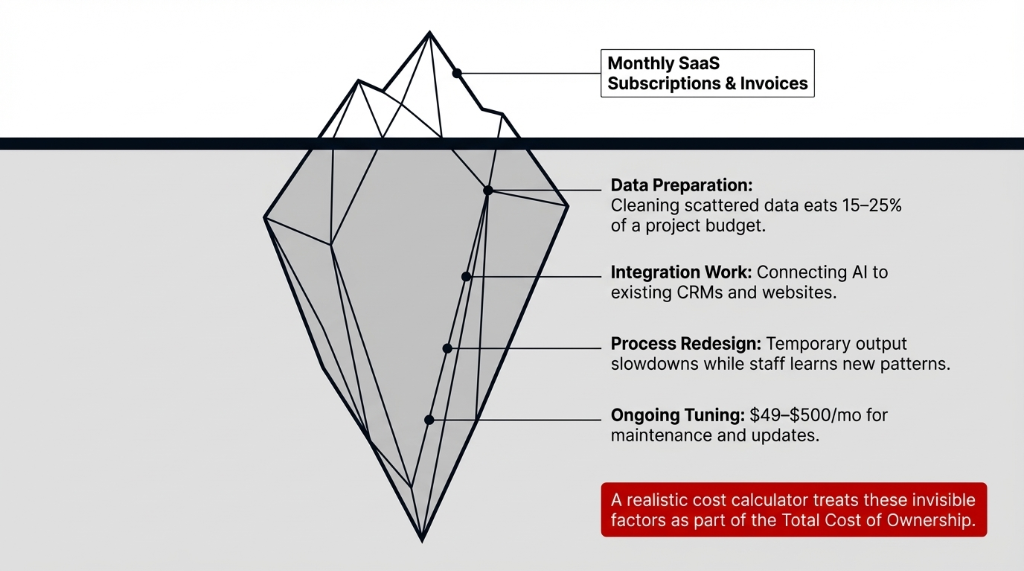
Four Hidden Cost Layers
Data Preparation
Many small businesses discover their data is messy, scattered, and not ready. Cleaning and organizing can eat 15-25% of a project budget.
Integration Work
Connecting AI into existing CRMs, websites, email tools, and support systems adds consulting hours or in-house dev time.
Process Redesign
Marketing, sales, finance, and service teams change how they work, which temporarily slows output while staff learns new patterns.
Ongoing Tuning
AI does not run itself forever. Maintenance and improvement budgets run $49-$500/month depending on complexity.
The Other Side of the Ledger: Time and Money Saved
So far, Lisa's spreadsheet shows extra costs. The real turning point comes when she adds what AI gives back.
The Savings Data
13 hours/employee/month saved by daily AI users in SMBs. Roughly $4,700 in value per person.
80% of support tickets resolved by AI chatbots without a human in small e-commerce and service settings.
26+ hours/week freed by stores using focused automation.
$3.50 returned for every $1 invested in AI marketing and sales scenarios. Many businesses report annual savings of $7,500+, with a quarter saving over $20,000/year.
Lisa applies this to her marketing company. Her team spends dozens of hours each week on drafting first-pass ad copy and email campaigns, summarizing meetings and creating task lists, building client performance reports, and answering recurring client questions.
By implementing targeted AI inside tools like CRM, email, and project platforms, she sees the potential for 10-20 hours per employee per month in time savings. If she values that time at $40/hour, even a modest 40-80 hours freed across her team translates into $1,600-$3,200/month in gained capacity.
Suddenly, a $1,000-$2,000 monthly AI stack looks very different when compared against what it returns.
How to Calculate AI ROI Like a Business Owner
The Simple ROI Framework
1. List all costs: AI subscriptions, infrastructure, one-time setup, training, ongoing support.
2. Estimate time savings: (Old manual time - New AI-assisted time) x frequency.
3. Value the time: Multiply hours liberated by fully loaded hourly cost.
4. Track revenue lift: Faster response times, better marketing, higher conversion.
5. Compute ROI: ROI = (Net Benefits / Total Costs) x 100.
Lisa's Year-One Calculation
$25,000
Total AI costs: licenses, setup, training.
$45,000
Savings: $30K in staff time + $15K in new project capacity.
$20,000
Net benefit. Triple-digit ROI. Expense becomes investment.
Starting Small: Low-Risk AI Experiments
A key trend is to start tiny, test, and scale only what works. Reports show that most companies struggle to scale AI beyond pilot projects. Careful experimentation before big rollouts helps avoid waste.
Practical First Steps
Pick one process: Begin with one or two low-overhead processes that are repetitive and rules-based — FAQ support, invoice reconciliation, or basic email sequences.
Use free tiers: Many AI vendors provide "scrappy" plans to help small businesses experiment.
Set a tight budget: $200-$500/month for AI tests during the pilot phase.
Define metrics first: Time saved, response times, lead volume — before scaling.
Where AI Fits in Your Budget (USA Focus)
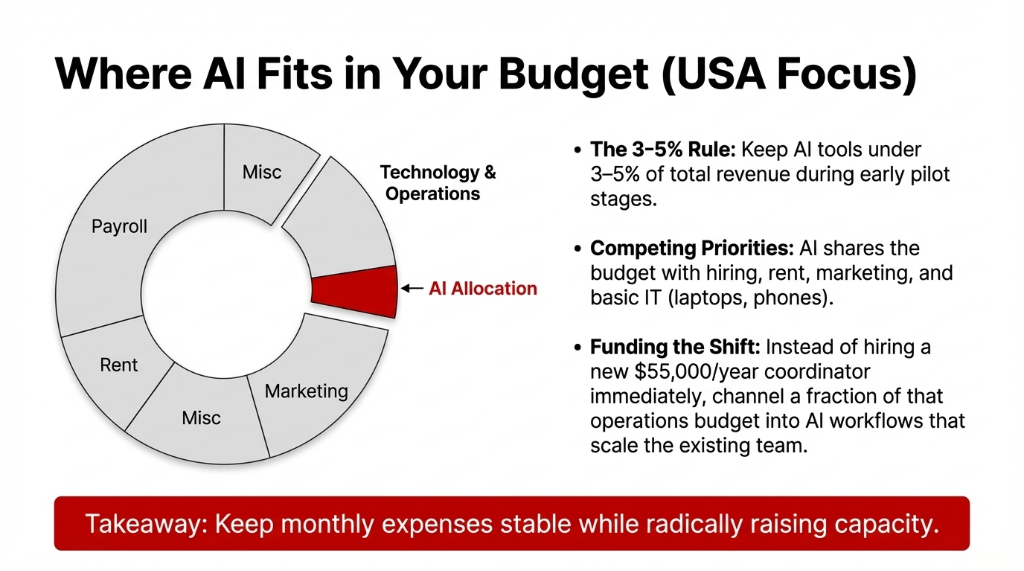
For US-based small businesses, AI spending usually competes with other priorities: hiring, rent, marketing, and basic IT like laptops and licenses. Practical starting guidance:
Budget Guidelines
3-5% Rule: Keep AI tools under 3-5% of revenue during early stages.
Expand on proof: Only increase once the AI stack shows clear contribution to reduced expenses or increased revenue.
Lisa chooses to allocate part of her marketing cost and part of her operations budget to AI. Instead of hiring another full-time coordinator at $55,000/year immediately, she channels funds into AI-powered workflows that scale her existing team. This keeps her monthly expenses stable while raising capacity.
Common Mistakes That Make AI Feel Overpriced
Four Patterns That Burn Money:
Buying before mapping: Jumping into tools without clearly defining problems leads to unused subscriptions.
Duplicated functionality: Paying for multiple AI tools that do similar things across different accounts.
Ignoring training: Skipping staff training leads to poor usage and low returns.
No measurement: Failing to use even a simple tracking sheet or metrics dashboard to measure impact.
Turning AI from Expense into Advantage
For Lisa, the turning point comes when she stops seeing AI as a mysterious tech bill and starts treating it like any other IT or marketing investment. She compares two paths:
Option A: Hire
Another coordinator at $55,000/year plus benefits. One person, fixed capacity, ramp-up time.
Option B: AI + Training
$15,000-$25,000/year in AI plus a training budget to upskill the team. More capacity, better quality, scales with the business.
With real data, she sees that thoughtful AI plus targeted training can free more capacity than one extra hire, while also improving quality and consistency. Over time, she uses AI not just in marketing workflows, but also in finance planning, cash-flow forecasting, and customer segmentation.
This is how many small business operators quietly build high-ROI businesses: not through flashy custom AI, but by stringing together a few well-chosen tools and rigorously tracking results.
FAQs
Is AI really too expensive for a typical small business?
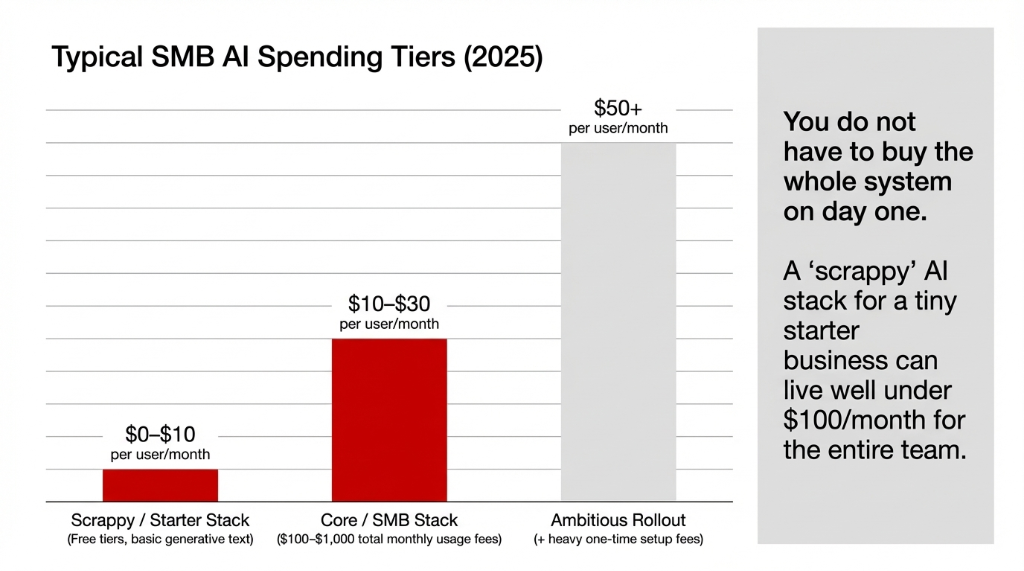
Usually no. Most small businesses can start with focused AI tools in the $50-$500/month range, far below enterprise budgets. A scrappy AI stack for a tiny starter business can live well under $100/month for the entire team.
What is the biggest hidden AI cost for small business owners?
The main hidden cost is integration and data preparation work, plus waste from running many overlapping tools without a plan. Data cleaning alone can eat 15-25% of a project budget.
How can a small business calculate AI ROI?
List all AI costs, estimate time and revenue gains, then apply: ROI = (Net Benefits / Total Costs) x 100. Track break-even by finding the month where cumulative savings equal total investment.
How fast can AI investments pay back?
Many SMBs see benefits within 2-4 years and some report positive ROI in under a year when projects are scoped tightly.
What is a smart first AI project for a new business?
Start with one repetitive, rules-based process like FAQ replies, appointment scheduling, or marketing email campaigns before tackling complex workflows.
Add Up Your AI Subscriptions Right Now
If your team is running more than 5 disconnected AI tools and nobody can tell you the combined monthly cost, you are already in the subscription trap. Pull up the invoices. Do the math. If it looks like a salary with nothing to show for it, book 15 minutes with us. We will show you where to consolidate and what to cut.