
Your inventory management system is not broken. It is just honest—and what it is honestly telling you is that you have no real idea what is actually in your warehouse right now.
That gap between system records and physical reality is costing US businesses an average of $14,000 per year for every 1% of inventory shrinkage on $1.4M in stock. If you are carrying $5M in inventory, you are potentially burning through $70,000 in silent losses annually—before you factor in emergency purchase premiums, missed orders from stockouts, and the 37 hours your operations team spends firefighting each week instead of executing.
Your Warehouse Is Lying to You—Quietly, Every Single Day
Walk into 80% of US distribution centers right now and you’ll find the same scene: an inventory management system that records what happened yesterday, a team reconciling stock in Excel with VLOOKUPs, and a supply chain that has no idea what tomorrow looks like.
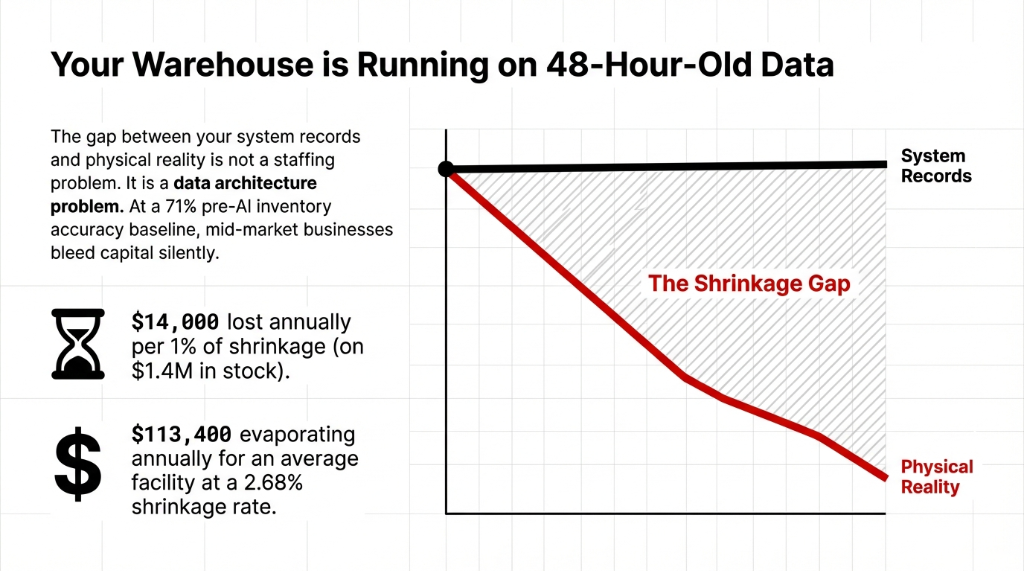
Impact: $113,400/year evaporating at a 2.68% shrinkage rate. No alarm ever goes off.
Your Warehouse Is Running on 48-Hour-Old Data
This is not a staffing problem. It is a data architecture problem.
Your current inventory software—whether it is ShipStation, a legacy WMS bolted onto QuickBooks, or an inventory tracking system your IT team built in 2016—records transactions. It does not predict demand 14 days out. It does not flag the supplier who consistently ships 3 days late in Q4. And it absolutely will not tell you that the 412 units your business inventory management system says are "in stock" are sitting in the wrong bin location, unscannable, and about to be written off.
Real Client: $4.2M Texas Distributor
The Finding: Inventory accuracy sat at 71%—for every 10 units the system claimed they had, only 7 were actually where they needed to be. The rest was ghost stock, misallocated product, and unrecorded shrinkage. Their shrinkage rate had climbed to 2.68%, reflecting the broader US warehousing trend where average shrinkage more than doubled between 2024 and 2025.
The Verdict
$113,400/year evaporating with no alarm ever going off
Why Your Current Inventory Management Programs Are Making It Worse
Here is the ugly truth most ERP vendors will never say out loud: if your "ai inventory management" strategy is just adding a dashboard on top of your existing business inventory system, you are spending budget on a paint job, not an engine.
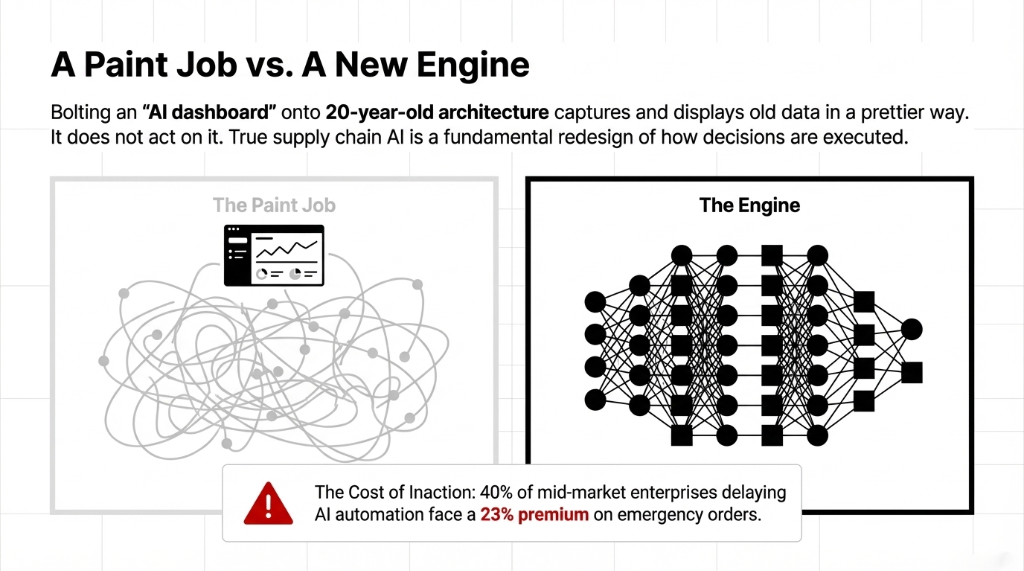
Most inventory software sold aggressively to US mid-market companies is built on architecture that is 20 years old. It captures data. It displays data. It does not act on data. Ai in business is not a UI feature—it is a fundamental redesign of how decisions get made inside your supply chain operations.
NetSuite charges you $80,000–$120,000 in year-one total cost to give you a slightly prettier version of the same reactive inventory management system you already hate. (Yes, their sales team will send us an angry email for saying this.)
The real question is not "which inventory management solution should I buy?" The real question is: does your current system prevent the stockout 12 days before it happens, or does it tell you about it the morning your biggest customer calls to cancel?
The Cost of Inaction
Over 60% of mid-market enterprises in the US are already moving toward AI-driven ERP ai and automation. The 40% that are not are the ones placing emergency orders at a 23% premium and wondering why their Q3 margins keep compressing.
Hidden cost: 23% premium on every emergency order. Every quarter. Indefinitely.
How Odoo’s AI-Powered Inventory Management System Changes the Physics of Your Warehouse
The Odoo warehouse management system is not a single feature—it is a connected inventory management ecosystem where ai software, ai and automation, and real-time data analytics operate inside one ERP, not across three platforms with sync delays and API conflicts.
Here is what that looks like in actual daily warehouse operations:
Odoo AI: What It Actually Does on Your Warehouse Floor
▸ AI Demand Forecasting
Processes historical sales, open POs, vendor lead time variance, seasonal trends
Orders exactly 143 units, 11 days before projected stockout, accounting for Supplier B’s Q4 delays
15–30% excess stock reduction = $750K–$1.5M freed capital on $5M inventory
▸ Real-Time Anomaly Detection
Wrong barcode scan? Unusual transfer quantity? Flagged immediately
Before this: errors lived silently 2–3 weeks, corrupting demand forecasts
Kills phantom-stock fulfillments on real customer orders
▸ Auto Inventory Classification
AI categorizes products by movement velocity automatically
Fast-movers: tighter reorder windows. Slow-movers: broader safety stock
18.5% average reduction in carrying costs within 6 months
▸ Odoo 19 Barcode Intelligence
Operation descriptions in scanner UI—operators know exact action at each step
Batch transfers + cluster picking = 3x faster pick operations
4.7 min/order → 1.6 min/order = 190 labor hours/month recovered
The Supply Chain AI Piece Nobody Talks About
Most conversations about ai for supply chain management stop at the warehouse. That is a mistake, and an expensive one.
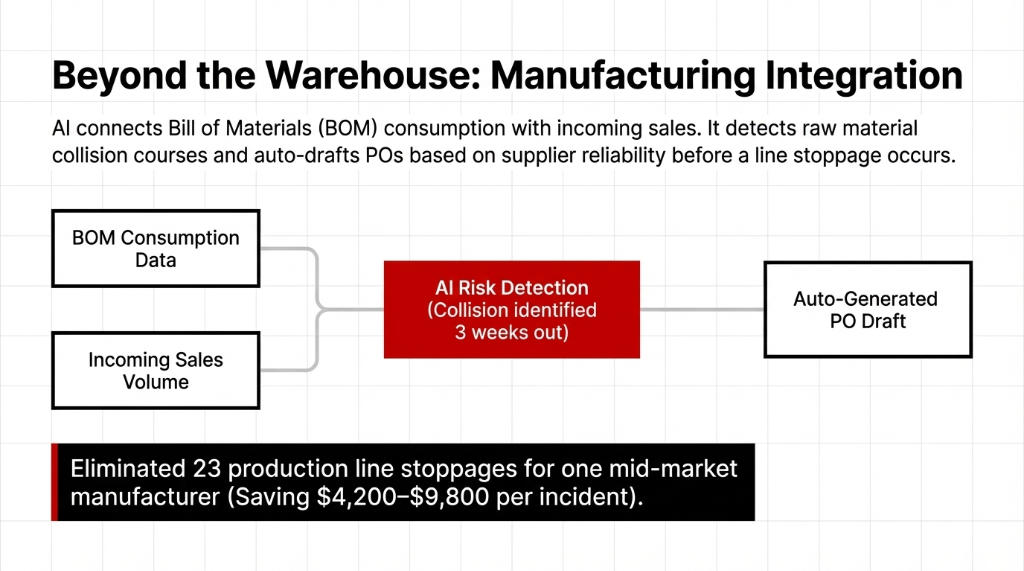
Odoo’s ai and data analytics layer connects your inventory management solution to procurement, manufacturing, and your order management system in a live loop—not a daily batch sync. When the AI detects that a raw material is trending toward a stockout based on current production orders and open customer commitments simultaneously, it does not wait for your procurement manager to run a Monday morning report. It auto-generates a purchase order draft, routes it for approval, and surfaces the supplier’s historical on-time delivery rate in the same view.
This is what digital transformation actually means at the operational level. Not a new mobile application. A system that thinks three steps ahead while your team executes the final decision.
Real Client: Midwest Manufacturer
Their supply chain ai integration recovered $23,400 in one quarter by eliminating emergency-purchase premiums on 14 key raw material SKUs. The inventory management system they had been running before? It had zero ability to see that production demand and open POs were on a collision course 3 weeks out.
What the Odoo AI Layer Feeds Your Business Intelligence
▸ Live inventory tracking with zero end-of-day data lag
▸ Predictive ai stockout alerts with AI-recommended action dates
▸ Supplier performance scores embedded inside procurement workflow
▸ Inventory planning reports your team can act on from the odoo inventory app—no export to Excel
This is what enterprise ai looks like when it is wired correctly into a business inventory management system—not bolted on from outside by a third-party tool.
The Real AI Use Cases Delivering ROI in US Warehouses Right Now
Let us get specific. These are the three ai use cases generating the fastest measurable payback for US manufacturers and distributors running Odoo:
Predictive Replenishment for Manufacturing
Fastest ROI use case
Odoo’s ai for inventory management processes BOM consumption alongside incoming sales orders to generate production-aware reorder suggestions. For one client running 300+ active SKUs in their manufacturing stock management software:
Result: Eliminated 23 production line stoppages in year one—each costing $4,200–$9,800 in downtime and rush procurement.
AI-Powered Cycle Counting
Biggest labor savings use case
Instead of shutting down warehouse zones for full physical inventory, Odoo 19 supports cycle counts during active operations. The AI prioritizes which locations and SKUs to count based on movement patterns and discrepancy risk.
Result: One US client reduced annual physical count labor from 312 hours to 41 hours while improving count accuracy. 271 hours recovered annually at $32/hour = $8,672 direct savings.
Disruption Early Warning
Highest risk-mitigation use case
Using ai data analytics from purchase history, vendor patterns, and lead time signals, Odoo flags high-risk supply chain disruptions before they hit.
Q1 2025 port congestion: Our clients running Odoo had already buffered stock on 38 affected SKUs based on AI-triggered alerts. Clients on legacy inventory management system software averaged $18,700 each in emergency air freight that quarter.
What an Odoo AI Implementation Actually Looks Like Week by Week
Here is the reality of going from your current inventory tracking programs to a fully live AI-powered odoo erp system:
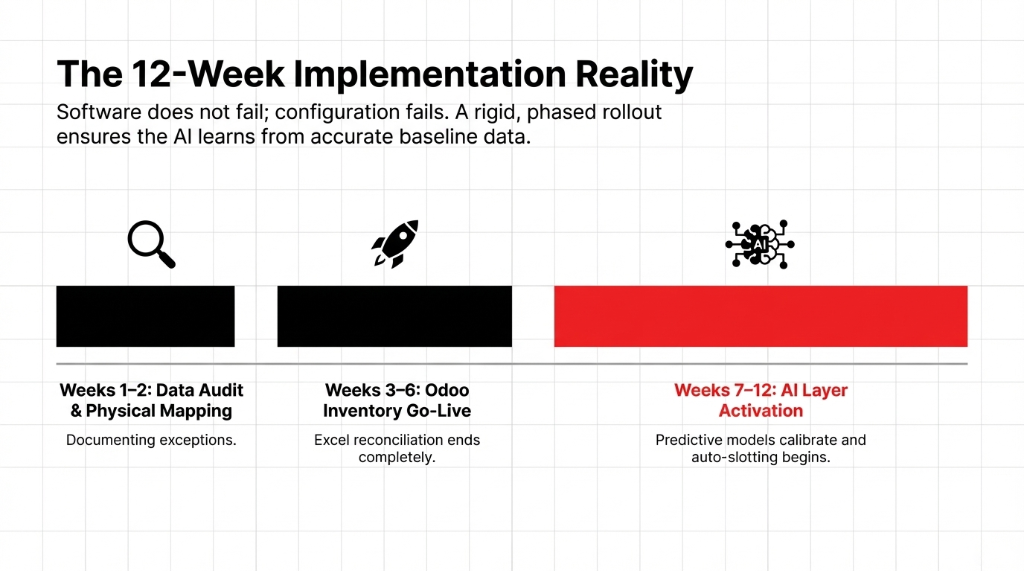
Weeks 1–2
Data Audit + Warehouse Mapping: Audit current inventory data, map every physical location, identify top 15 SKUs driving stockouts and discrepancy events. Document every exception your current system cannot handle.
Weeks 3–6
Odoo Inventory Go-Live: Live stock management, barcode workflows, automated reorder rules active. Your team stops doing manual stock management system reconciliation in Excel. Completely. The odoo inventory app is live on the floor.
Weeks 7–12
AI Layer Activation: Demand forecasting, predictive restocking, anomaly detection kick in. Clients typically recover $8,000–$17,000 in misallocated inventory within the first 45 days of AI monitoring going live.
The Honest Caveat
An Odoo implementation that fails is never a software failure. It is always a configuration failure. Generic implementations that ignore your specific warehouse flows, your SKU logic, and your vendor lead time patterns will underperform regardless of how good the platform is. We spend more time understanding your operation before writing a single line of configuration than most erp solutions partners spend on the entire project lifecycle.
Our Odoo support extends past go-live. The AI models get smarter as they consume your actual operational data.
And if you’re wondering whether your ERP integration can connect this warehouse AI layer to your accounting, CRM, and e-commerce channels—the answer is yes. But fix the inventory management foundation first. Walk before you run.
The Insight: Your Warehouse Team Should Be Executing Decisions, Not Making Them
The goal is not to replace your warehouse staff. It is to stop asking them to be psychic. When your ai inventory management system handles demand forecasting, anomaly detection, and auto-classification—your team handles the physical execution. Pick, pack, ship. Not "guess how many we need, hope the supplier shows up, and pray the count is right."
That’s the correct ratio. Anything else is burning $113,400/year in invisible shrinkage.
Frequently Asked Questions
Does Odoo’s AI warehouse management work for manufacturing businesses?
Yes—and it works better in manufacturing than in pure distribution. Odoo’s manufacturing inventory management system connects BOM consumption, WIP stock tracking, and finished goods in one AI-monitored loop. This eliminates production line stoppages from undetected component shortages, which typically cost $4,200–$9,800 per incident.
How long does a real Odoo implementation take for a US warehouse?
For a US business with 1–3 warehouses, expect 6–12 weeks to production-ready go-live. That covers data migration from your current inventory software, full warehouse configuration, barcode setup, and AI model calibration. Any partner quoting 6+ months is padding hours.
Can Odoo replace our current inventory system and QuickBooks at the same time?
Yes. Odoo erp handles inventory, procurement, accounting, and order management in one system—eliminating manual reconciliation between your separate inventory management app and accounting platform. That reconciliation work typically consumes 11–14 hours per week. After go-live, that number goes to zero.
What ROI should a US business expect from Odoo AI inventory in year one?
For businesses carrying $2M–$10M in inventory, ROI comes from freed working capital (15–30% excess stock reduction), eliminated emergency-purchase premiums ($18,700 average annual savings), and labor recovery (30–40 hours/week returned). Most clients cross breakeven between months 4 and 7.
Is Odoo the right inventory solution for scaling from $5M to $50M?
It is the strongest option in that range. NetSuite’s year-one total cost exceeds $120,000. A custom-built system runs $180,000–$250,000 and takes 14+ months. Odoo delivers enterprise-grade ai inventory management configured in weeks, not years, and scales past $50M without re-implementation.
Your Warehouse Is Leaking Money Every Single Week Your Inventory Data Is Wrong
Book our free 15-Minute Operations Audit—in one call, we will identify your single biggest inventory leak and tell you exactly what it is costing you per month. Still running reconciliation in Excel every Monday morning? Ask about our 90-Day Odoo AI Implementation Track.
Book Your Free 15-Minute Operations AuditOpen your inventory system right now. If it can’t tell you what you’ll run out of in 14 days, call us.