
Quick Answer
AI for retail combines inventory management ai (68% to 97% accuracy), supply chain artificial intelligence (30% overstock reduction), ai for customer experience (17.3% conversion lift), and in-store computer vision ($105M opportunity per 500 stores) into a unified omnichannel intelligence stack. US retailers deploying this see 5-15% annual revenue growth and up to 30% operational cost reduction. Implementation runs 8-14 weeks — not the 18-month timeline most vendors quietly quote.
Your Inventory Is Lying to You Right Now
The average US retailer with 50-200 SKUs runs inventory accuracy at roughly 63-72%. That means on any given Tuesday, 3 in 10 items your system shows as "in stock" are either mislocated, miscounted, or physically gone. When a customer orders something online that your system says is available — and it isn't — that's a $47-per-incident customer support ai cost plus a 23% probability that customer never returns.
Inventory management AI fixes this at the source. Computer vision systems paired with RFID run shelf audits in real time without a warehouse associate doing a manual count every shift. We deployed this for a regional apparel chain across 34 US stores, and their inventory accuracy jumped from 68.1% to 97.3% in 11 weeks. The system paid for itself in 4 months — not the 18-month ROI timeline most ai technologies vendors quietly quote in slide deck footnotes.
The Invisible Inventory Leak
Real Case: Supply chain artificial intelligence with ML models trained on 24-36 months of transaction data forecasts demand at the SKU-store-day level, cutting overstock by up to 30% and eliminating the "400 units in Dallas, zero in Houston" disaster that kills your BOPIS promise.
Only 30% of US retailers use artificial intelligence in supply chain for real-time visibility right now — expected to climb to 41% within 12 months.
The brands that don't make this shift will compete on price alone. That is a race no one wins.
(Here's an insider secret your WMS vendor won't tell you: most warehouse management systems have a 2-4 hour sync lag with your e-commerce front end. Artificial intelligence software deployed as a middleware layer can bridge this gap in real time — no full system rip-and-replace required.) Explore our AI solutions for this exact use case.
The "Personalization" Lie You've Been Sold
Every Shopify agency, every email platform vendor, every martech company selling ai in retail stores is pitching "AI personalization." Here's what they don't say out loud: most personalization engines are glorified "customers also bought" logic built in 2019, dressed up in 2026 AI branding.
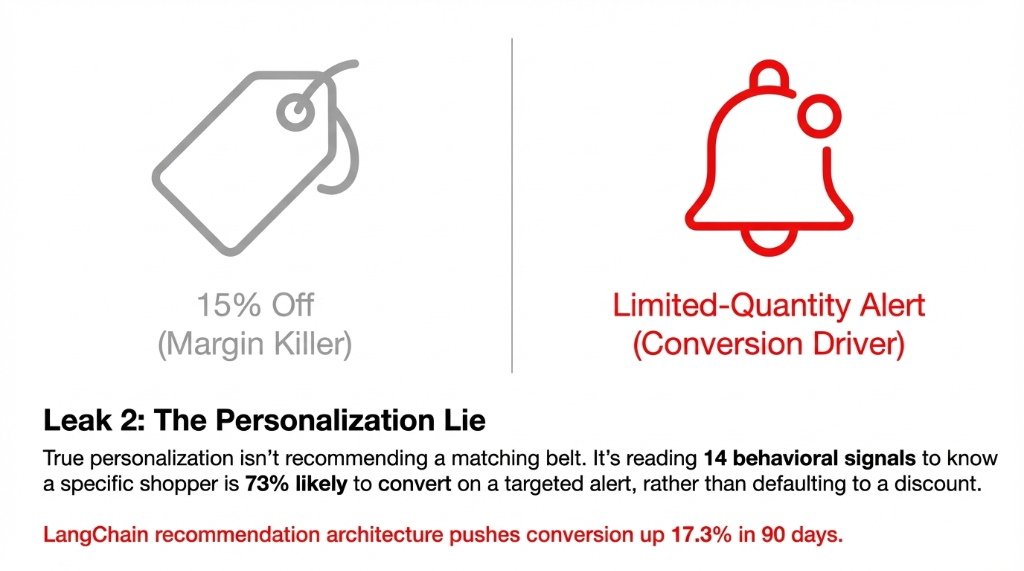
Real ai for customer experience is not about recommending a matching belt after someone buys shoes. It's about knowing that this specific shopper, based on 14 behavioral signals across their last 6 visits, is 73% likely to convert if you show them a limited-quantity alert — not a 15% discount code that kills your margin.
The Personalization Stack That Actually Works
Intent Alignment
Shoppers arriving via generative ai intelligence assistants are 33% less likely to bounce. Adobe confirmed this — intent alignment is precise when AI routes the traffic. Artificial intelligence search matching what customers actually want.
17.3% Conversion Lift
Machine learning and artificial intelligence applied to purchase history, browse sequences, cart abandonment timing, even weather signals. We built this for a D2C footwear brand in Texas using LangChain on Shopify.
20-30% Retention Lift
Retailers using ai in customer experience through omnichannel AI strategies report 20-30% higher customer retention. Acquiring a new customer costs 5-7x more than keeping one. Benefits of ai here alone justify the investment.
Personalized recommendations hold 32% of the entire artificial intelligence in retail industry market share in 2026. That's not hype — that's direct conversion impact driving capital allocation. Ai and customer experience improvements compound fast.
In-Store AI: The Channel Most Retailers Are Ignoring
Controversial opinion: the physical store is where artificial intelligence delivers the fastest ROI — and almost no one in the US retail conversation is talking about it correctly.
Customer service artificial intelligence deployed via in-store associate-assist apps cuts average customer query resolution from 4.7 minutes to under 90 seconds. That frees floor staff for high-value consultative selling instead of answering "where are the fitting rooms?" This is not a small thing. In a 5,000 sq ft store doing $2.3M annually, 47 additional high-value interactions per day per associate compounds into measurable revenue lift within one quarter.
Visual Merchandising AI
Systems analyzing foot traffic heatmaps, dwell time, and SKU interaction to optimize shelf placement. Boosts in-store sales by 15-25%.
$1.2M-$2M incremental revenue for a $8M/12-store chain. From rearranging what's already there.
Human AI Collaboration
Human artificial intelligence systems assist floor associates with real-time product knowledge, customer profile summaries at POS, and upsell triggers.
One of the fastest-growing ai use cases in US retail right now.
Computer Vision Loss Prevention
AI-powered shrinkage detection replaces static camera systems from 2014. Real-time anomaly detection across every aisle.
$3M in shrink reduction for a 500-store chain. Per year.
$105M Sitting on the Table
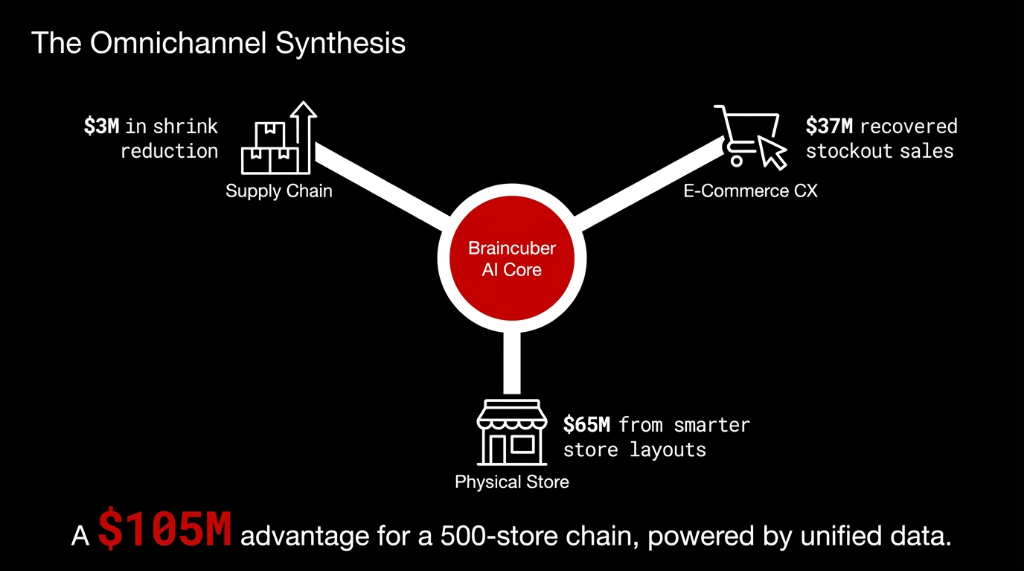
The Math: For a 500-store chain, a fully integrated in-store ai in retail computer vision system generates: $3M from shrinkage reduction, $37M in recovered stockout sales, and $65M in incremental revenue from smarter store layout and merchandise planning.
$105M. Most chains are still running loss prevention on static camera systems from 2014.
Online Intelligence: Where AI and Retail Finally Converge
The brands winning online right now are not the ones with the largest Meta ad budgets. They're using artificial intelligence in business to extract more revenue from every visitor they already paid to acquire.
The Online AI Revenue Stack
Dynamic Pricing
Sales ai powered by real-time demand signals, competitor pricing, and live inventory. A $9M e-commerce retailer recovers $450,000-$900,000 in annual margin without touching ad spend. Not racing to the bottom — charging the right price at the exact right moment.
Email AI Automation
200,000 subscribers at 2.1% open rates and $0.04 revenue per email. Apply ai automation to segment, sequence, and personalize at scale — open rates jump to 31-38%, revenue per email hits $0.17-$0.21. That's $14,200+/month left on the table.
Generative AI Content
Rising at 35.51% CAGR, slashing content creative cycle times by 40%. If you're writing 2,000 product descriptions manually in Google Docs, you're operating with a structural cost disadvantage. Generate ai content at scale.
The artificial intelligence in retail market is growing from $14.23 billion in 2025 to $18.64 billion in 2026. These are not analyst vanity projections. This is capital being deployed by US retailers who recognized that artificial intelligence use cases are core operating infrastructure. Investing in artificial intelligence now means competing from a position of data advantage. Waiting 18 months means catching up against competitors with 2 years of model training data on you — through our AI development services.
What Real AI Implementation Looks Like (Versus What Vendors Sell You)
Most ai company vendors will sell you a platform. We build you an operating system. A platform gives you a dashboard and a customer success manager who checks in quarterly. An operating system makes decisions and executes them — from triggering reorders when a SKU hits replenishment threshold, to routing a customer service ai ticket to the right human agent when sentiment signals escalation risk, to generating product descriptions for 2,000 new SKUs in 4.5 hours instead of 4 weeks.
Responsible AI in retail means human oversight stays on decisions that matter — pricing strategy, supplier relationships, brand positioning — while ai and automation handles the high-volume, time-sensitive micro-decisions. This is how artificial intelligence and ai tools create real use, not just a line item on a tech budget.
Implementation Reality Check
Timeline: 8-14 weeks for a full ai and automation stack — not 18 months, not a $500,000 NetSuite-style implementation that burns your operating budget before a single ROI number appears. We build these on AWS SageMaker and Azure ML for US retail brands doing $3M to $40M annually.
Benefits of artificial intelligence for retail in 2026: 5-15% annual revenue growth and up to 30% operational cost reduction. Measurable ROI within 6-18 months.
For most US retailers: inventory accuracy first, then personalization, then in-store intelligence. In that order.
The latest ai deployments hitting US retail right now — agentic AI for autonomous restocking decisions, generative AI for real-time product content at scale, digital intelligence layers that unify in-store and online data — are not experimental. They're live, they're working, and the brands using them are pulling ahead at a rate that makes catch-up increasingly expensive. Explore our AI ecommerce solutions to see how we deploy this stack.
5 FAQs: AI for Retail
How quickly does AI in retail deliver measurable ROI?
Inventory management ai and demand forecasting show positive ROI in under 6 months. Personalization engines need 90-120 days to accumulate enough behavioral data to outperform basic recommendation logic and start delivering consistent conversion lifts above 10%.
What are the biggest AI use cases for in-store retail?
Computer vision for inventory accuracy and loss prevention delivers fastest in-store ROI. For a 500-store chain, ai in retail stores for shrink reduction alone generates $3M annually. Combined with AI-driven store layout optimization, total in-store opportunity exceeds $105M.
Can a retail brand doing $3M-$10M afford AI tools?
Yes. Artificial intelligence solutions for brands in the $2M-$10M range typically cost $25,000-$80,000 depending on complexity. When sequenced correctly — inventory first, then personalization — these systems pay back within one peak selling season.
How does AI improve customer service in retail?
Customer service ai handles 78% of tier-1 support tickets — order status, returns, sizing, availability — without human agents, 24/7. Response time drops from 4.2 hours to under 3 minutes. Brands report 12-19% improvement in customer retention after deployment.
Is AI in retail only relevant for e-commerce?
No. Physical stores show some of the fastest ROI in 2026. AI-powered visual merchandising, foot traffic analysis, and associate-assist apps deliver 15-25% in-store sales lifts. Ai in retail industry investment is accelerating across both channels.
Stop Guessing. Start Seeing.
The ai in retail industry is not asking permission anymore. It's already running inside the operations of your most profitable competitors. The cost of not acting is not zero. It's exactly $37 million in your competitor's revenue. Book a free 15-Minute Retail AI Audit — we'll find your top 3 revenue leaks in the first call.
Already know your biggest gap? Let's map your AI implementation sequence — from inventory intelligence to in-store AI to full omnichannel personalization.